

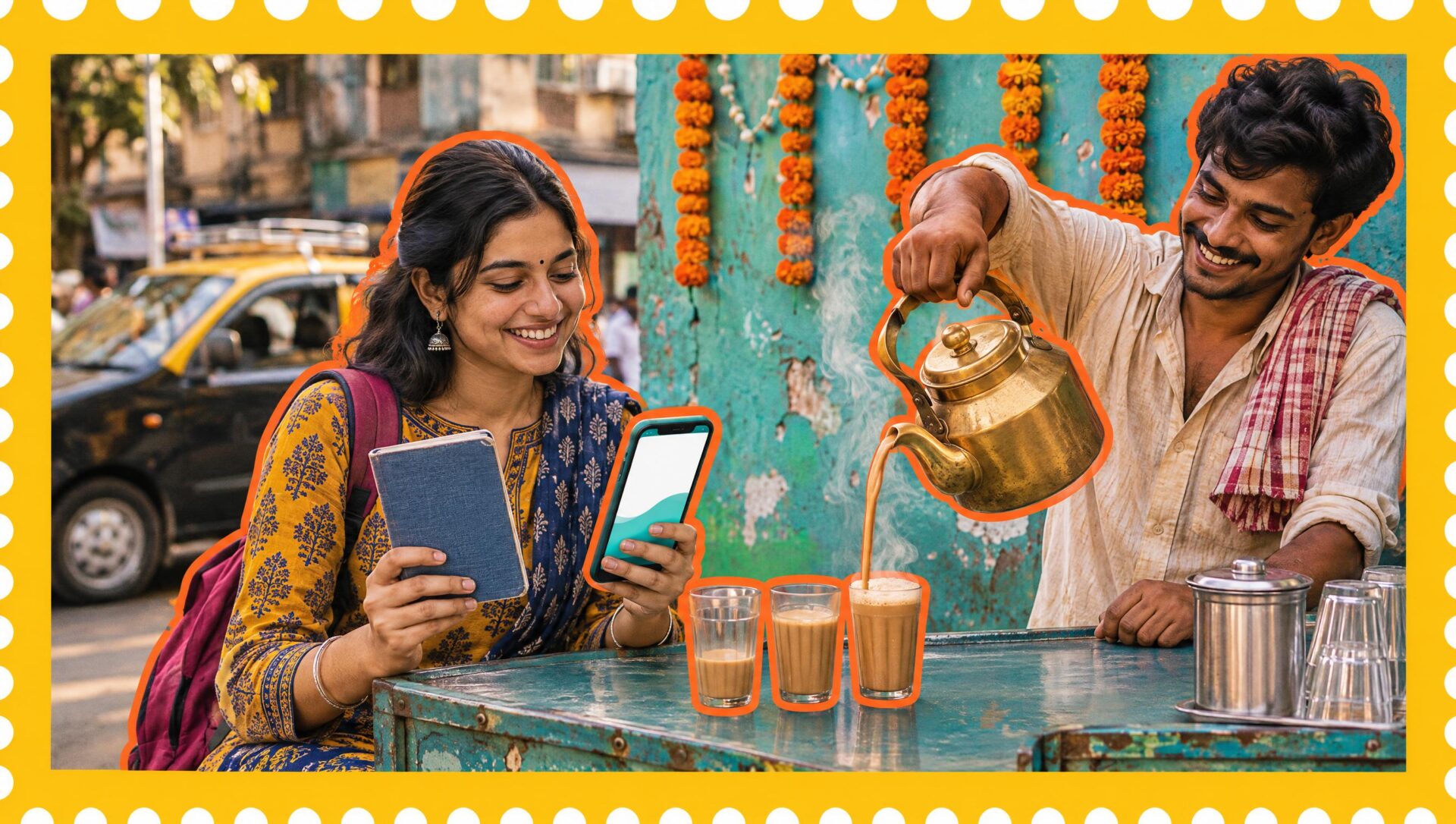
A pensioner waits in the queue at a State Bank of India branch in a district town. The poster above the counter says The Banker to Every Indian. On her grandson’s phone, the same bank is asking him to log in to YONO. Two lines from one bank, written about a decade apart, now sit in the same room. The SBI tagline story is about how a state-owned bank kept one promise steady while its product brand changed shape underneath it.
What is the SBI tagline today, and where did it come from?
SBI’s working tagline is The Banker to Every Indian. SBI’s own About Us page traces the bank to the Bank of Calcutta, set up on 2 June 1806, and records that the State Bank of India was constituted on 1 July 1955. The same page lists a 2023 coffee table book titled The Banker to Every Indian, so the line now works as the bank’s name for its own history as well as its advertising. Our list of 27 bank taglines in India sets it beside the lines of other public and private banks.
The line did not arrive first. Before it, in the middle of the decade, SBI ran a corporate campaign called Pure Banking Nothing Else. The Banker to Every Indian followed in print, and by March 2011 Campaign India described it as a campaign that had been running in print for a couple of years.
Other lines, such as With You All the Way and The Nation Banks on Us, circulate online as SBI taglines. We found no SBI document, annual report extract or trade press report that dates either one or names who wrote it, so this page treats their origin as not on record.
| Period | Line or name | What it answered | Source status |
|---|---|---|---|
| Mid-2000s | Pure Banking Nothing Else | New private banks selling features; SBI said banking itself was the product | Secondary accounts; exact date not confirmed |
| Late 2000s | The Banker to Every Indian, in print | Serving rich and mass customers without choosing between them | Campaign India, 4 March 2011, describes the print run |
| March 2011 | Four TV films on the same thought | Loans for home, car, education and small business | Campaign India, 4 March 2011 |
| November 2017 | YONO, You Only Need One | One app for banking and shopping offers | Business Today, October 2021 |
| July 2021 | The Banker to Every Indian, refreshed; sonic logo | A dated look for the line in SBI’s 66th year | BestMediaInfo, 8 July 2021 |
| 2025 | Same line with MS Dhoni and Smriti Mandhana | Wider recall for the line | Agency case study, 2025 |
| 15 December 2025 | YONO 2.0 | One app across mobile, tablet and desktop | PTI report, 15 December 2025 |
| Undated | With You All the Way; The Nation Banks on Us | Not known | Tagline directories only; origin not on record |
What problem was SBI’s brand trying to solve in the mid-2000s?
SBI had a segmentation problem. It was long seen as the solid, reliable government lender, while new private banks went after the modern, urban, affluent customer with steady media campaigns. SBI could not copy their look without telling crores of ordinary customers the bank had moved on from them.
Pure Banking Nothing Else was the first answer. It turned the private banks’ features into noise and put SBI’s basics forward as the point.
The weakness of a line like Pure Banking Nothing Else is that it defines the brand by what it refuses. It holds attention against a rival’s features and loses force once the bank starts selling its own features, which SBI soon had to do. Within a few years the bank needed a line that could carry a home loan, a car loan and a pension account at once.
Blue, a keyhole symbol and a public-sector name already did part of the work. Why so many Indian lenders end up in that colour is the subject of our piece on colour psychology in financial brands.
SIGNALNewsletter by Yamm Labs
The next piece, straight to your inbox.
New writing on BFSI brands, B2B and influencer marketing, and AI search.
One click to unsubscribe. Privacy policy

How did The Banker to Every Indian work?
The Banker to Every Indian worked by treating ordinary working people as the bank’s customers in their own right, without asking richer customers to feel the bank had moved down-market. The clearest public record of how it played out is the television work.
Campaign India reported on 4 March 2011 that four TV commercials on the same thought had been released, made by the agency Interpub, at a time when the campaign had already been running in print for a couple of years. The films covered home, car, education and small business loans. Each one turned on a reveal: a postman whose last delivery is his own home, a bus driver in a small new car, a shuttle driver who has also borrowed to send his daughter abroad to study, and a man who looks like a mechanic and owns the showroom.
| Decision | Constraint | What SBI chose | Why it held (our analysis) |
|---|---|---|---|
| Which customer to court | Could not drop mass customers to win affluent ones | Both, in the same frame | The label did the inclusion; nobody had to change class |
| What the line promises | A state bank cannot promise the best rate in every product | Reach and belonging, not price | A positioning claim needs no rate disclosure and does not date |
| How to sell loans under the line | Loan ads carry rate and cost disclosures | Stories in the films, numbers left to the product channel | The brand line stays free of figures that change |
| What to call the app | The app had to carry many regulated products | A separate name, YONO | The tagline stayed intact while the product brand carried the new promise |
Is YONO a new SBI tagline?
No. YONO is a product brand with a promise built into its name. SBI launched the platform in November 2017, and the name stands for You Only Need One. It put banking next to online shopping offers and lifestyle services in one app. Our SBI YONO advertisement and campaign history covers the launch film and what followed.
The name makes a bigger claim than the tagline does. The Banker to Every Indian promises a relationship. You Only Need One promises that a single app is enough for banking, investing, insurance and shopping. That is a usable idea for a product, and SBI kept it off the masthead.
In December 2025 SBI launched YONO 2.0. A PTI report of 15 December 2025 quotes Chairman C S Setty: 9.60 crore of SBI’s more than 50 crore customers used YONO, the bank wanted 20 crore on the platform, and other banks’ customers could use the new version. The YONO page on SBI’s site now describes it as one app for banking, payments, shopping and rewards.
For a brand team, the useful split is this. The tagline holds the brand’s meaning across decades. The product name holds a feature promise that can be updated, rebuilt or retired, as YONO 2.0 shows, without touching the masthead line. Our history of major Indian bank rebrands covers how other Indian banks handled the same choice.
A tagline can promise a relationship; only the product screen can promise a number.
What rules would a bank copying the SBI tagline playbook face?
A bank can copy the idea of a broad, inclusive line, but each product under it carries its own regulator’s rules. The rules below are the ones an Indian brand team meets first when it puts a celebrity, an app or a group company under one line. This is general guidance, not legal advice; your compliance team decides.
The celebrity decision. MS Dhoni is SBI’s official brand ambassador, and we found no public statement of the terms. An agency case study credits Expression 360 with a 2025 SBI campaign featuring Dhoni and Smriti Mandhana under The Banker to Every Indian. We did not find an RBI rule that bars a bank from using a celebrity in its ads. ASCI’s guidelines for celebrities in advertising do put duties on the celebrity, such as checking that the ad’s claims are true.
The same decision at a fund house. A mutual fund that shares a bank’s name cannot simply borrow the bank’s ambassador. Until SEBI’s new code takes effect in April 2027, Indian mutual fund rules allow celebrities only in industry-wide campaigns that promote mutual funds in general, with SEBI’s approval first. SEBI notified a common advertisement code in October 2026; from April 2027 it lets regulated firms use celebrities to endorse the brand, with prior approval and no claims about a specific product.
The insurance banner inside the app. Under IRDAI’s 2024 regulations on protecting policyholders’ interests, an insurer’s advertisement must show the insurer’s registered name with its trade name or logo prominently. An ad issued by a distribution channel, such as a bank selling a partner’s policy, needs the insurer’s written approval before it goes out. The insurer keeps its own register of approved ads, so the record of that approval sits with the insurer and the bank.
The loan journey. An app that sells loans cannot let the brand promise stand in for the cost. RBI requires lenders to give borrowers a Key Facts Statement, including the annual percentage rate, before the loan contract is signed, for retail and MSME term loans sanctioned from 1 October 2024. The rule came in an April 2024 circular and, for commercial banks such as SBI, now sits in RBI’s November 2025 Responsible Business Conduct Directions. The KFS screen belongs in the flow before the sign button, wherever the brand line sits.
The fund film. SEBI’s mutual fund rules require the standard risk warning in video and audio ads to be clear and understandable, both on screen and in voice-over. Five seconds is given as an example of what may meet that test, not a fixed minimum, and the warning’s wording cannot be changed. A one-line brand sign-off cannot share that time.
The web address in the end frame. On 22 April 2025 RBI told banks to move their websites to the .bank.in domain by 31 October 2025, in a circular on migration to .bank.in. When we checked in November 2026, SBI’s old About Us address redirected to sbi.bank.in. Any end frame, hoarding or QR code still showing a bank’s old domain is now a print error.
What happened: what results can SBI’s brand work claim?
The outputs are well documented; the business outcomes are not. Most of what shipped, and when, is on record: the print series, four television films in March 2011, a refreshed version of the line with a sonic logo in July 2021, the Dhoni appointment, the agency-credited 2025 campaign and YONO 2.0 in December 2025.
BestMediaInfo reported on 8 July 2021 that SBI marked its 66th foundation day by relaunching The Banker to Every Indian with a fresh look, introducing a musical logo it calls Mogo, a brand campaign called I am the I in SBI and an anthem, Hum Saath Hai. The same report put SBI’s customer base at 45 crore. SBI’s About Us page now states more than 50 crore customers and more than 23,000 branches, without a date against either figure.
We found no public source that links any of these campaigns to deposits, loan growth or account openings. The 2025 agency case study reports high public engagement, but that is the agency speaking about its own work. Whether the Dhoni association changed how younger customers see SBI is not publicly reported.
The one durable result is the line’s survival. An SBI tagline that was running in print by the end of the 2000s was still the centre of SBI’s campaign in 2025 and the title of the bank’s 2023 history book. SBI has rebuilt its app and refreshed the line’s look in that time without changing the words. That consistency is the measurable fact.
What can another Indian or Gulf bank reuse from the SBI tagline?
Four habits travel well from the SBI tagline to another bank’s brief. None of them depend on SBI’s size.
- Write the line about the relationship, not the product. The Banker to Every Indian makes no rate, return or speed claim, so it never needs a disclaimer and never dates. Put figures in product communication, where the KFS, the risk warning or the insurer’s registered name can sit beside them.
- Give the digital promise its own name. YONO carried the one-app idea without asking the masthead to change. When YONO 2.0 rebuilt the platform, the tagline did not have to move.
- Prove the line with facts the bank owns. SBI put the tagline in the title of its own 2023 history book, so the bank’s record carries the claim. A Gulf bank with a long local history can do the same with its own archive, provided every name and date is checked against that record.
- Map the group before the celebrity. If a bank’s insurance or fund company carries the same name, decide early which entity the ambassador endorses. The mutual fund and insurance rules above apply to those companies whatever the bank’s own contract says.
For a Gulf bank, the order of work is the same, though the regulators differ. A bank in the UAE or Saudi Arabia will answer to its own central bank and, for investment products, to the securities regulator in that market. Check each product’s advertising rules with your compliance team before the line is approved, not after the films are shot.
If you are planning a campaign around an existing line, our content and campaigns work starts from that product-and-regulator map.
| What goes wrong | Early sign | Fix |
|---|---|---|
| The tagline makes a measurable claim | Legal asks for a footnote on the masthead line | Move the number into product ads; keep the line about the relationship |
| The app name and the tagline compete | Ads end on two sign-offs | One closes brand ads, the other closes app ads; never both |
| A group company borrows the ambassador | The fund or insurance team asks for the same face | Check that entity’s own advertising rules first; today a fund house cannot use a celebrity for its own brand |
| Disclaimers squeezed by the sign-off | Risk warning and brand line share the last few seconds | Give the warning its own clear, readable frame and voice-over |
| Old addresses in creative | Print files still show the pre-2025 domain | Audit every end frame, QR code and hoarding against the .bank.in address |
When is a heritage tagline like SBI’s the wrong choice?
A line like The Banker to Every Indian only works when the claim is already true at scale. SBI could say it because its branch network and customer base made the statement plausible to anyone who read it. A neobank, a two-year-old NBFC or a Gulf fintech with one product has not earned that sentence, and readers will notice.
A heritage line is also the wrong tool when the brand’s job is to explain one product fast. A lender selling instant personal loans to salaried customers needs a line that says what it does. SBI could afford a broad promise because YONO and the product films did the explaining.
Finally, a broad line is the wrong choice when the business is about to change shape. If a merger, a new licence or a move into investments is coming, wait. Write the line for the bank you will be in three years, and test it against every product it will sit on.
People also ask
What is the current SBI tagline?
The current SBI tagline is The Banker to Every Indian. SBI ran it as a print campaign from the late 2000s, refreshed it in July 2021 and used it in its 2025 campaign with MS Dhoni and Smriti Mandhana.
What does YONO stand for?
YONO stands for You Only Need One. It is the name of SBI’s digital banking and lifestyle platform, launched in November 2017, and is a product brand, not the bank’s tagline.
Which agency made SBI’s Banker to Every Indian ads?
Campaign India credited Interpub with the four television films released in March 2011. An agency case study credits Expression 360 with the 2025 campaign featuring MS Dhoni and Smriti Mandhana. The agency behind the original print ads is not named in the sources we found.
Can a mutual fund use a celebrity the way SBI used MS Dhoni?
Not yet for its own brand. Until April 2027, Indian mutual fund rules allow celebrities only in industry-wide campaigns about mutual funds, with SEBI’s approval first. From April 2027, SEBI’s common advertisement code allows brand-level celebrity endorsements with prior approval and no claims about a specific product.
Does your bank’s tagline still hold up when it sits above a loan screen, a fund film and an insurance banner?
Get a free Fintech Brand Audit across 8 dimensions, plus 3 fixes. No pitch. Run the free Brand Audit →