

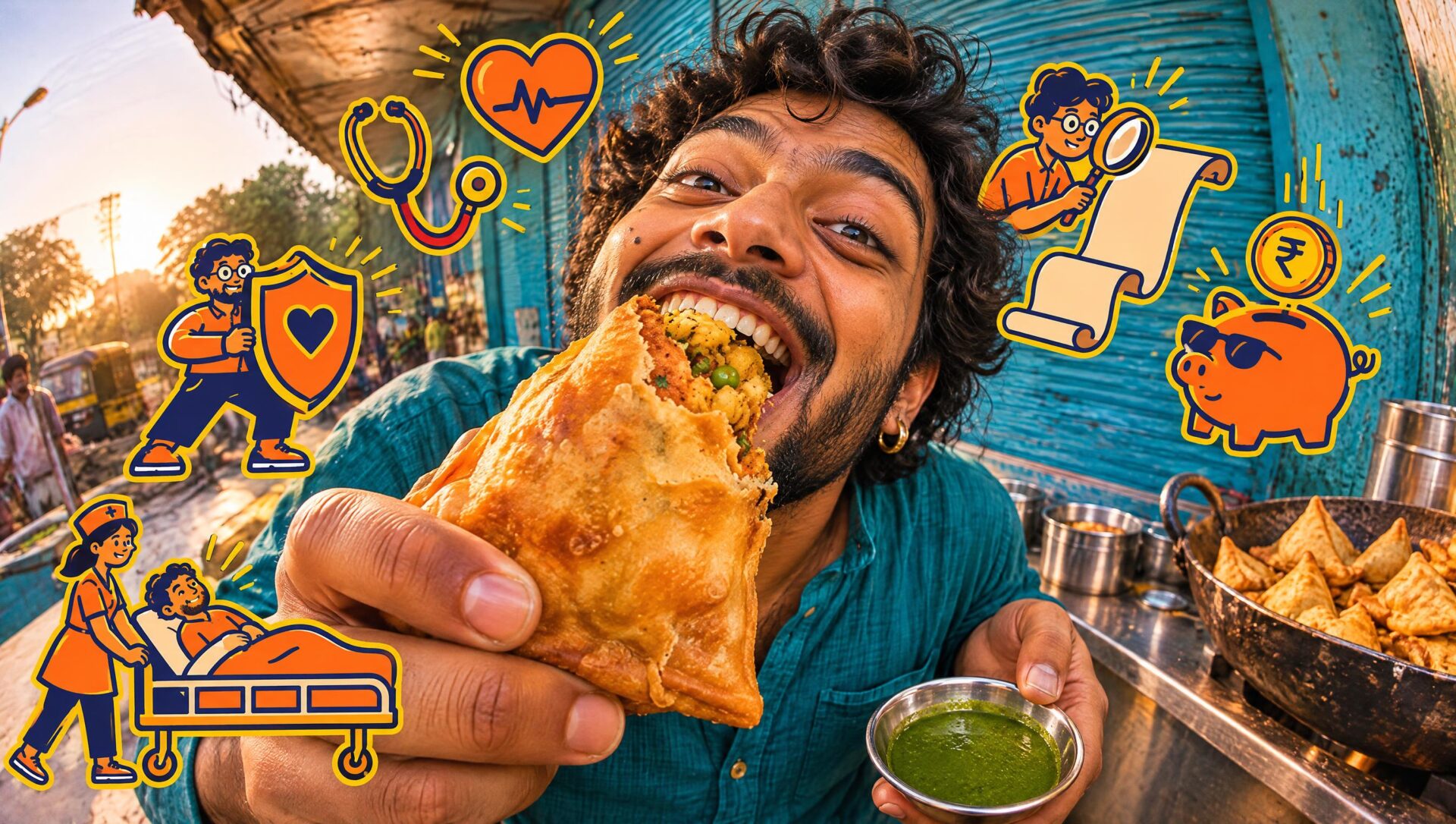
The storyboard for a 30-second health insurance film ends on an insured family settling into a private hospital room while the uninsured family waits in a corridor. The compliance reviewer circles the private room and writes one question in the margin: does every plan we sell pay for this room? That margin note is where most health insurance ads in India are won or lost, and it is the part the trade press rarely shows.
How were these health insurance ads chosen?
We picked campaigns that meet three conditions. First, the campaign is reported in the trade press with a date, so you can check what we describe. Second, it comes from one of the four standalone health insurers buyers search for most by name: Star Health, Care Health, Niva Bupa and Aditya Birla Health Insurance. Third, it shows a format another health insurer, bank partner or insurtech could reuse, along with a regulator-driven decision that the format forces.
We did not rank these health insurance ads by effectiveness. We found no published sales or claim outcomes tied to a single campaign, so any ranking would be a guess. Where a report does not name the agency or the origin of a line, we say so. The analysis of what each format demands from compliance is ours, written for a marketing head who has to defend the plan to a finance reviewer and an Advertisement Committee in the same week.
This is general guidance, not legal advice; your compliance team decides how the rules apply to your product.
Which health insurance ad format fits which job?
The table sums up all nine formats of health insurance ads before the detail. Effort covers production and media. Compliance load covers how much the format asks your Advertisement Committee to check before release.
| Format | Example on record | Best for | Effort | Compliance load |
|---|---|---|---|---|
| One platform line across very different films | Star Health, “lena smart hai” | A large insurer that wants every film to add up to one idea | High | Medium |
| Regional celebrity roster | Star Health, eight film and music names | Reaching several language markets in one burst | High | High |
| Proof-point outdoor | Star Health, “We’ve Got Your Back” | Brand reassurance at city scale | Medium | High |
| Actor-led add-on explainer | Care Health, Care Shield | Launching a rider or add-on that fixes a known gap | Medium | Medium |
| Short vernacular digital questions | Care Health, “Who cares?” | Testing messages across states on a small budget | Low | Medium |
| Freedom platform after a rebrand | Niva Bupa, “Zindagi Ko Claim Kar Le” | Introducing a new name without losing recall | High | Low |
| One-feature film on a bold product claim | Niva Bupa, ReAssure 3.0 | A product with one feature rivals do not match | Medium | High |
| Real customers on wellness rewards | Aditya Birla Health Insurance, 10,000 steps | Plans that pay back for healthy behaviour | Medium | High |
| Actor-led feature series | Aditya Birla Health Insurance, Activ One | A feature-heavy plan that needs one film per benefit | High | Medium |
What do IRDAI’s rules let health insurance ads promise?
IRDAI’s 2024 policyholder-protection regulations replaced the separate 2021 advertisement regulations, and they set the test every format below has to pass. The information in an ad must be fair and true and must reflect the risks in the product. An insurer has to show its registered name with its trade name or logo, displayed prominently. The insurer is responsible for approving its own ads.
The regulations then list what an ad may not do. In practice, these are the lines your reviewer will test in health insurance ads:
- No promise beyond the policy. An ad may not claim more than the policy can deliver, or hide or underplay its risks.
- No buried terms. It may not obscure terms and conditions, or leave out important exclusions, limits and conditions.
- No small print games. Text that is illegible, including because of font size, is itself a breach, and mandatory disclosures must be clear, conspicuous and legible.
- No invented numbers. False or fabricated facts, figures and features are barred.
- Social posts count. Static and interactive content on an insurer’s or distributor’s social media page falls under the same rules.
- Partners need sign-off. An ad issued by a distribution channel needs the insurer’s written approval before it runs.
IRDAI’s health insurance master circular of May 2024 adds the approval route. An Advertisement Committee approves every ad the insurer issues. It has at least two key management persons and three senior officials one level below them, with a quorum of three. The same circular sets service standards that ads often borrow: a decision on cashless authorisation within one hour of the request, and final discharge authorisation within three hours. If a film quotes those times, word them as the standard, and back any faster promise with your own data.
IRDAI’s 2024 policyholder-protection regulations are the primary text. For a production-side checklist, see our IRDAI advertisement regulations checklist for designers.
SIGNALNewsletter by Yamm Labs
The next piece, straight to your inbox.
New writing on BFSI brands, B2B and influencer marketing, and AI search.
One click to unsubscribe. Privacy policy

Star Health shows one line can carry very different films
Star Health’s strongest asset is a line, not a single film. In July 2025, after World Insurance Day, it released a split-screen film with actor Dibyendu Bhattacharya as the head of one family seen twice at a hospital, once insured and once not, closing on “Health Insurance abhi lena smart hai”. In November 2025 it ran three short films built with generative AI around a foodie, a traveller and a multitasking professional, under “Health Insurance Lena Smart Hai”. The trade press reported the AI films as a first for Indian insurance. Neither report names the agency.
The regulator-driven decision sits in the split screen. The insured side shows a private room and quicker care. Many retail health plans carry room-rent sub-limits, which IRDAI requires insurers to list in the Customer Information Sheet given with every policy. A brand copying this structure has to choose between showing a room every plan in the range pays for, or adding a visible condition. Our reading is that the shot is safe only when it matches the plan being advertised.
Try this: write your platform line first, then test each film’s hero shot against the sub-limits in the product’s Customer Information Sheet.
Star Health uses a regional celebrity roster to reach many language markets at once
In December 2025 Star Health unveiled a national campaign with eight film and music names: Shiva Rajkumar, Jeet, Nayanthara, Arjun Sarja, Teja Sajja, Kiran Abbavaram, Rahasya Gorak and Shreya Ghoshal. Different stars were matched to different language audiences, from Kannada to Tamil and Telugu. The message was preparation before a crisis. The release also carried company figures, including over 1.4 crore claims settled. The report does not name an agency.
The decision here is about who checks the claims. IRDAI’s 2024 advertisement chapter does not mention celebrities, so the restraint comes from elsewhere. ASCI’s guidelines for celebrities in advertising expect a celebrity to do due diligence on the claims they endorse, and ASCI counts an influencer with 500,000 or more followers on any single handle as a celebrity, a test it added in August 2023. Each star needs the substantiation file for every number they say aloud.
Mutual funds work differently, which matters if your group sells both. SEBI allows celebrities in mutual fund ads only in industry-wide campaigns with its approval until its common advertisement code takes effect in April 2027. Our guide to SEBI’s advertisement code for mutual fund creative covers that side.
Try this: send each celebrity’s team a one-page claims sheet with the source and date for every figure in their script.
Star Health turns outdoor into a proof point, and proof points need files
Star Health’s “We’ve Got Your Back” outdoor campaign used the back of billboards in Ahmedabad, Kolkata, Bengaluru, Chennai and Hyderabad, at sites where the reverse side faces traffic. It was conceptualised by the independent agency Talented and executed by Coral Media. Each execution paired a Star Health proof point with the line; one reported example was a claim settled every eight seconds.
A billboard has a few seconds of attention and no room for footnotes. IRDAI’s rules bar fabricated figures and illegible text, including text made illegible by font size. So the proof point needs a source, a period and a method on file, and any condition attached to it has to be readable from a moving vehicle. A brand copying the format usually ends up with fewer, simpler numbers than the first draft.
Try this: for every outdoor number, write the source, the period it covers and the calculation on the artwork approval form.
Care Health sells an add-on by naming the gap it fills
In January 2021 Care Health Insurance, renamed from Religare Health Insurance, ran its first product-led TV film for Care Shield, an add-on that covers consumables standard policies usually leave out. Hakuhodo India conceptualised it. Actor Divyenndu Sharma starred in the film, which is built around a hospital-room conversation between a father and his son. The brand’s marketing head said the add-on covered more than 60 non-payable consumables.
The format is useful because the problem is real and familiar: the bill that arrives with items the base policy did not pay. The regulator-driven decision is the boundary between the add-on and the base plan. The film must not suggest that the base policy covers consumables, and the add-on’s own exclusions still have to be disclosed. Under IRDAI’s health master circular, an add-on goes through the insurer’s Product Management Committee before launch, so the approved product file is the script’s source of truth.
Try this: draft the voice-over from the add-on’s Customer Information Sheet, then cut for warmth, never the other way round.
Care Health tests vernacular questions in 15-second digital ads
In February 2025 Care Health launched “Who cares?”, a set of 15-second digital ads for its Care Supreme plan, rolled out in phases in Kannada, Malayalam, Marathi, Tamil and Telugu. The ads covered healthy living, coverage, affordability, room-rent limits and the long-term value of comprehensive cover. The report does not name an agency.
Short regional ads are cheap to make and quick to test, which is why they suit a challenger health insurer. The decision they force is disclosure in the viewer’s language. IRDAI requires mandatory disclosures to be clear, conspicuous and legible, and the safe reading is that this applies to the ad as the viewer sees it. An English super on a Marathi film is hard to defend as clear. Fifteen seconds also leaves little space, so the claim has to shrink to fit the disclosure, not the reverse.
Try this: translate the disclosure with the script, and have a native-language reviewer sign the same approval form as the creative.
Niva Bupa used a freedom platform to carry a new name
After Max Bupa became Niva Bupa in 2021, its first campaign under the new name was “Zindagi Ko Claim Kar Le”, with three films directed by Shlok Sharma. Glue Creatives created the campaign. It framed health insurance as freedom to live fully, not a set of limits, and ran across TV, print, radio and digital, with over 9,300 movie-channel spots in three weeks and over 20,000 radio spots, as reported.
A rebrand creates a lockup problem before it creates a creative one. IRDAI’s rules require the registered name with the trade name or logo, shown prominently, on every ad. When the registered name changes, every end card, print footer, digital banner and partner asset has to change with it. Old health insurance ads still running through distribution partners are the usual gap.
Try this: before a rename goes live, list every asset in circulation, including partner and branch material, and set a withdrawal date for each.
Niva Bupa puts one bold product claim at the centre of a film
In September 2025 Niva Bupa launched “Yeh Hua Na Health Insurance” for ReAssure 3.0, which it describes as offering an unlimited sum insured. Leo Burnett India created the campaign, produced by Prodigious and directed by Harsh Maheshwari. The film follows a man who has always been told to stay within limits. The plan covered Hindi news and movie channels, YouTube, connected TV and Amazon’s streaming and display network.
For a health insurer, a one-feature film is efficient: one claim, one story, one product. It also carries the heaviest proof burden of any health insurance ads on this list. Words like unlimited and no limit are absolute, and IRDAI’s rules bar any claim beyond what the policy delivers and any ad that hides conditions. Whatever conditions the policy wording attaches to the feature need to be visible at the point of the claim, sized to be read. We have not reviewed Niva Bupa’s supers, so this is a note for anyone copying the format.
Try this: put the policy clause behind your headline feature next to the storyboard frame where the claim appears, and ask legal to mark it before the shoot.
Aditya Birla Health Insurance puts real customers behind its wellness rewards
In February 2023 Aditya Birla Health Insurance released a campaign by Dentsu Creative India encouraging people to walk 10,000 steps a day. It was produced by Thumbnail Pictures and directed by Sudip Bandyopadhyay. Real customers described what changed for them. The marketing head said at launch that more than 1,600 customers were earning up to 100% of HealthReturns, the insurer’s reward for staying active.
Testimonials and reward claims are where health insurance ads get specific, so this is where reviewers look hardest. “Up to 100%” is a ceiling, and the conditions for reaching it have to be as easy to find as the number. Each customer in the film also needs a signed release and a record that their story is accurate. Reward rules are part of the filed product, so the ad cannot simplify them past what the product allows.
Try this: show the reward condition on screen in the same frame as the percentage, at a size a phone viewer can read.
Aditya Birla Health Insurance splits a feature-heavy plan into a film series
In February 2024 Aditya Birla Health Insurance named actor Vikrant Massey the face of Activ One, its then-new plan, in a series of four films. The first explained Claim Protect, and the series also described how healthy customers can earn up to 100% of premiums back as HealthReturns. The tagline was “100% Health. 100% Health Insurance.” The films ran on TV, OTT, YouTube and Meta, with outdoor support. The report does not name an agency.
One feature per film keeps each disclosure short, which helps approval. The cost is volume: four films mean four approvals, four sets of supers and four cut-downs for each platform. If bank or broker partners reuse the films, each version they issue needs the insurer’s written approval under IRDAI’s rules.
Try this: approve the series as a set, with one disclosure template, and give partners locked files they cannot re-edit.
In a health insurance ad, the exclusion you hide is the claim you will be asked to defend.
How should your firm pick a format for health insurance ads?
Pick by who issues the ad and what you are allowed to say, then by budget.
- Standalone health insurer with a large base. A platform line with a regional roster or a feature series gives reach and recall. Budget the approval time for each film, not the campaign.
- General insurer adding a health line. Start with an add-on or one-feature film. You get a clear story without building a new platform.
- Bank or NBFC selling health cover as a distribution partner. Use the insurer’s approved assets or get written approval for your own, as IRDAI requires. Your ad may not suggest the product is yours, so the insurer’s registered name leads.
- Insurtech or aggregator. Short vernacular digital ads suit your budget and testing pace. The same IRDAI distribution-channel rules apply to every post and reel.
If you need a campaign team for this work, our content and campaigns page sets out how we brief and build regulated films.
What should a health insurer skip when copying health insurance ads?
Skip the hospital-room luxury shot unless every plan in the advertised range pays for it. Skip statistics that come without a source, a period and a method on file. Skip celebrity scripts that the celebrity’s team has not checked. Skip absolute words such as unlimited or 100% when the condition sits in a footnote nobody can read. Skip English-only disclosures on regional films.
Also skip ranking your plan against a named rival in the ad. None of the four insurers here did it in the campaigns above, and a comparison claim doubles the evidence your Advertisement Committee has to hold.
People also ask
Do health insurance ads need IRDAI approval before release?
The approval sits with the insurer. Under IRDAI’s 2024 rules, the insurer’s own Advertisement Committee approves every ad, and an ad issued by a distribution partner needs the insurer’s written approval before it runs.
Can a health insurer use a celebrity in its ads?
Yes. IRDAI’s 2024 advertisement chapter does not mention celebrities, and Star Health ran an eight-star campaign in December 2025. ASCI’s celebrity guidelines still expect the celebrity to check the claims they make.
What must every health insurance ad show?
The insurer’s registered name with its trade name or logo, shown prominently. The important exclusions, limits and conditions for any benefit claimed, in clear and legible text. Social media posts follow the same rules.
Can an ad quote claim settlement figures?
Yes, if the figure is true and you can show where it came from. IRDAI’s rules bar false or fabricated figures, so keep the source, the period and the calculation with the approved artwork.
Is your health insurance ad promising more than the policy wording pays?
Get a free Fintech Brand Audit across 8 dimensions, plus 3 fixes. No pitch. Run the free Brand Audit →