


A payments start-up in Doha has filed its licence application and pencilled a launch for the week after approval. Its agency’s brand deck puts the fee in a footnote nobody can read on a phone, runs the English wordmark alone on every screen, and shows the regulated name in a teaser meant to go out before the licence is granted. The compliance officer sends back three questions, all of them design questions. Fintech and BFSI branding in Qatar is a set of decisions the regulators force, and a good agency shows you those decisions before you ask.
- Which regulators shape BFSI branding in Qatar?
- What does the Qatar Central Bank licence rule do to a launch identity?
- Where do the price, the fee and the risk line sit in a Qatar advertisement?
- What changes for a payment fintech licensed by Qatar Central Bank?
- What changes for a firm regulated by the QFC Regulatory Authority?
- How do you brand for Qatar and India at the same time?
- How does Yamm Labs work with Doha clients from Gurugram?
- How should a Doha bank, insurer or fintech brief an agency?
- People also ask
Which regulators shape BFSI branding in Qatar?
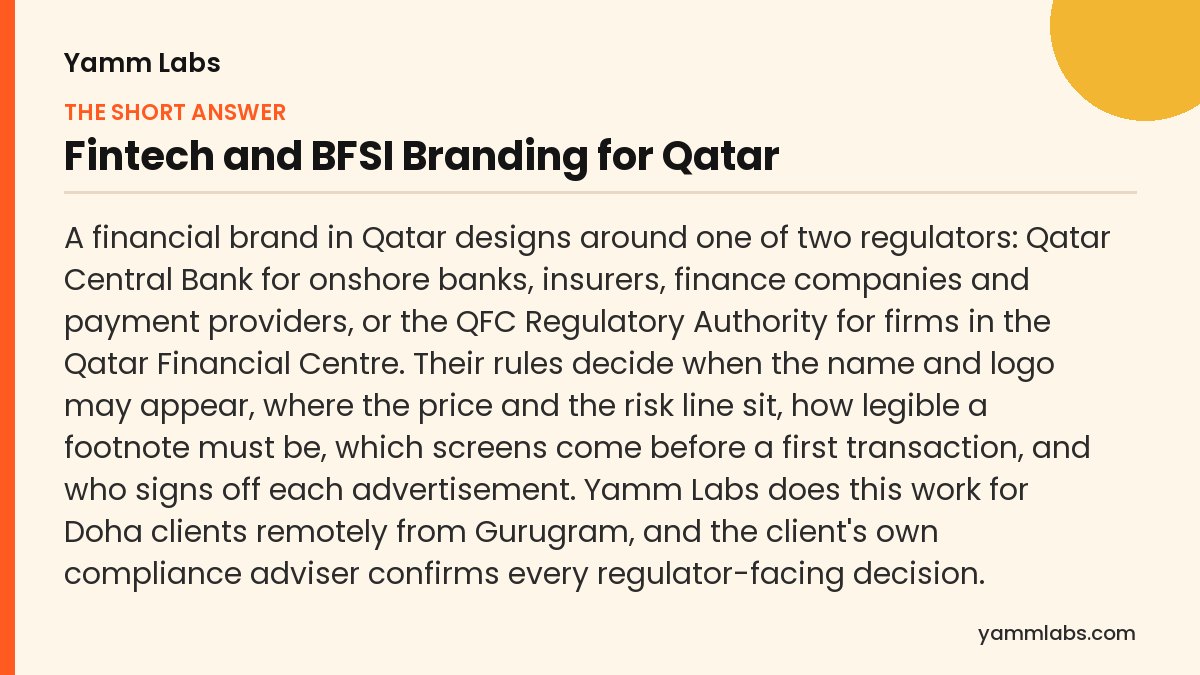
Two, and which one applies depends on where the firm is licensed. Qatar Central Bank sits over the onshore financial system. Its law covers banks, finance and investment companies, exchange houses, insurers and other financial institutions, and its payment services regulation covers e-money issuers, merchant acquirers and domestic money-transfer providers, the businesses most people mean by “fintech” in Doha. The QFC Regulatory Authority is the independent regulator of the Qatar Financial Centre and authorises and regulates firms and individuals conducting financial services in or from the centre, with its own rules on advertisements. The first line of any Qatar brand brief should say which of the two holds the licence, because the design rules differ.
| Regulator | What it governs | The design decision it forces |
|---|---|---|
| Qatar Central Bank | Licensing of onshore financial institutions; no one may display the name or logo of a bank, insurer, exchange house or other financial institution in documents or advertising before the licence is granted | Lockup rule and launch timeline: the identity is built and held unreleased, and the launch calendar runs from the licence date |
| Qatar Central Bank | Customer protection in advertising: clear, unambiguous, plain language, not misleading, with the essential data, prices, access conditions and risks of the service | Price-in-frame rule: any frame that names a product carries its price, conditions and risk line in body type, not in a footnote |
| Qatar Central Bank, payment services regulation | Terms preferably in English and Arabic; legal name, registered address and contact details clearly on the website; risk warnings; readable font size for all text including footnotes; client charter approved before any payment | Footnote floor, bilingual identity, locked footer block and an onboarding sequence that puts the charter before the first transaction |
| QFC Regulatory Authority | Advertisements by authorised firms: senior management review and written confirmation before release; clear, fair and not misleading; capital at risk made clear; prominent risk indication; name, contact, issue date and authorisation statement on durable material | Approval gate in the calendar, a fixed regulatory block on every printed or saved asset, and a risk line with the same prominence as the benefit |
What does the Qatar Central Bank licence rule do to a launch identity?
The decision that most separates a Qatar launch from an Indian one is the lockup rule. The central bank’s law says no one may display the name or logo of a bank, finance or investment company, exchange house, insurer or other financial institution in any document, correspondence or advertising before obtaining a licence. For the brand this means three things. The name has to survive licence review, because a name that signals a regulated activity cannot be shown until that activity is licensed.
SIGNALNewsletter by Yamm Labs
The next piece, straight to your inbox.
New writing on BFSI brands, B2B and influencer marketing, and AI search.
One click to unsubscribe. Privacy policy

The identity is designed, tested and locked in private, so the long “coming soon” campaign many Indian fintechs run is not available in the same form. And the launch timeline runs backwards from the licence date, not forwards from the agency’s delivery date. We plan the identity to be ready ahead of that date and hold it, so the first public appearance can happen the week the licence lands.
Redrawing a finished identity because the descriptor under the logo must change costs a full round, so we put the descriptor question, what the firm may call itself in public, to the client’s licensing adviser before the wordmark is drawn. It is a one-page memo, and it protects the most expensive piece of work in the project.
In Qatar the licence date is the launch date, and the brand has to be finished and waiting.
Where do the price, the fee and the risk line sit in a Qatar advertisement?
Qatar Central Bank’s law says an advertisement must be clear, unambiguous and in plain language, neither misleading nor deceptive, and must include the essential data, characteristics and prices of the service, the conditions for accessing it, and information on its risks. Read as a designer, that makes price, conditions and risk content, not small print. Our rule for Qatar creative is price-in-frame: if a frame names a product, the same frame carries the number, the conditions and the risk line, set in body type. On a social carousel the fee slide is the second slide, not the last.
The payment services regulation adds a legibility test for licensed payment providers: promotional material may not be misleading or exaggerated, and all text and numbers must be clearly visible, with a readable font size for everything including footnotes. We turn that into a footnote floor in the brand guidelines, a minimum size below which no text may be set on any channel, checked at the smallest size the asset will appear.
What changes for a payment fintech licensed by Qatar Central Bank?
The payment services regulation, in force since 15 September 2021, carries more design instructions than most founders expect. Four shape the brand system directly.
- Bilingual by default. Terms are to be given in clear, simple language, preferably in English and Arabic, and customer information in Arabic or a language agreed with the customer. So the Arabic wordmark is drawn alongside the Latin one rather than transliterated later, the type pairing holds the same weight in both scripts, and layouts mirror for right-to-left reading.
- A locked footer block. The licensee’s legal name, registered address and contact details must be clearly displayed on its website. We make that a locked component on every template, so no landing page built six months later can drop it.
- The screen sequence. Users acknowledge the terms before they participate, and user approval of the client charter is needed before any payment is executed. The onboarding flow therefore places the charter and terms as real screens between identity verification and the first transaction, not as a pre-ticked box.
- Risk warnings in the product. The regulation asks for adequate warnings to users and merchants about losses from the issuer’s insolvency, lost or stolen e-money instruments and fraudulent transactions. The component library carries a warning pattern with the weight of a notification, not a grey line at the bottom of a screen.
What changes for a firm regulated by the QFC Regulatory Authority?
Firms authorised in the Qatar Financial Centre work under the QFC Regulatory Authority’s customer and investor protection rules rather than the onshore regime. Before a firm makes or approves an advertisement, a member of its senior management must review it and confirm in a durable form that it complies. The advertisement must be clear, fair and not misleading, must make the risk clear where a customer’s capital is at risk, and must not disguise, diminish or obscure important warnings.
It cannot call something free unless the whole product or service is free. Advertisements in durable form, such as a brochure or a saved PDF, must carry the firm’s name, an address or contact, the date of issue and an expiry date where one applies, and a statement that the firm is authorised by the QFC Regulatory Authority.
Three decisions follow. The agency never publishes; every asset moves through the firm’s senior-management sign-off, and the campaign calendar names that step and its owner. Every durable template carries a fixed regulatory block with the name, contact, issue date and authorisation line, designed once so no one has to remember it. And the risk statement gets the same prominence as the benefit it sits beside, set in a weight and position that survive the crop from a wide banner to a square post.
How do you brand for Qatar and India at the same time?
Many Doha briefs involve India too: Indian institutions with Gulf plans, or fintechs serving Indian expatriates in Qatar. The brand then satisfies two rulebooks that agree on principle and differ in detail.
- Design the strictest disclaimer once. SEBI, IRDAI and RBI each set their own disclosure requirements for funds, insurers and lenders. We build one disclaimer component sized for the longest Indian text at the smallest permitted size, and the Qatar variants fit inside it.
- Three scripts, one hierarchy. Arabic for Qatar, Devanagari and other Indian scripts for India, Latin across both. The typeface is chosen so a headline reads at the same weight in each script, and that choice comes before colour.
- Two approval chains, one calendar. An Indian insurer’s Gulf campaign passes its Indian compliance review and its Qatar partner’s review. We schedule both as separate gates with named owners.
- Conditions in the frame. A remittance offer showing rupees and riyals carries the rate basis and eligibility in the same frame, because Qatar’s rules treat conditions as content.
Our Indian clients include TATA AIA Life Insurance, HDFC Life, Axis Bank, Paytm Money and Aditya Birla Sun Life Mutual Fund, and that regulated work is the base the Qatar layer sits on. The insurance branding brief we publish for India shows the Indian half of the pattern.
How does Yamm Labs work with Doha clients from Gurugram?
Remotely, and openly so. Yamm Labs is based in Gurugram and has no office, licence or registered presence in Qatar. We work with Doha clients over video calls, shared files and scheduled reviews in the hours when both working days overlap, and we meet in person for work in India. We read the regulation from the primary documents, and every regulator-facing decision is confirmed by the client’s own compliance officer or licensing adviser. We do not give legal advice; we design to the rules the client’s adviser confirms, and we say so in the proposal.
The sequence follows the order above: descriptor memo, identity built and held, disclaimer and footnote floor fixed, onboarding screens storyboarded, then the visual system, then channel assets through the client’s approval chain. We do not publish Qatar price bands; the India cost bands are our reference point, adjusted for bilingual scope and the extra approval gate. Every brief gets the same first document: a one-page list of the regulator-driven decisions we intend to make, before any creative is shown.
How should a Doha bank, insurer or fintech brief an agency?
- State the regulator on line one. Qatar Central Bank onshore, or the QFC Regulatory Authority in the centre.
- Give the licence status. Granted, pending or in a sandbox. The lockup rule and the launch calendar depend on it.
- List products and their conditions. Fees, minimums, eligibility and risks become content in the creative, so the agency needs them at the brief, not at artwork.
- Name the languages. Arabic and English at least; Hindi, Malayalam or others if the audience includes Indian expatriates.
- Name the approver. The person whose sign-off makes an advertisement ready to release, and how long they need.
- Ask for decisions, not adjectives. An agency that calls itself compliance-aware should be able to show its last three disclaimer placements and explain each. The fintech branding page for India shows how we set ours out.
People also ask
Does a fintech in Qatar need a licence before it can show its brand?
Qatar Central Bank’s law says the name or logo of a bank, insurer, exchange house or other financial institution may not be displayed in documents or advertising before a licence is obtained. A brand can be built and held before then, but its public launch is tied to the licence date, and the firm’s licensing adviser should confirm what may be shown in the meantime.
Do financial advertisements in Qatar have to be in Arabic?
The central bank’s payment services regulation asks licensed payment providers to give terms in clear, simple language, preferably in English and Arabic, and other information in Arabic or a language agreed with the customer. Most financial brands in Doha therefore design a bilingual system from the start, confirmed with the firm’s compliance officer.
What is the difference between Qatar Central Bank and the QFC Regulatory Authority for a brand?
Qatar Central Bank licenses and supervises onshore banks, insurers, finance companies and payment providers, and its law sets what their advertising must contain. The QFC Regulatory Authority regulates firms authorised in the Qatar Financial Centre and requires senior management to confirm each advertisement complies before release. A brand answers to one or the other, and the brief should say which.
Can an Indian agency work with a bank or fintech in Doha?
Yes, remotely. Yamm Labs works from Gurugram with Doha clients over calls and shared files, and designs to the Qatar rules the client’s compliance adviser confirms. It has no office or licence in Qatar and does not claim clients there.
Sources
Launching or refreshing a financial brand in Doha and want the regulator-driven decisions listed before the creative starts?
Get a free Fintech Brand Audit across 8 dimensions, plus 3 fixes. No pitch. Run the free Brand Audit →