

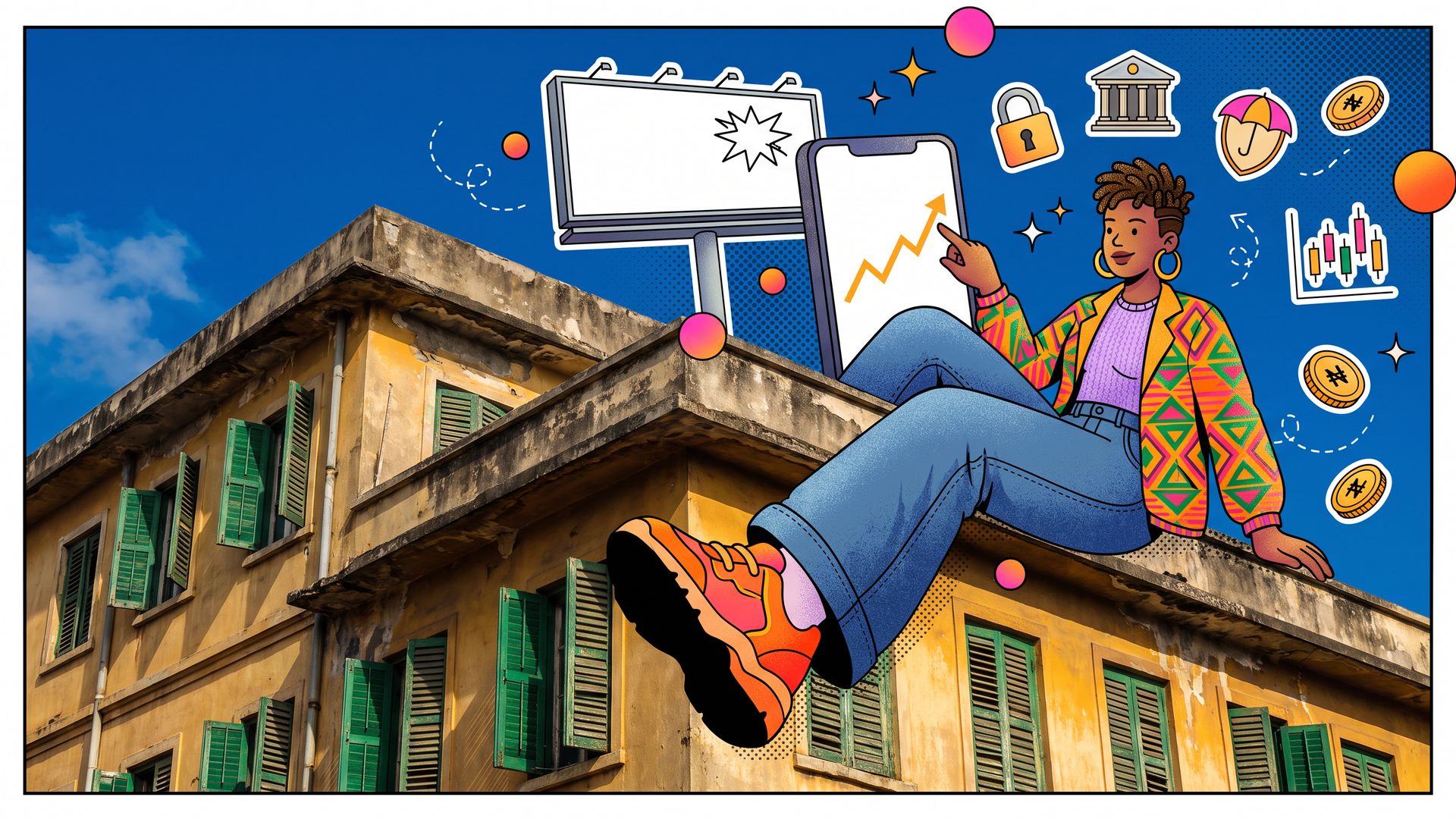
A savings app in Lagos is a week from its launch campaign. The headline on the billboard mock-up says the app offers the best rate in Nigeria. The compliance lead circles the word “best”, asks where the audited figure behind the rate comes from, and asks whether the Central Bank has been told the campaign is coming. The creative team had not planned for any of it. That is the real brief for fintech and BFSI branding in Nigeria: three regulators sit inside the design process, and the brand either plans for them on day one or rebuilds its work in the last week.
- Which regulators shape a financial brand in Nigeria, and what does each one govern?
- What does the Central Bank of Nigeria’s stance on advertising force a bank or fintech to design?
- What do SEC Nigeria’s advertising rules change for an offer or fund campaign?
- What must every insurance ad in Nigeria carry under NAICOM’s guidelines?
- How do you build one brand that works in both Nigeria and India?
- How does Yamm Labs work with fintech and BFSI clients in Lagos?
- What should a Nigerian bank, fintech or insurer put in an agency brief?
- A worked example: the Lagos savings app billboard
- People also ask
Which regulators shape a financial brand in Nigeria, and what does each one govern?
Three bodies matter most for brand and campaign design. The Central Bank of Nigeria supervises banks, payment service providers and other financial institutions, and its consumer protection rules decide how they may advertise. SEC Nigeria regulates capital market operators, public offers and collective investment schemes, and its rules decide what an offer or fund advertisement may show. NAICOM, the National Insurance Commission, regulates insurers, and its market conduct guidelines decide what every insurance ad, brochure and website must carry. The table maps each regulator to the design decision it forces. It describes the rules in plain terms; your compliance team and counsel hold the final reading.
| Regulator | What it governs for a brand | Design decision it forces |
|---|---|---|
| Central Bank of Nigeria | Advertising by banks, payment service providers and other regulated financial institutions, under its consumer protection and fair-marketing expectations | A headline system with no superlatives or rival comparisons, every number traced to an audited source, no prize-draw mechanics, and a pre-publication notification step built into the campaign calendar |
| SEC Nigeria | Advertising of public offers and collective investment schemes, and marketing by capital market operators | A separate, typographic offer-ad kit with no models, celebrities, mascots or landmarks, no TV crawlers, no issue slogans, and a fixed advisory footnote in every print and electronic ad |
| NAICOM | Insurance advertising, product literature and the conduct of insurers towards customers | A locked footer on every ad, brochure and web page that carries the approval number, the authorisation line with the licence number and the full contact block, plus a Naira-first rule for any foreign-currency figure |
What does the Central Bank of Nigeria’s stance on advertising force a bank or fintech to design?
In November 2025 the Central Bank of Nigeria told banks, payment service banks and other financial institutions it regulates to withdraw advertisements that fell short of its consumer protection and fair-marketing standards, according to press reports of the circular. The reports say the CBN wants marketing to be factual, balanced and transparent, bars comparative, superlative and de-marketing claims, bars lotteries and similar chance-based incentives, and objects to adverts that exaggerate benefits, hide risks or rely on unaudited financial statements.
Institutions were also told to notify the CBN before publishing new campaigns, with details such as creative content, timelines and target audience; reports quote the CBN as saying this notice is for monitoring and is not an approval. Three design decisions follow.
- A headline system without “best”, “No. 1” or “cheapest”. The brand voice has to win on specifics: a named feature, a clear fee, a real time saving. We write the headline library with the ban in mind, so the copy team never reaches for a superlative under deadline.
- A numbers rule in the design system. Every rate, customer count or growth figure in a template links to its source in the brief. If the figure is not from audited or verified data, it does not go on the artwork.
- A calendar with a notification step. The campaign plan carries a line for the notice to the CBN, with the creative, dates and audience ready, before any media goes live. That is a sequencing decision, and it belongs in the agency’s timeline, not in a compliance officer’s inbox.
In a regulated market, the brand that plans for the regulator on day one launches on time; the brand that treats it as a final check redesigns in the last week.
What do SEC Nigeria’s advertising rules change for an offer or fund campaign?
SEC Nigeria’s published rules treat advertising of a public offer as something the Commission approves before it runs, with the issuing house responsible for getting that approval. The rules require an offer advert to be truthful, to stay within the information in the approved offer documents, to avoid complex legal language and high-sounding slogans, and not to promise rapid profits.
SIGNALNewsletter by Yamm Labs
The next piece, straight to your inbox.
New writing on BFSI brands, B2B and influencer marketing, and AI search.
One click to unsubscribe. Privacy policy

They go further than most markets on visuals: models, celebrities, fictional characters, landmarks and caricatures may not appear in the advertisement, crawlers along the bottom of a TV screen are not allowed, and an advisory line telling investors to read the prospectus and consult a professional adviser must appear as a footnote in all print and electronic media advertisements. Awards mentioned in the ad need evidence cleared by the Commission first. For collective investment schemes, the rules require each advertisement to be approved, forbid comparing one scheme with another, and require any past performance to show how returns were calculated with a statement that it does not predict future results.
The design decision is structural. A capital market brand that uses a mascot, a famous face or a Lagos skyline in its brand campaign needs a second, stripped-back kit for offer and fund adverts: typography, the company’s normal name and logo, the approved facts, and a footnote zone sized for the advisory line in every format from a newspaper strip to a social story.
We design both kits at the same time so the offer ad still looks like the brand. SEC Nigeria also acts on marketing that runs ahead of approval; in June 2026 it ordered registered operators to stop publishing and take down promotional material about a share offer that had not been filed with or approved by the Commission.
What must every insurance ad in Nigeria carry under NAICOM’s guidelines?
NAICOM’s revised market conduct guidelines for insurers, issued in January 2024, make insurance advertising a prior-approval activity. They say advertisement content is subject to the Commission’s prior approval, that a product must be approved before it is marketed, and that the advert must carry the Commission’s approval number, with a fresh approval needed when the content changes. The advert must show the insurer’s corporate office address, phone numbers, email and website. Insurers must also carry an authorisation footer stating that they are authorised and regulated by the National Insurance Commission, with their licence number, on letterheads, brochures, leaflets, websites and other publications.
The guidelines add content rules a designer has to see in the layout: state the basis of any claimed benefit and its significant limits prominently, never conceal or obscure important statements or warnings, separate contractual benefits from non-contractual ones, show the Naira equivalent of any figure quoted in foreign currency, state interest as a rate per annum, back testimonials with evidence, and make no comparisons with named competitors. If an insurer learns an advert is misleading, the guidelines give it no more than seven days to withdraw and correct it.
- A locked compliance footer. One component, built once, that holds the approval number slot, the authorisation line with the licence number and the contact block. It sits in every template, and the approval number field is marked so no file goes to print with it empty.
- Benefit and limit at equal weight. A limitation set in hairline grey under a bold benefit invites the charge of obscuring a warning. We set the limit line in the same typographic family, close to the benefit, at a size that reads on a phone.
- Versioned artwork. Because a changed ad needs fresh approval, every master file carries a version number that maps to the approval it was cleared under.
How do you build one brand that works in both Nigeria and India?
Many fintech and insurance groups now operate in both markets, or plan to. The mistake is one global template with a single disclaimer box. Indian regulators have their own rules; SEBI, for example, requires the standard mutual fund risk warning in audio-visual adverts to be clear and understandable on screen and in voice-over, with five seconds given only as an example of what may meet that test. The warning’s wording is fixed, and an advert in a regional language must carry it in that language. Indian mutual fund rules also allow celebrities only in industry-wide campaigns that promote mutual funds in general, with SEBI’s approval first. SEBI’s Board approved a Common Advertisement Code on 24 September 2026, and SEBI notified it in October 2026; from April 2027 it lets regulated firms use celebrities for brand-level promotion with prior approval, but not for claims about a specific product. Nigeria’s rules sit in different places on the artwork: a footnote for an SEC offer ad, a footer with an approval number for a NAICOM ad, an audited-figures rule for a CBN-regulated bank.
We solve it with a shared master identity and market-specific compliance layers. The logo, colour, type and motion system stay global. Each market gets its own footer component, disclaimer slate and numbers rule, sized in advance so the layout does not break when the Nigerian text is longer than the Indian one. Currency and rate formats are set per market, with Naira shown first wherever a figure appears in another currency. Our pages on fintech branding in India and briefing an insurance branding agency in India cover the Indian layer in detail.
How does Yamm Labs work with fintech and BFSI clients in Lagos?
Yamm Labs works from Gurugram. We run workshops in person in Delhi NCR or remotely, and serve clients in the Gulf and other international markets remotely from Gurugram. We have no office in Lagos, hold no Nigerian licence and do not claim a Nigerian client. The BFSI brands we have worked with include TATA AIA Life Insurance, HDFC Life, Axis Bank, Paytm Money and Aditya Birla Sun Life Mutual Fund, all Indian businesses in regulated categories.
For a Nigerian client the work runs on video workshops, shared design files and a written decision log. Gurugram’s afternoon overlaps the Lagos working morning, so review calls sit inside both teams’ day. Your compliance team and Nigerian counsel stay the final authority on every regulatory reading; our job is to turn their reading into templates that make the right thing the easy thing. Media approvals and filings with the CBN, SEC Nigeria or NAICOM stay with you or your local partners.
What should a Nigerian bank, fintech or insurer put in an agency brief?
- Your regulators and licences. Name which of the Central Bank of Nigeria, SEC Nigeria and NAICOM supervise you, and which products each one touches.
- Your approval path. Who signs off internally, which ads need prior approval or notification, and how long that usually takes in your experience.
- Your fixed blocks. The footer text, advisory lines, licence numbers and contact details that must appear, so they are designed first.
- Your number sources. Which figures are audited and may appear in marketing.
- Your other markets. If the brand must also work in India or elsewhere, say so now, so the compliance layers are planned as a system.
Then ask every agency on your list to show you one regulator-driven decision it has made: a disclaimer placement, a footer rule, a screen sequence. For a sense of budget bands, see our guide to fintech branding cost.
A worked example: the Lagos savings app billboard
Go back to the savings app from the top of this page, a week from launch with “the best rate in Nigeria” on its billboard. Each of the compliance lead’s three questions maps to one of the design decisions above.
The word “best”. The headline library has no superlatives, so the line is rewritten around a specific: the feature that earns the rate, or the rate itself stated plainly. The brand still sounds confident. It simply stops making a claim it cannot prove against every rival.
The source of the rate. The numbers rule asks where the figure comes from. If it is not from audited or verified data, it does not go on the artwork. If it is, the brief records the source next to the template, so the next campaign does not have to ask again.
The notice to the CBN. The campaign calendar gains a line for the notification, with the creative, dates and target audience ready before any media is booked. Planned in week one, it costs a few days of lead time. Discovered in the last week, it costs the launch date.
None of this changes the brand’s colour, type or tone. It changes where the regulated decisions live, so the creative team can work inside them. Confirm the current text of each rule with your compliance team before release.
People also ask
Does a Nigerian bank need CBN approval before running an advert?
Press reports of the November 2025 circular say institutions must notify the Central Bank of Nigeria before publishing campaigns, and that the notice is for monitoring rather than approval. Confirm the current requirement with your compliance team, and build the notification step into the campaign calendar either way.
Can a Nigerian insurance ad run without a NAICOM approval number?
NAICOM’s market conduct guidelines say insurance advertisement content is subject to the Commission’s prior approval and that the advert must carry the approval number. Design a footer with a marked approval-number field so no artwork is released without it.
Can a public offer advert in Nigeria use a celebrity or a mascot?
SEC Nigeria’s rules on offer advertisements exclude models, celebrities, fictional characters, landmarks and caricatures. A brand that relies on a mascot needs a separate typographic kit for offer and fund adverts.
Can an agency in India handle fintech branding for a company in Lagos?
Yes, if it works remotely with discipline and treats your compliance team and local counsel as the final word on regulation. Yamm Labs does this from Gurugram, without claiming an office, licence or client in Nigeria.
Sources
- hallmarknews.com: Hallmark
- allafrica.com: Nigeria: CBN Orders Banks to Withdraw Non-Compliant Adverts, Gives 30-Day Deadline
- portal.cscs.ng: SEC Consolidated Rules r.284(1) and (2)(b), p.177 (PDF opened and text extracted).
- sec.gov.ng: SEC circular dated 23 June 2026 to registered CMOs
- naicom.gov.ng: Cover page
- SEBI: SEBI/IMD/CIR No.12/118340/08 (26 Feb 2008)
Building a financial brand for Lagos? Check it against its regulators first.
Get a free Fintech Brand Audit across 8 dimensions, plus 3 fixes. No pitch. Run the free Brand Audit →
One Comment