

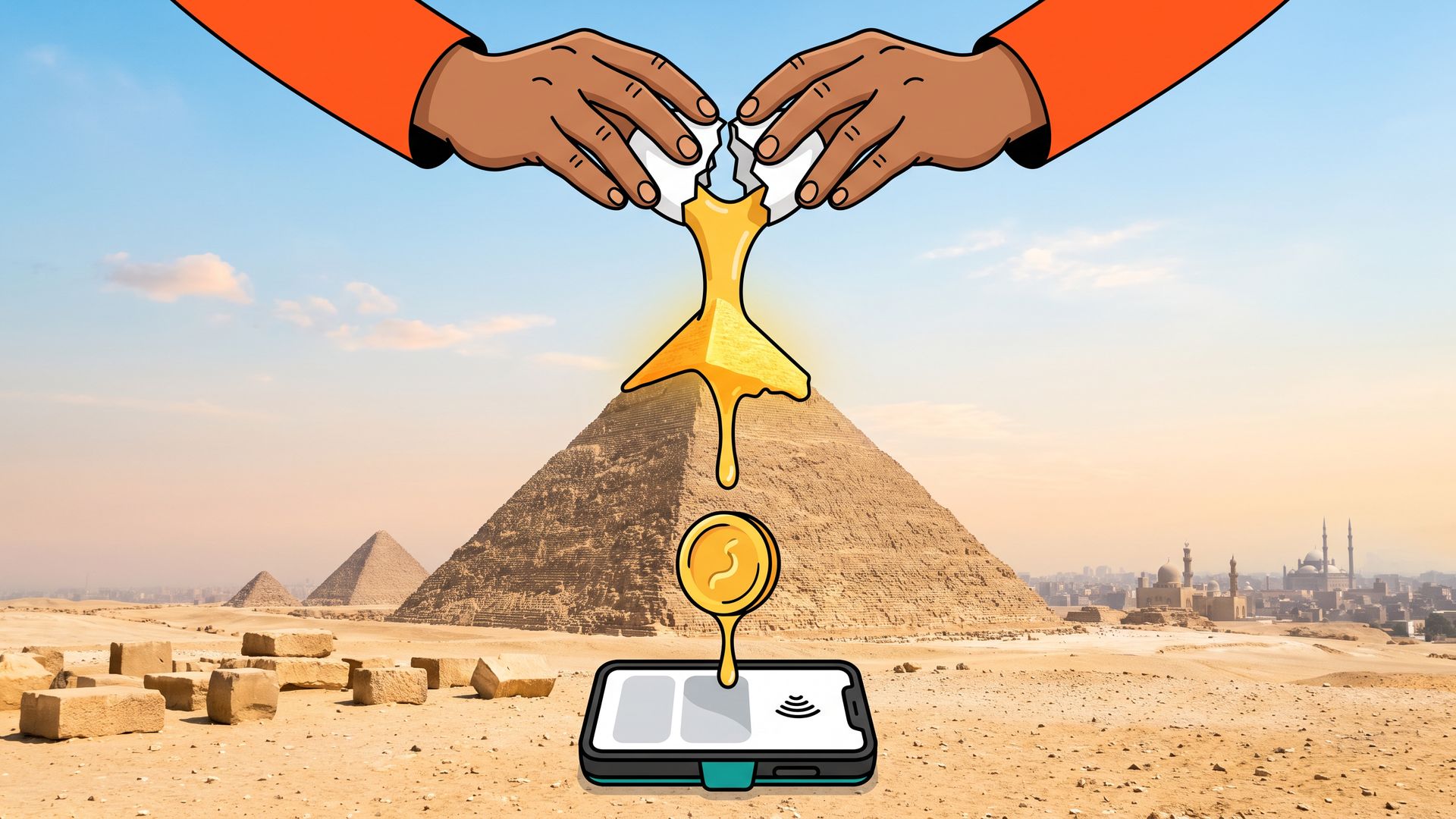
A growth lead at a Cairo lending app shares the new launch campaign on a video call. The hero frame is in English, the offer is a monthly instalment in big numerals, and the fees sit in a footnote nobody on the call can read at phone size. The Arabic version is a translation pasted into the English grid, so the text runs the wrong way around the logo. Her compliance colleague has two questions before anyone talks about colour: where does the full cost of the loan appear, and which regulator’s rules does this campaign fall under? In Egypt, those two answers shape the brand system more than any mood board.
- Which regulators govern a financial brand’s advertising in Egypt?
- What design decisions do Egypt’s disclosure rules force?
- How do you design a financial brand that works in both Egypt and India?
- How does Yamm Labs work with clients in Egypt?
- How should an Egyptian bank, insurer or fintech brief a branding agency?
- What should an Egypt financial brand avoid?
- A worked example: the Cairo lending app campaign, rebuilt
- A launch checklist for an Egypt financial brand
- People also ask
Which regulators govern a financial brand’s advertising in Egypt?
Two bodies matter for brand and campaign work, and the first job is to know which one your product answers to.
The Central Bank of Egypt supervises banks and, for fintechs, payments: payment service providers, e-wallets, instant payments, money transfers and digital banking. Its consumer protection page says it issued Consumer Protection Instructions for banks in February 2019 to govern the relationship between banks and their customers at every stage, and lists disclosure and transparency among its core principles, next to fair treatment, complaint handling, financial literacy and data privacy. Legal commentary on those instructions notes that banks must publicly disclose their real annual interest rates and give customers the information they need to make a sound decision.
The Financial Regulatory Authority supervises non-bank financial services. That covers insurance and reinsurance, insurance brokerage, consumer finance and buy now pay later, microfinance, SME finance, factoring, and securities and capital markets. The FRA’s website publishes registers of licensed companies in the insurance, financing and capital market sectors, and negative lists of entities the public should avoid. In September 2026 the FRA published a consumer finance rulebook that, as reported, covers marketing, advertising and customer disclosures, including how financing terms, repayment schedules, costs, fees, benefits and risks are presented.
A bank’s insurance tie-up or a fintech that both processes payments and offers consumer credit can sit under both. The brand system then has to carry two sets of expectations without looking like two brands.
| Regulator | What it governs for brand and marketing | The design decision it forces |
|---|---|---|
| Central Bank of Egypt | Banks, payment providers, e-wallets and digital banking; consumer protection built on fair treatment, disclosure and transparency; banks disclosing their real annual interest rates | A rate and fee component that sits on the same frame or screen as the headline offer, in Arabic, sized to be read at phone distance, never moved to a footnote or a later screen |
| Financial Regulatory Authority | Insurance, consumer finance, BNPL, microfinance, SME finance and capital markets; presentation of financing terms, repayment schedules, costs, fees, benefits and risks; public registers of licensed firms | A cost block showing finance amount, fees, annual rate and total amount due before the confirm step, plus a licence line in every ad so a customer can check the firm against the FRA’s registers |
| Both, for firms that span banking and non-bank activity | Payments and bank products under the CBE; credit, insurance or investment products under the FRA | One master identity with a disclosure layer per regulator, each owned by a named reviewer on the client’s compliance team |
What design decisions do Egypt’s disclosure rules force?
Competitors in this space describe themselves as compliance-aware and stop there. Here are the three decisions we would put on the table in the first workshop for an Egypt brand.
- An Arabic-first lockup, not a translated one. Practitioner guidance on Egyptian advertising law says Arabic must be used where the target audience is Egyptian. That makes the Arabic wordmark a primary asset, not a version. We design the Arabic and Latin marks together, check how each sits in a right-to-left layout, and fix where the logo lives on a screen that reads from the right. If the Arabic lockup is an afterthought, every ad after launch pays for it.
- A cost block that travels with the offer. Legal commentary on Egypt’s fintech rules notes that the FRA’s standard contract models require clear fee and pricing disclosure, including the finance amount, fees and annual interest rate, administrative and other expenses, and the total amount due. We turn that into a fixed component in the design library. In an app, it appears on the offer screen before the confirm button. In a social ad, it sits on the face of the frame, not in the caption. In outdoor, it gets a minimum size worked out from viewing distance, not from what fits.
- A licence line in the brand system. The FRA publishes registers of licensed firms and negative lists of entities to avoid, and it has warned the public about unlicensed online financial promotions. A licensed brand gains from making its status easy to check. We reserve a slot in the lockup system for the licence line, in Arabic and English, so it appears on every ad, landing page and app store listing without a designer deciding each time.
None of these is a clause-by-clause reading of the rules. Your legal counsel in Cairo confirms the exact wording, sizes and approvals. The design job is to build a system where the right wording has a permanent home.
How do you design a financial brand that works in both Egypt and India?
Some financial brands need to work in both markets: a group with operations in Egypt and India, or an Indian fintech expanding west. The mistake is to build the brand for one market and localise it for the other. The disclosure rules differ, the scripts differ and the reading direction differs, so the system has to be designed for both from the start.
SIGNALNewsletter by Yamm Labs
The next piece, straight to your inbox.
New writing on BFSI brands, B2B and influencer marketing, and AI search.
One click to unsubscribe. Privacy policy

We build one master identity with three layers. The core layer holds the mark, colour, type families and tone, and it never changes. The script layer holds the Arabic, Latin and, where needed, Devanagari lockups, each drawn to feel like the same brand rather than a translation. The disclosure layer holds the market-specific components: in Egypt, the Arabic cost block and the FRA or CBE licence line; in India, the components that SEBI and IRDAI rules call for, such as a mutual fund’s standard risk warning or an insurer’s registered name shown alongside its logo.
Each disclosure component has an owner. In India that is usually the client’s compliance team, which already reviews campaigns against SEBI or IRDAI rules. In Egypt it is the team that answers to the CBE or the FRA. The brand guidelines name both, so an agency in either market knows who signs off before anything goes live.
A financial brand that works in Cairo and Mumbai is one identity with two disclosure layers, not two brands that happen to share a logo.
How does Yamm Labs work with clients in Egypt?
Yamm Labs works from Gurugram. We do not have an office, a licence or a client base in Egypt, and we will not pretend otherwise. We serve clients across India first, and run work for clients in the Gulf and other international markets remotely from Gurugram.
For an Egypt brief, that means video workshops, shared review boards and a fixed weekly review slot. Cairo and Gurugram share a large part of the working day, so live reviews do not need anyone on a late call. For Arabic copy and the final type check, we ask the client to appoint or approve a native Arabic reviewer, and the client’s legal counsel in Egypt confirms every disclosure before release. We bring the BFSI design discipline; the client’s local advisers bring the local legal sign-off.
Our BFSI work in India includes brands such as TATA AIA Life Insurance, HDFC Life, Axis Bank, Paytm Money and Aditya Birla Sun Life Mutual Fund. That experience is why we start every financial brand with the disclosure components. For how we approach the same work at home, see our pages on the fintech branding agency in India and the insurance branding agency guide.
How should an Egyptian bank, insurer or fintech brief a branding agency?
A good brief saves two rounds of revisions. Put these five things in it before the first call.
- Your regulator map. List each product and whether it sits under the CBE or the FRA. If you have both, say so up front.
- Your disclosure inventory. Collect every line compliance already asks for: rates, fees, total cost, licence wording, risk statements. The agency designs around them; it does not write them.
- Your script and channel list. Arabic, English and any third script; app, social, outdoor, branch and print. Each channel changes the minimum size of the cost block.
- Your sign-off chain. Name who in compliance and legal approves each layer, and how long a review round takes.
- Your budget band and timeline. A system with two scripts and two disclosure layers takes longer than a single-market identity. Our guide to fintech branding cost explains how scope drives the number, and the same logic applies to an Egypt project.
Then ask every agency on the shortlist one question: show us the last disclosure component you designed and the compliance comment that shaped it. The answer tells you more than the portfolio.
What should an Egypt financial brand avoid?
Three patterns cause avoidable rework in regulated brands, and each has an Egypt-specific version.
- English-first design. A layout built in English and mirrored into Arabic breaks the grid, crowds the disclosure and weakens the mark. Design the Arabic version first or in parallel.
- Offer-only frames. A monthly instalment in large numerals with the total cost hidden in a caption is the pattern disclosure rules exist to stop. Treat the cost block as part of the offer.
- Promoting what you are not licensed to offer. Practitioner guidance notes that the CBE and FRA issued repeated warnings in 2025 against advertising or promoting crypto products. If a product is not covered by your licence, keep it out of the brand story entirely.
A worked example: the Cairo lending app campaign, rebuilt
Go back to the launch campaign at the top of this article. It had four problems: an English hero frame, a monthly instalment in big numerals, fees in a footnote nobody could read, and an Arabic version pasted into the English grid. Here is how the decisions above change it.
First, the regulator map. A consumer lending product sits with the Financial Regulatory Authority, so the FRA disclosure layer applies. If the same app also runs a wallet or payments feature, that part sits with the Central Bank of Egypt and its screens carry the CBE layer. The compliance colleague now has an answer to her second question before design starts.
Second, the hero frame. The Arabic lockup leads, drawn for a right-to-left layout, with the Latin mark as its partner. The monthly instalment stays, because it is the offer, but the cost block moves onto the face of the frame beside it: finance amount, fees, annual rate and total amount due. The footnote goes, because nothing important is left in it.
Third, the licence line takes its reserved slot at the base of the lockup, in Arabic and English, so a customer can check the lender against the FRA’s registers from the ad itself. Fourth, the app’s offer screen shows the same cost block before the confirm button, in the same order as the ad, so a customer who taps through from social sees no new numbers at the point of commitment.
A launch checklist for an Egypt financial brand
Run this list with the agency and the compliance team before any campaign or rebrand goes live in Egypt.
- Regulator confirmed per product. Every product in the campaign is mapped to the CBE, the FRA or both, and the right disclosure layer is attached.
- Arabic lockup checked in context. The Arabic mark has been reviewed in a right-to-left layout on phone, social, outdoor and print.
- Cost block on the same frame as the offer. No headline number appears without the cost items the product calls for beside it.
- Licence line in its reserved slot. It is present in Arabic and English on every ad, landing page and app store listing.
- Native Arabic review done. A reviewer approved by the client has read every Arabic line, disclosures included.
- Legal sign-off recorded. Counsel in Egypt has confirmed wording, sizes and approvals, and the named owner of each disclosure layer has signed off.
- Out-of-licence products removed. Nothing in the campaign promotes a product the firm is not licensed to offer.
This is a design checklist, not legal advice. Regulator guidance changes, so confirm the current text with your compliance team before each launch.
People also ask
Does a fintech in Egypt fall under the Central Bank of Egypt or the Financial Regulatory Authority?
It depends on the product. Payments, e-wallets and digital banking sit with the Central Bank of Egypt, while consumer finance, BNPL, microfinance, insurance and investment products sit with the Financial Regulatory Authority. A fintech offering both needs a brand system that carries both sets of disclosures.
Does financial advertising in Egypt have to be in Arabic?
Practitioner guidance on Egyptian advertising law says Arabic must be used where the audience is Egyptian. For a brand, that means designing an Arabic lockup and Arabic disclosure components as primary assets. Your legal counsel confirms how the rule applies to each campaign.
What should the cost disclosure on a lending app show?
Legal commentary on the FRA’s standard contract models lists the finance amount, fees and annual interest rate, administrative and other expenses, and the total amount due. Design those into one component that appears on the offer screen before the customer confirms.
Can an Indian branding agency handle a brand launch in Egypt?
Yes, if it works remotely with a clear review rhythm and pairs with a native Arabic reviewer and local legal counsel. Yamm Labs works from Gurugram with no office or licence in Egypt, and serves international clients remotely.
What is a licence line in a financial brand system?
A licence line is a short, fixed statement of the firm’s name and licensing regulator that appears on every piece of marketing. In an Egypt brand system it sits in a reserved slot in the lockup, in Arabic and English. It lets a customer check the firm against the FRA’s public registers. Your legal counsel confirms the exact wording.
Where should the cost block go in a social media ad?
On the face of the frame, beside the headline offer, not in the caption or on a later slide. Captions get truncated and later slides get skipped, so a cost shown there may never be seen. Size it for a phone screen and keep the same order of items as the app’s offer screen, so the numbers match at every step. Confirm the current text and any size rules with your compliance team.
Should Arabic and English be designed at the same time?
Yes. Designing both scripts together avoids the pasted-translation problem, where Arabic text runs the wrong way around the logo and crowds the disclosure. Draw the two marks as partners, test each in its own reading direction, and build the cost block and licence line in both languages from the first round. Adding a second script after launch usually means redrawing the grid and every template built on it.
Launching or refreshing a financial brand in Egypt? Start with the disclosure layer.
Get a free Fintech Brand Audit across 8 dimensions, plus 3 fixes. No pitch. Run the free Brand Audit →