


A growth lead at a Lagos fintech opens ChatGPT on a Monday morning and types the question her customers type: which savings app in Nigeria is safe to use? The answer names three brands. Hers is not one of them. She tries Perplexity, then Google AI Mode, then Gemini. Different wording, same three names, and one of them is quoted with an interest rate her compliance team would never let her publish. That AI visibility gap is not a media problem. It is a content, entity and compliance problem, and it can be measured.
- How do AI engines decide which Nigerian bank, insurer or fintech to name?
- What do ChatGPT, Gemini, Perplexity and Google AI Mode read about a Nigerian financial brand?
- What entity work does a Nigerian financial brand need before content?
- Which regulator-driven design decisions change how AI-facing content is written?
- How is AI visibility measured for a financial brand in Nigeria?
- How does Yamm Labs work with financial brands in Nigeria?
- People also ask
How do AI engines decide which Nigerian bank, insurer or fintech to name?
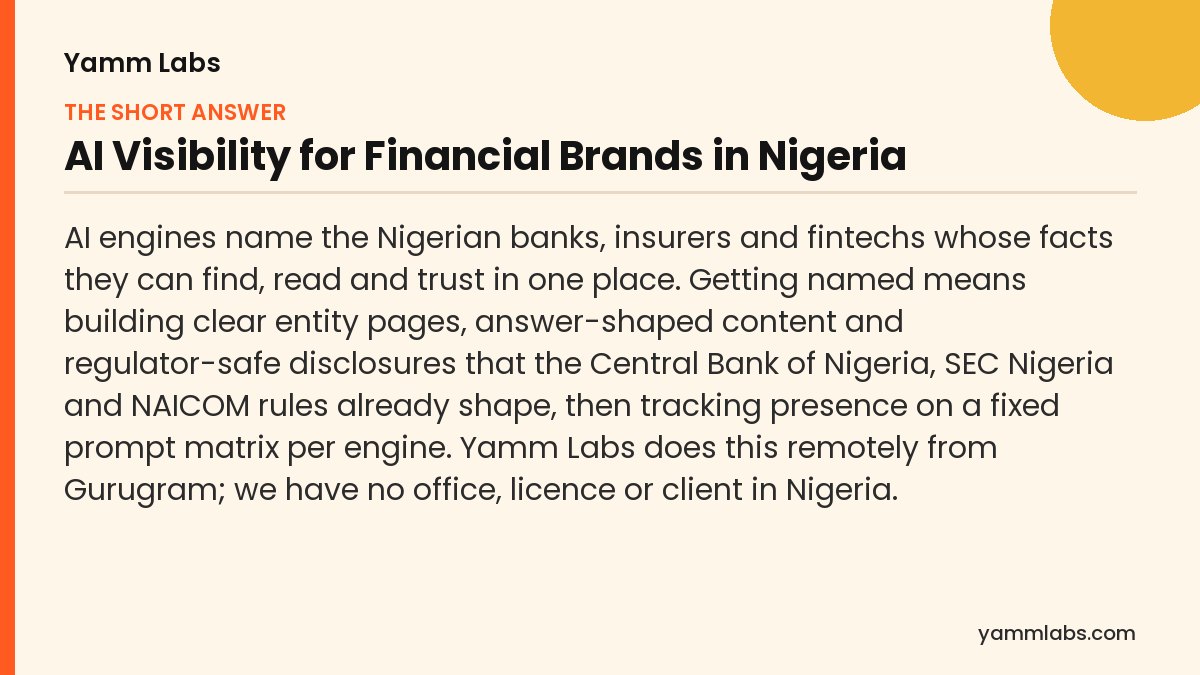
When someone asks an assistant which bank, insurer or investment app to use in Nigeria, the engine does not consult a ranking. It assembles an answer from pages it can retrieve and from what it already absorbed in training. Engines that browse, such as Perplexity and Google AI Mode, pull passages from live pages and cite them. Others lean more on what they learned earlier and on a smaller set of fetched pages.
Either way, three things decide whether a brand makes the answer. First, can the engine tell exactly who you are: your legal name, your licence category, what you sell and where. Second, is there a passage on a page it trusts that answers the buyer’s question directly, in a form it can lift whole. Third, do other sources agree with you, or does the engine find a stale rate on a blog, an old product name in the press and a different address on a directory.
Brands that are big offline are often thin online in exactly these places. The product pages are app-store copy, the rates live inside images, and the licence line is a footer graphic a crawler cannot read. The engine fills the gap with whoever wrote the clearest page, which is often a comparison blog, not the institution.
| Regulator | What it governs in marketing | The design decision it forces on AI-facing content |
|---|---|---|
| Central Bank of Nigeria | Advertising by banks, payment service providers and other institutions it regulates; expects marketing to be factual, balanced and transparent, bars prize-draw style inducements and distorting comparative claims, and asks to be notified before campaigns go out. | No superlative or head-to-head copy on pages written for engines. Answer pages state criteria and facts, and campaign content carries a notification step in the calendar before it publishes. |
| SEC Nigeria | Advertising for public offers and collective investment schemes; offer and scheme adverts need Commission approval, misleading slogans and promises of rapid profit growth are barred, and past performance must carry its basis and a statement that it does not predict future results. | Every return figure on a fund page sits in the same paragraph as its basis of computation and the past-performance statement, so any passage an engine lifts carries its own disclosure. |
| NAICOM | Insurance advertising and market conduct; advert content needs prior approval and must show the Commission’s approval number, benefits need their basis and limitations stated prominently, foreign-currency figures need a naira equivalent, and publications carry an authorization confirmation line. | The authorization line and registration number are written into the page body as text, not left in an image footer, and each policy page is batched into scheduled refresh cycles because changed content needs fresh approval. |
What do ChatGPT, Gemini, Perplexity and Google AI Mode read about a Nigerian financial brand?
They read the same public web a customer could read, weighted by how clear and consistent it is. For a Nigerian bank, insurer or fintech, the sources that tend to matter fall into five groups.
- The brand’s own site. Product pages, rate and fee pages, FAQs, the about page and the contact page. These are the only sources you fully control, and they are often the weakest.
- Regulator and official pages. Registers, public notices and circulars from the Central Bank of Nigeria, SEC Nigeria and NAICOM. An engine that finds your licence category on an official page has a reason to trust the rest.
- Press coverage. Nigerian business and fintech press, especially stories that state what you are licensed to do and what you launched.
- Reference and directory pages. Encyclopaedic entries, company profiles, app-store listings and maps listings for Lagos branches or offices.
- Third-party explainers. Comparison blogs, personal finance creators and forum threads. These fill any gap you leave, accurately or not.
The practical point is consistency. If your legal name, licence type, product names and headline facts match across all five groups, engines repeat them. If they conflict, engines either skip you or pick the version that is easiest to quote.
What entity work does a Nigerian financial brand need before content?
Entity work means making it unambiguous who you are, so an engine can attach every fact it finds to the right institution. For a regulated brand in Nigeria it comes before any new content, because content written on a confused entity gets attributed to the wrong name or not at all.
- One legal name, one brand name, one relationship between them. State both on the about page in a single sentence, for example that the app is operated by the named licensed company. Many fintechs trade under an app name while the licence sits with a different company, and engines need that link written down.
- Licence category in words. Write the licence or registration type as text on the about page and product pages, next to the regulator’s name. Engines cannot read a badge image.
- Fixed facts in one place. Head office address, customer contact channels, product list and the date the page was last reviewed. NAICOM’s guidelines already expect insurers’ adverts to carry corporate office address and contact details; put the same block on the site.
- Structured data that matches the page. Organisation, product and FAQ markup should repeat what the visible page says, never add claims the page does not make.
- Clean-up of old versions. Retired product names, old rates and earlier addresses on your own site and in listings you control get updated or redirected, so engines stop finding them.
SIGNALNewsletter by Yamm Labs
The next piece, straight to your inbox.
New writing on BFSI brands, B2B and influencer marketing, and AI search.
One click to unsubscribe. Privacy policy

Which regulator-driven design decisions change how AI-facing content is written?
Most agencies call their work compliance-aware and stop there. The useful question is which decision the rule forces on the page. For AI-facing content in Nigeria, three decisions come up every time.
Decision one: no superlatives, criteria instead. Published reporting on the Central Bank of Nigeria’s November 2025 directive describes it telling regulated institutions that marketing must be factual, balanced and transparent, and barring comparative claims that distort competition. The tempting AI-visibility play is a page titled “best savings app in Nigeria”. For a CBN-regulated brand that page is a risk. The page we would build instead answers “how to choose a savings app in Nigeria” with checkable criteria, states which ones the brand meets, and lets the engine draw the conclusion. Engines quote criteria pages readily because they answer the question without selling.
Decision two: the disclosure travels with the number. SEC Nigeria’s rules require a scheme advert that shows past performance to state how returns were computed and that past results are not necessarily indicative of future results. On a printed advert that line sits at the bottom. On a web page written for engines, the bottom is the wrong place, because an engine lifts a paragraph, not a page. So every return figure sits in the same paragraph as its basis and the past-performance statement. The same logic applies to NAICOM’s expectation that a figure in a foreign currency shows its naira equivalent and that an interest rate is stated per annum.
Decision three: approval shapes the refresh calendar. NAICOM’s guidelines make advert content subject to the Commission’s prior approval, require the approval number on the advert, and say changes to approved content need a fresh request. Where a policy page is promotional, we treat it as in scope and let the insurer’s compliance team decide. That turns weekly tweaking into a quarterly batch: collect the content changes the prompt matrix shows are needed, submit them together, publish together. The CBN’s pre-campaign notification works the same way for banks and payment providers, so campaign-linked answer pages get a notification step on the timeline before they go live.
How is AI visibility measured for a financial brand in Nigeria?
AI visibility is measured on a prompt matrix: a fixed list of buyer questions, run on each engine on a schedule, with the answers recorded the same way every time. A matrix for a Nigerian brand is built per market, because the same brand can be named for Lagos prompts and missing from national ones, or named in one engine and absent from another.
- Prompts. Questions a Nigerian customer types, grouped by intent: category prompts such as which bank to open a domiciliary account with, trust prompts such as whether a named app is licensed, and task prompts such as how to buy units in a money market fund.
- Engines. ChatGPT, Gemini, Perplexity and Google AI Mode at minimum, each run the same way so results are comparable over time.
- What is recorded. Whether the brand is named, where it appears in the answer, which pages are cited, which competitors are named instead, and whether the facts stated about the brand are correct.
- Accuracy as its own score. For a regulated brand, being named with a wrong rate or a missing disclosure is worse than not being named. We flag every inaccurate mention and trace it to the page the engine used.
We publish how we run our own matrix in the AI visibility log, starting with the day 1 baseline. The same method applies to a client’s market: baseline first, then changes, then re-runs, with no promise of a ranking because no engine sells one.
In regulated finance, an AI answer that names you with the wrong rate is worse than one that leaves you out.
How does Yamm Labs work with financial brands in Nigeria?
Yamm Labs works from Gurugram. We serve clients in India, the Gulf and international markets, and run international work remotely from our Gurugram office. For a Nigerian bank, insurer or fintech that means remote work: video workshops with marketing and compliance, shared documents for page drafts, and scheduled prompt-matrix reports. We have no office in Lagos, hold no Nigerian licence and do not claim a Nigerian client. Your legal and compliance teams remain the final word on what the Central Bank of Nigeria, SEC Nigeria and NAICOM require of your content.
Our BFSI clients in India include TATA AIA Life Insurance, HDFC Life, Axis Bank, Paytm Money and Aditya Birla Sun Life Mutual Fund. There we work under SEBI, IRDAI and RBI rules, and the principle carries over to Nigeria: the disclosure is designed in, not bolted on. The full service is described on our AI visibility and GEO page for BFSI brands, and common definitions are in the GEO and AEO FAQ for financial brands.
A typical engagement runs in three stages. We build the prompt matrix and baseline for your market. We fix the entity layer and the pages the baseline shows are missing or wrong, with your compliance team reviewing each one before it goes live. Then we re-run the matrix on a fixed schedule and report what changed and why.
People also ask
Can a Nigerian bank publish a “best bank in Nigeria” page to rank in AI answers?
It is a risk. Published reporting on the Central Bank of Nigeria’s 2025 directive describes a bar on comparative claims that distort competition and a demand for factual, balanced marketing. A criteria-based “how to choose” page is the safer page, and engines quote it readily.
Does SEC Nigeria’s advertising approval apply to fund pages on a website?
SEC Nigeria’s rules require every advertisement by a collective investment scheme to be approved by the Commission. Whether a given web page counts is a question for your compliance adviser, so we treat promotional fund pages as in scope and write disclosures into each passage that states a return.
What must an insurer’s web content show under NAICOM’s guidelines?
NAICOM’s market conduct guidelines expect adverts to carry the Commission’s approval number and the insurer’s contact details, to state the basis and limitations of claimed benefits prominently, and to show naira equivalents for foreign-currency figures. They also ask for a line stating the insurer is authorized and regulated by the Commission, which we write into the page as text.
How long before a financial brand shows up in AI answers in Nigeria?
There is no fixed timeline, and no engine sells placement. Engines that browse can pick up a clear new page soon after it is indexed, while answers drawn from training data change more slowly. A prompt matrix run on a schedule is the only honest way to see when it happens.
Sources
Want to see how AI engines describe your brand today?
Get a free Fintech Brand Audit across 8 dimensions, plus 3 fixes. No pitch. Run the free Brand Audit →
One Comment