

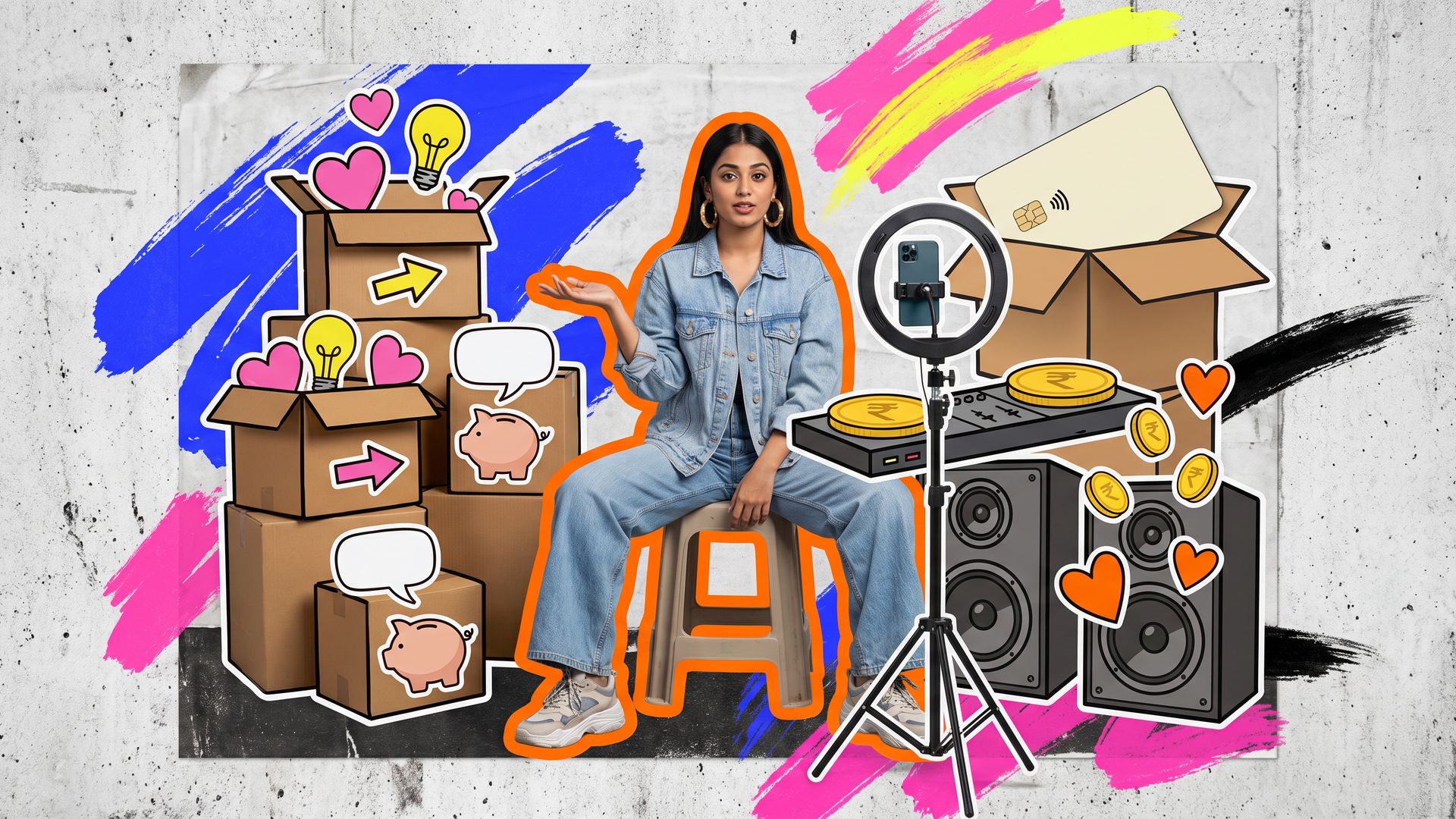
A product marketing lead at an Indian digital lender opens Chime’s creator videos in a Monday review. In each one a creator explains a money habit in under a minute, and the product turns up late, almost in passing. Then she opens Chime’s website, where the pages carry a line saying Chime is a financial technology company, not a bank. The compliance head leans in and asks the only question that matters for a regulated brand: who decided that line, and why is it there? That line is the story. Chime built one of the loudest social presences in American finance by teaching first and selling second, and every piece of that teaching still carried a regulator’s fingerprints.
- What did Chime run on TikTok, and when?
- Why did education-first content work for a US challenger bank?
- Who made Chime’s TikTok content?
- What regulator-driven design decisions sit inside Chime’s content?
- Where did Chime’s education-first model stop working?
- What should an Indian bank, insurer or fund take from Chime’s TikTok playbook?
- How would you build an education-first series for an Indian regulated brand?
- People also ask
What did Chime run on TikTok, and when?
Chime did not run one campaign. It ran a steady stream of creator videos and tentpole moments, most of them hung on one idea: money feels intimidating, so make it less so. The table below lists what can be dated from Chime’s own newsroom, its awards entries, its annual report and regulator records. Where a source does not say something, the table does not either.
| When | What happened | Why it matters for the content |
|---|---|---|
| 29 June 2020 | The Government of India blocks TikTok along with 58 other apps. | Chime’s playbook cannot be copied platform for platform in India. |
| 2021 | California’s financial regulator settles with Chime, which agrees to stop using chimebank.com and to clarify, in bold or larger type near banking references, that it provides technology and services to partner banks. | Creates the “not a bank” line that follows the brand into every channel. |
| February 2024 | The same regulator orders a $2.5 million penalty over how Chime handled complaints between January and March 2021. | The feed promised support; the complaint queue had to deliver it. |
| April 2024 | Chime renames Financial Literacy Month as Financial Progress Month. T-Pain and Tiffany Aliche, The Budgetnista, teach a Financial Progress 101 college class. | Education becomes a branded, repeatable tentpole. |
| May 2024 | The US consumer finance regulator orders a $3.25 million penalty and at least $1.3 million in redress for slow refunds on closed accounts. | A reputational cost that no video can offset. |
| 2024 | Chime reports 37 creator partnerships, 764M+ social views and an 87% rise in social engagement; it wins a Bronze Honor for Brand Voice at the 17th Shorty Awards. | The education-first voice is recognised by the industry. |
| April 2025 | The “You’re Making It” TV spot features Deion Sanders, Kai Cenat and Becky Lynch; Chime says it is working with major creators to bring FinTok trends such as loud budgeting and girl math to life. | Social trends move into paid television. |
| December 2025 | Chime publishes FinTok Wrapped 2025, a Talker Research survey of 2,000 Americans; 59% say they tried a money-saving trend. | The brand positions itself as the narrator of money TikTok. |
| May 2026 | The Financial Progress Month 2026 recap centres on schools, universities, community work and policy events, and does not mention TikTok or creator content. | The education push widens beyond the feed. |
Two notes on reading this table. The view and engagement figures come from Chime’s own awards entry, not from an independent audit. And Chime’s annual report for 2025 describes its marketing only in general terms, as social media engagement, product-led marketing, data-driven acquisition and member referrals, alongside 9.5 million active members at the end of 2025. No public source ties a member number to TikTok alone.
SIGNALNewsletter by Yamm Labs
The next piece, straight to your inbox.
New writing on BFSI brands, B2B and influencer marketing, and AI search.
One click to unsubscribe. Privacy policy

Why did education-first content work for a US challenger bank?
Chime’s own awards entry describes its audience as everyday people, many of whom live paycheck to paycheck. For that audience, a brand that explains things earns a hearing that a brand that advertises does not.
Chime’s awards entry states the objective in plain terms: make personal finance less intimidating for members and the target audience. It sets rules for the voice too. No corporate jargon, no stock-image speak, no complex financial terms that are not needed. Those are writing rules, and they are the part most banks skip.
- Teach the concept, then show the tool. A creator explains budgeting, saving or credit building. The product appears as one way to act on the lesson, not as the headline.
- Borrow the creator’s trust, not just the reach. Multi-year relationships, such as those Chime describes with Kai Cenat and Marshawn Lynch, let a face become familiar with the brand over time.
- Tie the feed to a moment. Renaming Financial Literacy Month gave Chime a calendar slot it could own every April and a reason for press, events and creators to line up.
- Speak to subcultures. Sports, music and fashion partnerships, such as the WNBA-led Ball on A Budget series, carried money lessons into places where bank ads are ignored.
- Report the culture back. FinTok Wrapped turns the platform’s own money trends into a survey story, which keeps Chime in the conversation even when it is not posting.
None of this needed a new product. It needed a point of view about who the customer is and what they are tired of hearing.
Who made Chime’s TikTok content?
No single agency made it, at least not on the public record. Chime’s 2024 Shorty Awards entry credits a long list of partners, including AKQA, Excel Sports Management, SLAM, Fresh Tape Media, Dinner Party, The Infinite Agency, PanOptica, Vox and The Art of Storytelling. The entry does not say which partner made which piece. Any article that names one agency as the author of Chime’s TikTok strategy is guessing.
What the record does show is a model where the brand owns the voice and the calendar, while creators, sports agencies and production partners each carry a slice. That model suits a regulated brand, because the brand keeps the one job that cannot be outsourced: deciding what can be said.
What regulator-driven design decisions sit inside Chime’s content?
Competitors call their work compliance-aware and leave it there. Chime’s content shows the actual decisions, because regulators forced them into the open.
- The “not a bank” lockup. After the 2021 California settlement, Chime had to make clear, in bold or larger type near banking references, that it is a technology company working with partner banks. Today its pages carry the line that Chime is a financial technology company, not a bank, with banking services provided by The Bancorp Bank, N.A. or Stride Bank, N.A., Members FDIC. That line is a fixed block. Designers work around it; they do not negotiate it.
- Disclosure inside the video. The US Federal Trade Commission’s guidance for influencers says a paid relationship should be disclosed in the video itself, not only in the description, and in simple words such as ad or sponsored. For a creator series, that sets the first-frame layout before the script is written.
- Education that stops short of advice. A creator brief for a money brand has to separate explaining from recommending. The creator shows how something works and leaves the decision with the viewer, which changes the script long before it changes the caption.
- Sourced numbers in the story. Chime’s FinTok Wrapped 2025 post names the pollster, sample size and fieldwork dates behind its survey claims. A survey number without a source is a claim a regulator can ask you to prove.
Each of these is a layout or script decision with a rule behind it. That is what a regulated brand should ask an agency to show.
Where did Chime’s education-first model stop working?
A feed can teach people to trust a brand faster than the brand’s operations can earn it. Chime’s own record shows the gap.
In February 2024, California’s regulator ordered a $2.5 million penalty over complaint handling in early 2021. In May 2024, the US consumer finance regulator found that Chime failed to refund balances on closed accounts within the 14 days its policy promised, including thousands of cases that ran past 90 days, and ordered a $3.25 million penalty plus at least $1.3 million in redress. Content that says we understand your money stress lands badly when a viewer is waiting weeks for their own money.
There is a second limit. Chime’s FinTok Wrapped 2025 survey reports that 75% of respondents rely on FinTok for financial advice. For a brand, that is reach. For a regulator, it is the exact risk that finfluencer rules exist to manage. The more a brand leans on creators to explain money, the more it owns what those creators say.
The third limit is the platform itself. India blocked TikTok in June 2020. A strategy that lives on one app is one government order away from starting over. Chime’s 2026 Financial Progress Month recap reads like a brand that has noticed: it spends its words on schools, universities, community programmes and policy rooms rather than the feed.
What should an Indian bank, insurer or fund take from Chime’s TikTok playbook?
Keep the teaching model. Change the platform and build the disclosures in first. In India the same format runs on Instagram Reels and YouTube Shorts, and the rules are tighter. We compared app quality with social presence in why great neobank apps still have forgettable Instagram, and the gap Chime closed is the same one most Indian fintechs still have.
- Time the ad label to the video length. The ASCI influencer guidelines ask for the label to stay at least three seconds on a video of 15 seconds or less, for a third of the running time on videos up to two minutes, and for the whole promoted section on longer videos. Put the label in the edit template, not in the caption.
- Put the creator’s credentials on screen. ASCI expects influencers talking about investments to show their SEBI registration with their name and qualifications, and others giving financial advice to hold suitable qualifications such as an IRDAI insurance licence or a CA. The credential sits in the opening frame, superimposed and upfront.
- Vet the creator before the brief. SEBI’s October 2024 circular bars SEBI-regulated entities from associating with unregistered persons who give securities advice or claim returns. Investor education without advice or return claims is allowed. For a fund house or broker, the creator list is a compliance document.
- Lock the insurer’s name block. IRDAI’s current policyholder protection regulations require an insurer’s ads to show its registered name alongside its trade name or logo prominently, and ads issued by distribution channels need the insurer’s written approval first.
- Give the fund warning its five seconds. SEBI’s standard mutual fund warning has to be displayed and voiced for five seconds in audio-visual ads. In a 30-second Reel, that is a sixth of the running time, so plan it into the storyboard.
- Explain the loan, then show the Key Facts Statement. RBI requires lenders to give a Key Facts Statement, including the annual percentage rate, before a retail or MSME term loan contract is executed. A lending explainer that teaches what APR means is education the regulator already wants.
Our clients include TATA AIA Life Insurance, HDFC Life, Axis Bank, Paytm Money and Aditya Birla Sun Life Mutual Fund. The pattern on every regulated brief is the same one Chime shows: the brand that decides the fixed blocks first gets to be playful everywhere else.
How would you build an education-first series for an Indian regulated brand?
Start with the screen sequence, not the script. A 30-second explainer for an Indian bank, insurer or fund can follow a fixed order that every creator and editor works from.
- Frame one: the question and the label. The viewer’s problem as a question, the ad label and, for a creator, their credential on screen from the first second.
- The middle: the concept. One idea, explained with a rupee example the viewer recognises, such as an EMI, a premium due date or a SIP instalment. No product claims yet.
- The turn: the tool. The product appears as one way to act on the lesson, in a single line that compliance has already approved.
- The end card: the lockup. Registered name, trade name or logo, and any mandatory warning, timed to its rule. This card is built once and reused.
The budget follows the sequence. When the fixed blocks are designed once and approved once, each new episode needs one review round for the script, not three for the edit. For more on how finance teams handle creators, approvals and posting rhythm, see our finance social media questions answered.
Teach first, sell second, and design the disclosure before the joke.
People also ask
Is Chime a bank?
No. Chime describes itself as a financial technology company, not a bank, with banking services provided by The Bancorp Bank, N.A. or Stride Bank, N.A., Members FDIC. A 2021 California settlement required it to make that clear near banking references.
What made Chime’s TikTok content different from other banks?
It taught before it sold. Creators explained budgeting, saving and credit building in plain language. The product appeared as one way to act on the lesson, not as the headline.
Can an Indian bank or fund copy Chime’s TikTok strategy?
It can copy the teaching model on Instagram Reels and YouTube Shorts, since TikTok has been blocked in India since June 2020. It must add ASCI ad labels, creator credentials and the warnings that SEBI, IRDAI or RBI rules require for its category.
Which agency ran Chime’s TikTok?
No public source names one. Chime’s 2024 Shorty Awards entry credits several partners, including AKQA, Fresh Tape Media and The Infinite Agency, without saying which made which piece.
Want your finance content to teach, sell and clear compliance in one pass?
Get a free Fintech Brand Audit across 8 dimensions, plus 3 fixes. No pitch. Run the free Brand Audit →