

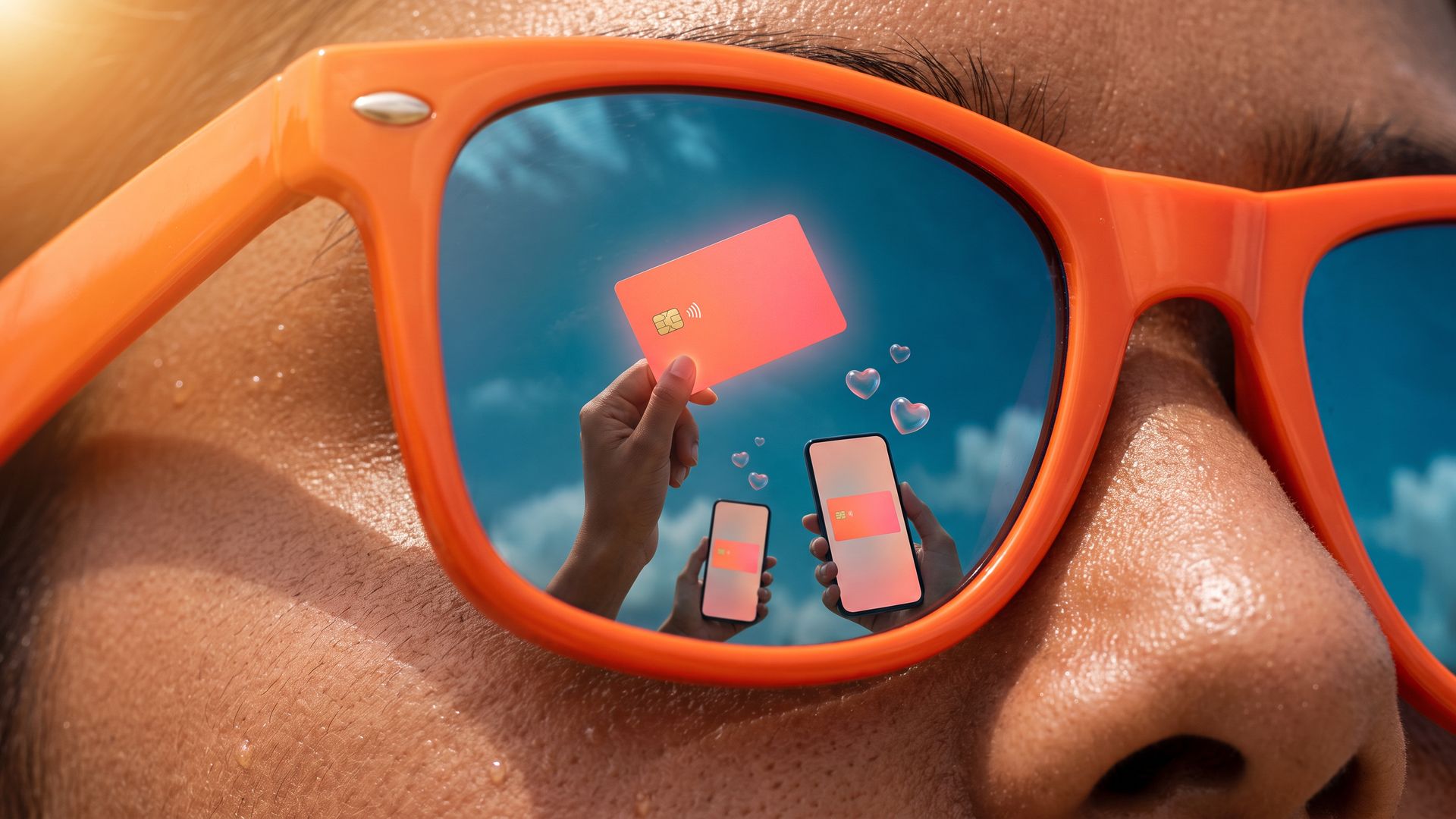
A customer at a London shop counter hands over a debit card. It is not navy, silver or black. It is a loud pink-orange, and the person behind the till asks what bank that is. The customer explains, the cashier asks how to join, and a bank that had no branches and almost no media budget has just run an advert that cost it nothing.
Monzo’s co-founder later wrote that the colour of the card alone often started that conversation. For any bank, NBFC or fintech brand deciding what its card, app icon or policy kit should look like, that exchange at the till is the lesson: the product people carry can do the work a campaign is usually paid to do.
- What was the Monzo hot coral card, and when did it run?
- Who designed the hot coral card, and who made the later identity?
- Why did a coloured debit card work as advertising?
- How did Monzo’s community turn customers into its marketing team?
- Where did the hot coral strategy stop working?
- Can an Indian fintech own a card colour the way Monzo did?
- What should an Indian bank, insurer or AMC take from Monzo today?
- People also ask
What was the Monzo hot coral card, and when did it run?
The hot coral card began as a beta prepaid card for Monzo’s first customers, when the company still traded as Mondo. Monzo’s own account of how a card is made says the team tested a range of neon inks, and a group of friends and early investors picked hot coral, a pink-orange blend that glows under ultraviolet light. The card was never replaced. It survived a change of name, the move from prepaid card to full current account, and a 2022 refresh of the whole identity. The table below sets out the dates that the bank, the UK regulator and the press have published.
| When | What happened | Why it matters for the card |
|---|---|---|
| 2015 | About 3,000 alpha cardholders, according to the co-founder’s account of Monzo’s growth | The first coloured cards reach a small group of testers |
| November 2015 | The Monzo community forum opens | Early customers get a public place to talk about the product and the card |
| 2016 | £1 million raised on Crowdcube in 96 seconds, from just under 2,000 investors | Customers become shareholders, and the raise itself becomes news |
| March 2016 | A waiting list is added because the team is posting every card itself and cannot keep up | Scarcity makes the card something people ask for |
| 11 August 2016 | Monzo announces a banking licence with restrictions; about 30,000 prepaid cards are in active circulation | The coloured prepaid card is still the whole product |
| 25 August 2016 | Mondo becomes Monzo after a public call for names that drew over 4,500 unique ideas from over 9,000 people | The name changes, the card and the logo initial stay |
| 2016 to 2017 | About 70,000 beta cardholders in 2016 and about 650,000 users in 2017 | The card spreads through wallets rather than through media |
| 5 April 2017 | Banking licence restrictions are lifted and Monzo becomes a fully authorised bank | Customers move from the prepaid card to a Monzo debit card |
| 2017 | About 40 percent of sign-ups come from Golden Tickets, one referral invite per active user | Every coral card in a wallet now comes with an invite to hand out |
| April 2018 to 2019 | An application to register hot coral as a single-colour trade mark for debit cards is filed at the UK IPO and later withdrawn | Owning the colour in use turns out to be easier than owning it in law |
| 24 May 2018 | The waiting list ends; new customers get their card the next day | The scarcity engine switches off |
| October 2018 to June 2022 | The period the UK Financial Conduct Authority later found Monzo’s financial crime controls and account-opening restrictions were not met | Fast, low-friction sign-up has a compliance cost |
| 17 October 2022 | A visual identity refresh with the design agency Ragged Edge adds secondary colours and new type, and keeps hot coral as the primary colour | The card is treated as the fixed point of the brand |
| 8 July 2025 | The FCA fines Monzo £21,091,300 for financial crime control failings | The growth story gets a regulatory footnote |
Who designed the hot coral card, and who made the later identity?
No agency is publicly credited with the original card colour. Monzo’s account describes an in-house design team working to a deadline, testing neon inks and letting friends and early investors choose. Other retellings add a story about a designer’s trainers; we stick to Monzo’s own account.
SIGNALNewsletter by Yamm Labs
The next piece, straight to your inbox.
New writing on BFSI brands, B2B and influencer marketing, and AI search.
One click to unsubscribe. Privacy policy

The later identity is documented. In October 2022 Monzo published a post on its refreshed brand and named Ragged Edge as the design agency it worked with. The refresh added secondary colours, a new hero typeface and a custom Monzo Sans, warmer photography and a new illustration style, and it said plainly that hot coral stays at the front of the brand, followed by deep navy and soft white. The bank’s own line was that it is the bank with the hot coral card, and that this is what keeps it distinctive. At the time, Monzo said it had 2,400 employees and 6 million customers.
The useful point for a brand team is the order of decisions. The card came first and the identity system was later built around it, not the other way round.
Why did a coloured debit card work as advertising?
A debit card is the one piece of a bank that customers show strangers. Monzo used that in five ways, and each one fed the next.
- A colour nobody else owned. A single flat pink-orange looked unlike the cards customers were used to seeing at a till, and the co-founder wrote that the colour alone often started a conversation.
- A public moment, many times a day. A television spot runs when the media plan says so. A card is seen every time a customer pays for coffee, splits a bill or taps in on a bus. The exposure scales with use, not with spend.
- Scarcity that made the card a status object. From March 2016 to May 2018, joining meant a waiting list. A card someone could not simply order is a card people notice and ask about.
- A way to answer the question at the till. Golden Tickets let an active customer skip a friend past the queue. The co-founder put their share of 2017 sign-ups at about 40 percent and said the mechanic cost the company nothing.
- A product that held up after the conversation. The co-founder also reported that users who joined with three or more friends already on Monzo retained at about 70 percent at day 90, against about 50 percent without friends. The card got people in; the app and the network kept them.
None of these five would have done much alone. A coloured card with no waiting list is a design choice. A waiting list with a grey card is an inconvenience. Together they made the product itself the most visible advert the bank had, and the co-founder wrote that Monzo reached a million customers without spending any significant money on marketing.
A card is the only advert a bank’s customers carry for free and show to strangers every day.
How did Monzo’s community turn customers into its marketing team?
The card got attention. The community gave people something to do with it. Monzo’s forum opened in November 2015, and by June 2016 the bank reported more than 2,500 members, around 250 daily visitors and more than 4,500 posts. A member’s suggestion led the bank to publish its product roadmap in public. The bank also described fixing a bug reported on the forum within a couple of days.
The name change showed how far that went. When a legal challenge to the Mondo trade mark made a new name necessary, the bank asked customers for ideas that kept the M. It reported more than 4,500 unique suggestions from over 9,000 people. Monzo was among them, and the people who suggested it were promised the first Monzo cards printed. The card was the reward for taking part.
Crowdfunding did the same thing with money. Raising £1 million in 96 seconds from just under 2,000 investors turned some of the most vocal customers into part-owners. Later press coverage quoted an early investor recalling that demand crashed the crowdfunding platform. That, too, was advertising the bank did not pay for.
Where did the hot coral strategy stop working?
Three limits showed up, and each is worth planning for.
The first was legal. In April 2018 Monzo applied at the UK Intellectual Property Office to register hot coral, described by a Pantone reference, as a single-colour trade mark for debit cards. A trade mark law firm reported in November 2019 that the application was withdrawn, apparently after a parallel application in the EU was refused, and that a single colour has to acquire distinctiveness through use before an office accepts it as a badge of origin. Monzo could own the colour in customers’ minds. It could not, at that stage, stop a rival printing a similar card.
The second was scarcity. In May 2018 Monzo ended the waiting list and began sending cards the next day. That was right for customers, but it retired the mechanic that made the card feel special. Golden Tickets stayed as a referral tool, and the card had to carry the brand on colour alone.
The third was control. The FCA’s final notice, announced in July 2025, found that Monzo’s anti-financial crime systems were inadequate between October 2018 and August 2020, and that between August 2020 and June 2022 it repeatedly breached a requirement not to open accounts for high-risk customers. The regulator said the bank’s customer numbers grew from about 600,000 in 2018 to over 5.8 million by 2022, and that its controls failed to keep pace. It cited customers using well-known London landmarks as their address. The fine was £21,091,300 after a 30 percent settlement discount.
None of this means the card failed. It means a product-led brand can grow faster than the business behind it, and word of mouth still sends every new customer through onboarding.
Can an Indian fintech own a card colour the way Monzo did?
It can own the colour. It cannot own a co-branded card on its own. When an Indian fintech offers a card through a partner bank or a licensed issuer, the RBI’s Master Direction on credit and debit card issuance sets the rules for co-branded cards, including co-branded debit and prepaid cards issued by banks. The direction requires a co-branded card to say it has been issued under a co-branding arrangement, to prominently bear the branding of the card-issuer, and to show the card-issuer’s name clearly in all marketing and advertising material. It also says the co-branding partner cannot market the card as its own product.
That rule turns into specific design decisions on the card face and in every advert:
- Lockup first, colour second. Reserve a fixed zone on the card front for the issuing bank’s mark and the co-branding line before choosing the colour field. The colour must work with a second logo on it, which rules out some shades a fintech might pick if it were alone.
- Issuer name in every frame that sells the card. In a 15-second film, a static post or an app banner that promotes the card, the issuer’s name has to be clearly shown. Build it into the end card and the banner template, not into a line the editor can drop.
- No card mailers as a growth trick. The same direction prohibits issuing unsolicited cards. Monzo’s queue worked because people asked. An Indian brand’s version of scarcity has to be an invitation the customer requests, never a card sent unasked.
For how these card rules sit next to the SEBI and IRDAI advertising codes, see our guide to SEBI, IRDAI and RBI advertising rules for creative teams.
What should an Indian bank, insurer or AMC take from Monzo today?
The transferable idea is not the colour. It is choosing one physical or on-screen object the customer handles often, making it unmistakable, and then designing the regulatory elements into it from the first sketch.
- Pick the object. For a bank it is the card and the app icon. For an insurer it may be the policy kit or the claims message. For a mutual fund it may be the SIP confirmation screen or the monthly statement. Choose one.
- Make it distinctive in the category, not in general. Hot coral worked because it looked unlike the cards around it. Look at what every competitor in your category carries before choosing a colour or a shape.
- Put the rule into the template. An insurer’s advertising has to show its registered name alongside its trade name or logo prominently under the IRDAI regulations that now govern policyholder protection and advertising; our IRDAI designer’s checklist shows where that lockup goes. A mutual fund film has to display and voice the standard warning for five seconds, so the edit needs a five-second end card from day one.
- Give early customers something to do. A forum, a named beta, a feedback loop the team answers in public. Monzo’s community did its naming, its bug-finding and part of its fundraising.
- Plan for the moment scarcity ends. Invitation mechanics stop working when anyone can join. Decide in advance what carries the brand after that.
- Scale controls with the growth. A product that sells itself sends more people through onboarding than a campaign would. The FCA’s findings against Monzo are the reminder.
Answers to common compliance questions on referral and card advertising sit in our BFSI marketing compliance FAQ.
People also ask
Why is the Monzo card hot coral?
Monzo’s own account says its design team tested several neon inks and a group of friends and early investors chose hot coral, a pink-orange blend that glows under ultraviolet light. The bank later said hot coral stands for its warmth, empathy and human quality. It kept the colour through its 2016 renaming and its 2022 identity refresh.
Did Monzo trademark the hot coral colour?
Monzo applied at the UK Intellectual Property Office in April 2018 to register hot coral as a single-colour mark for debit cards. A trade mark law firm reported in November 2019 that the application was withdrawn, apparently after a parallel EU application was refused. A single colour generally has to acquire distinctiveness through use before it can be registered.
How did Monzo grow without much advertising?
Monzo’s co-founder wrote that the bank reached a million customers without spending any significant money on marketing. Growth came from the visible card, a waiting list, Golden Ticket referrals that he put at about 40 percent of 2017 sign-ups, an active customer forum and crowdfunding that made customers part-owners.
Can an Indian fintech put only its own brand on a co-branded card?
No. The RBI’s card directions require a co-branded card to prominently bear the card-issuer’s branding and to indicate that it is issued under a co-branding arrangement. The issuer’s name must also be clearly shown in all marketing and advertising material, so the lockup has to be designed in from the start.
Sources
- Monzo: From desktop design to your doorstep, a Monzo card’s journey
- Tom Blomfield: Monzo Growth
- Monzo: Ask us anything, join the conversation
- Tech.eu: I had never heard of it, says investor in Monzo’s first-ever crowdfunding campaign in 2016
- Monzo: There’s no longer a waiting list to join Monzo
- Monzo: We Are Now a Bank
Is your card, app icon or policy kit doing the advertising, or just carrying the logo?
Get a free Fintech Brand Audit across 8 dimensions, plus 3 fixes. No pitch. Run the free Brand Audit →