


The marketing head of a mid-size NBFC has three agency decks open side by side. All three promise a bold, trustworthy, compliance-aware brand. Then her compliance head asks one question: where does the lender’s name sit on the loan offer screen when the loan is sold through a partner app? None of the decks has an answer. That question, not the moodboard, is how you choose.
- What should an NBFC look for in a branding agency?
- Which RBI rules change how an NBFC brand is designed?
- What regulator-driven design decision should the agency show you?
- How long does NBFC branding take, and what drives the budget?
- How do you make the final choice between agencies?
- A step-by-step way to choose a branding agency for NBFCs
- Worked example: scoring two pitch answers
- Common mistakes when choosing a branding agency for NBFCs
- How to brief the shortlisted agencies
- People also ask
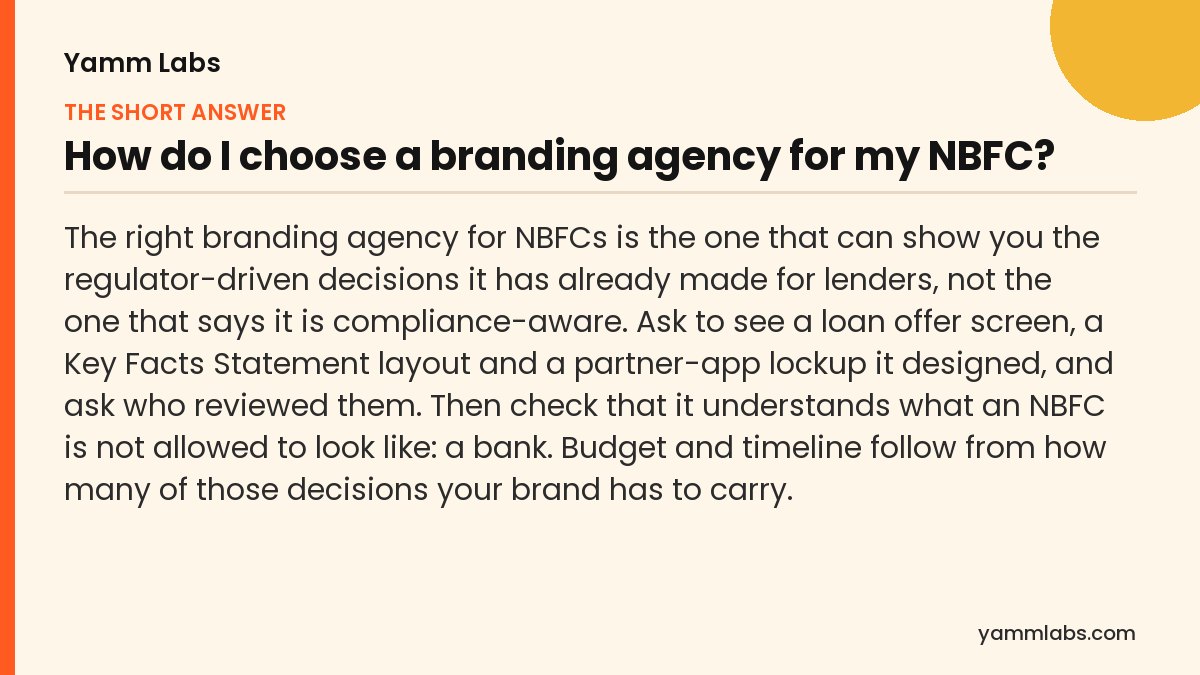
What should an NBFC look for in a branding agency?
An NBFC brand lives in places a consumer brand never visits: the sanction letter, the loan app, the collection SMS, the co-lending partner’s checkout page. A good agency designs for those places first and the billboard last. Four things separate the agencies that can do this from the ones that cannot.
- Lending touchpoints in the portfolio. Look for loan journeys, statements and app screens, not only logos and campaign films.
- A named decision, not an adjective. Ask for one specific trade-off they made between a regulatory element and the design idea, and how it was resolved.
- Compliance in the room early. The agency should ask to meet your compliance and legal team in week one, not at final artwork.
- Vernacular capability. Your borrowers may read Hindi, Tamil or Marathi first. The type system has to work in every script your documents use.
| Question to ask the agency | A strong answer | A red flag |
|---|---|---|
| Where does our NBFC’s name go on a partner app’s loan offer? | Shows a lockup rule and a screen it has designed | Talks about brand consistency in general |
| How will the Key Facts Statement look? | Shows a legible, standard layout inside the brand system | Treats it as a legal document outside its scope |
| How do we avoid looking like a bank? | Names the cues it removes and why | Suggests borrowing a bank’s visual language for trust |
| How many compliance review rounds do you plan for? | Puts them in the timeline on day one | Has no answer until you ask twice |
An NBFC brand is judged on the loan offer screen, not on the billboard.
Which RBI rules change how an NBFC brand is designed?
RBI’s lending rules say little about how a logo looks. They do set rules about what a borrower must see, and every one of them takes space on a screen or a page. An agency that knows them designs around them from the start.
- The Key Facts Statement. RBI requires NBFCs, like banks, to give prospective borrowers a Key Facts Statement in a standardised format before the loan contract is signed. It must show the annual percentage rate including all charges, and be in a language the borrower understands.
- Naming the lender in digital lending. RBI’s Digital Lending Directions of 2025 require a lending service provider’s app that shows offers from several lenders to name the lender behind each offer, and the grievance redressal officer’s contact details to be displayed prominently on the lender’s website, the partner’s website and the app.
- No dark patterns. The same directions bar content that pushes one lender’s product through deceptive design, and require offers from several lenders to be shown so a borrower can compare them fairly.
- An NBFC is not a bank. RBI’s own FAQ notes that NBFCs cannot accept demand deposits or issue cheques drawn on themselves, and that deposit insurance is not available to their depositors. The brand should never imply otherwise.
For the wider set of questions lenders ask about this, our fintech and BFSI branding FAQ holds the short answers.
SIGNALNewsletter by Yamm Labs
The next piece, straight to your inbox.
New writing on BFSI brands, B2B and influencer marketing, and AI search.
One click to unsubscribe. Privacy policy

What regulator-driven design decision should the agency show you?
Ask for one worked example. Here is the kind of decision a strong agency will talk you through without being prompted.
The partner-app lockup rule. Your NBFC lends through a consumer app with a far bigger brand than yours. The app wants its name large and yours small. The rule we set: on every loan offer and sanction screen, the NBFC’s name sits in a fixed block beside the offer, at a minimum size that stays readable on a small phone, with the partner’s brand above it. The block is defined in the brand guidelines, so the partner’s design team cannot shrink it later.
The screen sequence. The offer screen shows amount, tenor, APR, monthly repayment and penal charges together, in one type size. The Key Facts Statement follows before the borrower accepts, not after. The grievance contact lives in the footer of every screen in the journey, and in the help menu too.
The trust cues. No vault imagery, no pillars, no copy that hints at deposit safety. Trust comes from clarity: plain numbers, readable type, the lender’s name where the borrower expects it.
How long does NBFC branding take, and what drives the budget?
We will not quote a universal figure, because scope decides it. The budget is driven by how many touchpoint families the brand has to cover: identity, loan app and partner journeys, documents such as the Key Facts Statement and sanction letter, branch and field material, and vernacular versions of each. The timeline is driven by review rounds. Plan at least one compliance review for each touchpoint family, and put those rounds in the schedule on day one. An agency that leaves them out has quoted you for the easy half of the job.
How do you make the final choice between agencies?
Put the table above in front of each shortlisted agency in the pitch meeting. Score the answers, not the deck. Then ask each one to redesign a single screen from your current loan journey, with your compliance head in the review. The agency whose screen passes compliance review with the fewest changes, and still looks like your brand, is the one to hire. If you want to see how we approach this work, our page on fintech branding in India sets out the scope, and our bank branding questions cover where banks and NBFCs differ.
A step-by-step way to choose a branding agency for NBFCs
The process below fits a lender with a small marketing team and a busy compliance desk. It keeps the pitch short and moves the real test to your own screens.
- List your touchpoint families. Identity, loan app, partner journeys, the Key Facts Statement and sanction letter, collection messages, branch and field material. Note which languages each one needs.
- Name your compliance reviewer. Decide who signs off each family and how many working days a review takes. The agency will plan around this.
- Send the four questions in advance. Share the question table from this article before the pitch, so each agency comes ready to show work rather than talk.
- Ask for lending work only. Request loan screens, statements and partner lockups. Campaign films and logos can wait for the second meeting.
- Score answers, not decks. Give each answer a simple strong, partial or weak mark against the table, with a line of evidence for each mark.
- Run the one-screen test. Ask the top two agencies to redesign one screen from your current loan journey, with your compliance head in the review.
- Check the contract. Confirm that review rounds are listed per touchpoint family and that your organisation owns the source files and font licences at the end.
Seven steps sound like a lot. In practice the first four take a day of internal work, and the test screen saves weeks of rework later.
Worked example: scoring two pitch answers
Here is how the scoring works on the first question in the table: where does our NBFC’s name go on a partner app’s loan offer? This is an illustration of the method, not a record of a real pitch.
Agency A says the brand will be applied consistently across all partner environments and that it will work with the partner’s team to agree placement. It is a reasonable sentence and it is a weak answer, because it names no rule and shows no screen. Your NBFC’s name could still end up in grey eight-point type under the partner’s logo.
Agency B opens a loan offer screen it has designed. The lender’s name sits in a fixed block beside the offer, with a minimum size set in the guidelines, and the grievance contact sits in the footer. It explains that the block is defined as a rule so a partner’s design team cannot shrink it. That is a strong answer. It shows the decision, the rule behind it and how the rule is protected after handover.
Repeat the same scoring for the Key Facts Statement, the bank-look question and the review rounds. The agency with the most strong marks goes to the one-screen test.
Keep the marks and the evidence lines in one sheet. When the final choice is made, that sheet is the record of why, and it helps the next marketing head brief the same agency without starting again. It also gives compliance a view of which agency understood the rules before any fee was agreed.
Common mistakes when choosing a branding agency for NBFCs
These are the choices that look sensible in a pitch room and cost the most once the work starts.
- Judging the moodboard first. A beautiful identity that cannot hold the lender’s name block, the APR and the grievance contact on a small phone will be rebuilt by compliance.
- Leaving compliance out of the pitch. If your compliance head meets the agency at final artwork, every regulatory element becomes a late change.
- Borrowing bank cues for trust. Vaults, pillars and deposit-style reassurance imply something an NBFC is not. Clarity on the loan screen builds trust without the confusion.
- Treating documents as out of scope. The Key Facts Statement and sanction letter are where borrowers read the numbers. If the agency will not design them inside the brand system, someone less careful will.
- Ignoring vernacular early. A typeface chosen for English alone may fail in Hindi, Tamil or Marathi. Test every script your documents use before the identity is signed off.
- Comparing quotes without review rounds. A lower fee with no compliance rounds listed is not a lower price. It is a different, smaller job.
How to brief the shortlisted agencies
Keep the brief to two pages. Page one covers the business: what you lend, to whom, through which partners and in which languages. Page two covers the constraints: the touchpoint families in scope, your compliance reviewer, the review time per round and any fixed launch date.
Attach three things. A screenshot of your current loan offer screen, a current Key Facts Statement and one partner app journey. Ask each agency to come back with its view of those three items, not a general credentials deck. Add a line asking the agency to state the RBI requirements it thinks apply to each screen, and note that your compliance team will confirm the current text. The answers will show you, before any fee is paid, who has done this work before.
People also ask
Does an NBFC need a specialist BFSI branding agency?
It needs an agency that has designed lending journeys under RBI rules, whatever it calls itself. Ask for a loan offer screen and a Key Facts Statement layout it has made. If it cannot show either, it is learning on your budget.
Can an NBFC use a bank-like look to build trust?
It should not. RBI’s FAQ makes clear that NBFCs cannot take demand deposits or issue cheques, and deposit insurance is not available to their depositors. Borrowing a bank’s visual cues invites confusion; clarity on the loan screen builds more trust.
When should compliance join the branding project?
In the first week. The lender’s name block, the Key Facts Statement and the grievance contact all shape the layout. Deciding them before the visual work starts saves review rounds later.
How many agencies should an NBFC shortlist?
Three is usually enough. Fewer gives you no comparison; more turns the pitch into a week of decks and leaves no time for the one-screen test. Send the same brief and the same four questions to each, so the answers can be scored side by side. The one-screen test then goes to the top two only.
Should an NBFC choose a large agency or a small studio?
Size matters less than lending experience. A large agency may bring more hands for campaigns; a small studio may put senior people on every screen. Ask who will work on your loan journey day to day, and ask to see that person’s lending work. The name on the pitch deck does not design your Key Facts Statement.
What should an NBFC branding contract include?
List every touchpoint family in scope, the number of compliance review rounds for each and the price of an extra round. State that your organisation owns the final source files and that font licences cover your use. Add the handover: a brand guideline that includes the lender name block, the disclosure type size and the partner lockup rules.
Can the same agency handle the NBFC’s partner co-branding?
It should, because partner screens are where the lender’s name is most at risk. The agency that sets your lockup rules is best placed to write the partner version. Ask it to produce a short partner kit with the name block, minimum sizes and the grievance contact placement, so a partner’s design team has one clear reference.
Sources
Want to see how your loan journey reads to a borrower and a regulator?
Get a free Fintech Brand Audit across 8 dimensions, plus 3 fixes. No pitch. Run the free Brand Audit →