


A marketing head at a life insurer in Mumbai types the question her customers type: which term plan is best for a 30-year-old in India? ChatGPT answers in four short paragraphs. It names three insurers, quotes a comparison site and never mentions her company, although her own product page answers the question more fully. The page is not wrong. It was built to rank in a list of ten blue links, not to be lifted into a generated answer. That gap is what generative engine optimisation exists to close.
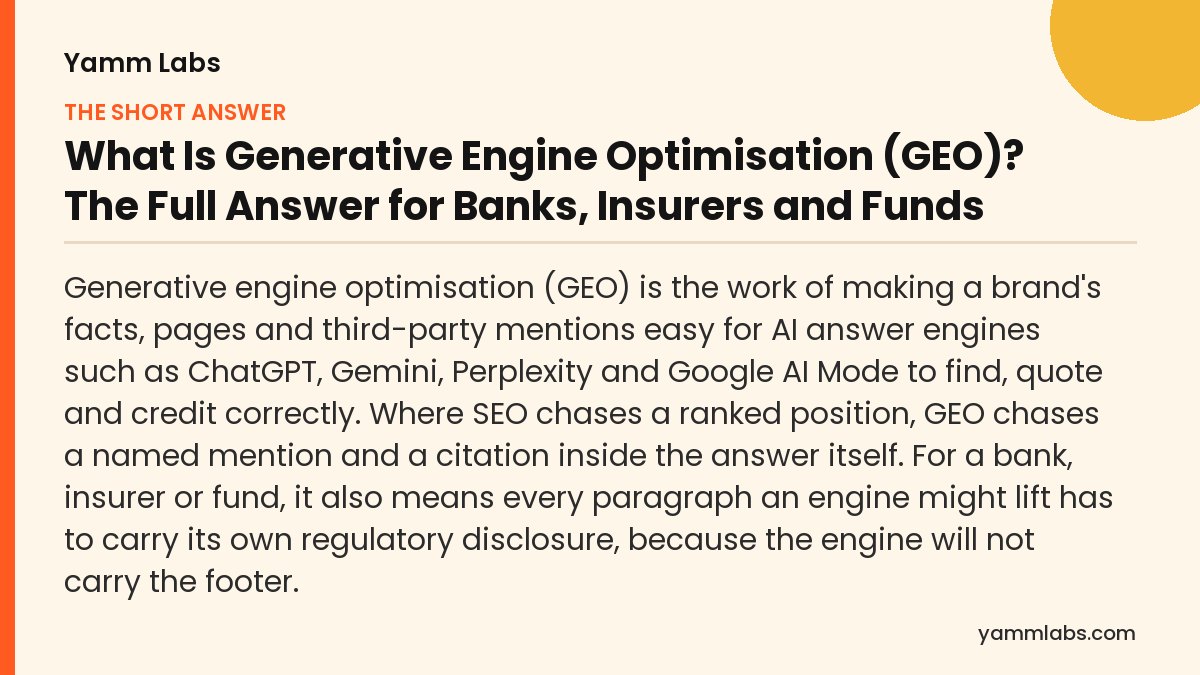
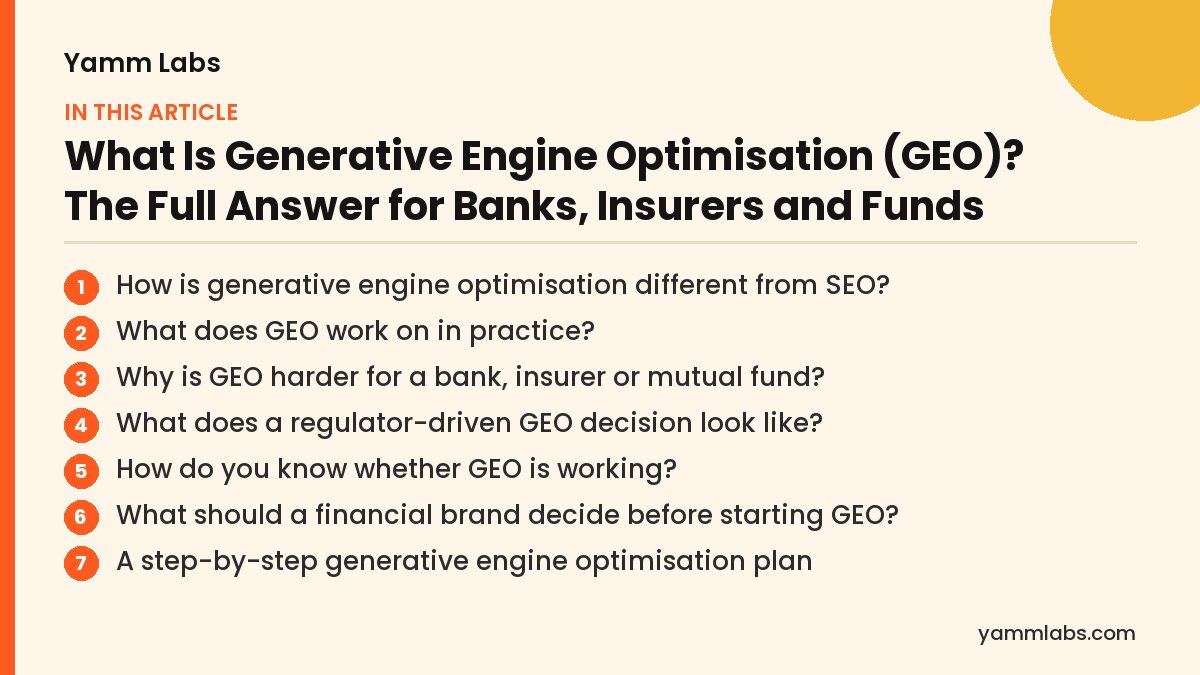
- How is generative engine optimisation different from SEO?
- What does GEO work on in practice?
- Why is GEO harder for a bank, insurer or mutual fund?
- What does a regulator-driven GEO decision look like?
- How do you know whether GEO is working?
- What should a financial brand decide before starting GEO?
- A step-by-step generative engine optimisation plan
- Worked example: rewriting a term plan answer
- What generative engine optimisation cannot do
- Common generative engine optimisation mistakes at regulated brands
- How to brief an agency or team on GEO
- People also ask
How is generative engine optimisation different from SEO?
SEO and GEO share foundations: crawlable pages, clear structure, credible links. The difference is the unit of success. A search results page shows ten links and lets the buyer choose. A generated answer picks a handful of sources, rewrites them into one reply and often names brands without sending a single click. The term was popularised by a research paper first posted in November 2023, titled GEO: Generative Engine Optimization, which framed visibility inside generated responses as its own problem and reported gains of up to 40% in the authors’ tests.
| Question | SEO | GEO |
|---|---|---|
| What counts as a win? | A high position on a results page | Being named, described correctly and cited in the answer |
| What does the engine read? | The whole page and its links | The one passage it can lift and attribute |
| Who else shapes the result? | Competing pages for the same keyword | Directories, press, review sites and forums the engine trusts |
| How is it measured? | Rank and clicks | Presence across a fixed set of buyer prompts, re-run over time |
What does GEO work on in practice?
A GEO programme works on three things, in this order. Each one fails without the one before it.
- Entity and technical signals. The engine has to know who you are: one consistent company name, founding facts, registration details and category across your site, schema markup and the directories that describe you.
- Liftable passages. Pages built as one question per section, with the answer in the first sentence and a paragraph that still makes sense when quoted alone.
- Third-party sources. Engines lean on sources they already trust. Accurate listings, press coverage and expert answers elsewhere decide whether you are named or passed over.
Our AI visibility programme for BFSI brands runs these as three 30-day pillars across a 90-day plan, then re-queries every month.
SIGNALNewsletter by Yamm Labs
The next piece, straight to your inbox.
New writing on BFSI brands, B2B and influencer marketing, and AI search.
One click to unsubscribe. Privacy policy

Why is GEO harder for a bank, insurer or mutual fund?
Financial regulators write disclosure rules for the medium the message appears in. SEBI’s standard market-risk warning for mutual fund advertisements has to be shown and spoken for five seconds in an audio-visual ad, and read out over five seconds on radio. IRDAI’s current advertisement rules require an insurer to show its registered name prominently alongside any trade name or logo, and bar advertisements that hide or underplay a policy’s risks or leave out its important exclusions and conditions.
A generated answer is a new medium with no footer. The engine takes one paragraph, trims it and places it next to a competitor’s. Whatever disclosure sat in the page footer or a collapsed accordion is gone. So a regulated brand has to decide, before writing, what each quotable paragraph must contain to stay compliant on its own.
What does a regulator-driven GEO decision look like?
These are the decisions we make on answer pages for regulated brands. None of them is a slogan about being compliance-aware; each one changes the layout.
- Registered name in the first sentence. For an insurer, the answer block opens with the registered company name, not the app brand or a shortened name, so the lifted paragraph identifies the insurer the way IRDAI expects.
- No return figure without the warning beside it. For a fund house, any sentence about scheme performance carries the standard market-risk warning in the same paragraph. If that makes the paragraph clumsy, the performance claim comes off the answer page.
- Exclusions above the fold. Answer pages about a policy put coverage and key exclusions in the same block as the benefit, before any application link.
- Dates on every answer. Rates, charges and rules change. A visible updated date tells the engine and the compliance reviewer which version they are reading.
An AI engine quotes the paragraph, not the page, so the disclosure has to live in the paragraph.
How do you know whether GEO is working?
You measure the answer, not the page. We agree 20 buyer prompts with the client, in the words a buyer would type, and run each one on six engines: ChatGPT, Google Gemini, Perplexity, Google AI Mode including AI Overviews, Microsoft Copilot and Claude. Each result is scored Present if the brand is named and described correctly, Partial if it is named with an error or appears only in a citation, and Absent otherwise. The full matrix is re-run on the first working day of every month. A falling count of Absent and Partial scores is the only result that matters.
What should a financial brand decide before starting GEO?
Three decisions come before any content is written. First, which buyer prompts matter, and which of them your brand can answer within its licence. Second, which existing pages become answer pages, with one question per section and a disclosure in every liftable block. Third, who in compliance signs off answer blocks, and how quickly, because monthly re-runs need monthly fixes. Our GEO and AEO FAQ for financial brands holds the short answers to the questions around this one, and the 100 AI search optimisation questions go deeper on each engine.
A step-by-step generative engine optimisation plan
The three pillars above turn into a working sequence. This is the order we follow for a bank, insurer or fund house, and each step feeds the next.
- Agree the buyer prompts. Write them in the words a buyer types, and remove any your licence does not let you answer.
- Take a baseline. Run every prompt on each engine and score it Present, Partial or Absent before changing anything.
- Fix the entity facts. Make the company name, registration details, category and head office identical on your site, in your schema markup and in the directories that describe you.
- Choose the answer pages. Pick the existing pages that should answer the prompts. Give each prompt one section with the answer in the first sentence.
- Write the disclosure into each passage. Decide what a quotable paragraph must carry to stand alone, and have compliance approve the pattern once before writing many pages.
- Correct third-party sources. Update listings, fix wrong descriptions and supply accurate facts to the directories and press an engine relies on.
- Re-run and repeat. Re-run the same prompts on a fixed day each month and fix what moved the wrong way.
Steps three to six can run in parallel once the baseline exists. Step seven never stops, because engines change what they read and how they answer.
Worked example: rewriting a term plan answer
Return to the life insurer in the opening. Her product page answers the term plan question well, but the answer is spread across a hero banner, a benefits carousel and a downloadable brochure. The engine names three other insurers instead. This is an illustration built from that scenario, not a client result.
The rewrite adds one section headed with the buyer’s question. Its first sentence names the insurer by its registered company name and states who the plan is for. The next sentences give the cover structure and the key exclusions in the same block, before any application link. A small table sets out the plan options in text an engine can read. The page shows a visible updated date.
Compliance reviews that section as a passage on its own, asking one question: if an engine quotes only this paragraph, is it still a fair and complete communication? Once the pattern is approved, the same structure is used across the insurer’s other product pages. The monthly re-run then shows whether the engine starts to name the insurer, and whether it describes the plan correctly.
What generative engine optimisation cannot do
It helps to be plain about the limits before a budget is set. GEO cannot make an engine say something your pages and trusted third parties do not support. It cannot guarantee a mention on a given prompt, because each engine decides what to cite and can change how it answers at any time. It cannot fix a product that buyers or reviewers describe poorly.
It also cannot move a disclosure into an engine’s summary. You control the source paragraph, not the engine’s rewrite. That is why the regulated version of GEO puts the warning inside every quotable paragraph: it raises the chance that a faithful quote carries the qualifier with it.
What GEO can do is remove the reasons an engine passes you over: unclear facts, pages that cannot be quoted, and third-party descriptions that are wrong or missing. For most financial brands, those reasons are the ones that matter.
Common generative engine optimisation mistakes at regulated brands
These are the errors that waste the most time for banks, insurers and funds starting GEO work.
- Starting with content before entity facts. Answer pages cannot help if the engine is unsure which company you are. Fix the name and registration facts first.
- Relying on the footer for disclosures. A lifted paragraph arrives without the footer. Write the disclosure into the paragraph, and confirm the current text with your compliance team.
- Putting return figures in answer blocks. A performance number without its warning in the same paragraph is the version an engine may repeat. Leave it out if the paragraph cannot carry both.
- Measuring with rank and clicks. GEO success is being named and described correctly. Track that directly with a fixed prompt set.
- Changing the prompts every month. A moving prompt set makes results impossible to compare. Fix the list and add new prompts as a separate set.
- Ignoring third-party pages. Engines lean on sources they already trust. A wrong directory listing can outweigh a perfect product page.
How to brief an agency or team on GEO
A useful brief fits on two pages. Give the team your buyer prompts, the products you can and cannot talk about, the pages that should answer each prompt and the engines you care about. Name the compliance reviewer for answer blocks and state how quickly reviews can turn around, because monthly re-runs need monthly fixes.
Ask for three outputs in every report: the prompt-by-engine scores, the before and after text of each rewritten passage, and the list of third-party sources corrected. Ask that each result carries the date it was run. With those three, a marketing head can see progress and a compliance head can see exactly what changed. Keep every report in one shared folder, so the history of each prompt can be read in order.
People also ask
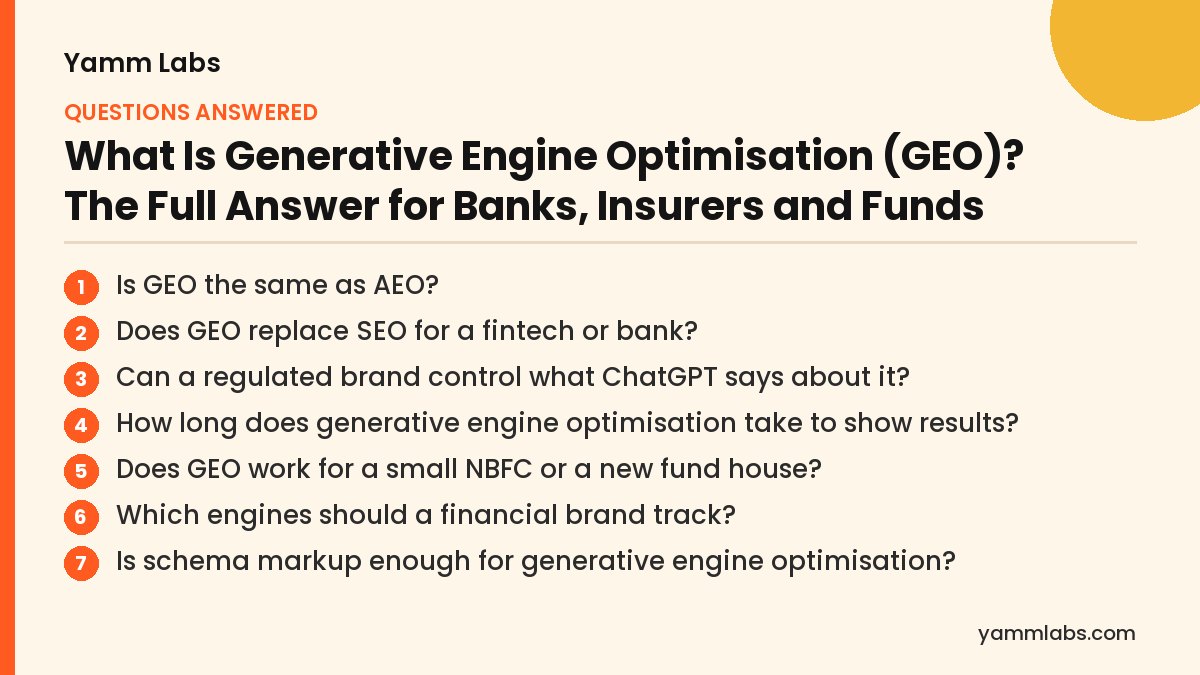
Is GEO the same as AEO?
They overlap. Answer engine optimisation is the content-formatting part: one question per section, the answer first, short self-contained paragraphs. GEO is the wider programme that also covers entity signals and the third-party sources an engine trusts.
Does GEO replace SEO for a fintech or bank?
No. Engines still retrieve from pages that are crawlable, fast and well linked, so weak SEO caps what GEO can do. GEO changes what those pages say and how each passage is built to be quoted.
Can a regulated brand control what ChatGPT says about it?
Not directly. It can control the facts it publishes, how quotable and self-contained they are, and whether trusted third parties repeat them accurately. That is where the disclosure decisions above pay off, because a correct paragraph is the one an engine is most likely to lift whole.
How long does generative engine optimisation take to show results?
It varies by engine and by how much needs fixing, so treat any promised date with care. Entity fixes and page rewrites can be done in weeks; third-party sources take longer to change. What you can control is the cadence: take a baseline, make the fixes and re-run the same prompts every month to see what moved.
Does GEO work for a small NBFC or a new fund house?
Yes, and the entity work matters even more. A newer or smaller brand has fewer third-party mentions, so the engine has less to go on. Consistent facts on your own site and in the main directories, plus clear answer pages for the questions you can answer within your licence, give the engine something accurate to use.
Which engines should a financial brand track?
Track the ones your buyers use. Our standard set covers ChatGPT, Google Gemini, Perplexity, Google AI Mode including AI Overviews, Microsoft Copilot and Claude. Keep the same set every month so the scores stay comparable, and add an engine as a separate line if your buyers start using it.
Is schema markup enough for generative engine optimisation?
No. Schema markup helps engines resolve who you are, which is part of the entity work. It does not make a paragraph quotable or correct a wrong third-party description. Treat it as one input to the first pillar, alongside consistent names and registration facts across your site and the directories that describe you.
Sources
Want to see how your brand reads when an AI engine quotes it?
Get a free Fintech Brand Audit across 8 dimensions, plus 3 fixes. No pitch. Run the free Brand Audit →