


The head of digital at a Mumbai asset management company has two proposals on her desk. One is titled AEO and promises answer-ready pages. The other is titled GEO and promises that ChatGPT and Google AI Mode will name the fund house. Half the line items are the same. Her compliance head reads both and asks one question: which of these pages do I have to approve? The answer to that question is also the difference between GEO and AEO.
- What is the difference between GEO and AEO, side by side?
- What does AEO cover for a bank, insurer or fund house?
- What does GEO add that AEO does not?
- How do SEBI, IRDAI and RBI rules change a GEO or AEO page?
- Should a financial brand start with GEO or AEO?
- Worked example: one fund house, two gaps
- A step-by-step plan that covers both
- How to compare a GEO proposal with an AEO proposal
- Who owns each one inside a BFSI firm?
- Common mistakes when buying GEO or AEO work
- People also ask
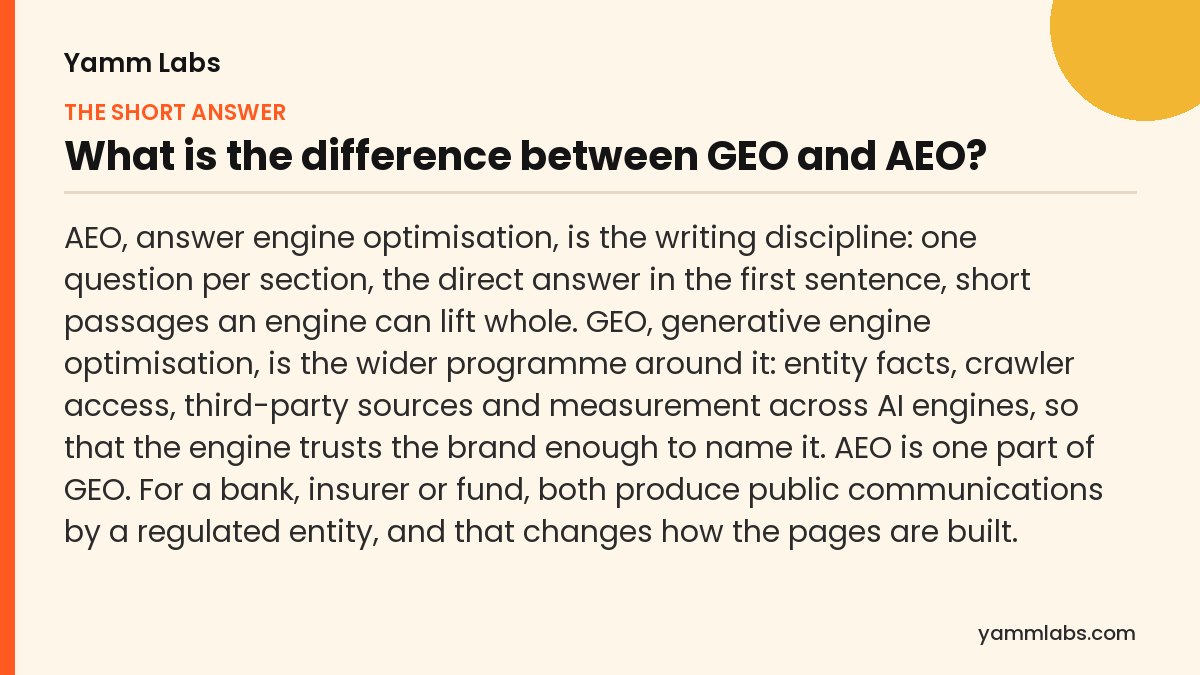
What is the difference between GEO and AEO, side by side?
The two terms are often used as if they mean the same thing. They overlap, but they answer different questions. AEO asks whether a page can be quoted. GEO asks whether the engine will choose to quote this brand at all, and whether what it says is correct. The table compares them on five points.
| Point of comparison | AEO | GEO |
|---|---|---|
| What it works on | The page and its passages | The brand across its own site, registries, directories, press and reviews |
| Where it came from | Featured snippets and voice assistants that return one answer | AI engines that write an answer from several sources |
| Typical deliverables | Question headings, first-sentence answers, comparison tables, visible dates | Entity clean-up, crawler and index checks, citable content, third-party mentions, a monthly re-query |
| What success looks like | A passage lifted into an answer | The brand named, described correctly and cited across engines |
| Who signs off in a BFSI firm | Marketing and compliance, page by page | Marketing, compliance, legal and whoever owns registry and listing data |
AEO decides whether a paragraph can be quoted. GEO decides whether the engine trusts the brand enough to quote it.
What does AEO cover for a bank, insurer or fund house?
AEO is the content-format work. It is the part a writer and an editor can do on a single page, and it is the part most agencies mean when they sell AI search content.
- One question per section. Each heading is a question a customer or a distributor would type, such as how a term plan’s claim process works or what an exit load is.
- The answer first. The first sentence under the heading answers it in plain words. Detail follows.
- Passages that stand alone. An engine lifts a section, not a page, so each section has to make sense with nothing around it.
- Tables for comparisons. Features, eligibility and documents compare cleanly in a table. Returns do not belong in one.
- A visible date. A dated page tells the engine and the reader how fresh the answer is.
SIGNALNewsletter by Yamm Labs
The next piece, straight to your inbox.
New writing on BFSI brands, B2B and influencer marketing, and AI search.
One click to unsubscribe. Privacy policy

What does GEO add that AEO does not?
A fund house can write perfect answer pages and still be missing from the answer, or be described wrongly, because the engine also reads everything else written about it. GEO covers that wider ground.
- Entity facts. The legal name, registration details, founding year and head office should match across the website, registries and listing sites; inconsistent facts make it easier for an engine to confuse the brand with another one.
- Crawler and index access. Google says there are no additional requirements to appear in AI Overviews or AI Mode, and that normal SEO best practice still applies. The page has to be crawlable and indexed before any engine can use it.
- Third-party sources. Engines compare brands using directories, press and review pages. What those say about you often outweighs your own homepage.
- Measurement. A fixed set of buyer prompts, re-run across engines every month, shows whether the brand is named and whether the description is right.
The term itself is recent. It was set out in a research paper first posted in November 2023 and accepted at KDD 2024. Our GEO and AEO FAQ for financial brands covers each of these parts in short answers.
How do SEBI, IRDAI and RBI rules change a GEO or AEO page?
The rules attach to the content, not to the engine. A page written to be quoted by ChatGPT is still a communication by a regulated entity. What changes is that the engine summarises, so the compliant version has to survive the summary. That drives three design decisions we make on every BFSI answer page.
- The risk statement sits inside the passage. SEBI requires mutual fund advertisements to carry a standard market-risk warning, and a 2008 SEBI circular set a minimum of five seconds for it in audio-visual advertisements. The intent is that the warning is actually seen. On an answer page that means the risk line goes in the same paragraph as the fund description, not in a footer the engine will never lift.
- Registration details are part of the entity data. IRDAI’s 2024 regulations, which replaced its 2021 advertisement rules, require an insurer’s advertisements to show its registered name prominently with its trade name or logo, and bar advertisements that leave out a policy’s important exclusions and conditions. We place the registered name, registration line and a link to the full terms on every insurance answer page, and keep them identical to what the registries show.
- No returns in the answer block. A hedged performance figure tends to lose its hedge once an engine rewrites it. The short answer on a fund or insurance page explains the product, the process or the eligibility. Performance, where compliance allows it, sits lower down with its disclosures in the same passage. Banks and NBFCs should treat rates and charges the same way, since RBI requires lenders to disclose them in full, including the annual percentage rate, in a Key Facts Statement.
The timeline follows from this. We book a compliance review for each batch of answer pages into the plan on day one, because a page that fails review after design costs a second round.
Should a financial brand start with GEO or AEO?
Start with a baseline, not a purchase. Run the prompts your buyers would type across the main engines and record whether you are named, how you are described and which sources are cited instead. If the engines describe you wrongly or blend you with another company, the gap is GEO: entity facts and third-party sources come first. If they describe you correctly but quote a competitor’s explainer, the gap is AEO: you need answer pages. Most BFSI brands need both, in that order. Our AI visibility programme for BFSI brands runs them as one plan, and the 100 AI search questions page answers the follow-ups.
Worked example: one fund house, two gaps
Go back to the head of digital in the opening. Before choosing either proposal, her team runs a baseline on the questions investors and distributors ask. This is an illustration of how the difference between GEO and AEO shows up in practice, not a client record.
On a question about a scheme category, one engine describes the fund house correctly but quotes a comparison site’s explainer, not the fund house’s own page. That is an AEO gap. The fund house’s page has the facts, but they sit in a long overview and a PDF, and the heading does not match the question.
On a question about who manages the fund house’s schemes, another engine gives an outdated description and mixes in details from a different company with a similar name. That is a GEO gap. No rewrite of one page will fix it. The legal name, registration details and head office have to match across the website, registries and listing sites, and the third-party pages that carry the wrong description need correcting.
The baseline tells her which proposal’s line items address which gap. Most of the entity work sits in the GEO proposal; most of the page work sits in the AEO one. The overlapping lines are the ones to negotiate.
A step-by-step plan that covers both
For most banks, insurers and funds, GEO and AEO are one plan run in a sensible order. This is the sequence we use.
- Fix the question list. Write the prompts buyers and distributors type, and keep the list fixed so results stay comparable.
- Run a baseline. Record whether the brand is named, how it is described and which sources are cited, engine by engine.
- Clean the entity facts. Make the legal name, registration details and head office identical on the site, in structured data and on registries and listings.
- Check crawler and index access. Confirm the pages that should answer each question are crawlable and indexed.
- Rewrite the answer pages. One question per section, the answer first, the risk line or registered name inside the passage.
- Book compliance review per batch. Review answer pages in batches, with the time for each round in the plan from day one.
- Re-run monthly. Run the same questions again and fix what moved the wrong way.
Steps three and four are GEO. Step five is AEO. The first two and the last one serve both, which is why buying them twice is the most common waste.
How to compare a GEO proposal with an AEO proposal
Put the two proposals side by side and sort every line item into three columns: page work, brand-wide work and measurement. Page work is AEO. Brand-wide work, such as entity facts, crawler checks and third-party sources, is GEO. Measurement should appear once, not in both.
Then ask each agency three questions. Which of our pages will you change, and will compliance see each one before it goes live? Which facts about our company will you correct, and where? How will you show that the engines now name and describe us correctly? The answers show whether the two proposals are really different, or the same work under two labels.
Who owns each one inside a BFSI firm?
AEO sits naturally with the content or digital team, because it is page work: headings, first-sentence answers, tables and dates. Compliance reviews each answer page as it would any public communication.
GEO needs a wider group. Marketing leads it, but the entity facts often live with legal, company secretarial or whoever manages registry and listing data, and third-party sources may involve PR. Name one owner for the question list and the monthly re-run, so both programmes report against the same baseline and nobody has to reconcile two sets of numbers.
Common mistakes when buying GEO or AEO work
- Paying twice for the same baseline. One set of prompts and one monthly re-run can serve both programmes.
- Buying AEO when the gap is GEO. Perfect answer pages will not help if the engine confuses your brand with another company.
- Buying GEO without answer pages. An engine that trusts your brand still needs a passage it can quote.
- Leaving compliance to the end. Both produce public communications by a regulated entity. Plan the review rounds before writing starts, and confirm the current text of every required warning with your compliance team.
- Putting returns in the short answer. A hedged figure tends to lose its hedge in a summary. Keep performance lower on the page with its disclosure in the same passage.
People also ask
Is AEO the same as SEO?
No. SEO aims for a ranked position on a results page; AEO shapes a passage so an engine can use it as the answer. The two share foundations, since a page that is not crawled and indexed cannot be quoted by any engine.
Does a BFSI answer page need compliance approval?
Treat it as any other public communication. If the same content would need a disclaimer or review in a brochure or an advertisement, it needs it on an answer page too. Plan the review round before writing starts.
Do we need special schema or AI files for GEO?
Google states that no special schema or AI text files are needed to appear in AI Overviews or AI Mode. Structured data still helps engines read entity facts such as your legal name and address, so keep it accurate rather than adding new formats.
Which is cheaper to start with, GEO or AEO?
AEO usually costs less to start, because it rewrites pages you already have and uses a review process you already run. GEO takes more coordination, since entity facts and third-party sources sit outside your own site. Start with a baseline; it tells you which gap is bigger, and that matters more than which is cheaper.
Can one agency do both GEO and AEO?
Yes, and for a regulated brand that is often simpler. One team keeps the question list, the entity facts and the answer pages consistent, and compliance deals with one review calendar. If you use two agencies, write down which owns the baseline and the monthly re-run, so the work is not bought twice.
How do we know whether our gap is GEO or AEO?
Look at what the engines get wrong. If they describe your brand correctly but quote someone else’s page, the gap is AEO. If they leave you out, describe you wrongly or mix you up with another company, the gap is GEO. Most financial brands find some of each, so plan both in that order.
Do GEO and AEO still matter if we already rank well on Google?
Yes. Ranking well means the page can be found; it does not mean an engine will quote it or name your brand in its answer. A page can sit near the top of the results and still be passed over for a clearer passage elsewhere. The baseline shows whether that is happening to you.
Sources
Want to know whether AI engines describe your financial brand correctly?
Get a free Fintech Brand Audit across 8 dimensions, plus 3 fixes. No pitch. Run the free Brand Audit →