


The marketing head of a mid-size asset management company in Mumbai has three agency proposals on her desk. One promises GEO. One promises AEO. The third calls it AI SEO and adds LLMO in a footnote. Her CFO asks the obvious question: are we being sold three services or one? Mostly one. The acronyms describe the same job from slightly different angles, and knowing which is which saves a month of confused briefing.
- What does each AI search acronym stand for?
- Where did the term GEO come from?
- Is GEO different from AEO, or is it the same thing?
- What changes when a regulated BFSI brand does GEO?
- Common mistakes buyers make with AI search acronyms
- A worked example: turning three proposals into one brief
- A one-page GEO brief for a financial brand
- How to explain the acronyms to a CFO or board
- Which acronym for AI search optimisation should you use in a brief?
- People also ask
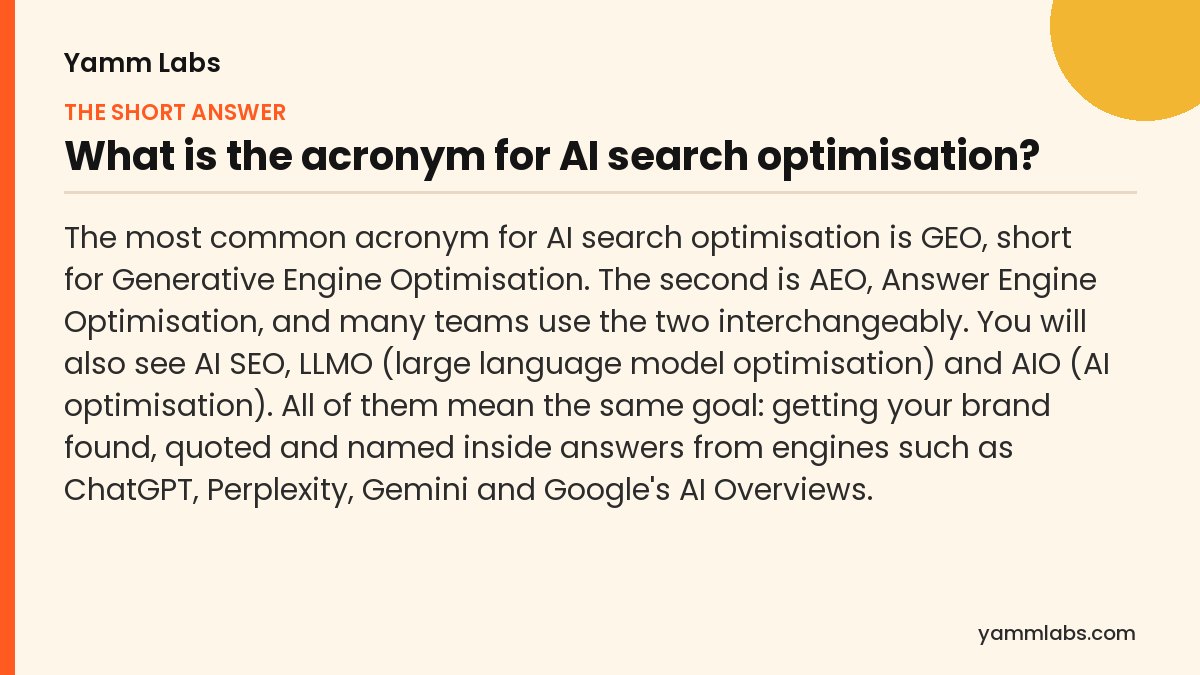
What does each AI search acronym stand for?
Each label grew out of a different community, which is why a single discipline carries five names. The table sets them side by side so you can read any proposal without a glossary.
| Acronym | Stands for | What it usually covers | Where you will meet it |
|---|---|---|---|
| GEO | Generative Engine Optimisation | Being cited and named inside answers written by generative AI engines | Research papers, agency proposals, most industry writing |
| AEO | Answer Engine Optimisation | Structuring pages so any engine can lift a direct answer, including voice assistants and featured snippets | SEO teams, FAQ and schema projects |
| AI SEO | AI search engine optimisation | An umbrella phrase for classic SEO plus AI visibility work | Sales decks and job titles |
| LLMO | Large language model optimisation | Influencing what language models say about a brand, including training and retrieval sources | Technical and product teams |
| AIO | AI optimisation | A loose catch-all; easily confused with Google’s AI Overviews | Vendor marketing |
If a brief has room for one term, use GEO. It is the most widely recognised and the only one with a named research paper behind it.
Five acronyms, one job: be the brand the answer names.
Where did the term GEO come from?
GEO was set out in a research paper titled GEO: Generative Engine Optimization, first posted in November 2023 and accepted at KDD 2024. The authors built a benchmark of queries, tested ways of rewriting content, and reported visibility gains of up to 40% in generative engine responses in their own tests. They also found that what works varies by domain, which matters for finance: a tactic that lifts a travel page may do nothing for a mutual fund page.
AEO is older as a phrase. It came from the era of featured snippets and voice assistants, when the aim was to be the single answer read out or boxed at the top of a results page. Generative engines widened that aim from one snippet to a written answer that cites several sources.
SIGNALNewsletter by Yamm Labs
The next piece, straight to your inbox.
New writing on BFSI brands, B2B and influencer marketing, and AI search.
One click to unsubscribe. Privacy policy

Is GEO different from AEO, or is it the same thing?
For a buyer, treat them as one discipline with two emphases.
- AEO leans on structure. Short answer blocks, question-style headings, FAQ sections and schema markup, so an engine can lift a clean answer.
- GEO leans on citation and naming. Whether engines mention your brand, which sources they trust when they do, and what they say about you compared with competitors.
- Both share the same base. Crawlable pages, consistent facts about the brand across the web, and answers specific enough to quote whole.
An agency that separates the two into different retainers is usually pricing the same work twice. Our GEO and AEO FAQ for financial brands covers where the line sits in practice.
What changes when a regulated BFSI brand does GEO?
An engine quotes a passage, not a page. For a mutual fund, insurer or lender, that turns a regulatory rule into a design decision about every answer block you publish.
Take mutual funds. SEBI’s advertisement code for mutual funds requires the standard warning, Mutual Fund investments are subject to market risks, read all scheme related documents carefully, in legible type, with no words added or removed, and in the vernacular language when the advertisement is vernacular. The same code bars testimonials and rankings, and bars claims built on projections.
The decision we build from that is simple to state and easy to check:
- The warning travels with the answer. Any short answer block that mentions a scheme or returns carries the standard warning inside the same block, word for word, so a quoted passage never loses it. A footer disclaimer does not travel.
- No best-fund language. Because rankings are barred, answer pages target questions such as how a fund category works, never which fund is best. That choice also stops engines quoting you in a list you cannot legally publish.
- One warning per language. A Hindi or Marathi answer page carries the warning in that language, not the English line pasted below.
Insurers answer to IRDAI and lenders to RBI, each with their own disclosure rules, and we apply the same test: if a block can be quoted alone, we keep the relevant disclosure inside that block. Our clients include Aditya Birla Sun Life Mutual Fund, HDFC Life, TATA AIA Life Insurance, Axis Bank and Paytm Money, and between them they answer to this whole mix of regulators. That is why generic GEO playbooks written for retail or software rarely fit BFSI.
Common mistakes buyers make with AI search acronyms
The CFO’s question in the opening is the right one. Most of the mistakes below come from not asking it.
Buying two retainers for one job. A GEO retainer and an AEO retainer from different agencies will overlap heavily. Both rest on crawlable pages, consistent brand facts and answers specific enough to quote. Buy the work once.
Confusing AIO with AI Overviews. AIO is a loose vendor term for AI optimisation. Google’s AI Overviews is a product. A proposal that promises “AIO results” may mean either. Ask which.
Comparing fees before deliverables. The acronym on the cover does not predict the work. Compare which pages will change, which prompts will be tracked and which engines will be measured, then compare fees.
Asking for “best fund” visibility. SEBI’s advertisement code for mutual funds bars rankings. A GEO plan built around being named the best fund in AI answers targets a claim the AMC cannot publish itself.
Treating LLMO as a separate project. LLMO focuses on what language models say about a brand. In practice it overlaps almost entirely with GEO, so it belongs in the same brief.
Leaving compliance out of the brief. If nobody on your side checks each answer block against SEBI, IRDAI or RBI rules, the acronym does not matter. The risk sits in the passage the engine quotes.
A worked example: turning three proposals into one brief
Here is how the AMC marketing head from the opening could answer her CFO and move forward in a week, using only what this article covers.
Day one, the translation. She maps each proposal to the table above. The GEO proposal is about being named in generative answers. The AEO proposal is about answer blocks and FAQ structure. The AI SEO proposal is classic SEO with AI visibility added, and its LLMO footnote overlaps with GEO. One job, three angles.
Day two, the deliverables. She lists what each agency will actually do: which pages it will change, which prompts it will track, which engines it will measure and how often. The overlap becomes obvious on paper.
Day three, the compliance line. She asks each agency who will check every answer block against SEBI’s advertisement code before it goes live, and how the standard warning will sit inside each block.
Day four, the brief. She writes one brief titled GEO, with the outcome in plain words underneath, and sends it back to all three agencies so their revised proposals can be compared line by line.
Day five, the answer to the CFO. One service, one brief, one set of measures. The acronym is settled because the work is defined.
A one-page GEO brief for a financial brand
Whichever acronym for AI search optimisation you choose, a short brief with these headings keeps every agency answering the same question.
- Title: GEO, with a one-line definition: being named, quoted and described correctly inside AI answers.
- Buyer questions: the list of prompts you want to be named in, written the way buyers type them.
- Engines: the engines to test, such as ChatGPT, Perplexity, Gemini and Google’s AI Overviews.
- Measurement: how often results are checked and how each result is scored.
- Pages in scope: which pages may change first, and which may not change at all.
- Compliance rules: the regulators that apply to you, and the rule that any answer block that can be quoted alone carries its own disclosure. Confirm the current text with your compliance team.
- Review route: who on your side approves each page, and how long review takes.
A brief built this way also makes the proposals easier to compare, because every agency is pricing the same list.
How to explain the acronyms to a CFO or board
Boards and finance heads do not need five acronyms. They need one sentence and one measure. The sentence: we want our brand named, quoted and described correctly when buyers ask AI engines about our category. The measure: across a fixed list of buyer questions and engines, how often we are named, and whether what the engine says is accurate and compliant.
Say GEO once, explain it in that sentence, and then talk only about the outcome. If someone asks about AEO or LLMO, the honest answer is that they describe the same work from a different angle, and the brief already covers them.
Which acronym for AI search optimisation should you use in a brief?
Write GEO in the title and describe the outcome in plain words underneath: which buyer questions you want to be named in, on which engines, and how often you will measure it. Then ask each agency three things. Which prompts will you track? Which pages will you change first? Who checks each answer block against SEBI, IRDAI or RBI rules before it goes live? The answers tell you more than the acronym ever will.
For the short version of this and 99 other questions, start with our hub on AI search optimisation questions. If you want to see how the work is scoped for a financial brand, read our page on AI visibility for BFSI brands.
People also ask
Is GEO replacing SEO?
No. Generative engines still draw on pages they can crawl and trust, so classic SEO remains the base. GEO adds a second test on top: whether the answer engines write actually name and cite you.
What does LLMO mean?
LLMO stands for large language model optimisation. It is used mostly by technical teams and focuses on what language models say about a brand. In practice it overlaps almost entirely with GEO.
Do mutual fund answer pages need the SEBI standard warning?
Where a page promotes a scheme or discusses returns, treat it as advertising and carry the standard warning exactly as SEBI’s code words it. Put it inside the answer block, because engines quote blocks, not footers. Your compliance team makes the final call.
What does AIO stand for in AI search?
AIO usually stands for AI optimisation. It is a loose catch-all used mainly in vendor marketing, and it is easily confused with Google’s AI Overviews, which is a product, not a discipline. If a proposal uses AIO, ask the agency to say exactly which engines and results it means.
Is AEO older than GEO?
Yes, as a phrase. AEO came from the era of featured snippets and voice assistants, when the aim was to be the single answer read out or boxed at the top of a results page. GEO was set out in a research paper first posted in November 2023, as generative engines began writing answers that cite several sources.
Should an RFP ask for GEO and AEO separately?
No. The two share the same base of crawlable pages, consistent brand facts and answers specific enough to quote. Splitting them into separate line items usually means paying for the same work twice. Ask for one programme and one set of deliverables, and let each agency explain how it covers both emphases.
How do you measure whichever acronym you buy?
With a fixed list of buyer questions, a fixed list of engines and a fixed schedule. For each question and engine, record whether your brand is named, whether you are cited, and whether what the engine says is accurate and compliant. The acronym does not change the measure.
Is GEO a real discipline or a marketing label?
It has a research base. GEO was set out in a paper titled GEO: Generative Engine Optimization, accepted at KDD 2024, which built a benchmark of queries and tested ways of rewriting content for generative engines. Agencies use the label loosely, so the research does not guarantee any single proposal. Judge the proposal on its deliverables and its measurement plan.
What is the difference between AI SEO and GEO?
AI SEO is an umbrella phrase for classic SEO plus AI visibility work, and it turns up mostly in sales decks and job titles. GEO is narrower: being cited and named inside answers written by generative engines. An AI SEO proposal usually includes GEO work, so check the deliverables list to see how much.
Do insurers and lenders need a different acronym from mutual funds?
No. The acronym is the same; the disclosure rules differ. Insurers answer to IRDAI and lenders to RBI, each with their own requirements. The test stays the same across all three: if an answer block can be quoted alone, the relevant disclosure sits inside that block. Your compliance team confirms the current wording.
Sources
Want to know which acronym your brand is actually winning on, and where AI answers leave you out?
Get a free Fintech Brand Audit across 8 dimensions, plus 3 fixes. No pitch. Run the free Brand Audit →