


A marketing head at a mutual fund has decks from three fintech branding agencies open on one screen. All three say “compliance-aware.” None of them shows a single frame where a rule changed the design. So she asks each agency one question on the pitch call: in a 15-second video, where does the standard warning go, and what gets cut to make room for it? One agency answers in a sentence. The other two promise to check with their legal team. That one question tells her more than the three decks did.
- Do fintech branding agencies in India understand SEBI, IRDAI and RBI rules?
- How can you tell if a branding agency knows the rules before you hire it?
- What does a regulator-driven design decision look like in practice?
- Is compliance the agency’s job or your compliance team’s job?
- What should a buyer decide before choosing a fintech branding agency?
- What mistakes do buyers make when choosing an agency?
- How should you brief an agency on SEBI, IRDAI and RBI rules?
- A worked example: one launch, three regulators
- People also ask
Do fintech branding agencies in India understand SEBI, IRDAI and RBI rules?
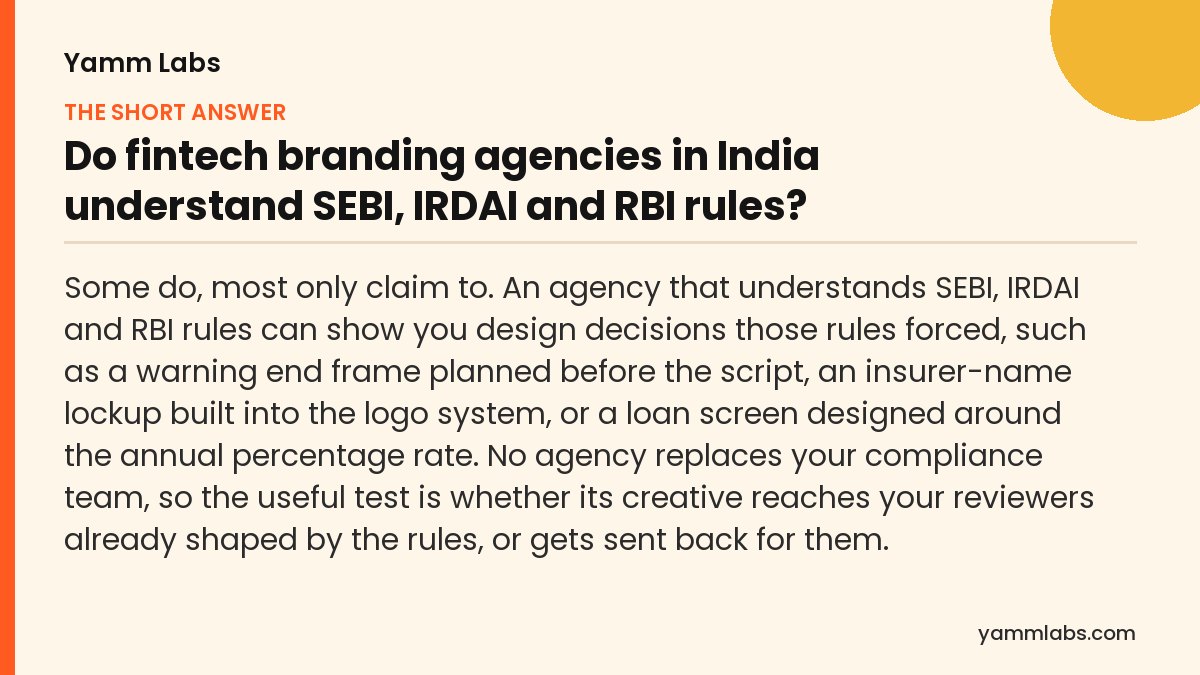
Most fintech branding agencies in India know the rules exist. Fewer design with them from the first draft. The difference shows up in the work: an agency that knows the rules plans disclosures as part of the layout, the edit and the screen flow, while one that does not adds them at the end, when there is no room left. Each regulator touches a different part of the creative, so an agency that works across banking, insurance and investments needs all three in its process, not one general caution.
| Regulator | What the rule touches in creative | Design decision it should force |
|---|---|---|
| SEBI (mutual funds) | The standard warning in audio-visual ads must be displayed and voiced for five seconds | Lock the end frame for the warning before the story is written, and write the idea into the time that remains |
| IRDAI (insurance) | Every insurer’s advertisement must show its registered name with its trade name or logo prominently | Build one name-and-logo lockup that stays legible in a two-second end frame, a banner and a WhatsApp card |
| IRDAI (insurance) | Ads issued through a distribution channel need the insurer’s written approval before issue | Plan a separate approval round for every bank or broker version, not a quick resize |
| RBI (lending) | A Key Facts Statement, including the annual percentage rate, must reach the borrower before the loan contract is executed | Design the pre-sign screen so the APR is the most visible number, placed before the signature step |
An agency that understands the rules shows you the frame a rule changed; an agency that does not shows you the word “compliant.”
How can you tell if a branding agency knows the rules before you hire it?
Ask for decisions, not claims. Five questions on the pitch call separate the agencies that have done this work from the ones that have read about it.
- Where does the warning go in your shortest video? A good answer names a fixed end frame and says what the story gives up for it. A weak answer says the warning will be added in the final edit.
- How does our logo sit next to the insurer’s registered name? For insurance work, the agency should have a lockup rule ready, not a plan to shrink the name into the footer.
- What changes when a partner bank runs our ad? The right answer includes the insurer’s written approval before issue and time in the plan for it.
- Where does the APR appear in a loan journey? For lending, the agency should talk about screen order and the step before the borrower signs, not only colour and type.
- How many review rounds do you plan for? An agency used to regulated work puts compliance rounds into the timeline from week one.
SIGNALNewsletter by Yamm Labs
The next piece, straight to your inbox.
New writing on BFSI brands, B2B and influencer marketing, and AI search.
One click to unsubscribe. Privacy policy

What does a regulator-driven design decision look like in practice?
It is a choice you can point to on the page or the screen. For a mutual fund film, we lock the last five seconds for SEBI’s displayed and spoken standard warning before a script exists. For an insurer, we design the registered name and the logo as a single unit, so no layout can separate them. For a lender, RBI’s Key Facts Statement rules, now consolidated in its Master Directions, shape the screen sequence: the rate and charges come before the signature step, and the APR is the largest number in view.
None of these decisions makes the work weaker. They make it faster to approve, because the reviewer is checking a known frame, not searching for a missing line. Our work in this category includes TATA AIA Life Insurance, HDFC Life, Axis Bank, Paytm Money and Aditya Birla Sun Life Mutual Fund. You can see how we approach it on our fintech branding agency page.
Is compliance the agency’s job or your compliance team’s job?
Sign-off stays with you. Your compliance and legal teams approve what goes out under your name, and in insurance the rules make the insurer’s approval explicit for ads issued through distribution partners. The agency’s job is to hand those teams work that already respects the rules, with the disclosure placed, sized and timed, so review is about judgment calls rather than basic fixes. An agency that says it will handle compliance for you is overstating its role; one that says compliance is not its problem will cost you review rounds.
What should a buyer decide before choosing a fintech branding agency?
Decide three things. First, which regulators touch your product: a neobank with a lending partner, a fund distributor and an insurer each carry a different set of rules into the brand. Second, how many review rounds your compliance team needs, so the agency’s timeline includes them rather than discovering them. Third, what budget band covers that extra time; our guide to fintech branding cost in India sets out the ranges. If you are comparing firms, our list of the best fintech branding agencies in India is a starting point, and the pitch-call questions above will do the rest. Shorter answers on related questions sit in our fintech and BFSI branding FAQ.
What mistakes do buyers make when choosing an agency?
Most bad agency choices in financial services are not about talent. They come from judging the pitch on the wrong things. These are the mistakes we see most often when marketing teams compare fintech branding agencies.
- Judging the portfolio on looks alone. A beautiful film for a consumer brand says little about how the same team handles a five-second warning or an insurer’s registered name. Ask to see regulated work, and ask what changed in it because of a rule.
- Accepting “compliance-aware” as an answer. The phrase appears in almost every deck. It only means something when the agency can point to a frame, a lockup or a screen that a rule shaped.
- Forgetting the partner versions. An insurance campaign that will run through a bank or a broker needs the insurer’s written approval for those versions. If the plan treats them as quick resizes, the timeline is already wrong.
- Leaving review rounds out of the budget. Compliance review takes time and so do the changes it asks for. An estimate that assumes one review round will run over.
- Letting the agency’s view replace your own review. An agency can reduce the work your compliance team does. It cannot sign off in its place.
How should you brief an agency on SEBI, IRDAI and RBI rules?
A brief that names the rules up front saves more time than any amount of review later. Before the first creative meeting, give the agency these things in writing.
- The regulators that apply. Say which products the brand covers and which regulator touches each one, so the agency knows whether it is designing for SEBI, IRDAI, RBI or a mix.
- The current disclosure texts. Ask your compliance team for the exact wording the ads must carry today, and send it as text, not as a screenshot of an old ad. Confirm the current text of the rules with your compliance team before you share it.
- The formats you will run. A 15-second video, a banner, a WhatsApp card and a loan screen each need the disclosure placed differently. List them so the agency plans each one.
- Your review process. Say how many rounds your compliance team normally needs, who signs off, and how long each round takes, so the timeline reflects them.
- Past rejections. Share two or three ads that compliance sent back and why. They teach an agency more about your reviewers than any policy document.
Then ask the agency to show where each disclosure sits in its first layout, not in the final one. If the first draft already has a home for the warning, the name and the rate, you have hired the right team.
A worked example: one launch, three regulators
This is an illustrative example, not a client story. Picture a financial group preparing one brand campaign that touches three products: a mutual fund scheme, a term insurance plan sold through a partner bank, and a personal loan in its app. The same campaign idea has to survive three different sets of rules.
For the mutual fund film, the last five seconds are locked for SEBI’s standard warning, shown and voiced, before the script is written. The story is written into the time that remains, so nothing has to be cut in the edit.
For the insurance plan, the insurer’s registered name and its logo are designed as one lockup that stays legible in a short end frame, a banner and a WhatsApp card. Because the partner bank will run its own version, the plan includes a separate round for the insurer’s written approval of that version.
For the loan, the app journey is designed so the Key Facts Statement, with the annual percentage rate as the most visible number, appears before the signature step. The campaign’s promise about speed has to fit around that screen, not skip it.
Three products, three rules, one brand. An agency that has done this before will describe these decisions without being asked. One that has not will describe the campaign idea and leave the rest to review.
People also ask
Can a branding agency approve a financial ad as compliant?
No. Approval sits with the regulated entity: the bank, insurer or fund house answers for its own advertising, usually through its compliance team. A good agency reduces the work that team has to do by designing disclosures into the creative from the first draft.
Who is responsible for insurance ads under IRDAI’s rules?
Under IRDAI’s 2024 policyholder protection regulations, the insurer keeps a record of its ads and makes them available to IRDAI when asked. The insurer is responsible for its ads, and ads issued through a distribution channel need the insurer’s written approval before they go out.
Does an RBI rule change how a loan app is designed?
Yes. RBI requires a Key Facts Statement with the annual percentage rate before the loan contract is executed, so the screens before the signature step need room for it. Designing that step early avoids rebuilding the flow later.
What should I ask fintech branding agencies on a pitch call?
Ask questions that need a design answer. Where does the warning go in your shortest video? How does our logo sit beside the insurer’s registered name? What changes when a partner bank runs our ad? Where does the APR appear in a loan journey? How many review rounds do you plan for? Agencies that have done the work answer in a sentence and can show you an example.
Is a specialist BFSI agency always better than a general branding agency?
Not always, but it usually needs fewer review rounds. A general agency can do strong work for a financial brand if it plans disclosures into the layout from the first draft and accepts compliance rounds in the timeline. The test is the same for both: can the agency show you design decisions that a SEBI, IRDAI or RBI rule forced?
How many compliance review rounds should a fintech campaign plan for?
That depends on your compliance team, so ask them before you brief the agency and write the number into the timeline. Insurance campaigns that run through partners need an extra round for the insurer’s written approval of each partner version. Planning the rounds up front is cheaper than discovering them after the launch date is fixed.
Does a brand refresh need compliance review, or only product ads?
Treat anything that carries a product claim, a rate or a call to invest as an ad for review purposes, and ask your compliance team where they draw the line for pure brand work. For insurers, a new logo system also has to keep the registered name prominent beside the trade name or logo, so the lockup itself deserves a review before it is rolled out.
What should an agency’s first layout show for a regulated product?
It should show a fixed home for every disclosure the product needs. For a mutual fund film, that is the end frame for the standard warning. For an insurer, it is the registered name inside the logo lockup. For a loan journey, it is the Key Facts Statement screen before the signature step. If those are missing from the first layout, expect them to be squeezed in at review.
Can one agency handle banking, insurance and investment work?
Yes, if its process covers all three sets of rules rather than one general caution. SEBI, IRDAI and RBI each touch a different part of the creative: the edit, the lockup and the screen order. Ask the agency to show one example from each area. A group brand that spans several products benefits from one team that plans all three from the start.
Sources
Want to see which rules your brand is already designed around, and which it is not?
Get a free Fintech Brand Audit across 8 dimensions, plus 3 fixes. No pitch. Run the free Brand Audit →