


A marketing head at a mutual fund house types “best flexi cap fund for a first-time investor” into Google and then asks the same thing of ChatGPT. On Google, the fund’s page sits in the top five blue links, exactly where the SEO team said it would. In the AI answer, the fund is not named at all. Two aggregator pages and a news story are. The SEO work did its job. It was built for a different contest.
- What is the difference between GEO and SEO?
- Does GEO replace SEO?
- Why does GEO change where a financial brand puts its disclosures?
- How should a bank, insurer or fintech decide between SEO and GEO spend?
- A step-by-step GEO vs SEO check for a financial brand
- Worked example: one fund page seen by both contests
- Common GEO vs SEO mistakes at financial brands
- How to brief an agency or in-house team on GEO
- People also ask
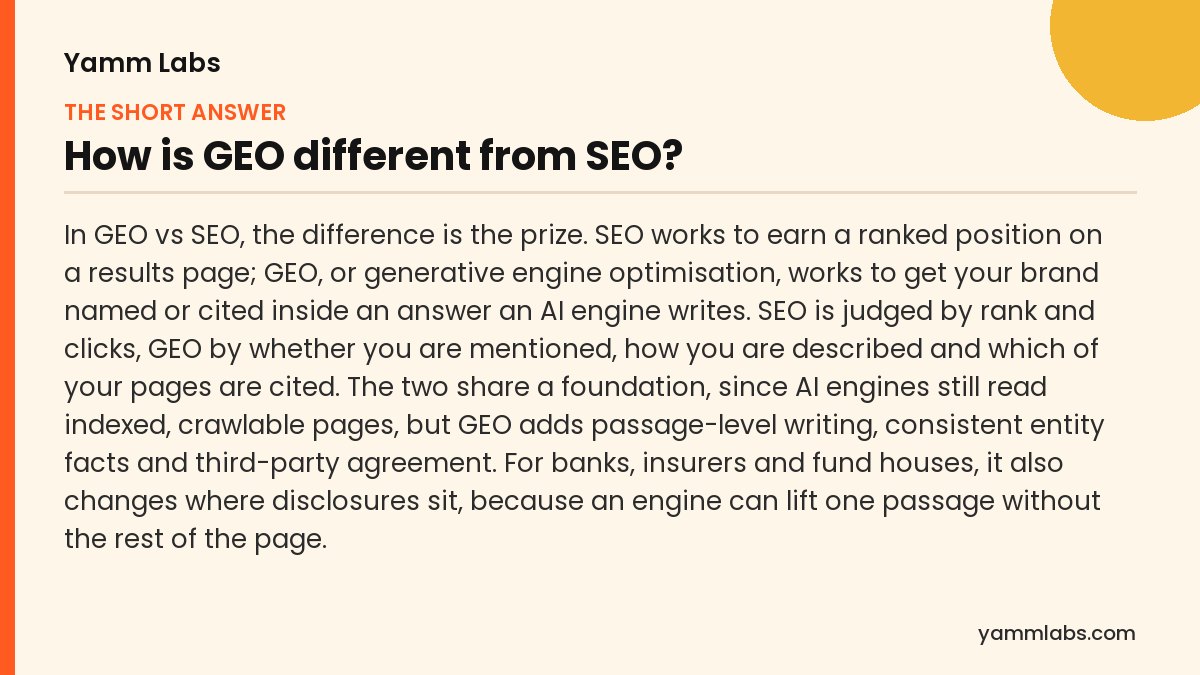
What is the difference between GEO and SEO?
SEO optimises a page to rank for a query. The reader sees a list, clicks, and lands on your page, where your full context, disclaimers and design do the rest. GEO optimises for a different outcome: an engine such as ChatGPT, Perplexity or Google’s AI Overviews reads many pages, writes one answer, and names a few brands or links a few sources. The reader may never visit your site. What the engine says about you is the result.
The table below sets out five differences a marketing or compliance head will notice first. None of them means the old work was wasted. Each one shows where the GEO vs SEO split asks for a different decision on the same page.
| Question a buyer asks | SEO | GEO |
|---|---|---|
| What does it win? | A ranked position on a results page | A mention or citation inside a generated answer |
| What unit does the engine use? | The whole page, ranked against other pages | A passage lifted from a page and combined with others |
| What signals matter most? | Relevance, links, technical health, page experience | Clear answer-first passages, consistent brand facts, agreement across third-party sources |
| How is success measured? | Rank, impressions, clicks, conversions | Share of answers that name you, how you are described, which pages are cited |
| Where do disclosures travel? | With the page the reader lands on | Only if they sit inside the passage the engine quotes |
SEO gets your page seen; GEO decides what an engine says about you when nobody clicks.
Does GEO replace SEO?
No. GEO sits on top of SEO. Google says there are no additional requirements or special optimisations needed to appear in AI Overviews or AI Mode, and that a page must be indexed and eligible to show with a snippet to be used as a supporting link. In practice that means crawlability, indexing, clean structure and fast pages remain the entry ticket. What GEO adds is the work that decides whether an engine picks your passage over another eligible one.
- Write answer-first. Put the direct answer to the question in the first two sentences of a section, then the detail. Engines lift passages, and a passage that opens with the answer is easier to quote whole.
- Keep entity facts identical everywhere. Your brand name, product names, what you are regulated as and what you offer should read the same on your site, your directory listings and your partner pages.
- Earn third-party agreement. Engines tend to repeat what several independent sources agree on, so press coverage, industry directories and comparison sites carry more weight than one more page on your own domain.
Our GEO and AEO FAQ for financial brands holds the short version of this answer alongside related questions on AEO and AI Overviews.
SIGNALNewsletter by Yamm Labs
The next piece, straight to your inbox.
New writing on BFSI brands, B2B and influencer marketing, and AI search.
One click to unsubscribe. Privacy policy

Why does GEO change where a financial brand puts its disclosures?
Because an engine quotes a passage, not a page. A returns claim three screens away from its risk warning is compliant on the page and can be quoted alone in an answer. Indian regulators set what an advertisement must carry; GEO decides how those rules are laid out so they survive being lifted. These are the decisions we make on BFSI pages.
- Keep the mutual fund warning inside the passage. SEBI requires the standard mutual fund warning on advertisements, displayed and voiced for five seconds in audio-visual ads. On a scheme page written for GEO, every section that mentions returns or performance carries the warning in the same paragraph, not only in the footer.
- Write the insurer’s registered name with its brand name. Under IRDAI’s 2024 policyholder protection regulations, an insurer’s advertisement must show its registered name with its trade name or logo prominently. We write the registered name and trade name together in the first line of product pages and in the organisation markup, so the name an engine repeats is the one the regulator expects.
- Publish the APR as text, not an image. RBI’s rules on the Key Facts Statement, now consolidated in its Master Directions, require lenders to give borrowers a Key Facts Statement that includes the annual percentage rate before the loan contract is executed. On lending pages we show the APR and fees in an HTML table an engine can read, next to the sentence that describes the loan.
- Get insurer approval before seeding partner pages. IRDAI’s regulations require an advertisement issued through a distribution channel to have the insurer’s written approval before it goes out. Third-party pages help GEO, so a bancassurance partner’s page that promotes a policy goes into the approval plan before it is published, not after an engine starts quoting it.
How should a bank, insurer or fintech decide between SEO and GEO spend?
Start by checking what the engines say today. Ask ChatGPT, Perplexity and Google’s AI Mode the ten questions your buyers ask before they choose a product, and record who is named and which pages are cited. If your pages do not rank or are not indexed, fix SEO first; GEO cannot cite a page an engine cannot find. If you rank but are missing or misdescribed in answers, the gap is GEO: restructure key pages into quotable passages, align your facts across third-party sources and move disclosures into the passages that carry the claims.
Our work in financial services includes TATA AIA Life Insurance, HDFC Life, Axis Bank, Paytm Money and Aditya Birla Sun Life Mutual Fund. See how we run this for BFSI brands on our AI visibility (GEO/AEO) service for BFSI, or browse 100 AI search optimisation questions answered.
A step-by-step GEO vs SEO check for a financial brand
This is the sequence we run before recommending any spend. It takes a working week for one product line and needs no special software, only a spreadsheet and access to the engines your buyers use.
- Write the buyer questions. List the ten questions a customer asks before choosing the product, in the words they would type. Ask sales and the call centre, not only the marketing team.
- Check the SEO base. Confirm the pages that should answer those questions are indexed and can show with a snippet. If a page is missing from the index, stop here and fix that first.
- Run the questions on each engine. Ask ChatGPT, Perplexity and Google’s AI Mode each question and save the full answer, the brands named and the sources cited.
- Mark each answer. Record whether your brand is named, whether the description is correct and which of your pages, if any, is cited.
- Find the passage that should have been quoted. For each miss, open your own page and find the paragraph that answers the question. Note whether it opens with the answer or buries it.
- Check the disclosure in that passage. Mark whether the paragraph carries its own risk warning, registered name or rate disclosure, or relies on the footer.
- Rank the fixes. Index problems first, then answer-first rewrites, then consistent facts across third-party pages. Re-run the same questions a month later and compare.
The output is a short table that shows, question by question, whether the gap is SEO, GEO or both. That table is also what compliance needs to see, because it lists every passage that will be rewritten.
Worked example: one fund page seen by both contests
Take the fund house from the opening of this article. Its scheme page ranks in the top five for the flexi cap question, so the SEO base is sound. The AI answer names two aggregator pages and a news story instead. When the team reads its own page as a passage, the reasons are plain.
The page opens with a brand story, not an answer. The scheme’s category, the type of investor it suits and the fund manager’s approach sit in three different tabs. The risk warning lives in the footer. An aggregator page, by contrast, puts the category, the suitable investor and the key facts in two sentences at the top. The engine lifts the aggregator’s passage because it can quote it whole.
The rewrite keeps the page and its ranking. It adds one section headed with the buyer’s question, answers it in the first two sentences, lists the scheme facts in a small HTML table and carries the standard mutual fund warning in the same paragraph as any performance mention. Compliance reviews that section as a passage, on its own, before it goes live. Nothing about the page’s SEO gets worse. The page simply becomes quotable. This is an illustration built from the scenario above, not a client result.
Common GEO vs SEO mistakes at financial brands
Most of the errors we see come from treating the two as rivals rather than layers. These are the ones that cost the most time.
- Cutting SEO to fund GEO. An engine cannot cite a page it cannot find. If indexing and crawlability slip, the GEO work has nothing to stand on.
- Measuring GEO with SEO numbers. Rank and clicks will not show whether an engine names you. Track the share of answers that mention you and how you are described.
- Keeping key facts in PDFs and images. Fees, rates and product names locked in a brochure PDF or a banner image are hard for an engine to quote in one piece. Put them in page text.
- Letting brand facts drift. A product called one name on the website, another on a partner page and a third in a directory gives the engine three answers. Pick one and use it everywhere.
- Leaving disclosures in the footer. A passage quoted without its warning is the version the reader sees. Write the warning into the passage that carries the claim, and confirm the current text with your compliance team.
How to brief an agency or in-house team on GEO
A good brief is short and specific. Give the team the ten buyer questions, the product pages that should answer them and the names of the engines you care about. State who in compliance reviews rewritten passages and how many days a review takes, so the plan includes those rounds from the start.
Ask the team to report in two columns, one for SEO health and one for answer presence, so the two are never blended into one score. Ask for the before and after text of every rewritten passage, not a summary. And ask for the date each test was run, because engine answers change and a result without a date cannot be compared with the next one.
People also ask
Is GEO the same as AEO?
They overlap. AEO, answer engine optimisation, usually refers to winning direct answers such as featured snippets and voice results, while GEO refers to being named or cited in answers written by generative AI engines. Most of the work, answer-first writing and consistent facts, serves both.
Do I need special markup or an AI text file for GEO?
Not for Google. Google says you do not need new machine-readable files, AI text files or markup to appear in its AI features. Standard structured data that describes your organisation and products still helps engines resolve who you are.
Can a mutual fund page be optimised for AI answers and stay compliant?
Yes, if the risk warning travels with the claim. Write each section that mentions returns so it carries the standard warning in the same passage, and have compliance review the page as the separate passages an engine could quote.
Which comes first for a new fintech, GEO or SEO?
SEO comes first. A new site needs pages that are crawlable, indexed and able to show with a snippet before any engine can use them. Build those pages answer-first from the start, though, so the GEO layer costs little later. Writing each section so it opens with the answer serves both contests at once, and it saves a second rewrite once the brand starts appearing in AI answers.
How do you measure GEO vs SEO results side by side?
Keep two reports. SEO is measured by rank, impressions, clicks and conversions from search. GEO is measured by running a fixed set of buyer questions on each engine and recording whether you are named, how you are described and which pages are cited. Run the same questions on a set date each month so the results can be compared.
Does GEO matter if our buyers still click through to the website?
Yes. The answer shapes the shortlist before the click. If an engine names three competitors and not you, many buyers never reach the results page where your SEO work sits. If it names you but describes you wrongly, the buyer arrives with the wrong expectation. Both outcomes happen before anyone opens your site.
Who should own GEO inside a bank or insurer?
Usually the team that owns SEO and site content, with compliance as a named reviewer. The work touches product pages, brand facts and partner listings, so marketing leads it. Compliance signs off every rewritten passage that makes a claim, and whoever manages directory and partner listings keeps the brand facts consistent.
Sources
- Google Search Central: AI features and your website
- SEBI: Standard warning in advertisements by mutual funds (SEBI/IMD/CIR No. 12/118340/08)
- taxguru.in: IRDAI (PPHI, Operations & Allied Matters of Insurers) Regulations, 2024 (Advertising)
- taxguru.in: RBI (Non-Banking Financial Companies, Responsible Business Conduct) Directions, 2025
Want to know what AI engines say about your brand today?
Get a free Fintech Brand Audit across 8 dimensions, plus 3 fixes. No pitch. Run the free Brand Audit →