


A quality engineer at a die-casting plant in Faridabad gets a new part nomination from a Tier-1 customer. Attached is a PPAP checklist with eighteen rows, a column marked “Required” and a column marked “Submitted”. Some rows she knows well. Others raise questions. Does a build-to-print supplier owe a design FMEA? What counts as a qualified laboratory? Who signs the appearance report? The list is short. Knowing what each row asks for, and who produces it, is the real work.
- What are the 18 PPAP elements, and who produces each one?
- Which PPAP elements can a supplier mark not applicable?
- What do customer rules change inside the 18 elements?
- How should a supplier split the 18 elements between desk and plant?
- How do the PPAP elements connect to each other?
- Common mistakes when assembling the PPAP elements
- A step-by-step checklist for the 18 PPAP elements
- How to brief a documentation team on the PPAP elements
- People also ask
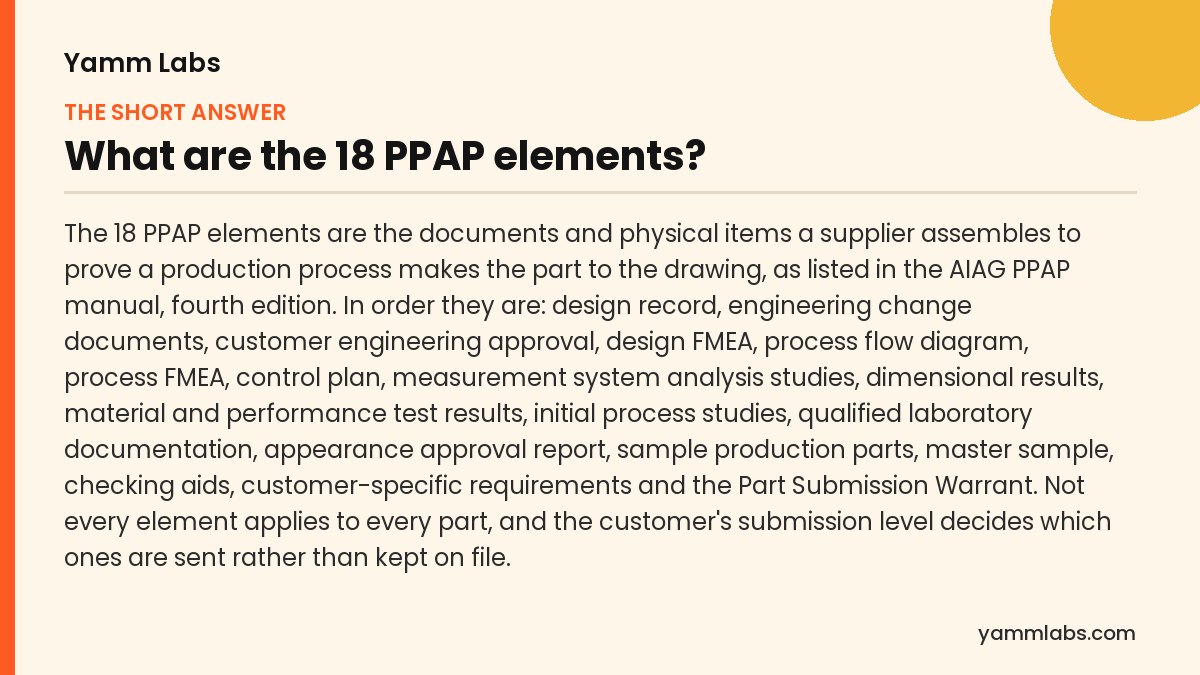
What are the 18 PPAP elements, and who produces each one?
The elements fall into three groups: design inputs from the customer, process documents the supplier writes, and evidence that only the plant floor can produce.
| No. | Element | What it proves | Who produces it |
|---|---|---|---|
| 1 | Design record | The released drawing, ballooned so every characteristic maps to a result | Customer drawing, ballooned by the supplier |
| 2 | Engineering change documents | Any change not yet on the drawing is authorised | Customer |
| 3 | Customer engineering approval | Engineering trials or approvals the customer requires | Customer |
| 4 | Design FMEA | Design risks are analysed | Whoever is design-responsible |
| 5 | Process flow diagram | Every step from incoming material to dispatch | Supplier |
| 6 | Process FMEA | Process risks are ranked and controlled | Supplier |
| 7 | Control plan | How each characteristic is checked, how often and with what | Supplier |
| 8 | MSA studies | Gauges are fit for the job, usually through Gage R&R | Plant, from real trials |
| 9 | Dimensional results | Every drawing dimension measured on production parts | Plant |
| 10 | Material and performance test results | Material and functional specifications are met | Plant or its laboratory |
| 11 | Initial process studies | Key characteristics are stable and capable | Plant, from the production run |
| 12 | Qualified laboratory documentation | The laboratory that ran the tests is competent | Laboratory |
| 13 | Appearance approval report | Colour, grain and finish are approved, where they matter | Supplier fills, customer signs |
| 14 | Sample production parts | Physical parts from the production run | Plant |
| 15 | Master sample | A signed reference part kept for training and comparison | Plant |
| 16 | Checking aids | Fixtures and gauges are listed and calibrated | Plant |
| 17 | Customer-specific requirements | Every extra item this customer asks for | Customer sets, supplier meets |
| 18 | Part Submission Warrant | The supplier’s signed declaration that the package is complete and true | Supplier’s responsible official |
The last column is the one buyers skip. Elements 5, 6 and 7 can be drafted from the drawing and the process route before a single part is made. Most of elements 8 to 16 cannot. They are evidence, and evidence comes from the plant’s own tools, gauges and people.
Which PPAP elements can a supplier mark not applicable?
Several elements depend on the part and on who owns the design.
- Design FMEA. It belongs to the design-responsible party. Ford’s customer-specific requirements title this element as applying if the organisation is product design-responsible, so a build-to-print supplier usually does not author one.
- Appearance approval report. It applies only to parts with appearance items. Ford defines those as visible interior, exterior, luggage compartment and select under-hood components.
- Engineering change documents. Needed when a change is authorised but not yet shown on the drawing. A clean first release may have none.
- Customer engineering approval. What it covers depends on the customer, often an engineering trial with production parts or written approval of test results.
Whatever the level, keep a line in the package index for every element, with either the document or a short reason it does not apply. A reviewer who sees a missing row assumes a missing document.
The process documents can be written at a desk; the evidence has to be earned on the shop floor.
What do customer rules change inside the 18 elements?
The AIAG manual sets the list. The customer’s own requirements, element 17, decide how each item is judged, and they change real design decisions in the pack. PPAP rests on the AIAG manual, IATF 16949 and each customer’s own requirements rather than a government rulebook, so these customer documents carry real weight.
Three examples from Ford’s customer-specific requirements for PPAP, published through IATF Global Oversight, show the pattern:
- Traceability is required, not optional. Ford asks for characteristic traceability from the design FMEA through the process FMEA to the control plan and the process instructions. That fixes the order of work: characteristic register first, then PFMEA, then control plan.
- The laboratory rule is about competence. Ford asks that the internal or external laboratory comply with the latest ISO/IEC 17025 or a national equivalent, and says accreditation is not required. Other customers ask for an accredited laboratory, which in India means one accredited by NABL, the national board that accredits testing and calibration laboratories to ISO/IEC 17025. Check which rule your customer uses before you book the tests.
- The appearance report travels with the warrant. For parts with appearance criteria, Ford requires the completed appearance approval report with every warrant submission, so the colour and grain review has to be booked before the submission date, not after.
Other customers set out their own rules in supplier quality manuals or PPAP guidelines. Read those first and build the package index to that checklist. The APQP, PFMEA and control plan questions go deeper on elements 5 to 7.
How should a supplier split the 18 elements between desk and plant?
Split them by what each party can truthfully produce. A documentation desk can draft the ballooned print and characteristic register, the process flow diagram, PFMEA, control plan, process sheets, the checking-aid list, the report formats for MSA, dimensional results and capability, and a draft warrant with a package index. The plant keeps the trial run, the measurements, capability studies, Gage R&R trials, laboratory testing, samples and master sample. Only the supplier’s responsible official signs the Part Submission Warrant.
That is the split Yamm Labs’ PPAP Desk works to from Gurugram, and the AI PPAP generator page explains why no measurement or capability figure is ever generated. For short answers on all 80 PPAP questions, including the elements, see the PPAP documentation FAQ.
How do the PPAP elements connect to each other?
The 18 PPAP elements are not independent forms. Most of them describe the same list of characteristics from a different angle, which is why a change in one element ripples into several others.
Start with the ballooned design record. Each balloon number is a characteristic. The same number should appear in the process flow diagram where the characteristic is created, in the PFMEA row that ranks the risk of getting it wrong, in the control plan row that says how it is checked, and in the dimensional results where it is measured. When the numbering holds across all five, a reviewer can trace any dimension from drawing to evidence without asking a question.
The measurement elements hang off the control plan. Every gauge the control plan names should have its MSA study in element 8 and a line in the checking-aids list in element 16. The initial process studies in element 11 cover the characteristics the control plan marks as key. The Part Submission Warrant then summarises the whole set.
| If this changes | PPAP elements to review |
|---|---|
| Drawing revision | Design record, engineering change documents, PFMEA, control plan, dimensional results, warrant |
| A process step is added or moved | Process flow diagram, PFMEA, control plan, initial process studies |
| A new or different gauge | Control plan, MSA studies, checking aids |
| A different test laboratory | Material and performance test results, qualified laboratory documentation |
| A new appearance requirement | Appearance approval report, master sample, customer-specific requirements |
The table is a review list, not a resubmission rule. Whether a change triggers a fresh submission is set by the AIAG manual and the customer, so check it with the customer’s supplier quality contact each time.
Common mistakes when assembling the PPAP elements
Most returned packages fail on consistency, not on missing effort. These are the mistakes that come up again and again.
- Balloon numbers that drift. The drawing says characteristic 14, the control plan says 12 and the dimensional report lists it without a number. Each document may be correct on its own, but the reviewer cannot match them.
- A PFMEA and control plan that disagree. A control listed in the PFMEA that never appears in the control plan tells the reviewer the two were written separately.
- MSA on the wrong gauge. The Gage R&R study covers a gauge from the quality room while the control plan names the one at the machine. The study has to match the gauge that actually checks the part.
- Blank rows. An element left empty reads as forgotten. Write “not applicable” and one line of reason instead.
- Appearance approval booked late. For customers that want the appearance report with the warrant, a review booked after the submission date delays the whole pack.
- Assuming the laboratory rule. One customer accepts a competent laboratory, another insists on accreditation. Read element 17 before the test booking, not after the results arrive.
- Evidence from the wrong parts. Measurements and tests belong to parts from the production run. Our note on why PPAP parts must come from a production run at rate explains the reasoning.
A step-by-step checklist for the 18 PPAP elements
This is the order that keeps rework low. It follows the traceability logic described above: characteristics first, documents second, evidence third, signature last.
- Read the customer’s rules. Collect the customer-specific requirements, the PPAP checklist and the required submission level. Confirm the level in writing.
- Freeze the drawing. Note the revision, balloon every characteristic and keep that numbering for the rest of the job.
- Collect customer inputs. Engineering change documents and customer engineering approvals, or a line saying none apply.
- Build the characteristic register. One row per balloon, with the specification, whether it is a key characteristic and the gauge that will check it.
- Write the process documents in order. Process flow diagram, then PFMEA, then control plan, each drawn from the register.
- Plan the evidence. Book the production run, the gauges, the laboratory and, where needed, the appearance review.
- Run production and measure. Dimensional results, test results, capability studies and MSA all come from this run.
- Gather the physical items. Sample parts, the master sample and the checking-aid list with calibration records.
- Build the package index. All 18 PPAP elements, each with a document reference or a reason it does not apply.
- Cross-check and sign. Trace three or four characteristics from drawing to results. Then the responsible official signs the warrant.
Customers set their own detail on top of this sequence, and the AIAG manual is updated from time to time. Confirm the current text with your compliance team or the customer’s supplier quality engineer before you lock the plan.
How to brief a documentation team on the PPAP elements
Whether the documents are written by an internal team or an outside desk, the brief decides how many rounds of questions follow. Send these with the request:
- The drawing at its released revision, plus any authorised changes not yet on it.
- The customer’s PPAP checklist, customer-specific requirements and the submission level.
- The process route: operations, machines and where inspection happens.
- The gauge and fixture list the plant intends to use.
- The laboratory you plan to use and whether it is accredited.
- The submission date and the name of the official who will sign the warrant.
What comes back should be drafts of the desk elements and blank report formats for the plant’s evidence. If a team offers to fill in measurement results, capability figures or Gage R&R numbers without your plant’s data, decline. Those PPAP elements only count when they come from your own parts and gauges.
People also ask
Are all 18 PPAP elements required for every part?
No. Every element that applies to the part must be completed and kept on file, but some, such as the appearance approval report or design FMEA, do not apply to every part or supplier. The customer’s submission level then decides which completed elements are sent.
Which PPAP element is the Part Submission Warrant?
It is element 18, the last one. It summarises the package, states the reason for submission and the level, and is signed by the supplier’s responsible official as a declaration that the parts meet every requirement.
Is the PPAP element list the same for every customer?
The 18 elements come from the AIAG manual and stay the same. Element 17, customer-specific requirements, is where each customer adds forms, portals, laboratory rules and extra evidence, so two customers can ask for very different packages.
What is the difference between PPAP elements and submission levels?
The PPAP elements are the contents of the package: the 18 documents and physical items. The submission level decides delivery: which of those completed elements go to the customer and which stay on file at the plant for review. A supplier completes every applicable element whatever the level. The level changes what is sent, not what is done.
Which PPAP elements can be prepared before the production run?
The design inputs and the process documents: the ballooned design record, change documents and approvals from the customer, the design FMEA where the supplier owns the design, the process flow diagram, PFMEA and control plan. The report formats for later evidence can be set up early too. The measurements, studies, tests and samples wait for the run.
Why does the characteristic list matter across the PPAP elements?
Because it is the thread that links them. The drawing, PFMEA, control plan, MSA studies and dimensional results all refer to the same characteristics. Build the list once, number it from the ballooned drawing and draw every document from it. A reviewer can then follow any characteristic through the pack, which is what the review is really testing.
What happens if one of the PPAP elements is missing from the package?
A reviewer who finds a gap usually queries it or returns the package, and either way the clock keeps running toward the submission date. If an element truly does not apply, say so in the package index with a one-line reason. That turns a question into a closed item.
Eighteen rows on the checklist and a submission date on the calendar?
Prove it on two live parts: a five-day pilot inside your existing quality process. No retainer, no software setup. Start a 2-part pilot →