

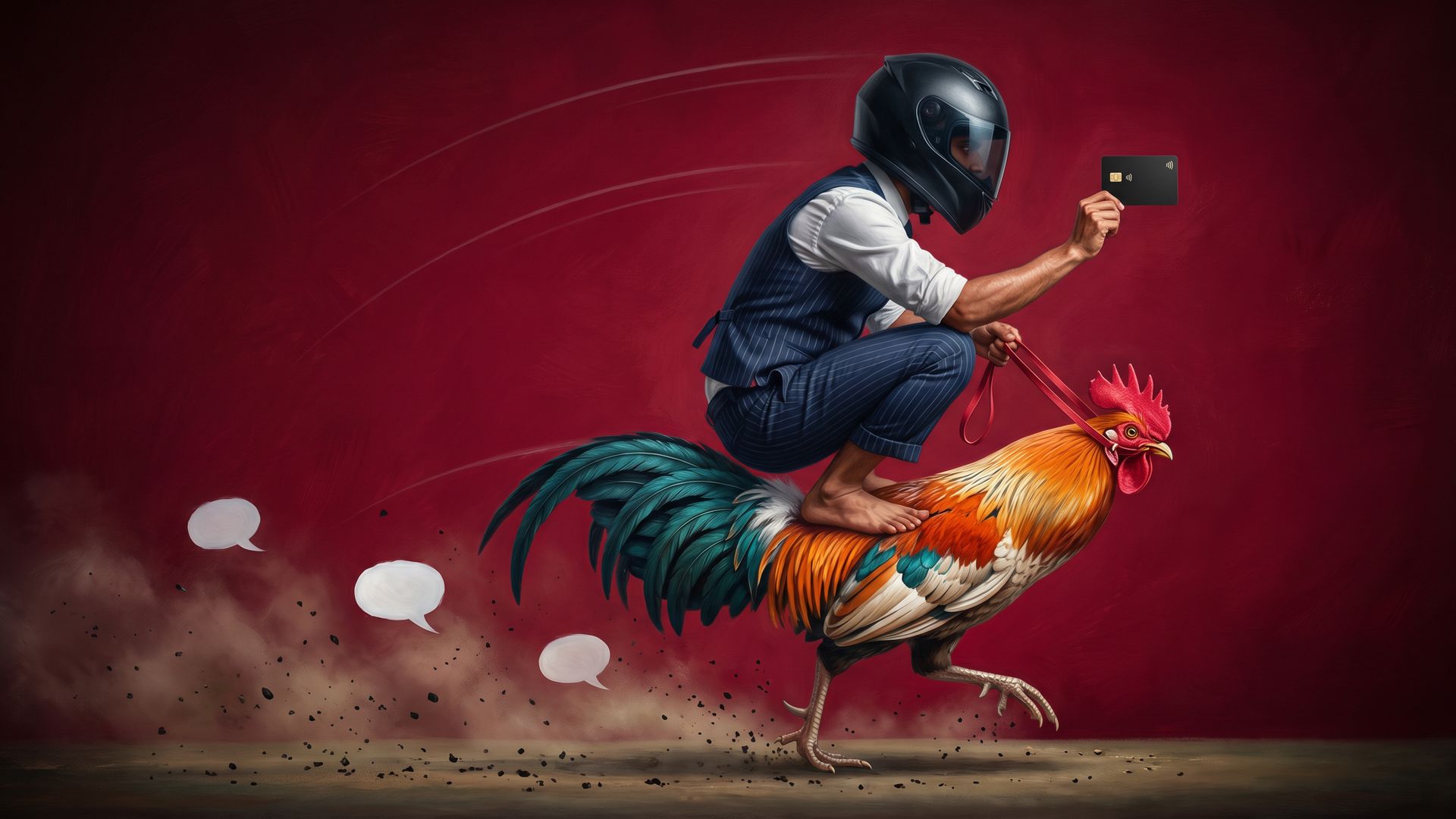
It is Friday afternoon and one meme format is all over Instagram. The social lead at a mid-sized fintech has a version ready: the brand mascot, a deadpan caption, and a jab at “banks that still make you visit a branch”. It would take ten minutes to publish. It sits in the compliance queue until Tuesday, and by then the format is dead. The team calls this the price of being regulated. The draft had a bigger problem. It compared the brand with its rivals, it hinted at a product benefit, and nothing on it said it was promotional. Unhinged marketing can work for a regulated brand, but only after you decide what the joke is allowed to touch.
Unhinged marketing works for brands with nothing to disclose
Unhinged marketing is a social media style in which a brand account behaves like an erratic, self-aware character. It replies fast to trending posts, mocks itself, teases rivals and followers, and posts memes that rarely mention the product. The appeal is that it looks unplanned. The account seems to be run by one funny person with no approval chain.
That look is the whole trick, and it is why the style suits some categories and fails others. A snack brand or a food-delivery app can post anything that is not offensive, because its posts carry no financial claim. Nobody loses money if a crisp brand exaggerates. When a mutual fund jokes about returns, a reader may act on the joke.
So the useful question for a financial brand is narrower than “should we go unhinged?” It is this: which parts of our account can sound loose, and which parts must read like an advertisement because, legally, they are one? Our view is that the loose part is smaller than most social teams think, and larger than most compliance teams fear.
The split also differs by stage. A new-age fintech that sells a payments app to people under 30 has more room than a hundred-year-old bank, because its audience expects a casual voice and its posts are less often about regulated products. An incumbent bank has more to lose from one bad screenshot, and its account is read by customers, regulators, journalists and its own staff, all at once.
What BFSI teams usually do with unhinged marketing now
Most banking, financial services and insurance (BFSI) brands land in one of three positions. Each is reasonable on its own terms, and each has a cost.
They copy the format and sand off the edges. The brand takes a trending meme, swaps in its mascot or product, and sends it through the normal approval route. This is the most common approach. The result is usually a meme that arrives three days late and has lost the joke in review. It rarely gets the reach the team hoped for, and it still carries risk, because the product is in the frame.
They hand the account to a young team with light approvals. Some fintechs let a small in-house or agency team post replies and memes without line-by-line review, on the logic that brand banter is not advertising. This gets the speed. It also means the first person to read a risky post may be a customer or a regulator.
They ban the style. Many banks and insurers keep every post formal and product-led. This is safe and predictable. The cost is attention: a feed of rate cards and festival greetings gives followers no reason to stop scrolling, and the brand ends up paying for reach it could have earned.
None of these teams is careless. The trouble is that all three treat the account as one thing, with one level of risk. A financial brand’s account carries two kinds of post, and they need different rules. For more on how we plan feeds for regulated brands, see our page on financial services social media.
SIGNALNewsletter by Yamm Labs
The next piece, straight to your inbox.
New writing on BFSI brands, B2B and influencer marketing, and AI search.
One click to unsubscribe. Privacy policy

Why unhinged marketing breaks under Indian and Gulf rules
It breaks because the rules read the post, not your intent. A meme that names a product, implies a benefit or mocks a rival is an advertisement under most financial advertising codes, and the codes were written to stop exactly the moves that make unhinged posts funny.
Take mutual funds first. The advertisement code in SEBI’s (Securities and Exchange Board of India) Mutual Funds Regulations says advertisements must be accurate, true, fair and clear. It bars testimonials and rankings, slogans that are exaggerated or unrelated to the product’s risk and return, celebrities (SEBI allows them only in industry-wide campaigns it approves first), and ads that discredit other advertisements or make unfair comparisons. The standard warning that mutual fund investments are subject to market risks must appear in legible fonts, with no words added or removed. In audio-visual ads, the warning has to be shown and voiced, and the code gives fourteen words running for at least five seconds as an example of clear and understandable.
Read SEBI’s list as a social media brief and most of the unhinged playbook is gone. Roasting a rival is an unfair comparison. A creator saying “this fund changed my life” is a testimonial. “Returns go brrr” is an exaggerated slogan. And if a seven-second meme reel that mentions a scheme follows the code’s five-second example, the warning takes up most of the reel, on screen and in voice. That is a design decision, made by the rule, before anyone writes a joke.
SEBI has also closed the side door. Its 2024 amendments, published in the Official Gazette on 29 August 2024 and explained in a January 2025 circular, bar SEBI-regulated entities and their agents from any direct or indirect association with a person who gives securities advice without registration or makes claims of returns or performance without permission. People engaged only in investor education are excluded, as long as they do neither. An unhinged collaboration with a popular money meme page is exactly the association those rules cover.
Insurance has its own version. Under IRDAI’s (Insurance Regulatory and Development Authority of India) 2024 regulations on policyholder protection and insurer operations, every insurer’s advertisement must show its registered name with its trade name or logo prominently. Advertisements issued by distribution channels, such as brokers and corporate agents, need the insurer’s written approval before they go out. Under the 2024 rules, that approval sits with the insurer. A broker’s quick meme about claim rejections is the insurer’s problem the moment it posts.
Across categories, the Advertising Standards Council of India (ASCI), a self-regulatory body, applies its code. It bans content that is indecent or vulgar, and ads that unfairly denigrate other products or their makers. It lists the disclosure labels it permits for promotional posts. It also allows obvious untruths or exaggerations meant to amuse, provided they are clearly seen as humorous or hyperbolic. That last line matters, and we come back to it below.
The Gulf is stricter on form. The Central Bank of the UAE’s Consumer Protection Standards apply to advertising on every channel, social media included. Licensed institutions’ ads must by default be in both Arabic and English, be immediately identifiable as promotional, and show the institution’s name, logo and contact details prominently. Disclaimers must be legible, and text must be at least size 10. A meme template for a UAE bank needs that frame built in before the joke is written. Separately, the UAE’s media content standards require respect for religious beliefs, the state and its institutions, national identity and culture, and personal privacy, and bar false or misleading content. Edgy humour that works in Mumbai can breach those standards in Dubai.
For a global contrast, the UK Financial Conduct Authority’s finalised guidance on social media promotions, published on 26 March 2024, says any type of communication can be a financial promotion and names memes directly. It says firms remain responsible for every promotion they make or cause to be made, including through influencers. It also says a firm that shares a customer’s post is responsible for compliance, even though the firm did not write it. That kills one more unhinged habit: reposting a follower’s meme about your product.
None of this bans humour. It means the joke and the product have to be kept apart, or the joke has to pass the same compliance review as a print ad. This is general guidance, not legal advice; your compliance team decides.
A risk filter for unhinged marketing at a regulated brand
The filter sorts each unhinged move into one of three verdicts: post freely, post only from a pre-approved format, or do not post. It is built from the rules above and from design logic. It is a starting point for your compliance team, not a substitute for it.
| Unhinged move | What it looks like | Rule it runs into | Verdict |
|---|---|---|---|
| Self-mockery | The mascot admits the app crashed on payday | Usually none, if no product claim is made | Post freely, with a tone check |
| Joining a trend with no product | A meme about Monday traffic, brand handle only | Decency and cultural standards, mainly in the UAE | Post freely in India; pre-approve in the Gulf |
| Replying to strangers | Witty replies under a viral post | Becomes an ad the moment it names a product, rate or fee | Pre-approved reply bank only |
| Roasting a rival | “At least our app opens” | SEBI and ASCI rules on unfair comparison and denigration | Do not post |
| Joking about returns or rates | “Your FD after inflation” with a fund logo | Exaggerated slogans, missing warnings, return claims | Do not post |
| Reposting a follower’s meme | Sharing a customer’s post about your product | The FCA treats the sharer as responsible; Indian codes read it as your ad | Pre-approve, or do not share |
| Meme-page or creator collab | A money meme account posts for the brand | SEBI’s association rules; ASCI disclosure labels; insurer approval | Only with a registered or vetted partner, labelled |
To run the filter on a single draft, ask these questions in order:
- Does the post name, show or imply a product, rate, return, premium, fee or claim? If yes, it is an advertisement: send it through the full ad review. If no, go to question 2.
- Does it mention, picture or hint at a competitor? If yes, do not post. If no, go to question 3.
- Will it run in the UAE or the wider Gulf? If yes, check it against the local content standards and the bilingual frame. If no, go to question 4.
- Is it a reply, a repost or a collaboration? If yes, use only a pre-approved format or a vetted partner. If no, it can go out after a tone check.
Many unhinged drafts at a financial brand fail at question 1, because the social team wants the joke to sell something. That is the habit to break. The jokes that survive the compliance filter are about the brand’s own quirks and the shared misery of everyday money admin, never about what the product will do for you.
Be loose about yourself and strict about the product.
The strongest case for unhinged marketing in BFSI
The best argument against our view is a fair one, and part of it is right. ASCI’s code allows clearly humorous exaggeration. Plenty of brand posts have no product in them at all, so the product codes do not bite. And a stiff, product-only feed loses people. Younger customers in India grew up on meme accounts, and a bank that posts only rate cards looks like it does not want them.
The argument goes further. Fintechs compete with apps that post freely, and a fintech that sounds like a bank gives up one of the few edges it has. Compliance queues are slow because teams are cautious, not because every rule demands it. A good compliance partner can approve a format in advance, which is how some brands keep pace.
We accept most of that. Where we part ways is on the asymmetry. The upside of an unhinged post is reach, which fades within days. The downside is a screenshot of your brand mocking a rival or joking about returns, which lasts as long as someone keeps it. For a regulated brand the bad outcome is a mis-selling complaint, a regulator’s letter, a news story or a pile-on in the comments, and those cost more than one viral week earns.
There is also the trend itself. Unhinged marketing is a style of this moment, and styles turn. A brand that rebuilds its whole voice around chaos may find, in a year or two, that it has a personality its audience has moved past and its compliance team never liked. A voice with loose edges and a plain core is easier to adjust when the trend fades.
So our answer to the strongest case is to take what it gets right, which is speed and self-mockery, and refuse the parts that carry the risk: rivals, returns, reposts and unvetted collaborations.
What to do instead of full unhinged marketing
Run two lanes on the same account. The first lane is the character: fast and allowed to be silly about the brand, its people and everyday money annoyances. The second lane is the product: plain, accurate and fully disclosed. Nothing moves from lane one to lane two without full review.
Here is what a marketing head can do on Monday:
- Write the never list. One page, signed by compliance: no rivals, no returns or rates in jokes, no claims language, no reposts of customer posts about products, no collaborations with unregistered advice accounts. Give it to everyone who touches the account, including the agency.
- Pre-approve twenty formats. Ask compliance to approve reply templates and meme frames once, so the team can fill them in on the day without a new review. For a UAE account, build the bilingual frame, name, logo and contact details into the template.
- Agree a fast lane. Set a turnaround time for lane-one posts that fits a trend window, and a named compliance reviewer who can say yes or no within it. If the reviewer is unavailable, the default is no.
- Keep a record. Archive every post and reply with the date, the writer and the approval, including the ones that went through the fast lane. If a post is questioned later, you can show who approved it and why.
- Vet every partner. Before a meme page or creator posts for you, check their registration status where SEBI’s rules apply, the disclosure label they will use, and, for insurers, the written approval.
Then tell your compliance team, in writing: what lane one may cover, what is on the never list, which formats are pre-approved, who signs off on the fast lane and where the archive lives. That email is what lets a social team move quickly without guessing. For the questions finance social teams ask us most, see our finance social media questions page.
A hypothetical example shows how the lanes play out. An AMC’s social team spots a trending meme about people checking their bank balance after a long weekend. Lane one: the mascot posts the meme about its own team checking the office coffee budget, with no fund in sight, from a pre-approved frame. Lane two, a week later: a plain carousel on why systematic investment plans spread out purchase prices, with the standard warning in legible type. The first post gets the attention. The second does the selling, and it has been reviewed like an ad because it is one.
What would change our view on unhinged marketing
Three things would loosen our position. The first is regulator guidance that speaks to humour and brand banter directly, the way the FCA’s guidance speaks to memes, and says where a joke stops being a promotion. The second is platform tools that keep a disclosure or warning attached to a post when it is shared, cropped or screenshotted. The third is published, independent evidence that unhinged posts from financial brands produce customers and not only followers. We have not seen that evidence for Indian or Gulf financial brands yet.
Until then, our advice is the same for a Gurugram fintech or a Dubai bank. Borrow the pace and the self-mockery. Keep the product out of the joke. For how we work from Gurugram with BFSI brands in India, the Gulf and other markets, see about Yamm Labs.
People also ask
Is unhinged marketing allowed for mutual funds in India?
A brand post with no scheme or returns in it is less likely to count as an advertisement under SEBI’s definition, which covers communication that may influence investment decisions, though ASCI’s code still applies. Once a post mentions a scheme or returns, SEBI’s code bars exaggerated slogans, testimonials, celebrities and unfair comparisons, and requires the standard warning. That leaves little room for unhinged humour about the product itself.
Can a fintech reply to trending memes without compliance approval?
It can if the reply is drawn from formats compliance has approved in advance and does not mention a product, rate, fee or rival. Anything outside the approved formats should go through compliance review. A reply is a post, and regulators read it the same way.
Does unhinged marketing work for banks in the UAE?
Only in a narrow lane. The Central Bank of the UAE’s consumer protection standards require ads from licensed institutions to be identifiable as promotional, by default in Arabic and English, with the name, logo and contact details shown prominently. The UAE’s media content standards add limits on religious, national and cultural content, so edgy humour needs local review.
Want to know which of your social posts would survive a compliance review today?
Get a free Fintech Brand Audit across 8 dimensions, plus 3 fixes. No pitch. Run the free Brand Audit →