


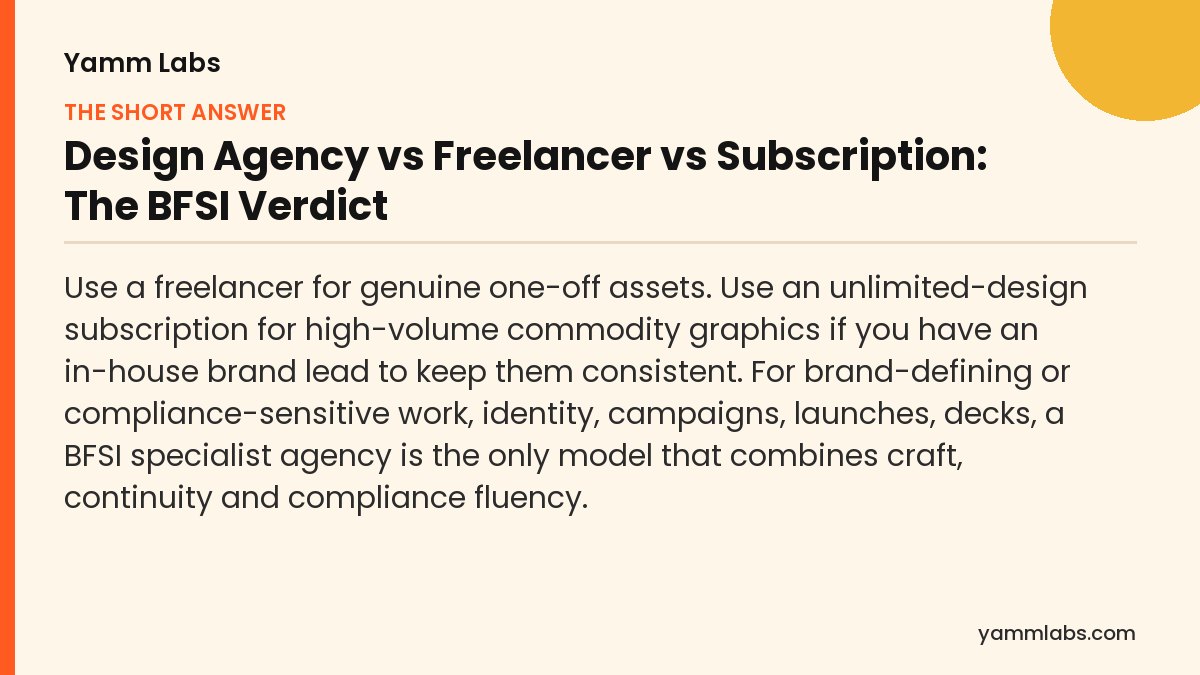
If you run marketing at a fintech or financial company, you have faced the choice: hire a freelancer, subscribe to an unlimited-design service like Superside or Design Pickle, or engage a specialist agency. Each has a place. For a regulated financial brand, though, they are not interchangeable, and picking the wrong model is expensive in ways that only show up later, in a rejected campaign or a brand that looks like every competitor. Here is an honest agency vs freelancer vs subscription comparison, from an agency that only does BFSI.
- The freelancer
- The unlimited-design subscription
- The specialist agency
- Agency vs freelancer vs subscription, side by side
- The honest verdict
- What each model really costs you
- How to decide: five questions for each piece of work
- A worked example: one quarter of design work, split by model
- Who checks compliance in each model
- Common mistakes when choosing a design model
- How to brief a freelancer, a subscription or an agency
- Signs your current model is not working
- People also ask
The freelancer
Best for: one-off assets, tight budgets, fast turnarounds on simple work.
The BFSI problem: a freelancer rarely carries compliance fluency or brand-system continuity. They will execute a brief beautifully. They will not catch that your disclaimer placement breaches a platform policy, and they cannot hold a multi-touchpoint brand system together over months. For a one-off social graphic, that is fine. For anything that has to clear SEBI, IRDAI or RBI framing, you are relying on luck.
The unlimited-design subscription
Best for: high-volume, low-complexity graphics at a predictable monthly cost.
Services like Superside, Design Pickle, Kimp and ManyPixels are genuinely good at production velocity. If you need fifty on-brand social variations a month, they deliver.
The BFSI problem: rotating designer pools mean no brand consistency and no strategic input. Critically, they carry zero compliance depth. They cannot run a rebrand, and they do not know a risk-o-meter from a rate card. For a regulated brand, that is not a discount; it is a liability waiting for the campaign that gets pulled. A subscription only works safely once you already have a system for it to follow, and an in-house owner enforcing it.
The specialist agency
Best for: brand systems, campaigns, launches, and any work where strategy and compliance matter, which, in finance, is most work.
The trade-off: higher cost per asset than a subscription.
The payoff: a partner who already knows your regulatory constraints, holds your brand together across every touchpoint, and starts from positioning rather than pixels. The value is not the individual asset; it is that nothing has to be re-cleared, re-explained or re-designed because the partner understood the context the first time.
Agency vs freelancer vs subscription, side by side
| Freelancer | Subscription | Specialist agency | |
|---|---|---|---|
| Best for | One-off assets | High-volume commodity graphics | Brand, campaigns, launches, decks |
| Compliance depth | Rarely | None | Built in |
| Brand continuity | Limited | Weak (rotating pool) | Strong |
| Strategy | Executes briefs | None | Starts from positioning |
| Cost per asset | Low–medium | Lowest at volume | Highest |
| Risk for a regulated brand | Medium | High | Low |
The honest verdict
There is no single winner. The right answer is a mix, matched to the work. Use a freelancer for genuine one-offs. Use a subscription for high-volume commodity graphics once you have an in-house brand lead and a system to keep them consistent. For the work that defines how a financial brand is perceived, use a BFSI specialist. The cheapest option is expensive if it fails legal review or makes you look like every competitor. In regulated finance, compliance fluency is not a premium feature; it is the thing that keeps your campaigns live.
The cheapest design is expensive if it fails legal review or makes you invisible.
What each model really costs you
The price on the proposal is only part of the cost. For a regulated brand, the rest shows up in your team’s time and in work that has to be done twice. Before comparing quotes, count these.
- Briefing time. A freelancer or a rotating subscription designer needs the context explained each time. Someone on your team writes those briefs, answers questions and repeats the brand rules. That is salaried time, even if it never appears on an invoice.
- Review rounds. Every round pulls in marketing, and often legal and compliance. Work that arrives without the disclaimers and disclosures in the right place adds rounds.
- Rework and re-clearing. An asset that fails legal review is redesigned and sent back through approval. A campaign pulled after launch costs the media already spent and the time to rebuild it.
- Brand drift. When many hands produce work without a system, the brand slowly stops looking like one company. Fixing that later usually means a new guidelines project.
- Onboarding. A new freelancer, or a new designer from a subscription pool, has to learn your brand from scratch. A long-term partner learns it once.
None of this makes the cheaper models wrong. It means the fair comparison is cost per approved, on-brand asset, not cost per file delivered.
How to decide: five questions for each piece of work
The agency vs freelancer choice is rarely one decision for the whole year. It is a decision per type of work. Run each piece through these questions.
- Does this work define how the brand is perceived? Identity, a rebrand, a launch campaign or an investor deck shapes perception for years. If yes, it belongs with a specialist.
- Will it go through compliance review? Anything carrying product claims, returns, risk language or regulated disclosures needs a partner who designs for review from the start.
- Is there a system for it to follow? If brand guidelines, templates and a component library already exist, a freelancer or subscription can produce consistent work inside them. If not, build the system first.
- Who owns consistency in-house? A subscription only works safely with a named brand owner who checks every output. Without that person, quality drifts.
- How much volume is there? Fifty social variations a month is a volume job. One launch film is not. Volume favours the subscription; stakes favour the specialist.
If the answers point in different directions, the stakes question wins. A high-volume job that also carries regulated claims still needs someone who understands the rules.
A worked example: one quarter of design work, split by model
Picture a fintech marketing team planning a quarter. It has a product launch, an always-on social calendar, a sales deck refresh and a handful of small requests. Applying the logic of this article, the split looks like this.
- Launch campaign and key visual: specialist agency. It defines perception, carries product claims and must clear compliance before it goes live.
- Sales and investor deck: specialist agency, because it represents the brand in the rooms that matter most and often includes figures that legal will check.
- Social variations of the launch visual: subscription, once the key visual and templates exist and the in-house brand lead reviews every output.
- A one-off event banner: freelancer, briefed with the brand guidelines and the approved lock-ups.
The specialist builds the system and the high-stakes pieces. The cheaper models then work inside that system, where their speed is useful and their lack of compliance depth is contained. That is the mix the verdict above describes.
Who checks compliance in each model
In India, financial advertising answers to the sector regulator, such as SEBI, IRDAI or RBI, and to the self-regulatory code of the Advertising Standards Council of India. The ASCI Code asks that advertisements be honest and truthful. Sector rules add product-specific requirements on claims, warnings and disclosures. Confirm the current text with your compliance team, because the rules are updated.
The design model changes who carries that knowledge. With a freelancer or a subscription, your team supplies every rule in the brief and checks every output. With a specialist, much of that thinking is built into the work before it reaches your reviewers. Either way, final sign-off stays with your compliance function. Our overview of SEBI, IRDAI and RBI advertising rules covers the principles by regulator.
Common mistakes when choosing a design model
Choosing by monthly cost alone. A lower invoice can hide more review rounds, more rework and more of your own team’s time. Compare the cost of approved, on-brand work.
Starting a subscription before a system exists. Rotating designers need rules to follow. Without guidelines and templates, each designer invents the brand again.
Giving brand-defining work to the cheapest option. This is the pattern the callout above describes: paying once for the cheap version and again to fix it.
Assuming a talented freelancer knows the regulations. Craft and compliance fluency are different skills. Unless the freelancer has worked on regulated financial briefs, assume the rules must be spelled out.
No named brand owner in-house. Every model needs someone on your side who says yes or no. Without that role, consistency depends on whoever happened to make the last asset.
Using one model for everything. The work varies, so the model should too. A mix matched to the stakes is usually cheaper and safer than any single option.
How to brief a freelancer, a subscription or an agency
Freelancer. Send the brand guidelines, approved logo files, the exact copy including disclaimers, the sizes needed and one example of work you consider on-brand. Name who approves the final file and by when.
Subscription. Set up a brand folder once: guidelines, templates, fonts, colour values, approved imagery and the standard disclaimer blocks. Every request should point to a template. Your in-house brand lead reviews each output before it goes anywhere near compliance.
Specialist agency. Brief the business problem, not just the deliverable. Share the positioning, the audience, the product details compliance will check, the channels, the review path and the launch date. Ask for the thinking before the design, so the direction is agreed while changes are still cheap.
For more on choosing a partner, see our guide to what a fintech brand agency does.
Signs your current model is not working
Most teams do not choose a model once and forget it. The work changes as the company grows, and the model should be reviewed when the warning signs appear.
- Legal keeps sending work back. If the same kinds of comments return on every asset, the people making the work do not have the rules built into their process.
- Your assets no longer look related. Put the last month of creative on one wall. If it looks like several companies, consistency has slipped.
- Your team spends more time briefing than thinking. When marketing managers are rewriting instructions every week, the model is using their time as its quality control.
- Launches feel rushed every time. If each campaign starts from a blank page, there is no system to build on.
- You cannot say who owns the brand. If nobody can approve or reject a design with confidence, add that role before adding more production capacity.
One sign alone may be a bad month. Two or three together usually mean the split between models needs to change, often by moving system-building work to a specialist and keeping volume work where it is.
People also ask
Are unlimited-design subscriptions worth it for fintech?
For high-volume commodity graphics, yes, provided you have an in-house brand owner and a system to keep the rotating designers consistent. For brand-defining or compliance-sensitive work, no, because these services carry no compliance depth or strategic input.
What is the cheapest safe option for a regulated brand?
A specialist for the brand system and high-stakes creative, plus a subscription or freelancer for commodity volume once that system exists to keep them on-brand. The system is what makes the cheaper models safe to use.
Can a freelancer handle BFSI design work?
For simple one-off assets, often yes. For anything that must clear SEBI, IRDAI or RBI framing or hold a brand system together over time, a freelancer rarely carries the compliance fluency and continuity the work needs.
Is a design agency or a freelancer better for a fintech startup?
It depends on the work. For the brand identity, launch campaign and investor deck, a specialist agency is the safer choice because those pieces shape perception and often face compliance review. Once guidelines and templates exist, a freelancer can handle one-off assets inside that system at a lower cost, as long as someone in-house checks the output.
Can you use a design subscription and an agency together?
Yes, and many teams do. The agency builds the brand system and the high-stakes creative. The subscription then produces volume work, such as social variations and banner resizes, from the agency’s templates. An in-house brand lead keeps the two aligned and routes regulated claims through compliance before anything is published.
What should a BFSI design brief always include?
The business goal, the audience, the channel and sizes, the exact copy with every disclaimer and disclosure, the brand guidelines, an example of approved work, the review path and the deadline. For regulated products, add the specific claims compliance will check, so the designer can plan space for mandatory text instead of squeezing it in later.
When should a financial brand switch from freelancers to an agency?
Usually when the work starts to define the brand rather than decorate it: a rebrand, a product launch, a fundraise deck or a campaign that will run across many channels. Another signal is drift, when assets from different people no longer look like one company. At that point a system is needed before more volume.
How do you keep a design subscription on-brand?
Give it a system to follow and a person to answer to. That means brand guidelines, editable templates, approved imagery, colour values and the standard disclaimer blocks in one shared folder, with every request pointing to a specific template. A named in-house brand lead reviews each output before it moves to compliance or goes live.
What does an in-house brand lead do in a mixed model?
They hold the brand together across every supplier. That means keeping the guidelines and templates current, writing or approving briefs, reviewing each asset for consistency before it reaches compliance, and deciding which work goes to which partner. In a small team this can be part of a marketing manager’s role, but it needs to be named and owned, not shared loosely.
Why does a specialist agency cost more per asset?
Because you are paying for context, not just execution: regulatory knowledge, brand continuity across every touchpoint, and strategy that starts from positioning. That context is what stops work from being re-cleared, re-explained or redesigned later.
Not sure which model fits your stage?
Ask us for a free 15-minute brand call. We will give you a straight answer on what to keep in-house, what to outsource, and where a specialist actually pays for itself. Book a call →
2 Comments