


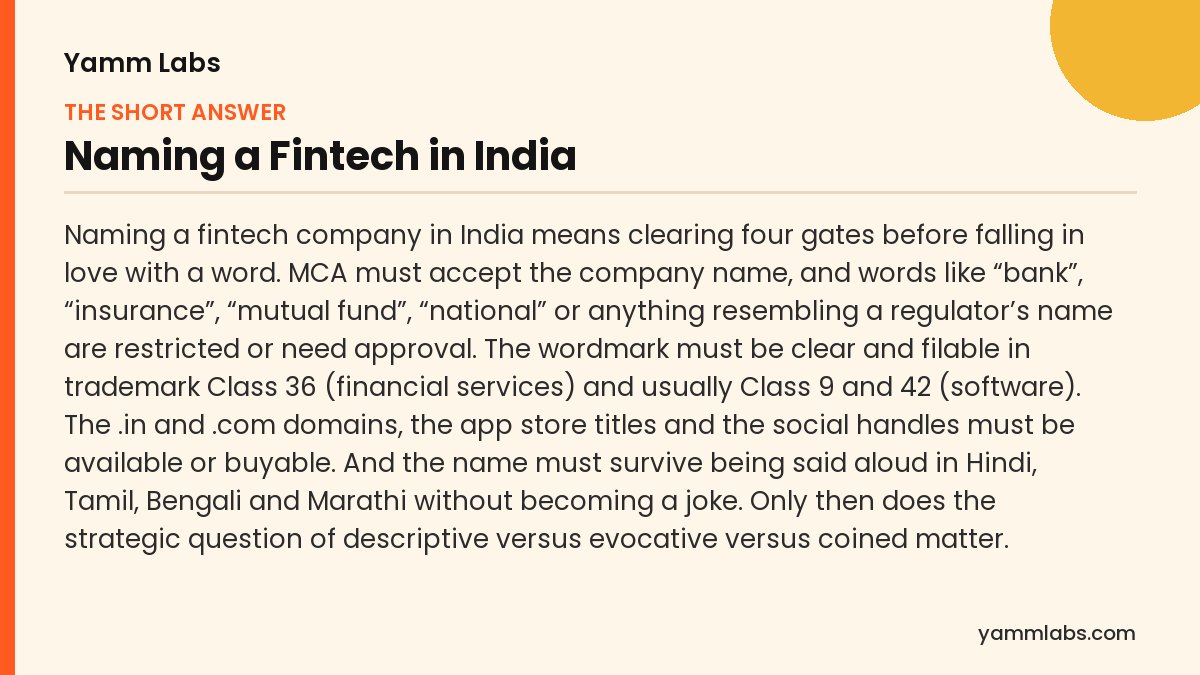
A founder walks in with a name she has loved for six months. The .com is taken by a dentist in Ohio, the .in is parked, an NBFC in Coimbatore filed a similar wordmark in Class 36 in 2019, and the second syllable sounds like a Hindi word for “loss”. None of this came up in the pitch deck. Fintech naming in India is a legal, regulatory and linguistic exercise with a creative layer on top, and the order matters: the constraints first, the creativity inside them.
- What kinds of names do fintech companies choose, and what does each signal?
- What are the Indian legal and regulatory constraints on a fintech name?
- How do you search and file a trademark in Class 36 for a fintech?
- Which domain, app store and handle checks matter, and does .in beat .com?
- How do you test a fintech name for pronunciation across Indian languages?
- How do you score candidate names before choosing one?
- What does naming a fintech company look like from brief to registered mark?
- People also ask
What kinds of names do fintech companies choose, and what does each signal?
Four strategies cover almost every Indian fintech name. Each has a cost in trademark strength, explanation burden and how it ages.
- Descriptive. The name says what the product does: Cashfree, Scripbox, Khatabook, Stable Money, Lendingkart. Easy to understand, cheap to explain in a 6-second ad, weak as a trademark because descriptive terms are hard to protect and easy for competitors to sit near. Descriptive names also trap a company in its first product; a lender called “Lendingkart” has to work to be seen as anything else.
- Evocative. A real word borrowed for its associations: Jupiter, slice, Jar, Navi, Groww (a misspelling to secure the mark and domain). Stronger trademarks than descriptive names, more room to grow, but they need a tagline or a category cue for the first two years. Jupiter needed “the 1-app for everything money” underneath the name for a long time.
- Coined. An invented or constructed word: Zerodha (zero plus “rodha”, Sanskrit for obstacle), Razorpay, Kuvera (from Kubera, the deity of wealth), Paytm (pay through mobile), PhonePe (a bilingual pun on “phone pe”, on the phone). Strongest trademark position, cleanest domain and handle availability, highest explanation cost. The best coined names carry a hidden meaning that the company can tell as a story.
- Abbreviated or founder-led. CRED (credit, credibility), Fi (from “financial”, operated by epiFi), INDmoney, Dhan. Short names dominate app icons but are harder to clear; every two- and three-letter combination has prior filings somewhere. Founder names are rare in fintech, unlike in broking and wealth (Motilal Oswal, Bajaj) where a family name signals lineage.
What a name signals matters more than its category. Zerodha signals engineering and a founder’s philosophy. CRED signals exclusivity. Navi signals a fresh start. Groww signals the retail investor’s goal in one word. Kuvera signals cultural rootedness to an audience that wants a quiet, trustworthy wealth product. Among the names in India’s 50 best fintech brands, the ones that age well had their signal chosen deliberately rather than inherited from a domain that happened to be free.
SIGNALNewsletter by Yamm Labs
The next piece, straight to your inbox.
New writing on BFSI brands, B2B and influencer marketing, and AI search.
One click to unsubscribe. Privacy policy

What are the Indian legal and regulatory constraints on a fintech name?
These are the gates, in the order a company hits them.
- MCA name availability. A company name is reserved through the MCA’s SPICe+ process. The Registrar rejects names that are identical or too similar to an existing company or LLP, that are identical to a registered trademark in the same field without consent, that are misleading about the company’s business, or that contain restricted words. A reserved name is held for a limited period, so the trademark search should be done before reservation, not after.
- Words that need prior approval or an NOC. Under the Companies (Incorporation) Rules, words such as “Bank”, “Banking”, “Insurance”, “Assurance”, “Mutual Fund”, “Asset Management”, “Venture Capital”, “Stock Exchange” and “Nidhi” require a no-objection from the relevant regulator (RBI, IRDAI, SEBI or MCA itself). A separate list of words including “National”, “Union”, “Central”, “Federal”, “Republic”, “Board”, “Commission” and “Authority” requires Central Government approval. The Banking Regulation Act reserves “bank”, “banker” and “banking” for licensed banking companies. Under the Emblems and Names (Prevention of Improper Use) Act, names resembling the Reserve Bank of India or national emblems are prohibited outright. RBI has publicly cautioned against unregulated entities using “bank” in their names or apps.
- Regulated-entity naming. If you will hold an RBI certificate of registration as an NBFC, a SEBI registration as a broker, investment adviser or AMC, or an IRDAI licence, the regulator sees the name on the application and can object to anything that implies a status you do not have. An unregistered entity implying it is a “registered” adviser, “authorised” payment system or “licensed” lender is a violation, not a naming choice.
- Lending service providers. Under RBI’s digital lending guidelines, a lending app must disclose the regulated entity behind the loan. If your company is an LSP and not the lender, the app name and brand must not suggest you are the one lending. A name like “X Loans” for a marketplace that does not lend is a compliance conversation waiting to happen.
- Payment brands. A third-party UPI app operates through a PSP bank and is on-boarded by NPCI. The app name appears in the UPI ecosystem and on merchant surfaces, and NPCI’s brand norms for the UPI mark apply. Names that resemble NPCI products (BHIM, RuPay, UPI itself) are off-limits in practice.
How do you search and file a trademark in Class 36 for a fintech?
Trademark Class 36 covers insurance, financial affairs, monetary affairs and real estate. Every fintech files there. Most also file in Class 9 (software and apps), Class 42 (software as a service) and Class 35 (business and advertising services), because a wordmark protected only for “financial services” does not stop a competitor registering the same word for an “app”.
- Search before you fall in love. The IP India public search allows wordmark, phonetic and device (Vienna code) searches. Run all three in Classes 36, 9, 42 and 35. Phonetic search is the one founders skip and the one that catches “Kredit” against “Credit”. Then search MCA’s company master data and the LLP register for similar names, and the RBI’s list of registered NBFCs, because a similar NBFC name is a practical conflict even if the trademark register is clear.
- Read the results as a lawyer would. An identical mark in Class 36 with status “Registered” is a stop sign. An identical mark “Abandoned” or “Withdrawn” may be clearable. A similar mark in Class 36 for a different financial service is a judgement call that a trademark attorney should make, not a designer.
- File early, in all relevant classes. The application form is TM-A. Government fees for e-filing are lower for a startup recognised under Startup India or a small enterprise than for a larger company, per class per mark. Filing establishes priority from the application date; registration typically takes a year or more with no opposition, longer with one. Use “TM” from filing, “®” only after registration.
- File the wordmark, then the logo. A wordmark in standard characters protects the name in any font. A device mark protects the specific logo. File both, separately, so that a future redesign does not orphan your protection. Our post on fintech logo design mistakes covers why a logo tied too closely to a launch-year trend becomes a re-filing problem later.
- Watch the register. Set up a watch on similar filings in your classes. The cheapest opposition is the one filed within the four-month window after a conflicting mark is advertised in the Trade Marks Journal.
Which domain, app store and handle checks matter, and does .in beat .com?
For an Indian fintech the practical answer is: get both, use one. The .com signals scale and is what a global investor types. The .in signals Indian, is administered by NIXI, and is cheap to hold. Most Indian fintechs use .com as primary (zerodha.com; groww.in is the exception), hold the .in defensively, and a newer generation uses money-related TLDs (jupiter.money, fi.money). Those newer TLDs are acceptable for a consumer app and often the only way to get a short name, but they need more type-in reinforcement in advertising because Indian users still default to .com.
Beyond the domain, check in this order:
- App store titles. Both Apple’s App Store and Google Play limit app titles to 30 characters and will reject a title that duplicates an existing app in the same category. A coined name is usually free; an evocative single word almost never is, which is why so many fintech apps carry a colon and a descriptor (“Jupiter: UPI & Credit Cards”).
- Social handles. Instagram, X, LinkedIn, YouTube. Consistency matters more than brevity; “@navi” is worth less than the same handle everywhere.
- UPI handle. Your VPA suffix is assigned through the PSP bank, so it will not be your name unless you are large enough to negotiate one. Plan the customer-facing UPI ID pattern early; it appears on every QR sticker.
- Email and SMS sender IDs. TRAI’s sender-ID registration means your six-character SMS header is a brand asset. Reserve it with the name.
How do you test a fintech name for pronunciation across Indian languages?
An Indian fintech name will be spoken in at least four scripts and by call-centre agents in six cities. Test it before filing.
- The “v” and “w” problem. Hindi, Marathi and Bengali speakers merge v and w in different directions. “Kuvera” survives because both readings are close; a name built around a hard “w” often does not.
- The “z” problem. Zerodha is routinely “Jerodha” in the Hindi belt. That has not hurt Zerodha, but a name whose meaning changes with z-to-j should be avoided.
- Doubled and silent letters. Groww works because the double-w is invisible in speech. A silent letter that changes the spelling a user types into an app store is a customer-acquisition tax.
- Unintended meanings. Check Hindi, Tamil, Telugu, Kannada, Malayalam, Bengali, Marathi, Gujarati and Punjabi at minimum. A one-day exercise with native speakers; it has stopped more names than trademark search has.
- Read it aloud in an ad. Record a 15-second radio script in Hindi and Tamil. If the voice artist stumbles, so will the customer.
How do you score candidate names before choosing one?
Every shortlist goes through this scorecard. A name must pass the first three rows outright; the rest are scored 1 to 5 and weighted. Names that score well on strategy but fail a gate are dropped without discussion, which spares the founder the six-month attachment problem.
| Criterion | Gate or score | How to test | Weight |
|---|---|---|---|
| MCA availability and restricted words | Gate | MCA name search; check the restricted-words lists; regulator NOC needed? | Pass/fail |
| Trademark clearance in Class 36, 9, 42, 35 | Gate | Wordmark, phonetic and device search on IP India; attorney opinion | Pass/fail |
| Regulator conflict (RBI, SEBI, IRDAI, NPCI) | Gate | Does the name imply a licence, a product or a regulator you are not? | Pass/fail |
| Domain and app-store availability | Score | .com and .in status; app store title conflict; handle consistency | 15% |
| Pronunciation across Indian languages | Score | Native-speaker read-aloud in 8 languages; radio script test | 15% |
| Strategic signal (what the name says about the company) | Score | Founder and customer interviews; does it match the positioning? | 20% |
| Distinctiveness in the category | Score | Place it on a page with 20 competitor names; does it stand apart? | 15% |
| Room to grow beyond the first product | Score | Say the name with “credit card”, “insurance”, “wealth”; does it still work? | 15% |
| Visual potential | Score | Letterforms, length in an app icon, ability to abbreviate | 10% |
| Story | Score | Can the founder explain the name in one sentence a journalist will repeat? | 10% |
What does naming a fintech company look like from brief to registered mark?
A realistic timeline is eight to ten weeks from brief to a cleared, filed name, and a year or more before the trademark registers. The sequence: positioning brief (week 1), 150 to 300 candidates across all four strategies (weeks 2 to 3), cut to 30 on strategic fit (week 4), gate checks (weeks 4 to 5), language testing and scoring on the surviving 10 (week 6), attorney opinion and MCA reservation on the final 3 (weeks 7 to 8), then trademark filing and domain purchase the day the name is chosen. Identity work starts after filing. The name then goes into the guidelines with its pronunciation, story and legal-name pairing, which we cover in brand guidelines for fintech startups.
In India, a fintech name is cleared by MCA, protected in Class 36 and pronounced in eight languages before it is ever loved.
People also ask
Can a fintech company use the word “bank” in its name in India?
No, unless it holds a banking licence from RBI. The Banking Regulation Act reserves “bank”, “banker” and “banking” for licensed banking companies, and MCA will not reserve a company name containing those words without RBI’s no-objection. Neobanks and payment apps operate on top of a partner bank and must make that relationship clear rather than adopt the word.
Which trademark class should a fintech register in?
Class 36 (insurance, financial and monetary affairs) is the core class. Most fintechs also file in Class 9 for software and mobile apps, Class 42 for software as a service, and Class 35 for business services, so that the name is protected both as a financial service and as a technology product.
Is a .in domain enough for an Indian fintech?
It is enough to operate and it signals Indian origin, but most fintechs treat .com as the primary domain for investor and global credibility and hold the .in defensively. If the .com is unavailable, newer TLDs such as .money or .app are workable for a consumer product, provided the name is short and advertising reinforces the full address.
How long does trademark registration take for a fintech in India?
Filing can be done in a day and gives priority from the filing date. Examination, advertisement in the Trade Marks Journal and the opposition window mean registration typically takes a year or more if unopposed, and considerably longer if a third party opposes. Companies can use the name and the TM symbol from the filing date.
Sources
A name that passes every gate is the first brand decision you never have to revisit.
Get a free Fintech Brand Audit across 8 dimensions, plus 3 fixes. No pitch. Run the free Brand Audit →