


A relationship manager at a Mumbai distribution firm has 40 minutes before her 11 am client meeting. She has a new mid-cap NFO to talk about, a 38-slide scheme presentation from the AMC in her inbox, and a factsheet she cannot open on her phone without pinching the screen. She opens WhatsApp instead and forwards a competitor’s one-pager, because it fits and it says what she needs to say. That is the moment most AMC distributor communication is lost.
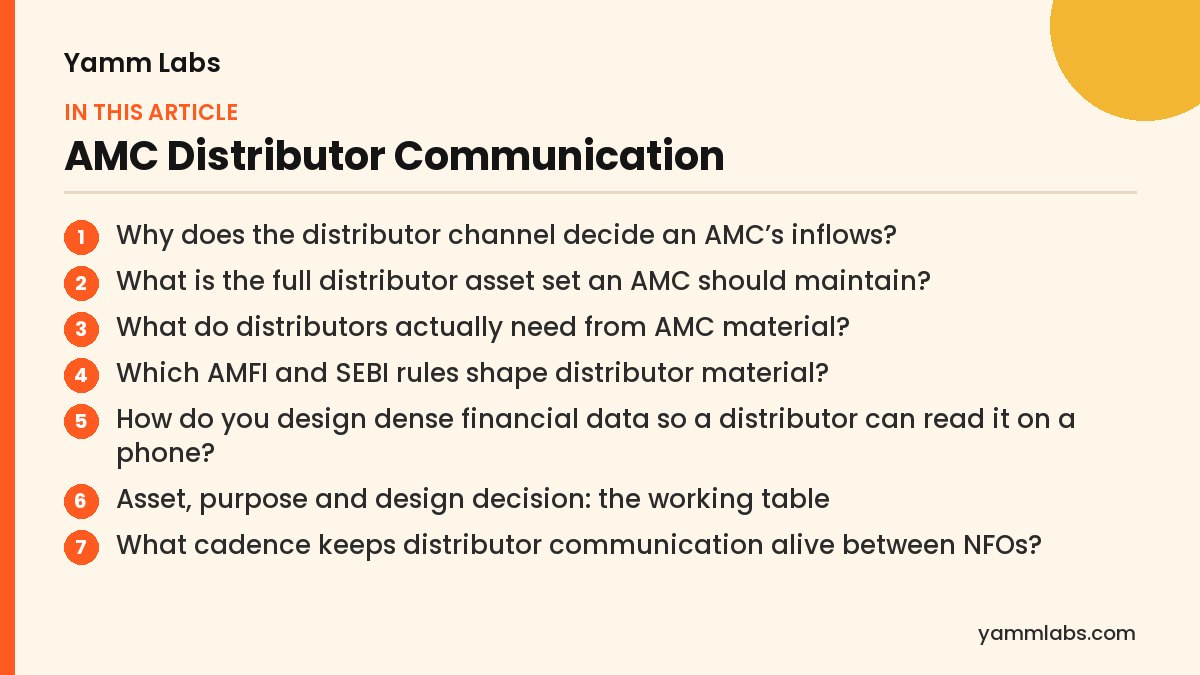
- Why does the distributor channel decide an AMC’s inflows?
- What is the full distributor asset set an AMC should maintain?
- What do distributors actually need from AMC material?
- Which AMFI and SEBI rules shape distributor material?
- How do you design dense financial data so a distributor can read it on a phone?
- Asset, purpose and design decision: the working table
- What cadence keeps distributor communication alive between NFOs?
- How should an AMC brief a design team on distributor material?
- People also ask
Why does the distributor channel decide an AMC’s inflows?
India’s mutual fund industry has grown to a scale measured in lakhs of crores of rupees, and a large share of retail equity flows, including the bulk of SIP registrations outside the direct-plan apps, still comes through mutual fund distributors (MFDs) and independent financial advisers (IFAs). AMFI’s registered distributor base runs into lakhs of ARN holders, from national distributors and bank channels to single-person practices in tier-2 towns.
For an AMC, this changes what “marketing” means. The end investor rarely reads a scheme presentation. The distributor does, and then translates it across the table. So the AMC’s real audience is a time-poor intermediary who is simultaneously selling schemes from 40 other fund houses. If your material is harder to use than Nippon India’s, Mirae’s or ICICI Prudential MF’s, the distributor uses theirs. The fund with the clearest explanation gets the mention, and the mention gets the SIP.
Across years of AMC work we have found that AMC distributor material fails for one repeated reason: it is written to describe the scheme, not to help someone sell it. Those are different documents.
What is the full distributor asset set an AMC should maintain?
Most AMCs produce these seven assets, but few treat them as one system with shared components. The list below is the working set we build for fund houses, with what each asset is for.
- Product note (2 to 4 pages). The scheme’s investment thesis, portfolio construction rules, fund manager, benchmark, where it sits versus category peers, and who it is for. This is the reference document a distributor reads once and quotes from for a year.
- Scheme presentation (12 to 15 slides). The deck a distributor projects or shares in a client meeting. It must survive being forwarded without a presenter.
- Monthly factsheet. The regulated document: portfolio holdings, sector allocation, performance versus benchmark, riskometer, expense ratio, AUM. It must be accurate first and legible second, but legible matters more than most AMCs accept.
- One-pager. A single A4 or a single phone screen that carries the scheme’s positioning, three reasons, the riskometer and the disclaimer. This is the most forwarded asset in the set.
- WhatsApp creative. A 1080 x 1080 or 1080 x 1350 image with one idea, the scheme name, ARN placeholder space and the compliance block. It is where most tier-2 and tier-3 distribution actually happens.
- Training deck. The internal deck for distributor onboarding sessions: category explanation, scheme mechanics, objections, and worked examples. Longer than the scheme presentation, and never sent to investors.
- Sales pitch video (60 to 120 seconds). The fund manager or product head explaining the scheme in plain Hindi and English, captioned, with the disclaimer on screen. Distributors forward this more than any PDF.
SIGNALNewsletter by Yamm Labs
The next piece, straight to your inbox.
New writing on BFSI brands, B2B and influencer marketing, and AI search.
One click to unsubscribe. Privacy policy

What do distributors actually need from AMC material?
We have sat in distributor briefings for AMC clients and asked what they use and what they discard. The answers are consistent across cities and firm sizes.
- Comparison, not description. A distributor needs to know how this flexi-cap differs from the three flexi-caps they already recommend. A side-by-side table of portfolio style, market-cap split, turnover, expense ratio and rolling returns does more than ten slides of philosophy.
- Positioning versus peers in one sentence. “Higher mid-cap allocation than the category average, lower churn” is usable. “A disciplined, research-driven approach to wealth creation” is not, because every fund house says it.
- Talking points in the distributor’s voice. Three to five lines a person can say aloud to a client without sounding like a brochure. Written in the second person, in Hindi and English, and tested by reading them out.
- Objection handling. “Why not just buy the index fund?”, “The mid-cap index is at a high, should I wait?”, “Your five-year return is lower than Quant’s.” The AMC has better answers to these than any distributor can improvise. Write them down.
- Something to forward. Every meeting ends with the client asking for “something on WhatsApp”. If the AMC has not made that asset, the distributor will make a worse one, or forward a competitor’s.
- Current numbers. A distributor quoting a stale AUM figure or an old expense ratio loses credibility. Monthly material must be dated on the front, visibly.
Which AMFI and SEBI rules shape distributor material?
Distributor communication is advertising under SEBI’s mutual fund advertisement code, even when it is only shared with intermediaries, because it is designed to be shown to investors. The rules below are the ones that most often change a design decision. Where we describe them generically, check the current SEBI circular and AMFI guidance before publishing.
- The standard disclaimer. “Mutual Fund investments are subject to market risks, read all scheme related documents carefully.” It must appear on every piece, in a legible size, and in video it must be on screen and audible for a specified duration. This decides the bottom 8 to 10 per cent of every layout.
- The riskometer. The scheme riskometer, and where required the benchmark riskometer, must appear with the scheme name. On a WhatsApp creative this is a fixed graphic component that cannot be cropped out. Build it into the template, not as an afterthought layer.
- Performance rules. Past performance must be shown in the prescribed format: point-to-point CAGR for the standard periods since the scheme’s inception, alongside the benchmark and, where required, additional benchmarks, with the fund manager’s other schemes disclosed. Selective periods and cherry-picked charts are not permitted. This is why a factsheet’s performance table has a fixed shape and why a “10x in 10 years” creative is a compliance problem, not a design flourish.
- No superlatives without a source. “Best”, “top”, “number one” require a named, independent ranking and its date and methodology. Most AMC copy is simpler without them.
- Distributor identification. Material distributed by an MFD carries the ARN and, where applicable, the EUIN of the person. Templates must leave a fixed, legible field for this rather than expecting distributors to overwrite a footer.
- AMFI’s code of conduct for intermediaries. Distributors cannot promise returns or make unfair comparisons. The AMC’s material should make the compliant path the easy path: give them an approved comparison table so they do not build an unapproved one.
Our guide to SEBI, IRDAI and RBI advertising rules covers the broader creative constraints; the point here is that distributor material carries all of them plus the ARN layer.
How do you design dense financial data so a distributor can read it on a phone?
A factsheet has to show 60 holdings, 12 sectors, four performance periods, three benchmarks, a riskometer and a dozen scheme facts. The temptation is to shrink everything to 6 point and call it done. Instead:
- Set a floor of 8 point on print and 12 pixels on screen. Below that the disclaimer is technically present and practically unread, which is the worst of both worlds. If the content does not fit, cut holdings to the top 10 and link to the full portfolio.
- One scheme per page, one idea per block. A combined factsheet for 30 schemes is a reference document. The distributor needs a single-scheme extract they can send. Generate both from the same data.
- Tables over charts for performance. A performance table with the benchmark in the adjacent column is more honest, more compliant and faster to read than a line chart. Use the chart only for the growth-of-₹10,000 illustration, and label its assumptions.
- Consistent units, always visible. AUM in ₹ crore, returns in per cent CAGR, expense ratio in per cent, dated as of a specific month-end. Put the unit in the column header, never in a footnote.
- Colour carries meaning, not decoration. One colour for the scheme, one neutral for the benchmark, one for the category. No rainbow sector charts; use a sorted horizontal bar instead.
- Mobile-first PDF. A portrait A4 factsheet reads badly on a phone. Build a 1080 x 1920 vertical variant of the one-pager and the performance block for WhatsApp and Telegram, where most distributor sharing happens.
Asset, purpose and design decision: the working table
| Asset | Purpose for the distributor | Design decision that matters | Compliance element built in |
|---|---|---|---|
| Product note | Learn the scheme once, quote it for a year | Comparison table versus category on page 1, thesis on page 2 | Riskometer, disclaimer, dated data, performance in prescribed format |
| Scheme presentation | Present or forward in a client meeting | 12 to 15 slides, one message per slide, readable without a presenter | Disclaimer slide, riskometer on title and performance slides |
| Monthly factsheet | Verify holdings, returns, expense ratio | Single-scheme extract generated from the master; 8 point floor | Full prescribed performance table, benchmark riskometer |
| One-pager | Leave-behind after a meeting | Three reasons, one comparison, ARN field, portrait phone variant | Riskometer and disclaimer locked into the template |
| WhatsApp creative | Start a conversation with a client | One idea, 1080 x 1350, 40 per cent of the frame left for whitespace | Uncroppable compliance strip, no return figures unless in prescribed format |
| Training deck | Onboard a distributor to a category or scheme | Worked examples, objection cards, quiz slide; internal-only marking | Marked “for distributor training only, not for circulation” |
| Sales pitch video | Forward to a client who will not read | 60 to 120 seconds, captions burnt in, Hindi and English cuts | Disclaimer on screen and in voice-over for the required duration |
What cadence keeps distributor communication alive between NFOs?
An AMC that only talks to distributors during an NFO is remembered only during the NFO. The cadence below is what we recommend fund houses run, with the design implication for each.
- Monthly: factsheet and market view. Released within the first ten days of the month, in the master PDF, single-scheme extracts and a WhatsApp performance card. The template must allow data to flow in without a designer touching the layout, or it will be late.
- Quarterly: portfolio review and fund manager note. A four-slide update on what changed in the portfolio and why, with a two-minute video. This is the asset distributors use to retain existing SIPs, which matters as much as new ones.
- NFO burst: three weeks before to one week after. Product note and training deck two weeks before launch, scheme presentation and one-pager at launch, WhatsApp creatives in a sequence of five to seven over the subscription window, and a “why this scheme after the NFO” one-pager for the ongoing period. Our NFO launch marketing checklist covers the timeline in detail.
- Event-driven: category or regulatory change. When SEBI changes a category definition or a scheme merges, distributors need a one-pager within days, before clients call them. Keep the template ready.
A distributor does not sell your scheme. They sell the explanation you gave them, so design the explanation.
How should an AMC brief a design team on distributor material?
The brief that produces usable distributor material has five parts, and product teams usually skip the first two.
- The comparison set. Name the three to five peer schemes the distributor will compare you with. Provide the data. Without this, the designer produces a description, not a positioning.
- The three reasons. Agree the three claims the scheme can make, in compliant language, before any layout starts. Every asset in the set repeats them.
- The compliance block. The exact disclaimer text, riskometer artwork, performance table format and ARN field specification, signed off by compliance once and applied as locked components.
- The channel mix. Which assets go to national distributors, which to IFAs, which to bank channels. Bank channels need co-branded space; IFAs need ARN fields; national distributors need editable talking points.
- The data pipeline. Who supplies month-end data, in what format, by which date. The factsheet template is designed around this, not the other way around.
The same discipline applies to the fund house’s own investor and institutional pitch material; our post on investor pitch deck design for BFSI covers the presentation side.
People also ask
What is the difference between a mutual fund factsheet and a product note?
A factsheet is the monthly regulated disclosure of a scheme’s portfolio, performance and facts, in a format shaped by SEBI’s requirements. A product note is a sales and reference document that explains the scheme’s thesis, positioning versus peers and target investor. The factsheet updates monthly; the product note updates when the strategy or fund manager changes.
Can mutual fund distributors create their own marketing material?
Distributors can share AMC-approved material with their ARN and EUIN added. Creating their own performance claims, comparisons or return projections exposes them to AMFI’s code of conduct and to SEBI’s advertisement rules, so most AMCs supply approved templates with editable ARN fields instead of expecting distributors to design their own.
Does the riskometer have to appear on WhatsApp creatives?
Yes. Any communication that names a scheme and is intended for investors must carry the scheme riskometer and the standard disclaimer. On a small social or WhatsApp creative the practical solution is a fixed compliance strip that is part of the artwork and cannot be cropped out.
How long should an AMC scheme presentation be?
Twelve to fifteen slides for the version a distributor shares with clients, with one message per slide and a disclaimer slide at the end. The longer training deck, typically 30 to 40 slides, is for distributor onboarding and should be marked as not for circulation.
Sources
If your distributors are forwarding a competitor’s one-pager, your kit has a design problem, not a channel problem.
Get a free Fintech Brand Audit across 8 dimensions, plus 3 fixes. No pitch. Run the free Brand Audit →
One Comment