


A lending startup’s founder shows us the brand deck their previous agency built. Page four says “Money, simplified.” Page nine says “Instant credit for everyone.” Page twelve has a purple gradient. Then the compliance head opens the RBI digital lending guidelines on her laptop and asks which of these pages the partner NBFC has approved. None. The deck was a brand strategy for a consumer app. The company sells a regulated product.
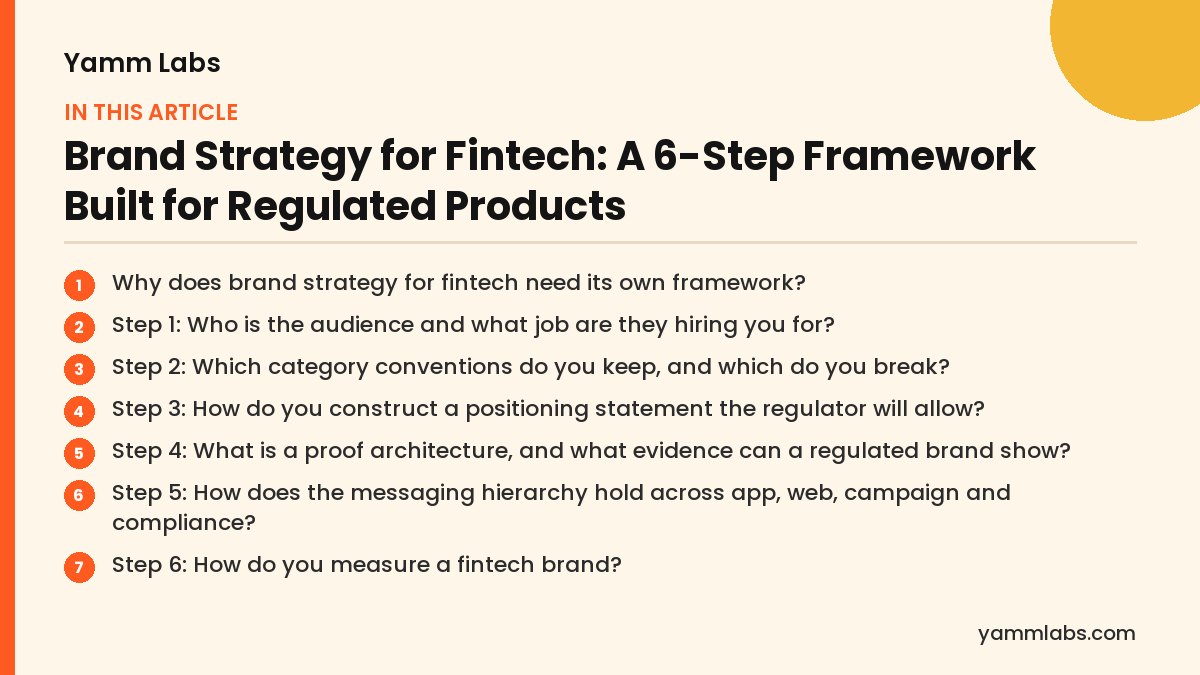
- Why does brand strategy for fintech need its own framework?
- Step 1: Who is the audience and what job are they hiring you for?
- Step 2: Which category conventions do you keep, and which do you break?
- Step 3: How do you construct a positioning statement the regulator will allow?
- Step 4: What is a proof architecture, and what evidence can a regulated brand show?
- Step 5: How does the messaging hierarchy hold across app, web, campaign and compliance?
- Step 6: How do you measure a fintech brand?
- Worked example: a fictional salaried-credit app
- Who owns each step, and what does each produce?
- People also ask
Why does brand strategy for fintech need its own framework?
Most brand strategy frameworks were written for products where the company can say what it likes about itself. A fintech cannot. A lending app operating with a partner NBFC must name that NBFC, show the cost of credit in a prescribed way and route complaints to a named officer. A wealth app that is a SEBI-registered investment adviser cannot show a selective return. A payments app cannot draw the UPI mark in its own colours. The brand still has to be distinctive, but distinctiveness has to be found inside those limits, not by ignoring them.
The framework below is what we run for fintech clients. It maps to the same logic we set out in what makes a great BFSI brand: trust signals first, category codes second, personality third.
Step 1: Who is the audience and what job are they hiring you for?
Start with a person and a moment, not a demographic. The job-to-be-done for a personal loan is rarely “borrow money”. It is “pay the hospital deposit tonight without telling my father-in-law” or “bridge the twelve days until salary without a card”. The job for a first-time mutual fund investor is often “stop feeling stupid about the money sitting in savings”. The brand has to speak to the job, and the job tells you the emotional register: relief, control, competence, privacy.
Write three things down. The primary user and the moment of need. The person they will justify the choice to (a spouse, a parent, a CFO). And the alternative they are using today, which in India is usually a person: a relative, a moneylender, a bank relationship manager, a friend who “knows about stocks”. Your brand is competing with that person’s credibility, not with another app’s feature list. For B2B fintech the same logic applies with a different buyer, and we have covered that in B2B fintech positioning: sell to the CFO, not the developer.
Step 2: Which category conventions do you keep, and which do you break?
Categories have codes. Some exist because customers need them to recognise the product. Some exist because everyone copied the same three apps in 2019. Sort them.
- Keep the codes that carry trust or are required. The UPI and RuPay marks reproduced as NPCI specifies. The KYC sequence the user expects. The key fact statement before a loan is accepted. Rupee formatting with Indian digit grouping. The regulated entity’s name on the screen where money moves. The mutual fund standard disclaimer at the size the code requires.
- Break the codes that are only habit. The purple-to-teal gradient. The 3D coin illustration. The word “instant” in the headline. The “zero” claims (zero fees, zero paperwork) that a regulator can read as misleading and that customers have stopped believing. The celebrity who signals nothing about the product. Zerodha broke almost every visual convention in broking by having almost no campaign identity at all and letting the product interface carry the brand. CRED broke the convention that a credit product should look responsible. Both decisions were deliberate, and both were made after deciding which codes to keep.
The output of this step is a two-column list. Column one is non-negotiable, and design works around it. Column two is where the brand gets its distinctiveness.
SIGNALNewsletter by Yamm Labs
The next piece, straight to your inbox.
New writing on BFSI brands, B2B and influencer marketing, and AI search.
One click to unsubscribe. Privacy policy

Step 3: How do you construct a positioning statement the regulator will allow?
A positioning statement has four parts: for whom, what you are, the one thing that makes you the right choice, and the reason to believe it. In fintech the third and fourth parts are where the licence bites. “Highest returns”, “cheapest loan”, “guaranteed”, “risk-free”, “RBI-approved app” are unavailable or misleading. What remains is usually one of five positions:
- Process. How you do it: the decision in minutes, the claim without a call, the SIP that adjusts itself.
- Transparency. What you show: the full cost before consent, no hidden charge, every fee on one screen.
- Access. Whom you serve that others do not: gig workers, first-jobbers, small-town salaried employees, women-run businesses.
- Competence. Who is behind it: a research team, a credit model, a founding team with a record.
- Restraint. What you refuse to do: no nudges to borrow more, no upsell in the payment flow, no dark patterns.
Test the draft statement against three readers: the customer (does it answer the job), the competitor (can they say it), and the compliance head (can you say it). A statement that survives all three is rare, which is the point.
Step 4: What is a proof architecture, and what evidence can a regulated brand show?
Trust in financial brands is built from evidence more than from tone, a point we made in the psychology of trust in financial brand design. A proof architecture is the ordered set of evidence the brand will show, where, and in what form. Regulated fintechs have more legitimate proof than they use, and they often reach for the one kind they cannot use.
| Proof type | Legitimate examples for an Indian fintech | Not available or risky |
|---|---|---|
| Regulatory standing | The regulated entity’s name and registration displayed clearly; the partner NBFC or bank named on the loan screen; SEBI registration number for an adviser or broker | “RBI-approved app” or any phrase implying the regulator endorses the product |
| Cost transparency | The key fact statement and annualised cost shown before consent; a fee page with every charge; a worked repayment example | “Zero cost” or “no charges” headlines with charges in the footnote |
| Process proof | A measured, auditable time-to-decision or time-to-disbursal, stated as a median with the period; a claims or grievance turnaround you actually report | “Instant” without a measured basis; cherry-picked best cases |
| Third-party proof | Credit rating of the lending entity from a registered rating agency; security certifications; app-store rating with the date | Paid awards; influencer endorsements that SEBI rules restrict for regulated entities |
| Recourse proof | Named grievance officer, ombudsman route, response SLA published on the site | A chatbot as the only route |
| Scale proof | Audited or filed numbers: customers, assets under management, loans disbursed, stated with a date | Round numbers with no source; growth rates without a base |
| Performance proof (wealth) | Performance shown in the format the mutual fund advertisement code prescribes, with the riskometer and disclaimer | Selective periods, model-portfolio returns, “our users earned X percent” |
Rank the proof. Put the strongest legitimate evidence in the first thirty seconds of every journey: the app onboarding, the website hero, the first ten seconds of film. Most fintechs bury the regulated entity’s name and the fee page, which are the two things a sceptical customer looks for first.
Step 5: How does the messaging hierarchy hold across app, web, campaign and compliance?
Fintech brands fall apart between surfaces. The campaign says one thing, the app says another, the terms page says a third, and compliance copy has been written by someone who never saw the other three. A messaging hierarchy fixes the order and the voice.
- Brand promise. One sentence, from Step 3. It appears in the campaign and on the website hero. It does not appear inside the app, where it would be noise.
- Product proposition. One line per product: what it is, for whom, the one proof. Appears on product pages, app store listing, the first app screen for that product.
- Feature and process messages. The steps, the limits, the timelines. Appear in the app, in onboarding, in support.
- Mandatory layer. Regulated entity name, disclaimers, cost disclosures, grievance route. Appears everywhere the rules require, in a designed component that does not change from surface to surface.
The rule that keeps it coherent: every level may be more specific than the level above it, but never contradict it. If the promise is restraint and the app pushes a top-up loan on the repayment screen, the hierarchy is broken, and customers notice before the brand team does. Write the mandatory layer in the brand voice too. A disclaimer written plainly reads as honesty; one in legal register reads as something to hide.
A regulated brand’s most persuasive sentence is usually the one compliance made it write.
Step 6: How do you measure a fintech brand?
Three measures, tracked together, because each one alone misleads.
- Recall. Aided and unaided recall in the target segment, tracked quarterly through a panel. Cheap to start at a small sample; the trend matters more than the level.
- Trust. A short trust index you write yourself and repeat: would you keep Rs 50,000 here for a year; would you recommend it to a parent; do you believe the fees shown are the fees charged. Supplement with complaint volume per thousand customers and app-store review sentiment.
- Conversion. The funnel steps the brand affects: install to KYC start, KYC start to completion, key fact statement viewed to accepted, first transaction to second. A brand that raises recall and trust but not KYC completion is not yet doing its job in the product.
Worked example: a fictional salaried-credit app
The company below is invented to show the framework end to end. Any resemblance to a real product is unintended.
Kadam is a personal-credit app for salaried employees at companies with fewer than 200 staff, in cities outside the top eight. Loans are originated by a partner NBFC; Kadam is the lending service provider and the brand the customer sees.
- Step 1, audience and job. A 27-year-old accounts executive in Indore whose employer pays late every third month. The job: cover rent and a school fee without asking family and without a credit card he was refused. The person he justifies it to: his wife. The alternative: a colleague who lends at 3 percent a month.
- Step 2, conventions. Keep: the partner NBFC’s name on the loan screen, the key fact statement before consent, the exact repayment date, rupee formatting. Break: “instant” in the headline, the coin illustrations, purple, the top-up nudge on the repayment screen.
- Step 3, positioning. For salaried employees at small companies, Kadam is the credit line that shows the full cost before you say yes and never pushes you to borrow more. Reason to believe: the fee page is the home page, and the app has no top-up prompts.
- Step 4, proof architecture. First: the partner NBFC’s name and registration on the hero. Second: the full-cost example for a Rs 25,000 loan over 6 months, on the first scroll. Third: median time from approval to disbursal, measured monthly and stated with the month. Fourth: the grievance officer’s name and a 48-hour response commitment. Not used: “RBI-approved”, “instant”, “lowest rate”.
- Step 5, hierarchy. Promise: “The loan that tells you everything first.” Proposition: “Rs 10,000 to Rs 1 lakh for salaried employees, full cost shown before consent.” Process: “Decision in one working day, money in your account the next.” Mandatory: the NBFC identification block, the KFS, the grievance route, in one designed component reused across app, web and film.
- Step 6, measurement. Unaided recall among salaried employees in tier-2 cities; a three-question trust index; KFS-viewed-to-accepted rate as the conversion measure the brand owns.
Who owns each step, and what does each produce?
| Step | Output | Owner | Compliance involvement |
|---|---|---|---|
| 1. Audience and job | Audience brief with the moment, the justifier and the alternative | Founder or CMO with the agency | None |
| 2. Conventions | Two-column keep/break list | Agency with product and compliance | Confirms the keep column |
| 3. Positioning | One positioning statement, tested against three readers | Agency with the CEO | Approves the claim |
| 4. Proof architecture | Ranked proof list with source, format and placement per surface | Agency with product, finance and legal | Approves each proof and its wording |
| 5. Messaging hierarchy | Four-level message map and the mandatory-layer component | Agency with product marketing | Owns the mandatory layer |
| 6. Measurement | Recall tracker, trust index, conversion dashboard | Marketing with product analytics | Reviews complaint metrics |
Run in sequence, the six steps take eight to twelve weeks for a fintech with one product, and the positioning and proof steps take the longest because they need compliance in the room. Run in parallel, or with compliance at the end, they take longer, because the work gets redone.
People also ask
What is brand strategy for a fintech company?
Brand strategy for fintech is the set of decisions about audience, positioning, proof and messaging that make a regulated financial product distinctive and trusted. It differs from consumer brand strategy because the regulator limits what can be claimed, so the strategy has to be built from evidence the licence permits: regulatory standing, cost transparency, measured process, third-party ratings and clear recourse.
What can a fintech legitimately claim in its branding in India?
It can show the regulated entity behind the product, the full cost in the prescribed format, measured process times with a basis, ratings and certifications from third parties, and its grievance route. It should avoid guaranteed or selective returns, “instant” or “zero” claims without basis, and any phrase suggesting RBI or SEBI has endorsed the product. Confirm specifics with compliance.
How long does a fintech brand strategy take?
Eight to twelve weeks for a single-product fintech when compliance is involved from the second step. The positioning and proof-architecture steps take longest because each claim and each piece of evidence needs approval. Running compliance review at the end instead adds four to eight weeks of rework.
How do you measure whether a fintech brand is working?
Track three things together: aided and unaided recall in the target segment, a short repeated trust index supplemented by complaint rates, and the conversion steps the brand influences such as KYC completion and key-fact-statement acceptance. Recall without conversion means the brand is known but not believed; conversion without trust usually means the acquisition is being bought.
Sources
If your positioning statement has never been read by your compliance head, it is a wish, not a strategy.
Get a free Fintech Brand Audit across 8 dimensions, plus 3 fixes. No pitch. Run the free Brand Audit →
One Comment