

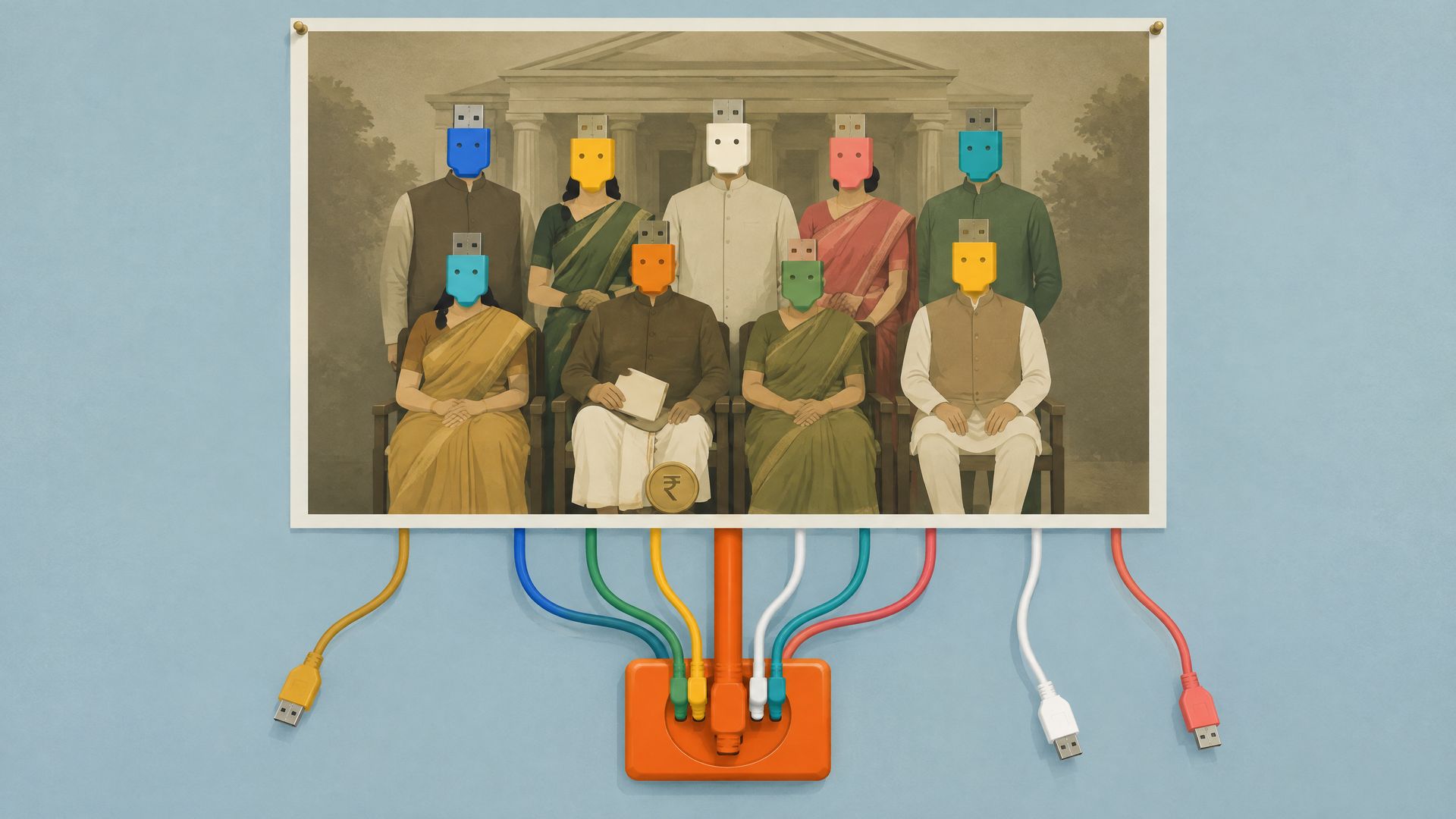
A bank’s head of marketing shows us a slide with eleven logos on it. The bank, its life insurance JV, its general insurer, its asset manager, its broking arm, its housing finance company, a credit card business, a payments app it acquired, two sub-brands for youth and wealth customers, and a super app that is supposed to hold all of them. Six of the eleven were drawn by different agencies. Three use different blues. The question on the slide is “can we make these consistent?” The real question is which of the three architecture models the group has chosen, because nobody had.
- What are the three brand architecture models, and which Indian financial groups use each?
- What forces the decision: regulation, cross-sell or risk?
- How do you choose between masterbrand, endorsed and standalone?
- What does each model mean for naming, lockups and the visual system?
- How do you migrate a financial group from a mess to a chosen architecture?
- Which mistakes do Indian financial groups make most often?
- People also ask
What are the three brand architecture models, and which Indian financial groups use each?
Brand architecture is the set of rules for how a group’s entities relate to each other in name, lockup and visual system. In Indian BFSI the three models are easy to see because the regulators force each licensed business into a separate legal entity, and every group has had to decide how those entities present themselves.
- Masterbrand (branded house). One name, one visual system, descriptors for each business. SBI is the purest case: SBI Life, SBI Card, SBI Mutual Fund, SBI General all carry the same wordmark and the same blue, with the business as a descriptor. Kotak does the same across Kotak Mahindra Bank, Kotak Life, Kotak Securities and Kotak Mutual Fund. ICICI runs a masterbrand with JV exceptions (ICICI Prudential, ICICI Lombard) where the partner’s name is contractually part of the entity name. HDFC Bank, after the 2023 merger with HDFC Ltd, now has HDFC Life, HDFC AMC and HDFC Ergo as subsidiaries under a single group name, though their visual systems still show their separate histories.
- Endorsed. Each entity has its own name and identity; the parent appears as a signature, a lockup element or a shared naming prefix. Bajaj Finserv is the Indian textbook: Bajaj Finance, Bajaj Housing Finance, Bajaj Allianz Life, Bajaj Allianz General and Bajaj Finserv Mutual Fund share the Bajaj name and a family resemblance but operate as distinct brands with distinct audiences. Jio Financial Services follows the same logic with Jio Finance, Jio Payments Bank and its asset-management JV with BlackRock, borrowing the Jio consumer brand as the endorsement. Axis Max Life, renamed after Axis Bank became a co-promoter of Max Life, is an endorsed name created by adding the bank’s brand to an existing insurer.
- Standalone (house of brands). Entities carry no visible parent link. Axis Bank’s acquisition of Freecharge in 2017 kept the Freecharge name and identity intact, because the audience, the product and the risk profile had nothing to gain from an Axis lockup. Paytm’s group is a mixed case: Paytm, Paytm Money and Paytm Payments Bank shared a name, and when RBI restricted the payments bank in early 2024 the whole family took the reputational hit, which is the contagion argument for standalone brands in one sentence.
SIGNALNewsletter by Yamm Labs
The next piece, straight to your inbox.
New writing on BFSI brands, B2B and influencer marketing, and AI search.
One click to unsubscribe. Privacy policy

What forces the decision: regulation, cross-sell or risk?
Four criteria settle most architecture debates in Indian financial groups. We take them in the order they usually come up in a boardroom.
- Regulatory entity separation. A bank is licensed by RBI under the Banking Regulation Act, an insurer by IRDAI, an asset manager and a broker by SEBI. Each must be a separate legal entity with its own board, capital and compliance function. The regulator does not care what your logo looks like, but it does care that a customer knows which entity they are dealing with. When a bank distributes insurance it does so as a corporate agent, and the communication must make clear who underwrites the policy. When an AMC’s fund is sold in a bank branch, the fund’s name and the AMC’s name, not the bank’s, must appear with the SEBI-mandated disclaimers. Architecture must make this attribution effortless. Our guide to SEBI, IRDAI and RBI advertising rules covers the disclosure side.
- Licence and naming constraints. The word “Bank” may only be used by a licensed banking company. An insurer’s name must signal its class of business. A mutual fund is named as “X Mutual Fund” under SEBI’s regulations. So a masterbrand descriptor is not a free design choice; “Kotak Life” is a brand, “Kotak Mahindra Life Insurance Company Limited” is the entity, and both have to appear in the right places.
- Cross-sell economics. The strongest argument for a masterbrand is that a bank customer who already trusts the name will buy the life policy and the SIP more readily. SBI’s and HDFC’s distribution reach depends on this. The counter-argument is that a masterbrand also makes the group’s non-bank products look like bank products, which invites both regulatory attention and customer confusion when a market-linked product loses value.
- Risk contagion. Any lending or payments entity can have a bad year that becomes a headline. Under a masterbrand, that headline attaches to every entity. Under an endorsed model, it attaches mainly to the entity and partially to the parent. Under a standalone model, most customers never make the link. The Paytm Payments Bank episode and every NBFC liquidity scare since 2018 are the case studies.
How do you choose between masterbrand, endorsed and standalone?
The table below is the decision framework we use in architecture workshops. Score each entity, not the group; a single group often ends up with a masterbrand core, an endorsed ring and one or two standalone brands at the edge.
| Criterion | Points to masterbrand | Points to endorsed | Points to standalone |
|---|---|---|---|
| Who owns the customer relationship? | The bank; the product is an extension of the account | The entity, with the bank as introducer | The entity alone; different acquisition channel |
| Regulatory attribution needed in every communication | Manageable with descriptors and legal-name footers | Clear by construction; entity name is already distinct | Clearest; no shared name to disambiguate |
| Risk profile relative to the bank | Similar or lower (deposits, cards, secured lending) | Different but acceptable (insurance, AMC, housing finance) | Materially different (unsecured digital lending, BNPL, payments to a new segment) |
| Target audience overlap with the bank’s base | High | Medium | Low or deliberately different (Gen Z, gig workers, merchants) |
| Joint venture or partner equity | Only if the partner accepts a descriptor role | Natural fit; both names in the lockup (ICICI Prudential, Bajaj Allianz, Axis Max Life) | When the partner’s brand is stronger in that category |
| Possible future divestment | Hard; the name leaves with the buyer or must be licensed back | Manageable; the endorsement is removed | Easy; nothing to unwind |
| Marketing budget per entity | Low; the masterbrand carries it | Medium; each entity needs some of its own | High; the brand must be built from zero |
A useful test: if this entity had a very bad quarter, would the bank’s board want the bank’s name in the headline? If no, it should not be a masterbrand entity. If the bank’s board would want the credit for a very good quarter, it should not be standalone. Everything in between is endorsed.
What does each model mean for naming, lockups and the visual system?
Architecture decisions become real in the lockup: the fixed arrangement of parent mark, entity name and descriptor that appears on every screen, card and branch fascia. These are the rules we set for each model.
- Masterbrand lockups. One wordmark, one symbol, one typeface. The descriptor (“Life”, “Mutual Fund”, “Securities”) sits in a fixed position at a fixed size ratio and never gets its own colour. The legal entity name appears in a footer or legal line, never in the lockup. Colour stays constant across entities; SBI’s discipline here is why a customer recognises SBI Life instantly, and also why any SBI-named entity’s problem is SBI’s problem.
- Endorsed lockups. The entity has its own wordmark and often its own colour. The parent appears as one of three endorsement forms: a prefix in the name (Bajaj Finance), a signature line (“A Jio Financial Services company”), or a shared symbol used at reduced size. Choose one form per group and hold it. The most common failure is a group that uses all three depending on which agency made the file.
- Standalone lockups. No parent mark. The relationship appears only where regulation or disclosure requires it, usually in the legal footer and the app store listing. Freecharge under Axis is the reference.
- JV names. When two parents are in the name, the lockup order is contractual, not aesthetic. ICICI Prudential, Bajaj Allianz, Tata AIA and Axis Max Life each fixed the order in a shareholders’ agreement. A brand team that flips it for visual balance has created a legal problem.
- Sub-brands inside the bank. Youth accounts, wealth tiers, super apps (YONO, iMobile, Kotak 811, Axis’s digital propositions) are not entities and should not be designed as if they were. They get a product mark that lives inside the bank’s system, not a second logo.
All of this belongs in the guidelines, with the lockups drawn, not described. Our post on brand guidelines for fintech startups covers what a usable guideline document contains; for a group, add an architecture chapter that names every entity, its model and its lockup.
How do you migrate a financial group from a mess to a chosen architecture?
Architecture change in a regulated group is a sequence, not a launch. The order matters because each step has a regulatory or contractual dependency on the one before.
- Map the entities and the contracts. Every legal entity, its regulator, its licence conditions, any brand licence or royalty agreement between entities, and any JV agreement that fixes a name. This map decides what can change and what cannot.
- Decide the model per entity. Use the table above. Record the decision and the reason; the reason matters when a new CEO asks in three years.
- Handle legal names first. A change of registered name goes through MCA, the relevant regulator and, for a listed entity, the exchanges. Axis Max Life’s renaming is the visible end of a long approval process. Nothing visual should be released until the name is legally in force.
- Change the highest-traffic surface first, then the rest. For most groups that is the app, then the website, then statements and emails, then cards, then branch signage and print. Regulatory filings and policy documents change at the next scheduled reissue, with the old name in brackets where the regulator requires continuity.
- Run a dual-brand window. “Formerly X” on every surface for a fixed period, so a customer holding an old policy or card is never confused about who they are dealing with. Six to twelve months is typical.
- Lock the guidelines and the asset library. One set of lockups, one source of files, one approval path. The eleven-logo slide came from eleven sources of truth.
The migration sequencing is close to the one we described for a whole-bank identity change in how to rebrand a bank without losing trust; the difference in an architecture project is that several entities move on staggered timelines, and the group must look coherent at every stage in between.
Which mistakes do Indian financial groups make most often?
- Choosing masterbrand by default because “trust”. The bank name is a trust asset, but it is also a liability that transfers. The choice deserves a risk conversation, not just a marketing one.
- Letting each subsidiary’s agency decide. The insurer’s agency drew a lockup, the AMC’s agency drew another, the app’s agency ignored the parent. Architecture is a group decision that must be enforced by the group brand team.
- Confusing product sub-brands with entities. A super app is a product. Giving it an identity as strong as the bank’s creates a fourth brand nobody budgeted for.
- Ignoring the disclosure line. Masterbrand groups in particular forget that the corporate-agent disclosure and the underwriter’s name are not optional decoration. The lockup and the legal line are designed together.
A masterbrand shares trust in good years and blame in bad ones; choose it for the entities you would defend in a headline.
People also ask
Can a bank in India use the same brand name for its insurance and mutual fund subsidiaries?
Yes, and most do, subject to each entity being separately licensed by IRDAI or SEBI and using its own legal name in regulated communication. The bank’s involvement in distribution must be disclosed as a corporate agent or distributor, and the product’s regulated disclaimers must name the actual insurer or AMC.
What is the difference between an endorsed brand and a masterbrand in banking?
A masterbrand uses the bank’s name and visual identity on every entity, with only a descriptor changing (SBI Life, Kotak Securities). An endorsed brand gives the entity its own name and identity with a visible parent link, such as a shared prefix or a “part of” signature (Bajaj Finance under Bajaj Finserv, Jio Finance under Jio Financial Services).
Why did Axis Bank keep the Freecharge name after acquiring it?
Freecharge served a payments and recharge audience acquired through a different channel from the bank’s customers, and its brand equity in that segment was worth more than an Axis lockup would add. Keeping it standalone also kept the bank’s name away from a product with a different risk and service profile.
How long does a brand architecture migration take for a financial group?
Legal name changes alone can take several months through MCA and the sector regulator, and a listed entity also needs exchange approvals. The visible migration across app, web, statements, cards and branches typically runs 12 to 18 months for a multi-entity group, with a “formerly known as” window of six to twelve months on customer-facing surfaces.
Sources
Eleven logos on one slide is not a brand family. It is a decision that has not been made yet.
Get a free Fintech Brand Audit across 8 dimensions, plus 3 fixes. No pitch. Run the free Brand Audit →
2 Comments