


A marketing head at a mid-size AMC in Mumbai sits in a pitch room with three agencies. Every deck opens with the same slide: a still from an AMFI film, two friends in a local train, the line “Mutual Funds Sahi Hai” under it. Nobody in the room made that film. Everybody in the room has to live with it. The category campaign owns the phrase, the tune and the first thought a new investor has about the product. The AMC’s own brand has to find the second thought. That is the real brief, and it has been the real brief since 15 March 2017.
- What was Mutual Funds Sahi Hai, and who paid for it?
- What ran, and when? The timeline from 2017 to 2026
- Why did the campaign work when so many category campaigns do not?
- Where did the campaign stop working, or draw fire?
- What changed in 2026, and why does the creative mandate matter to an AMC?
- What should an AMC’s own brand do when the category campaign wins the attention?
- People also ask
What was Mutual Funds Sahi Hai, and who paid for it?
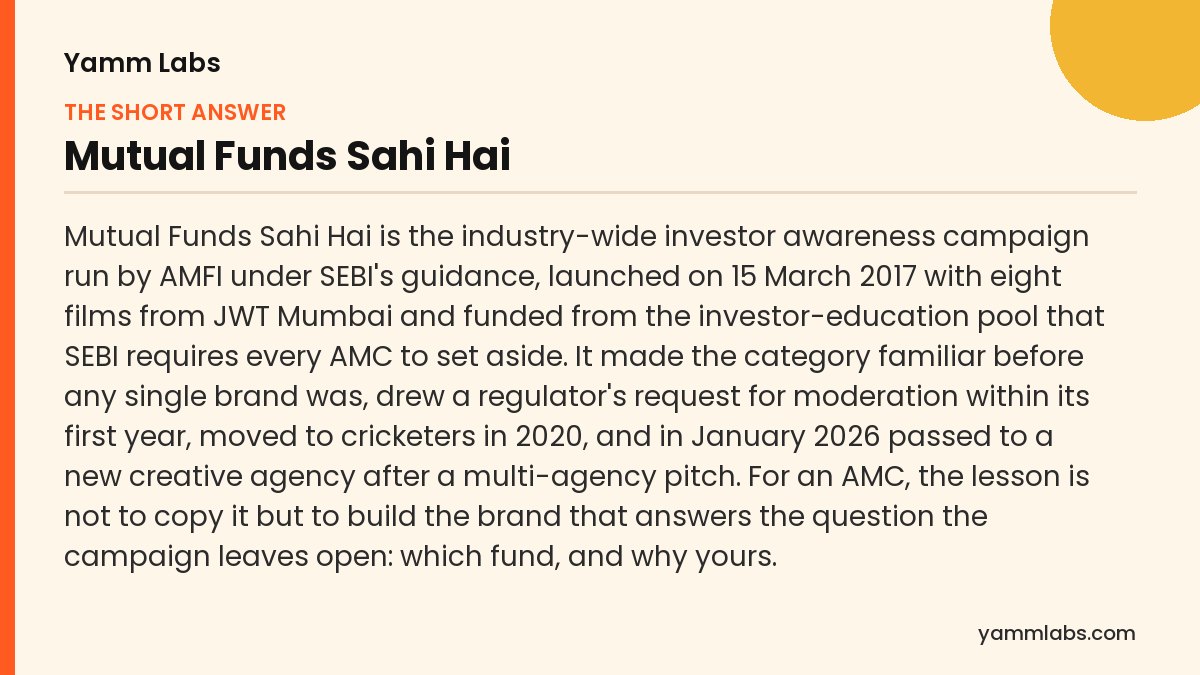
It was the first time every fund house in India promoted the category together instead of their own schemes. The Association of Mutual Funds in India launched it on 15 March 2017 at an event where a SEBI whole-time member did the unveiling. The creative came from JWT Mumbai: eight commercials shot in a fortnight, using non-professional actors in real locations with live sound. A car, a wedding, a train, a showroom, a parlour, a halwai shop, a golf course, a concert. Friends talking. One of them knows a little more than the other. The line lands at the end.
The money did not come from a marketing budget in the usual sense. SEBI requires every asset management company to set aside at least two basis points of daily net assets each year for investor education and awareness, within the expense-ratio ceiling. AMFI’s own site describes the campaign as run under SEBI’s guidance, and the industry’s pooled investor-education money is what funds it.
That single fact explains most of what the campaign could and could not say. It could never name a scheme. It could never promise a return. It had to stay on the side of awareness, because that is what the levy is for. The February 2025 SEBI clarification restates the two-basis-point requirement and adds financial inclusion to the list of things the money may fund.
Media ran across television, print, radio, cinema, outdoor and digital, in eight languages at launch. A microsite went up alongside the films. The medium was wide because the audience was wide: the household that had never bought a financial product beyond a fixed deposit and an LIC policy.
What ran, and when? The timeline from 2017 to 2026
The campaign has had three creative lives and one media life so far. The table lists only dates and facts an opened source states. Where an agency is named, a source names it.
| When | What ran | Who made it | What changed |
|---|---|---|---|
| 15 March 2017 | Launch: eight everyday-conversation films, TV, print, radio, cinema, outdoor, digital, eight languages, microsite | JWT Mumbai (creative and digital); microsite by Mirum | First industry-wide category promotion in Indian mutual funds |
| December 2017 | Press reports said SEBI asked AMFI to moderate the campaign’s tone after complaints about mis-selling in smaller towns | Not applicable | Reported request to keep to the practical benefits and stay off life-changing claims |
| April 2018 | AMFI reported 32 lakh new investors in year one and announced a second phase on hybrid and debt products, with a target of 50 lakh new investors by end of FY 2018-19 | Not named in the opened source | Message widened from equity to the whole product shelf |
| March 2020 | Films with Sachin Tendulkar, MS Dhoni and Mithali Raj on consistency, stability and trust | Wunderman Thompson South Asia | Celebrities enter, framed as friends in conversation, not as endorsers |
| September 2020 | Four more cricketers signed; AMFI became an associate sponsor of IPL 2020 | Not named in the opened source | Youth and first-time investors become the stated audience |
| November 2022 | Festive-season SIP film with Tendulkar and Dhoni | Wunderman Thompson India | Sharper call to action: start a monthly SIP for a long-term goal |
| May 2025 | AMFI issued an RFP for the next creative phase, with a “Bharat-first” brief for smaller towns | Incumbent named as Wunderman Thompson Mumbai | Open pitch after eight years with one creative lineage |
| September and December 2025 | Bombay High Court dismissed a PIL calling the ads misleading; the Supreme Court rejected the appeal | Not applicable | Legal challenge to the campaign’s basis closed |
| 23 January 2026 | Concept Communications appointed mainline creative agency for a refresh of the campaign | Concept Communications | New creative mandate after a multi-agency pitch |
| April to June 2026 | Media review of a mandate reported at about ₹300 crore; Lodestar UM won integrated media; MOMS Outdoor won OOH | Lodestar UM (media); MOMS Outdoor (outdoor); incumbent reported as Dentsu after more than a decade | Media split into integrated and outdoor specialists |
One number sits behind the whole table. AMFI’s own industry page puts assets under management at ₹15.63 trillion on 31 August 2016 and ₹87.08 trillion on 31 August 2026, with folios at 28.35 crore by August 2026. The campaign did not do that alone. Demonetisation, a long equity run, cheap smartphones, UPI and the direct-plan apps all pushed the same way. What the campaign did was give all of that a name.
SIGNALNewsletter by Yamm Labs
The next piece, straight to your inbox.
New writing on BFSI brands, B2B and influencer marketing, and AI search.
One click to unsubscribe. Privacy policy

Why did the campaign work when so many category campaigns do not?
- It sold a sentence, not a scheme. “Sahi hai” is a verdict a friend gives, not a claim a company makes. A verdict is easier to repeat, and repetition is what a category needs before any brand can matter.
- It cast people who looked like the buyer. Eight films with non-professional actors and live sound in real places, in eight languages. The viewer in Nagpur or Coimbatore saw a person, not a model, and a situation, not a studio.
- It carried no product to defend. Because the money came from the investor-education pool, there was no scheme name, no return, no fund house logo to argue about. The regulatory constraint became the creative constraint, and the creative was better for it.
- It ran long enough to compound. The same phrase held from March 2017 through the cricket films of 2020 and 2022 into the 2026 refresh. Category campaigns usually die when the committee changes. This one has run for nine years and through a change of creative agency.
- It answered the fear, not the feature. The 2020 films were built on consistency, stability and trust, the qualities a first-time investor needs to believe in before putting money in. Later work on SIPs addressed the next doubt: how do I start.
The category campaign tells India that mutual funds are right; your brand has to tell one household which fund is right for them.
Where did the campaign stop working, or draw fire?
Three moments show the limits. The first came inside the first year. In December 2017, business press reports said SEBI had asked AMFI to moderate the campaign’s tone after complaints that the phrase was being used to mis-sell in smaller towns and villages. The reported ask was to stick to the practical benefits and avoid anything that sounded like a life-changing promise. Whatever the exact exchange, the lesson is clear: a phrase that travels well also travels into the hands of every distributor, and the regulator holds the campaign owner responsible for how it is used.
The second was attribution. By 2019, some financial press had begun asking whether the campaign had made the public any wiser, as opposed to any more invested. That is a fair question for any awareness campaign funded by a levy. Awareness is cheap to claim and hard to prove. AMFI’s own year-one report counted new investors and SIP accounts, which are outcomes the industry can measure, and those are the numbers that have carried the argument since.
The third was legal. A public interest litigation argued that the ads were commercial rather than educational and misled investors. The Bombay High Court dismissed it on 17 September 2025 and the Supreme Court rejected the appeal on 12 December 2025. The campaign survived, but the fact that the argument reached the Supreme Court tells an AMC something about the line between education and promotion: the regulator draws it, the courts have now upheld where it sits, and every fund house’s own content lives on one side of it.
What changed in 2026, and why does the creative mandate matter to an AMC?
Two things changed in the first half of 2026, and both were ordinary agency reviews with unusual consequences. On 23 January 2026, AMFI appointed Concept Communications as its mainline creative agency after a multi-agency pitch, with a brief to refresh the campaign for younger first-time investors, digital-first behaviour and non-metro markets. Then from April, AMFI reviewed a media mandate the trade press put at around ₹300 crore, shortlisted four networks, and in June split the work: Lodestar UM for integrated media, MOMS Outdoor for out-of-home. The reported incumbent, Dentsu, had held the account for more than a decade.
For an AMC, this matters in three ways. The tone of the category film will change, and the AMC’s own work has to sit next to a new voice after matching the old one since 2017. The media weight will be redistributed, and an AMC that bought around the category plan in television and outdoor will find the category in different places. And the “Bharat-first” brief means the category will be doing the AMC’s first-town work in cities the AMC has not yet reached, which is an opportunity if the AMC’s own onboarding, KYC flow and regional-language screens are ready, and a leak if they are not.
What should an AMC’s own brand do when the category campaign wins the attention?
Do not compete for the first thought. AMFI has spent nine years and the industry’s pooled money on it. Compete for the second thought, and build the compliance into the idea itself. Here is the sequence we run, with the regulator-driven decisions shown, because “compliance-aware” is a word and a decision is a decision.
- Plan the standard warning as a frame, not a super. SEBI’s advertisement rules require the standard market-risk warning in every mutual fund advertisement, and in audio-visual ads the visual and the voice-over must each be clear and understandable, with five seconds given as an example of what may meet that test, not a fixed minimum; that guidance dates from a SEBI circular effective 1 April 2008. In a twenty-second film, five seconds is a quarter of the runtime. The decision: the warning is the closing frame, the brand lockup shares that frame, the last line of dialogue ends by second fourteen, and the voice-over for the warning is cast and recorded with the same care as the film’s voice. Films written to twenty seconds of story and then cut to fifteen fail this and go back for a second edit.
- Keep the lockup rule fixed across every unit. Because the category campaign does not carry a fund house logo, the AMC’s own logo is doing all the brand work. The rule we set: one lockup, one clear space defined as a fraction of the mark’s height, one minimum size for each medium, and the warning always in the same position relative to the lockup. A static so a reel, a hoarding and a branch standee read as one brand at a glance.
- Separate investor education from scheme promotion at the brief stage. The investor-education levy pays for awareness content and the rules keep it apart from scheme advertising. The decision: two content lines, two approval routes, two visual systems that share a family but never a headline. An AMC that lets a SIP explainer drift into a scheme pitch has moved money and content across a line the regulator watches.
- Sequence the screens for the doubt, not the feature. A first-time investor arriving from a category film has one question: which one, and how. The onboarding screen order we use: goal first, tenure second, risk band third, scheme last. The scheme’s riskometer and the standard warning appear on the screen where the scheme is named, not three screens later on the confirmation.
- Write in the register the category taught. Friends talking, in the buyer’s language, with one fact per sentence. The creative guide to the SEBI advertisement code shows how to keep that register while carrying the disclosures, and the questions to ask a mutual fund marketing agency tell you what to check before signing.
- Budget by review round, not by film. Every compliance round costs time and design hours. A film that plans the warning frame, the riskometer and the lockup from the script stage usually needs fewer review rounds than one that adds them at the end. Set the timeline and the budget band on that basis, and put the compliance reviewer in the first script meeting, not the last.
If you want the full list of what AMCs ask before a campaign, the hundred mutual fund marketing questions cover placement, sequence and timeline in more detail.
People also ask
Who runs the Mutual Funds Sahi Hai campaign?
The Association of Mutual Funds in India runs it, and its site says the campaign operates under SEBI’s guidance. It is funded from the investor-education money that SEBI requires every AMC to set aside, part of which is pooled with AMFI, and the films promote the category and name no scheme or fund house.
When did Mutual Funds Sahi Hai launch and who made the first films?
The campaign launched on 15 March 2017. The first eight films were made by JWT Mumbai with non-professional actors in real locations, and they ran on television, print, radio, cinema, outdoor and digital in eight languages.
Which agency has the Mutual Funds Sahi Hai creative mandate in 2026?
Concept Communications was appointed AMFI’s mainline creative agency on 23 January 2026 after a multi-agency pitch, with a brief to refresh the campaign. Separately, Lodestar UM won the integrated media mandate and MOMS Outdoor the outdoor mandate in June 2026.
Can an AMC use the phrase Mutual Funds Sahi Hai in its own ads?
The phrase belongs to AMFI’s industry-wide investor-education campaign, so an AMC should treat any use as a question for AMFI and its own compliance team rather than a design choice. The safer path is to build a brand line that answers the question the category leaves open, and carry the standard warning and the other required disclosures as SEBI’s rules set them out.
AMFI won the first thought. Let us check whether your brand is winning the second.
Get a free Fintech Brand Audit across 8 dimensions, plus 3 fixes. No pitch. Run the free Brand Audit →
One Comment