


A product head at a Mumbai life insurer opens ChatGPT on a Tuesday evening and types the question her own customers type: “which term insurance plan should a 35-year-old in Mumbai buy?” The answer names four insurers. Hers is not one of them. She tries Perplexity, Google AI Mode and Gemini. Two names repeat every time. Hers appears once, in a citation attached to a three-year-old press release. AI search visibility for financial brands in India is not a ranking. It is whether the engine can find a clear, consistent, regulator-safe description of who you are and what you sell, and whether it trusts that description enough to repeat it.
- How do ChatGPT, Gemini and Perplexity answer “which bank or insurer” prompts for India?
- What do AI engines actually read about an Indian financial brand?
- Which Indian regulators shape the pages an AI engine will quote?
- Three regulator-driven design decisions that change how an engine names you
- How is AI search presence measured on a prompt matrix per market?
- How does Yamm Labs work with financial brands in India?
- People also ask
How do ChatGPT, Gemini and Perplexity answer “which bank or insurer” prompts for India?
Ask an AI engine a shopping question about Indian financial products and it does three things in sequence. It decides what kind of answer the prompt wants, usually a short list with a reason for each name. It retrieves pages it can read, from the brand’s own site, regulator registers, comparison sites, news and forums. Then it writes a summary and attaches citations. The names that survive are the ones described the same way across several of those sources.
This is why a brand with a large advertising budget can still be missing. Television reach does not create readable pages. A brand that keeps its product facts inside PDFs, app screens and image banners gives the engine nothing to quote. A smaller brand with a plain page that says what the product is, who it is for, what it costs and who regulates it gets named.
Prompts also carry a city. “Best savings account in Bengaluru” and “best savings account in Chennai” retrieve different local pages and can produce different lists. Presence has to be measured per market, not once for India.
What do AI engines actually read about an Indian financial brand?
The retrieval layer of every major engine leans on a small set of source types. They are typically the brand’s own pages, public registers, press coverage, comparison and listicle pages, and community discussions. The mix shifts by engine and by month, which is one reason a single snapshot means little.
Regulator sources matter more in finance than in any other category. An engine asked “is this lender registered with RBI” needs a source that says so, and the lender’s own page stating its registration is the one the brand controls. An engine asked about an insurer needs the same from the insurer’s site: its registered name and IRDAI registration, in text. If the brand’s own pages do not state these facts in text, the engine either omits the brand or hedges about it, and a hedged answer rarely makes the shortlist.
The entity work, then, is unglamorous. One canonical description of the company: registered name, regulator, registration number, products, cities served, founding year, parent group. The same description, word for word, on the About page, the footer, the schema markup, the LinkedIn page, the Wikipedia entry if one exists, and every press boilerplate. Engines reward consistency because consistency lowers their risk of being wrong. Our AI visibility service for BFSI brands starts with this audit before any page is written.
SIGNALNewsletter by Yamm Labs
The next piece, straight to your inbox.
New writing on BFSI brands, B2B and influencer marketing, and AI search.
One click to unsubscribe. Privacy policy

Which Indian regulators shape the pages an AI engine will quote?
Five bodies govern how a financial brand in India may describe itself and its products. Each one forces a design decision on the pages an engine reads. The table below is the map we use at the start of every Indian engagement.
| Regulator | What it governs for a brand’s public pages | The design decision it forces on an AI-readable page |
|---|---|---|
| SEBI | Mutual fund and securities advertising, including the standard market-risk warning and limits on performance claims | The standard warning sits in live text directly below the answer block on any page that solicits investment, never only in a footer image; video transcripts carry the warning as spoken words |
| IRDAI | Insurance advertisements and disclosures, including use of the registered name and how benefits, risks and conditions are stated | The registered legal name and registration number appear in text on the About page and footer; every benefit sentence states in the same paragraph whether it is guaranteed |
| RBI | Bank, NBFC and digital lending disclosures, including the key facts statement, all-in cost of a loan and the grievance officer’s contact | The lender’s name, the all-in cost disclosure and the grievance officer block are plain text on the loan page, so the engine can confirm the lender is who it says it is |
| NPCI | UPI and BHIM brand marks, including where the Powered by UPI unit must appear and how partner logos may sit next to it | Product names never attach a prefix or suffix to the UPI name; the entity description uses the partner’s own name and describes UPI as the rail, which keeps the brand’s entity distinct in the engine’s index |
| AMFI | Mutual fund distributor conduct, including the mandatory distributor tagline next to the name and limits on naming and on scheme-specific claims online | The distributor’s name and its AMFI tagline appear together on the site, in the schema and in every profile, and no page calls the firm an adviser or wealth manager unless it holds that SEBI registration |
None of these rules mention AI engines. They were written for hoardings, television spots, apps and brochures. They still decide what an engine sees, because an engine reads the same page a compliance officer signs off. A rule that says “state the registered name, not merely a logo” is, for an engine, a rule that says “give me the entity in text”.
Three regulator-driven design decisions that change how an engine names you
Most agencies describe themselves as compliance-aware and stop there. Here are the actual decisions, with the regulator behind each one.
- The SEBI warning goes below the answer, as text. SEBI’s advertisement code requires the standard warning, “Mutual fund investments are subject to market risks, read all scheme related documents carefully”, on every communication that solicits investment in a scheme. In audio-visual advertising the warning must be shown and spoken for at least five seconds. On an answer-first page this becomes a layout rule: the answer block first, the warning immediately under it in live text, the same warning in the video transcript. An engine that quotes the answer then quotes the warning with it, which is what a fund house’s compliance team wants and what the engine’s own safety filters prefer. SEBI’s own guidance says a pure corporate brand advertisement that does not solicit investment does not need the warning, so brand pages and product pages are designed differently.
- The IRDAI registered name and the guarantee status travel together. IRDAI’s advertising rules require an insurer to show its registered name prominently alongside any trade name or logo, and bar highlighting a product’s benefits without a fair indication of the risks and conditions attached. They also bar conditions set in illegible text. The design decision: the entity block on every page carries the registered name and registration number in text, and every product page states the guarantee status inside the same paragraph as the benefit, never in a footnote. An engine summarising the page then cannot separate the benefit from its condition, which is the outcome the regulation is after.
- The RBI grievance officer block is a trust signal, so it stays on the page. RBI’s digital lending directions require a lender and its service providers to display the nodal grievance redressal officer’s contact details prominently on their websites and apps, to name the lender extending the offer, and to give the borrower a key facts statement with the all-in annual cost before the contract is signed. Teams often bury these in a legal page. We keep them on the loan page itself, in text, because “is this lender legitimate” is one of the most common prompts an Indian borrower types into an AI engine, and the officer block plus the lender’s registered name is exactly what the engine looks for to answer yes.
Two smaller decisions follow from NPCI and AMFI. NPCI’s brand guidelines forbid adding any prefix or suffix to the UPI identity, so a fintech cannot name its feature as a UPI variant and should describe UPI as the rail. AMFI requires a distributor to place the “AMFI-registered Mutual Fund Distributor” tagline with its name in all communication, including its website, and bars adviser or wealth manager names without a SEBI adviser registration. Both rules shape the entity name the engine stores, which is the name it will repeat.
An AI engine reads the same page your compliance officer signs; design it for both in the first draft.
How is AI search presence measured on a prompt matrix per market?
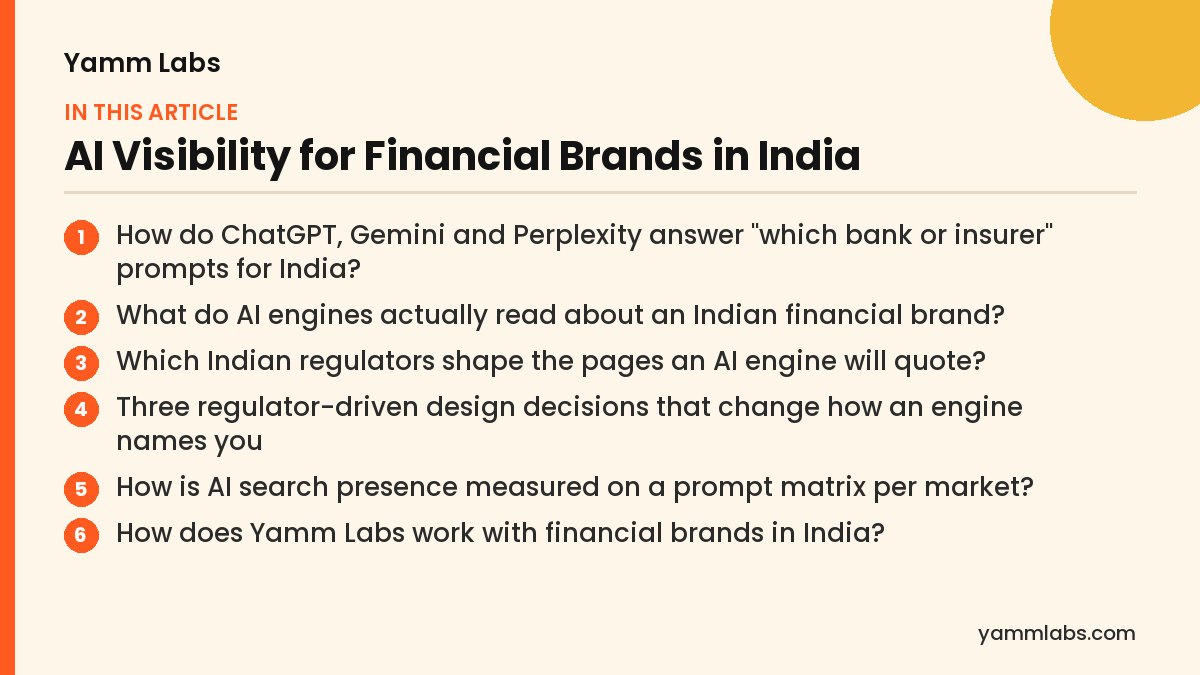
A single search on one laptop tells you nothing, because engines personalise and answers drift week to week. Measurement needs a fixed instrument. Ours is a prompt matrix: a set of buyer prompts whose wording never changes, run on each engine from a logged-out session on an India IP and re-run every month. Each answer is scored Present, Partial or Absent. Presence becomes a count: the prompt-engine pairs in which the brand is named, and separately those in which it is cited as a source.
For a financial brand in India the matrix has three axes. Prompts: the questions customers ask, grouped by product line, from “best ULIP for a 40-year-old” to “which NBFC gives a personal loan without a salary slip”. Engines: ChatGPT, Gemini, Perplexity, Google AI Mode, Microsoft Copilot and Claude. Cities: the markets where the brand actually sells, since prompts that carry a city retrieve city-anchored pages. A brand named in Mumbai and absent in Chennai has a content problem in Chennai, not a brand problem.
Two rules keep the number trustworthy. The prompt text never changes, so month-on-month comparison is valid. And the results are reported with the prompts behind them, so a marketing head can check the evidence rather than take the agency’s word. We publish our own baseline this way; the day-one visibility log shows the format, including the prompts where we were absent.
How does Yamm Labs work with financial brands in India?
Yamm Labs is based in Gurugram and serves clients across India and the Gulf, with international clients. Teams outside the National Capital Region are served remotely, with calls and reviews scheduled across time zones, and the writing, entity work, schema and measurement run from Gurugram. We do not maintain offices outside Gurugram and we do not claim one.
Financial brands we have worked with include TATA AIA Life Insurance, HDFC Life, Axis Bank, Paytm Money and Aditya Birla Sun Life Mutual Fund. Each engagement follows the same sequence: an entity audit, a compliance map like the table above, a prompt matrix baseline, answer-first pages with the disclosures placed as text, then monthly measurement against the same matrix. The client’s compliance team is in the room from the first draft.
Budgets follow the sequence of the work: a fixed baseline and entity audit, a page programme that scales with product lines and cities, and a monthly measurement retainer. The questions buyers ask us most often are answered in our GEO and AEO FAQ for financial brands.
People also ask
Does AI search visibility for an Indian bank or insurer need different work from ordinary SEO?
Yes. Ordinary SEO earns a position on a results page. AI visibility earns a mention inside a written answer, which depends on entity consistency, answer-first page structure and disclosures the engine can read as text. The two overlap, but a page can rank well on Google and still never be named by ChatGPT.
Which regulators matter for AI-readable financial pages in India?
SEBI for mutual funds and securities, IRDAI for insurance, RBI for banks, NBFCs and digital lending, NPCI for UPI brand marks and AMFI for mutual fund distributors. Each one sets a disclosure rule that decides where a warning, a registered name or a registration number sits on the page, and those placements are what an engine reads.
How long does it take for an AI engine to start naming a financial brand?
There is no fixed period and anyone quoting one is guessing. Engines do not publish their refresh schedules, and a brand’s own pages must be re-crawled before answers change. The honest approach is a baseline on a fixed prompt matrix, then monthly re-measurement, so movement is observed month by month.
Can a financial brand be named by ChatGPT in Mumbai but not in Chennai?
Yes, it can happen. Prompts that carry a city retrieve city-anchored pages, so a brand with no Chennai-specific page or coverage can be absent there while present in Mumbai. This is why presence is measured city by city and why the content plan is built per market.
Sources
- SEBI: SEBI FAQs for MF intermediaries (updated 31 Aug 2024) Q9
- SEBI: SEBI/IMD/CIR No
- Reserve Bank of India: RBI (Digital Lending) Directions, 2025 (8 May 2025)
- Reserve Bank of India: RBI circular on Key Facts Statement for Loans & Advances (15 Apr 2024)
- npci.org.in: NPCI BHIM UPI brand guidelines
- AMFI: AMFI Guidance on MFD Nomenclature
Want to know which prompts name your brand today, city by city, before you spend on content?
Get a free Fintech Brand Audit across 8 dimensions, plus 3 fixes. No pitch. Run the free Brand Audit →