

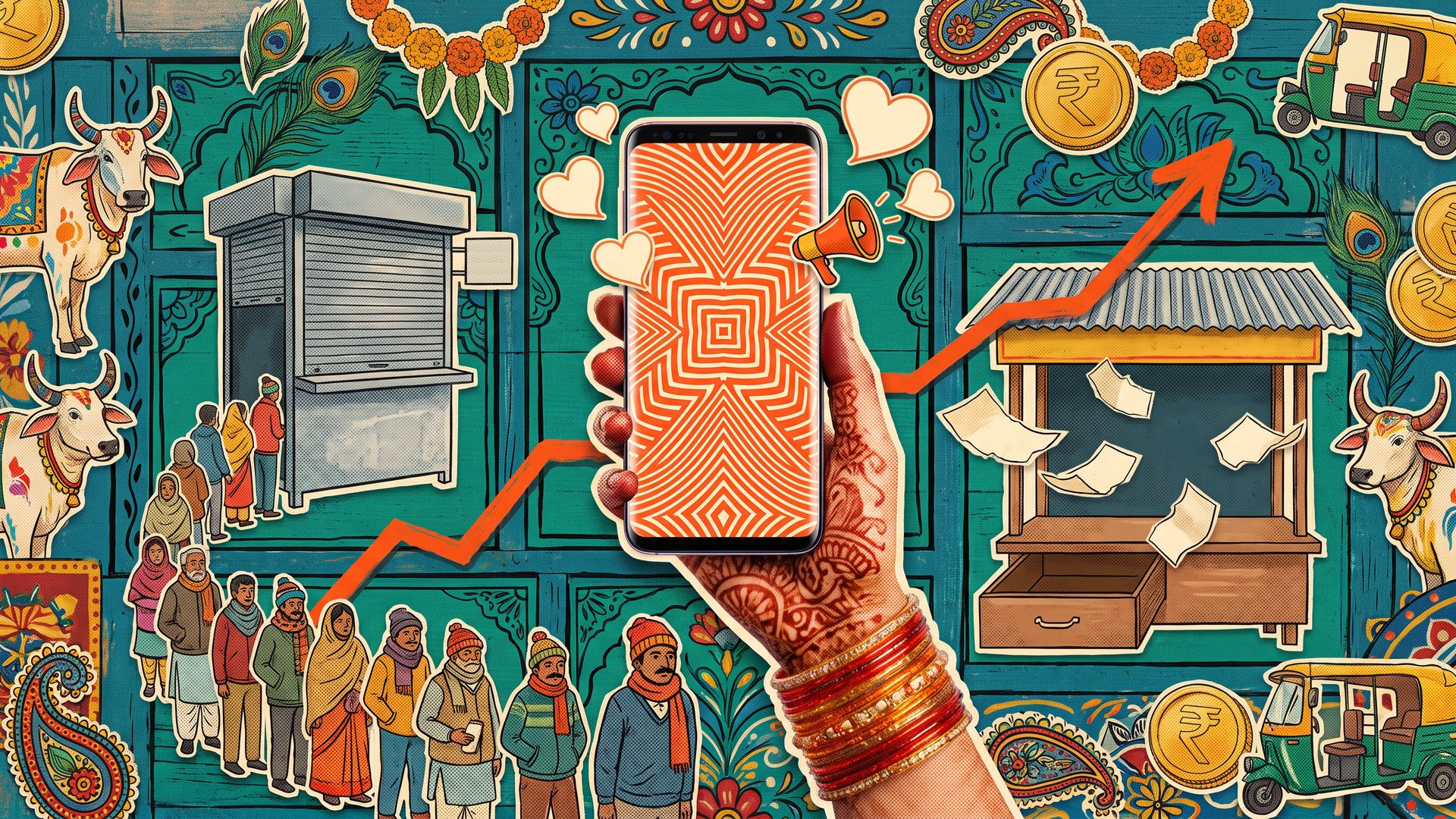
It is a Tuesday evening in Noida. At 8:15 pm on 8 November 2016 the Prime Minister goes on television and tells the country that its ₹500 and ₹1,000 notes stop being legal tender at midnight. In a payments company across the expressway, the marketing team does not go home.
By the time the newspapers land on doorsteps the next morning, Paytm has a full-page advertisement on the front of the national dailies, congratulating the Prime Minister and telling readers to stop looking for an ATM. One week later it has a household name, a television film it had to re-cut in a day, and a government notice about that front page. This is the story of that week, what it built, what it broke, and what a regulated brand should copy and avoid.
- What happened on 8 November 2016, and why did a wallet win the week?
- What did Paytm actually run that week, and who made it?
- Why did the campaign work?
- Where did it stop working, and what did it cost?
- What did the regulator change afterwards, and what did it mean for the wallet?
- What should a regulated brand take from this today?
- People also ask
What happened on 8 November 2016, and why did a wallet win the week?
The Reserve Bank of India’s press release of 8 November 2016 set out the mechanics. The ₹500 and ₹1,000 notes of the Mahatma Gandhi series lost legal tender status. From 10 November the public could deposit the old notes at any bank branch and exchange up to ₹4,000 per person in cash over the counter.
ATMs stayed shut on 9 November for recalibration, and when they reopened, withdrawals were capped at ₹2,000 a day at first. The deadline to deposit the old notes was 30 December 2016. The notes withdrawn made up about 86 per cent of the currency in circulation by value, roughly ₹15.41 lakh crore. Later RBI reporting showed that almost all of it came back to the banking system.
That is the context that made a mobile wallet suddenly useful. A shopkeeper could not take a ₹500 note. A customer could not draw more than a small amount from an ATM. A wallet that moved small sums by phone number, with no card and no queue, went from a convenience to a necessity in a single evening. Paytm’s founder later put it in one line: overnight the company went from a new thing to a must-have.
| Date | What happened | Why it mattered to the brand |
|---|---|---|
| 8 Nov 2016, 8:15 pm | Televised address; ₹500 and ₹1,000 notes cease to be legal tender at midnight; RBI issues its press release the same evening | The problem the product solved became universal in one night |
| 9 Nov 2016 | ATMs closed for recalibration; Paytm’s full-page front-page ads run in national dailies, congratulating the Prime Minister with his photograph and the line telling readers to use Paytm instead of an ATM | First-mover ownership of the moment; the photograph later drew a government notice |
| 10 Nov 2016 | Banks begin exchanging notes; Delhi’s Chief Minister tweets that Paytm is the biggest beneficiary and asks what the deal is; Paytm’s founder replies that the country is the biggest beneficiary | The brand became a political story within 48 hours |
| 13 Nov 2016 | Television film airs with a domestic worker telling her employer to stop the drama and use Paytm | Backlash on social media for mocking people in queues |
| 14 Nov 2016 | Re-cut film replaces the line with a softer one meaning do not worry about us; Paytm calls it an upgraded ad | A 24-hour correction that limited the damage |
| 10 Nov to 20 Dec 2016 | Paytm reports about 20 million new users and about 7 million transactions a day within two weeks; a traffic-driven outage hits on 20 December | Growth outran the infrastructure that had to carry it |
| 30 Dec 2016 | Deadline for depositing old notes | The end of the acute cash crunch; the habit had to hold on its own |
| 11 Oct 2017 | RBI issues its master direction on prepaid payment instruments, tightening wallet KYC and mandating interoperability | The regulator’s answer to a year of wallet growth |
| 28 Nov 2017 | Paytm Payments Bank formally inaugurated | The wallet brand became a licensed bank brand |
| 31 Jan 2024 and 24 Apr 2026 | RBI orders Paytm Payments Bank to stop accepting deposits and top-ups; the banking licence is later cancelled | The trust lesson arrived in full |
What did Paytm actually run that week, and who made it?
Three things ran, in this order. First, print. On the morning of 9 November, full-page advertisements appeared on the front pages of the major national dailies. They carried a photograph of the Prime Minister, congratulated him on what the copy called the boldest decision in the financial history of independent India, and closed with the line that has since become shorthand for the whole episode: no ATM, use Paytm.
SIGNALNewsletter by Yamm Labs
The next piece, straight to your inbox.
New writing on BFSI brands, B2B and influencer marketing, and AI search.
One click to unsubscribe. Privacy policy

Second, television. On 13 November a film went on air in which a domestic worker tells her employer, who is complaining about the cash crunch, to stop the drama and pay her through Paytm. Trade press credited the film to McCann Delhi. Press reports described the front-page print ad as work Paytm rushed through with its ad and media agencies on the night of the announcement.
Third, feet on the street. Contemporary reporting described Paytm signing merchants at speed and pushing salespeople into towns and smaller cities, on top of a network it already claimed across hundreds of thousands of stores. The advertising told people the wallet existed; the sales push made sure the shop on the corner would accept it.
One disclosure before we go further. Paytm Money is a Yamm Labs client. We had no part in the 2016 campaign and nothing in this piece comes from client work. Everything here comes from the RBI’s own publications and published press reporting.
Paytm did not win the week because the ad was clever. It won because the product was the answer, and the ad said so first.
Why did the campaign work?
- The product was the message. The front page did not need to explain a benefit. The country already knew the problem by breakfast. A single line told people the solution had a name, and the name was already on their phone from mobile recharges.
- Speed bought ownership. Rivals had wallets too. The company that appeared on the front page the next morning owned the association between the event and the category.
- Distribution matched the ad. Downloads only become transactions when a shop accepts the wallet. Paytm’s merchant push in the same weeks turned a spike in installs into daily use. Contemporary reporting put daily transactions around seven million within two weeks of the announcement.
- The habit already existed. Paytm had been a recharge and bill-payment app for years before 2016. The wallet was not new to its users; the reason to use it every day was.
- The founder was visible. When the Chief Minister of Delhi questioned the ad on 10 November, the reply came from the founder within the day, in plain words, and it reframed the argument around the country rather than the company.
Where did it stop working, and what did it cost?
The first was the photograph. India’s Emblems and Names law bars the commercial use of the Prime Minister’s name or picture without prior permission from the central government. The Department of Consumer Affairs sent Paytm a notice over the front-page ad, as it had to another large advertiser earlier that year, and Paytm apologised for what it called an inadvertent mistake.
The statutory fine is small, in the hundreds of rupees, and the government’s own advisory to newspapers afterwards asked them to check for permission before running such ads. The cost to Paytm was not the fine. It was headlines that paired the brand with the words notice and apology at the exact moment it was asking a country to trust it with money.
The second was the film. Stop the drama, use Paytm was written for a viewer who found the queues an inconvenience. Most of the audience was standing in one. Within a day the company replaced the line with one that meant do not worry about us and issued a statement about its belief in financial inclusion for every Indian. A second round of criticism followed from people who thought the retreat was cowardly. The re-cut was the right call, and the speed of it is the part worth copying. The wrong call was the original approval, made without asking who in the country would hear the line and how.
The third was capacity. Growth of the kind Paytm reported in November and December, about 20 million new users in six weeks and a user base the company put around 170 million, strained the systems carrying it. On 20 December an outage hit at around three times the previous peak traffic. The same month the company disclosed a set of fraud cases on its commerce side. None of it was fatal; all of it was the kind of load planning a bank does before a launch, the standard the company would soon be held to.
What did the regulator change afterwards, and what did it mean for the wallet?
The RBI’s response to a year of wallet growth arrived on 11 October 2017 in a master direction on prepaid payment instruments. Two parts mattered for the brand. Wallets opened with only a mobile number and a self-declared name became a limited category with a monthly cap on loading, and they had to be upgraded to full KYC within a fixed window or lose the ability to be topped up. Wallets that completed KYC were to become interoperable through the Unified Payments Interface within six months. In plain terms, the regulator said the easy onboarding that powered the November surge was over, and the wallet would now have to prove who its customers were.
Paytm had already moved towards a licence. Paytm Payments Bank was formally inaugurated on 28 November 2017, a year after the notes were withdrawn. From that point the brand carried a bank’s obligations. In June 2018 the RBI barred the bank from opening new accounts over KYC concerns and allowed it to resume in January 2019. In March 2022 it was again stopped from onboarding new customers.
On 31 January 2024 the RBI ordered it to stop accepting deposits and top-ups after a deadline that was later extended to 15 March 2024. On 24 April 2026 the banking licence was cancelled. The wallet that became a household name in a week spent the next decade learning that a licence is a promise the regulator will hold you to every day.
The design consequence was visible in the product. The friction the 2016 campaign sold against, forms and identity proof, came back as a mandatory screen sequence. A wallet brand that had promised no queues now had to design a KYC journey that a customer would finish. That is a brand problem as much as a compliance one.
What should a regulated brand take from this today?
When a client asks how fast a regulated brand can move, the answer is: as fast as its pre-agreed rules allow. These are the decisions we fix in advance so that a crisis-speed campaign does not end in a notice.
- Public-figure rule, decided in advance. No serving public official, national symbol or protected name appears in any Yamm Labs creative without written government permission in the file before the artwork goes to the publisher. Paytm’s front page would have run without the photograph, and the line would have carried it.
- Lockup rule for the crisis message. The brand mark, the regulated entity name and the regulator’s registration line travel together as one locked unit, sized to a fixed minimum on every format, including a hurried front page.
- Disclaimer placement fixed by format. For print, the statutory lines sit in a fixed band at the foot of the page at a size the compliance head has already signed off. For a 20-second film, the disclosure is a pre-approved end frame with a set on-screen duration.
- Screen sequence for onboarding. Any acquisition message is checked against the first three screens a new customer will see. If the ad promises no queue and the app opens with an identity form, the promise is rewritten, not the form.
- Timeline with a hard stop. Crisis creative gets one legal and compliance pass with a named owner and a fixed turnaround measured in hours. If the pass is not complete, the work does not run. Paytm’s 24-hour re-cut shows the speed a good team can reach; the aim is to reach it before the first airing.
- Audience test in the room. Before any line goes out, someone in the approval chain who is not the target customer reads it aloud. Stop the drama would not have survived a domestic worker hearing it.
Budget follows the sequence. We advise regulated clients to hold a small reserve of the annual brand budget for unplanned moments, with creative templates already approved, so the spend on the night is media, not lawyers. There is no fixed percentage; it depends on the category and the media plan.
If you want to see where these rules bite in the earliest brand decision of all, our piece on fintech logo design mistakes shows how a mark that ignores the regulator’s lockup fails on exactly the formats a crisis uses. For a brand aimed at wealthier customers, where trust signals carry even more weight, see our note on wealthtech branding for HNI audiences. And if you would like these checks run on your own brand, the free Fintech Brand Audit covers all of them across eight dimensions.
People also ask
Did Paytm’s demonetisation ad break any rule?
The front-page ad used the Prime Minister’s photograph without the prior permission that India’s Emblems and Names law requires for commercial use. The Department of Consumer Affairs sent a notice and Paytm apologised, calling it an inadvertent mistake. The fine under the law is small; the reputational cost was the larger one.
Which agency made the Paytm demonetisation campaign?
Trade press credited the television film, the one with the stop-the-drama line, to McCann Delhi. Press reports described the front-page print ad as work rushed through with Paytm’s ad and media agencies on the night of 8 November 2016.
How much did Paytm grow during demonetisation?
Contemporary reporting put the gain at about 20 million new users between 10 November and 20 December 2016, taking the base to around 170 million, with daily transactions around seven million within two weeks of the announcement. These are company-reported figures carried by the press, not audited numbers.
What is the main trust lesson for a payments brand?
Speed wins the moment, but every fast creative decision still needs one regulator check before it ships. Decide the public-figure rule, the lockup, the disclaimer placement and the onboarding sequence in calm weather, so that on the night the only question left is which template to use.
Sources
- Wikipedia: 2016 Indian banknote demonetisation
- Reserve Bank of India: RBI press release 8 Nov 2016
- gulfnews.com: Gulf News quotes Vijay Shekhar Sharma
- dnaindia.com: DNA
- thequint.com: After Kejriwal Asks Why’s Modi in Paytm Ads, Company CEO Hits Back
- huffpost.com: Paytm Tones Down Its ‘Stop The Drama’ Ad After Flak On Social Media
Want to move at crisis speed without earning a regulator’s notice?
Get a free Fintech Brand Audit across 8 dimensions, plus 3 fixes. No pitch. Run the free Brand Audit →
2 Comments