


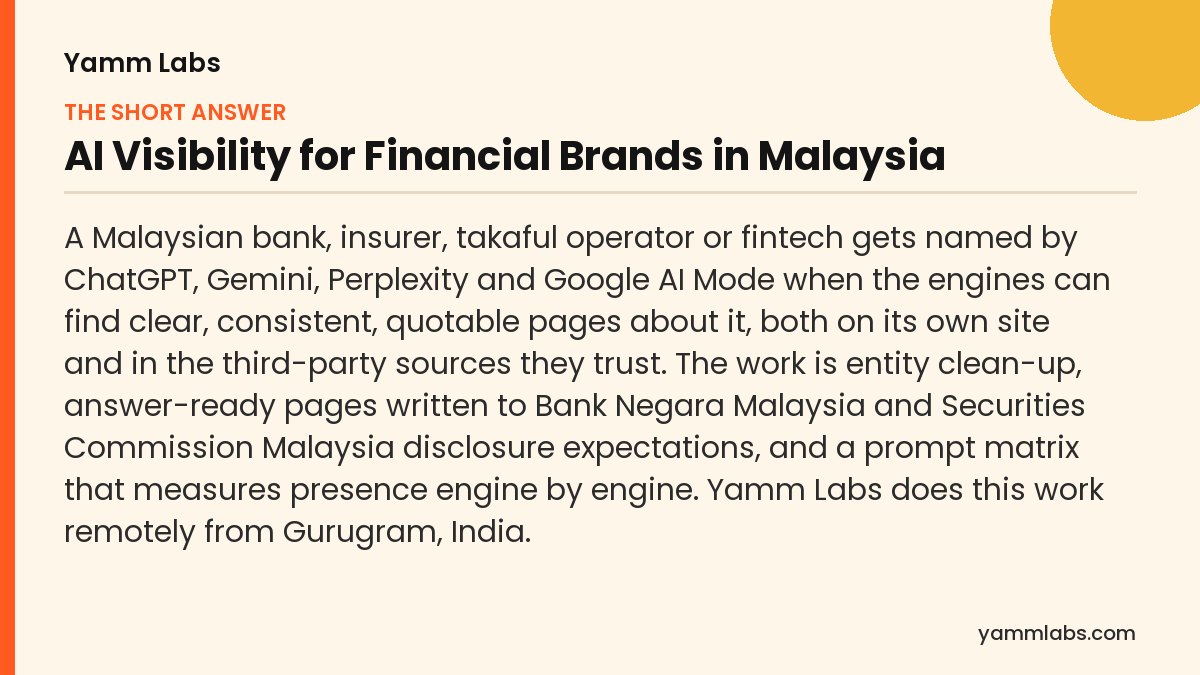
A head of digital at a bank in Kuala Lumpur types a simple question into ChatGPT: which Malaysian bank has the best savings account for a young family? The answer names three brands, quotes a comparison site and a forum thread, and never mentions her bank. Her product page is live, her Product Disclosure Sheet is compliant, and her rates are competitive. None of that mattered, because the engine could not find a page it was willing to quote. That gap is what AI visibility work for Malaysian financial brands has to close, and it has to close it inside the rules Bank Negara Malaysia and the Securities Commission Malaysia already set for advertising and disclosure.
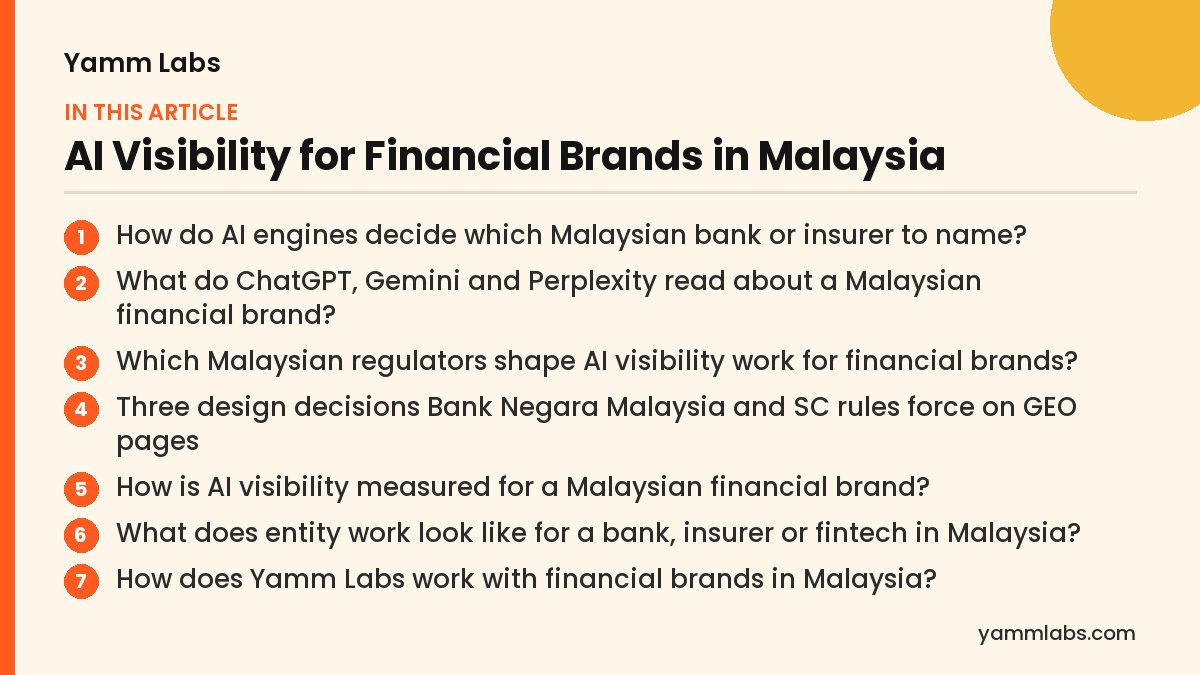
- How do AI engines decide which Malaysian bank or insurer to name?
- What do ChatGPT, Gemini and Perplexity read about a Malaysian financial brand?
- Which Malaysian regulators shape AI visibility work for financial brands?
- Three design decisions Bank Negara Malaysia and SC rules force on GEO pages
- How is AI visibility measured for a Malaysian financial brand?
- What does entity work look like for a bank, insurer or fintech in Malaysia?
- How does Yamm Labs work with financial brands in Malaysia?
- What should a Kuala Lumpur marketing team ask a GEO agency before signing?
- People also ask
How do AI engines decide which Malaysian bank or insurer to name?
When a buyer asks an engine which bank, insurer or fintech to choose in Malaysia, the engine does not rank ten blue links. It assembles one answer and names a handful of brands inside it. The brands it names are the ones it can describe with confidence: what they are, what they sell, who regulates them and why they suit the question.
That confidence comes from retrieval. Perplexity and Google AI Mode show the pages they drew on as citations. ChatGPT shows sources when it searches the web. Gemini can draw on Google Search. In every case the engine pulls pages it can read, compares what they say, and repeats the claims that agree across sources.
So a brand that is well known offline can still be invisible in an answer. If its product pages hide the key facts inside images or PDFs, if its name appears three different ways across the web, or if the only pages comparing it are written by someone else, the engine quotes someone else.
What do ChatGPT, Gemini and Perplexity read about a Malaysian financial brand?
The sources behind a typical “which bank” or “which takaful plan” answer fall into a few groups. Each one is a place where a brand can be present or absent.
- The brand’s own explainer pages. Plain-language pages that answer one buyer question each, with the key facts in text an engine can lift.
- Regulator and official registers. Lists of licensed and approved institutions that confirm a brand is what it says it is.
- Comparison and review sites. Rate tables and product round-ups that engines quote for “best” and “cheapest” prompts.
- News and trade press. Coverage that gives the engine a second, independent description of the brand.
- Forums and community threads. Real customer discussion, which engines often surface for experience questions.
- Structured data. Organisation, product and FAQ markup that tells an engine which facts belong to which entity.
The job is to make the first and last groups excellent, to make sure the brand is described the same way in the middle groups, and to measure which of them each engine is using for each prompt.
SIGNALNewsletter by Yamm Labs
The next piece, straight to your inbox.
New writing on BFSI brands, B2B and influencer marketing, and AI search.
One click to unsubscribe. Privacy policy

Which Malaysian regulators shape AI visibility work for financial brands?
Two regulators matter most for the pages an engine will quote. Bank Negara Malaysia sets conduct and disclosure expectations for licensed banks, including digital banks, Islamic banks, insurers, takaful operators and approved payment instrument issuers. Its product transparency and disclosure policy document covers advertisements, digital disclosure and the language of product information. The Securities Commission Malaysia regulates the capital market, and its advertising guidelines for capital market products were revised in March 2025 with a new effective date of 1 November 2025.
Neither regulator writes rules for AI engines. They do not need to. An explainer page, an FAQ block or a comparison page published by a licensed institution is still promotional material about a financial product, and an engine can quote it word for word. The design decisions below come from that fact.
| Regulator | What it governs | Design decision it forces on GEO pages |
|---|---|---|
| Bank Negara Malaysia | Advertisements for banking, insurance and takaful products: risks given balanced prominence, effective rates shown where rates appear, no “free” claims when conditions apply | Every quotable rate sentence carries the effective rate and the key condition in the same sentence, so an engine cannot lift the benefit without the qualifier |
| Bank Negara Malaysia | Digital disclosure: the Product Disclosure Sheet shown prominently, with no promotional content on the same page | The disclosure sheet page stays clean; the engine-facing explainer lives on its own page and links to it |
| Bank Negara Malaysia | Language of product information, with Bahasa Melayu given priority | Answer pages and the prompt matrix run in Bahasa Melayu and English, not English alone |
| Securities Commission Malaysia | Advertising for capital market products: warnings placed close to the main message, a statement that the advert was not reviewed by the SC, no use of the SC’s name to imply endorsement | Risk lines sit inside each answer block, not in a page footer, and licence status is stated as a plain fact with no badge or logo |
| Securities Commission Malaysia | Finfluencer guidance: promoting capital market products on social media for commission may need a licence | No paid seeding of forums or creator posts to win citations; third-party presence is earned through press and licensed partners |
Three design decisions Bank Negara Malaysia and SC rules force on GEO pages
Most agencies call their AI visibility work “compliance-aware” and stop there. Here is what that phrase has to mean on an actual page for a Malaysian brand.
- The qualifier travels with the claim. Bank Negara Malaysia expects risks to get balanced prominence and, where rates are given in promotional material, the effective rate to be disclosed. An engine usually quotes a sentence or two, rarely the whole page. So a sentence like “our fixed deposit pays a promotional rate” is rewritten to carry the effective rate, the tenure and the main condition in the same sentence. The footnote approach fails here, because the quoted sentence arrives without the footnote.
- The warning sits next to the answer, not at the bottom. The SC’s advertising guidance asks for warnings and disclaimers presented as close as possible to the main message, with prominence matched to their weight in the decision. For a unit trust or robo-advisory brand, each FAQ answer that describes returns carries its own short risk line inside the answer block. A single disclaimer in the page footer does not survive being quoted.
- The disclosure page and the answer page are separate pages. Bank Negara Malaysia expects the Product Disclosure Sheet to be displayed prominently on digital channels without promotional content on the same page. Engines prefer short, direct answer pages. The clean solution is two pages: the disclosure sheet stays exactly as compliance approved it, and a plain-language explainer answers the buyer’s question and links to it.
There is a fourth decision for capital market brands. The SC’s guidance on finfluencers makes clear that promoting capital market products on social media with an expectation of commission can require a licence. Seeding forum threads or paying creators to mention a fund, simply because engines read forums, is not a shortcut worth taking.
An engine quotes a sentence, not a page, so the risk line has to live in the sentence.
How is AI visibility measured for a Malaysian financial brand?
Presence is measured on a prompt matrix, not a keyword ranking. The matrix is a fixed list of the questions buyers in the market ask, run on each engine at a steady interval, with the answers saved and scored.
- Prompts. Real buyer questions by product line: savings accounts, home financing, credit cards, takaful, unit trusts, e-wallets. Each is written once in English and once in Bahasa Melayu.
- Engines. ChatGPT, Gemini, Perplexity and Google AI Mode, each tested separately, because each draws on different sources.
- What gets scored. Whether the brand is named, where it appears in the answer, whether the description is accurate, and which pages the engine cited.
- What gets fixed. Every cited page that describes the brand wrongly, and every prompt where a competitor is named from a page the brand could have published itself.
We publish how we run our own baseline in the AI visibility log, so a Kuala Lumpur team can see what a matrix looks like before it commits to one.
What does entity work look like for a bank, insurer or fintech in Malaysia?
Engines name entities they can pin down. Entity work makes sure every source describes the brand the same way.
That starts with one canonical description: the legal name, the brand name, what the institution is licensed as and by whom, the product lines it offers and the markets it serves. That description goes into Organisation markup on the website, into the about page, into press boilerplate and into every directory profile the brand controls. Names are made consistent across English and Bahasa Melayu versions, including Islamic banking and takaful sub-brands, which engines often treat as separate companies.
Licence status is stated as a plain fact and linked to the regulator’s own register where one exists. The SC’s advertising guidance says the SC’s name or logo must not be used in a way that implies endorsement. So the page says what the licence is, in words, and does not use a regulator’s logo as a trust badge.
How does Yamm Labs work with financial brands in Malaysia?
Yamm Labs works from Gurugram, India. We serve clients across India, and work remotely with clients in the Gulf and other international markets. We do not have an office, a licence or a client in Malaysia, and we will not claim one.
For a Malaysian brand that means the work runs on shared documents and video calls. Malaysia is two and a half hours ahead of India, so most of the working day overlaps. The brand’s own compliance team, or its Malaysian legal adviser, signs off every page before it goes live; we design the pages so that sign-off is quick. The service itself is described on our AI visibility (GEO/AEO) agency page for BFSI brands.
Our financial services experience comes from India, where we have worked with brands including TATA AIA Life Insurance, HDFC Life, Axis Bank, Paytm Money and Aditya Birla Sun Life Mutual Fund. Those are Indian clients working under the rules of Indian regulators such as SEBI, IRDAI and RBI, not Malaysian ones. What carries over is the habit of treating each regulator’s disclosure expectation as a design decision made at the start.
What should a Kuala Lumpur marketing team ask a GEO agency before signing?
- Show me a regulator-driven decision. Ask for one page where a Bank Negara Malaysia or SC expectation changed the layout, the sentence structure or the page split. An adjective is not an answer.
- Show me the prompt matrix. Ask which prompts, which engines, which languages and how often. If Bahasa Melayu is missing, a large part of the market is missing.
- Tell me how you earn third-party mentions. The answer should be press, partners and useful data, not paid forum posts.
- Tell me where your team is. A remote agency is fine. An agency that implies a local office it does not have is not.
Our GEO and AEO FAQ for financial brands covers the general questions in more depth.
People also ask
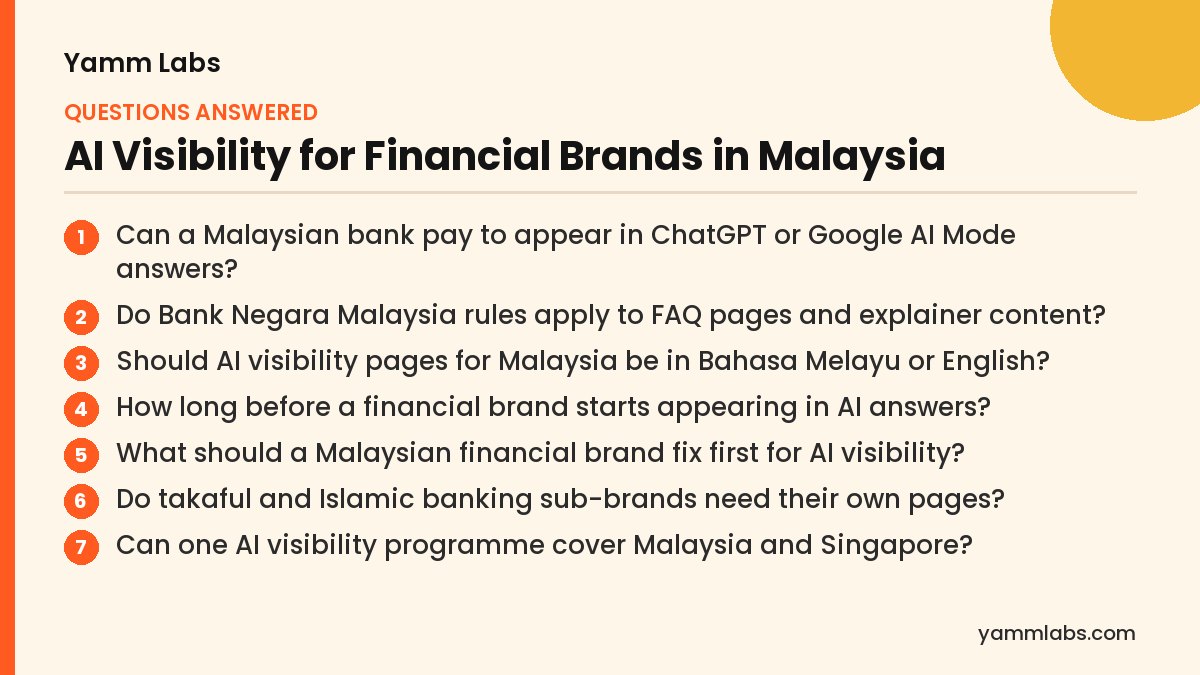
Can a Malaysian bank pay to appear in ChatGPT or Google AI Mode answers?
Not in the answer itself. Where an engine shows ads, they are labelled as ads and sit apart from the answer that names brands. A brand is named in the answer because the engine finds clear, consistent pages about it that it trusts enough to quote.
Do Bank Negara Malaysia rules apply to FAQ pages and explainer content?
Bank Negara Malaysia’s disclosure policy document treats advertisements and promotional material in any medium, including digital channels, as in scope. An explainer page about a product from a licensed institution should be written to the same standard. Confirm the specific treatment of each page with your compliance team.
Should AI visibility pages for Malaysia be in Bahasa Melayu or English?
Both. Bank Negara Malaysia expects Bahasa Melayu to be prioritised in product information, and buyers ask engines questions in both languages. A prompt matrix that tests only English misses part of the market.
How long before a financial brand starts appearing in AI answers?
There is no reliable published benchmark, and any agency quoting a fixed number of weeks is guessing. Engines that search the live web can pick up a new page soon after it is indexed, while broader shifts depend on third-party sources catching up. The prompt matrix shows when it happens.
What should a Malaysian financial brand fix first for AI visibility?
Start with the canonical description. Make the legal name, brand name, licence and product lines read the same way on the website, in Organisation markup, in press boilerplate and in directory profiles, in both English and Bahasa Melayu. Then move any rate or key fact that sits inside an image or PDF into live text, with its qualifier in the same sentence. Build the prompt matrix after that, so progress is measured from a clean start.
Do takaful and Islamic banking sub-brands need their own pages?
They need to be clearly tied to the parent. Engines often treat Islamic banking and takaful sub-brands as separate companies, so each sub-brand page should state which licensed entity offers the product and link back to the parent’s canonical description. Use the same naming in English and Bahasa Melayu, and confirm the licence wording with your compliance team.
Can one AI visibility programme cover Malaysia and Singapore?
The method carries over, but the pages and prompts do not. Bank Negara Malaysia, the Securities Commission Malaysia and the Monetary Authority of Singapore set different disclosure expectations, and buyers in each market ask different questions, often in different languages. Run a separate prompt matrix for each market and keep separate templates, even when the brand is the same.
Find out what the engines say about your brand before your buyers do.
Get a free Fintech Brand Audit across 8 dimensions, plus 3 fixes. No pitch. Run the free Brand Audit →