


The head of digital at a Riyadh fintech types the same question into ChatGPT twice, once in Arabic and once in English: which consumer finance app should I use in Saudi Arabia? The English answer names her brand third and quotes a rate from an old comparison blog. The Arabic answer does not name her brand at all. Her compliance team has a different worry. If an engine repeats a rate without the APR and the finance term beside it, who owns that sentence? AI visibility for a Saudi financial brand is not a copy of a Western SEO playbook. It is entity work, Arabic-first content and regulator-shaped design, measured prompt by prompt.
- How do AI engines decide which Saudi bank, insurer or fintech to name?
- Which regulators govern financial advertising in Saudi Arabia, and what does each expect?
- What design decisions do SAMA and CMA rules force on an AI visibility programme?
- What does entity work look like for a Saudi financial brand?
- How is AI visibility measured on a prompt matrix per market?
- How does Yamm Labs work with financial brands in Riyadh and Jeddah?
- Common AI visibility mistakes for Saudi financial brands
- People also ask
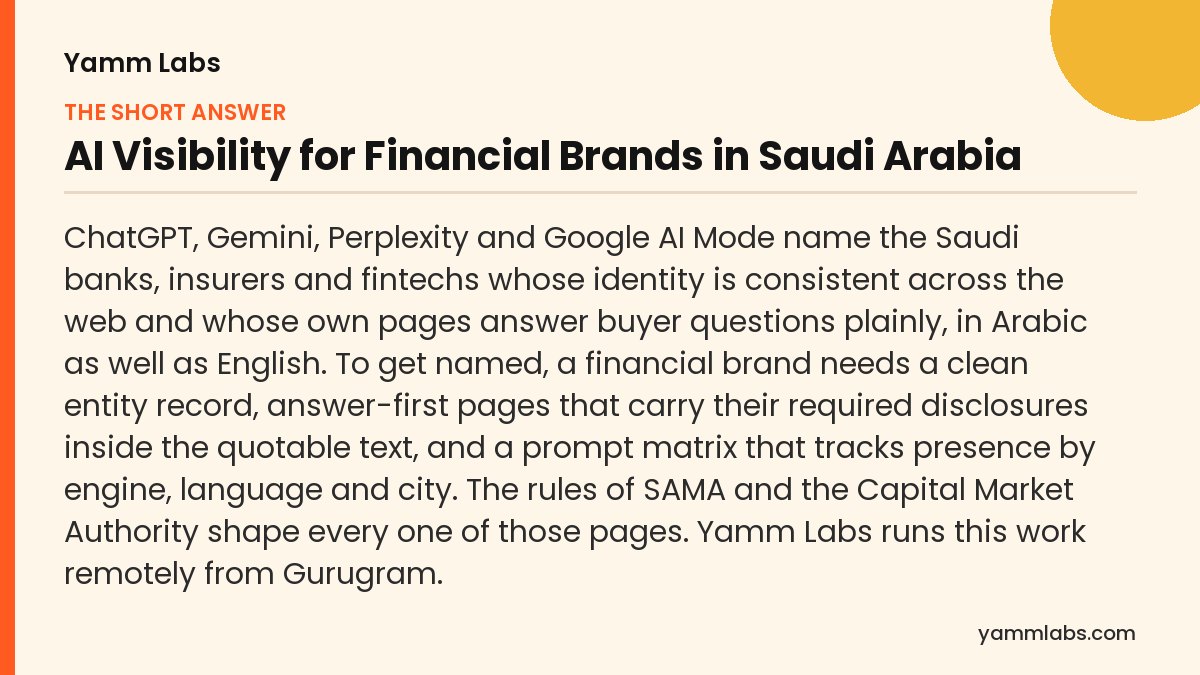
How do AI engines decide which Saudi bank, insurer or fintech to name?
An AI engine answering “best digital bank in Saudi Arabia” or “which app for Sharia-compliant savings in Jeddah” does two jobs. First it works out which entities exist in the category. Then it picks the ones it can describe with confidence and cite. Both jobs depend on what the engine can read and cross-check.
The sources it leans on are familiar: the brand’s own site, especially the About, product and FAQ pages; press coverage; comparison and review sites; directories and listings; and official pages. Engines with live search, such as Perplexity and Google AI Mode, fetch pages at the moment of the question. ChatGPT and Gemini blend what they learned in training with what they retrieve. In every case, a brand whose Arabic name, English name, licence status and product names match across these sources is easier to name than one whose details drift.
Three patterns decide most answers for Saudi financial brands:
- Entity clarity. The engine must be sure that the Arabic trade name, the English trade name and the licensed legal entity are the same organisation. When they read as three different companies, the brand gets split and loses.
- Answerable pages. Engines quote pages that answer one question in the first few lines. A product page that opens with a slogan and hides the fees in a PDF gives the engine nothing to lift.
- Corroboration. An engine repeats claims it can find in more than one place. A brand that is mentioned in press, directories and comparison pages, with the same facts each time, gets named more often than one that only talks about itself.
SIGNALNewsletter by Yamm Labs
The next piece, straight to your inbox.
New writing on BFSI brands, B2B and influencer marketing, and AI search.
One click to unsubscribe. Privacy policy

Which regulators govern financial advertising in Saudi Arabia, and what does each expect?
Two regulators matter most for a financial brand’s public content in the Kingdom. The Saudi Central Bank, SAMA, supervises banks, finance companies, payment firms and other institutions it licenses. Its rules for advertising products and services ask for Arabic as the language of advertising, with an exception for advertisements aimed at non-Arabic speakers. They also require clear terms and numbers, including in headers and footnotes; the institution’s name, logo and contact details; fees and commissions including VAT; the APR and finance term for finance products; a statement that the institution is under SAMA’s supervision; and written sign-off by the compliance function before anything is published. The same rules forbid using SAMA’s own name or logo in an advertisement.
The Capital Market Authority governs securities business. Its Capital Market Institutions Regulations expect a licensed firm to state that it is licensed by the Authority on communications issued to the public, to keep advertisements clear, fair and not misleading, to name the firm and its address, to avoid forecasting the future price of securities, and to carry a warning that past performance is not necessarily a guide to future performance.
The CMA’s securities business rules also treat an advertisement as made in the Kingdom when it is available to people there, including over the internet. A note on scope: insurance supervision has moved from SAMA to a separate Insurance Authority, so an insurer should confirm with its own compliance team which rulebook now applies to its content.
| Regulator | What it governs | What its expectations mean for AI-visible content | The design decision |
|---|---|---|---|
| SAMA | Banks, finance companies, payment firms and other institutions it licenses | Arabic as the advertising language; clear numbers; APR and term on finance products; supervision statement; written compliance approval | Arabic-first answer pages, with the APR, term and supervision line inside the same paragraph as the product claim |
| SAMA | Promotional offers and “free” claims | Offer mechanism and start and end dates stated clearly; “free” made explicit with the target group named | Offer pages carry a dated answer block and are retired on the end date, so engines stop quoting expired offers |
| Capital Market Authority | Capital market institutions: brokers, asset managers, advisers and their funds | Licence statement; name and address; clear, fair and not misleading; no price forecasts; past performance warning | Investment FAQs answer process questions, not return questions; the licence line sits in the byline strip of every answer page |
| Capital Market Authority | Advertisements available in the Kingdom, including online | Content reachable from the Kingdom can count as a securities advertisement | English pages on a global domain go through the same approval route as Arabic ones |
In a regulated market, the disclosure has to travel with the sentence the engine quotes.
What design decisions do SAMA and CMA rules force on an AI visibility programme?
Competitors describe themselves as compliance-aware. Here is what that means on the page for a Saudi brand. Each decision below starts from a regulator expectation and ends in a layout or process choice.
- Arabic is the primary page, not the translation. Because SAMA treats Arabic as the language of advertising, the Arabic version of each answer page is written first and approved first. The English page mirrors it and links to it. Both carry the same numbers, so an engine that reads one language cannot quote a figure the other language contradicts.
- The disclosure sits inside the quotable block. A finance product page opens with a two to four sentence answer that names the product, the APR, the finance term, whether fees include VAT, and the line stating the institution is supervised by SAMA. Nothing that a customer needs to judge the offer is left to a footnote or a downloadable schedule.
- Investment pages answer process, not performance. For a CMA-licensed firm, FAQ answers explain how to open an account, what a fund invests in and what the fees are. Where past performance appears at all, it carries a source and the standard warning in the same block. No answer suggests where a price will go.
- Compliance approval is on the timeline, not after it. SAMA expects written approval before publication, and the CMA treats online content reachable in the Kingdom as advertising. So every answer page moves through a fixed route: draft in Arabic, English mirror, compliance review, publish, then log the approved version. In our planning, the review round is booked into the calendar on day one rather than squeezed in at the end.
What does entity work look like for a Saudi financial brand?
Entity work makes sure every source an engine reads describes the same organisation in the same words. For a Saudi bank or fintech, that means getting four things aligned.
- Names. The Arabic trade name, the English trade name and the licensed legal name, written the same way on the site, in structured data and in every directory listing. The alternate name in schema links the Arabic and English forms so engines treat them as one entity.
- Licence status. A plain statement of which regulator licenses the firm, on the About page and in the footer, in both languages. Engines asked whether a fintech is licensed look for exactly this line.
- Location. Head office city, such as Riyadh or Jeddah, and the branch or service footprint, stated once and consistently. A brand listed in Riyadh on its site and in Khobar on a directory confuses the engine.
- Products. One canonical page per product, with a stable name. When a card or finance product is renamed, the old name is mentioned on the new page so engines can follow the change.
Most of this is dull work with a large effect. It is also the part a brand can control fully. Our GEO and AEO FAQ for financial brands covers the schema and crawl basics in more depth.
How is AI visibility measured on a prompt matrix per market?
A prompt matrix is a fixed list of buyer questions, run on a schedule across several AI engines, with each result scored. For a Saudi financial brand the matrix needs three extra dimensions that an India-only matrix does not.
- Language. Every prompt runs in Arabic and in English, because engines can give different answers in each, and a brand can be present in one and absent in the other.
- City and product. Prompts are written the way buyers ask: “best home finance in Riyadh”, “Sharia-compliant investment app in Jeddah”, “which bank has the lowest fees for salary transfer”. Each prompt maps to the page meant to answer it.
- Vantage point. Engines personalise by location. We run the matrix remotely from Gurugram and record where each run came from. Where local results matter, the client’s own team in the Kingdom spot-checks a sample, and we log both results side by side.
Our standard BFSI matrix is 20 buyer prompts, re-run every month across six engines: ChatGPT, Gemini, Perplexity, Google AI Mode, Microsoft Copilot and Claude, with each answer scored Present, Partial or Absent. For a Saudi programme, the Arabic and English runs are scored separately. The monthly report shows which engine named the brand, which page it cited, and whether it got the licence status, head office city and product names right. The method is set out on our AI visibility agency page for BFSI brands. No one can guarantee a place in an AI answer; what we commit to is the work, the cadence and an honest scorecard.
How does Yamm Labs work with financial brands in Riyadh and Jeddah?
Yamm Labs works from Gurugram, India, and serves clients in India, the Gulf and internationally. We have no office in Saudi Arabia, hold no Saudi licence, and do not claim a Saudi client. Work with Saudi teams runs remotely: video calls for workshops and reviews, shared documents for drafts, and roughly two hours a week of the client team’s time, including a standing review with compliance. Gurugram is two and a half hours ahead of Riyadh, which leaves a comfortable overlap in the working day. In-person workshops happen in India.
What we bring is the regulated-market habit. Our India clients include TATA AIA Life Insurance, HDFC Life, Axis Bank, Paytm Money and Aditya Birla Sun Life Mutual Fund, and working under SEBI, IRDAI and RBI rules has taught us to design the disclosure first and the idea around it. The Saudi rulebooks differ in detail, so every page we draft for a Saudi brand is reviewed and approved by that brand’s own compliance function before it goes live. We ask the client’s Arabic-speaking team to review Arabic copy before it reaches compliance. For a longer list of questions buyers ask before starting, see AI search optimisation: 100 questions answered.
Common AI visibility mistakes for Saudi financial brands
Most gaps we would look for in a first audit come from treating AI visibility as a copy of an English-language SEO project. These are the patterns to check first.
- Translating the English page into Arabic at the end. The Arabic page then trails the English one, carries different wording, and sometimes different numbers. Write and approve the Arabic answer first, then mirror it.
- Keeping the disclosures in a footer or a PDF. An engine that quotes the answer paragraph will not quote a footnote. Put the APR, finance term, fee basis and supervision line inside the block that answers the question.
- Letting names drift. A product renamed on the app but not on the site, or an English trade name spelt two ways across directories, splits the entity. Fix the names before writing new pages.
- Leaving expired offers live. A promotional page that stays up after its end date gives engines an old offer to repeat. Date every offer block and retire it on time.
- Measuring only in English. A brand can be named in English answers and missing from Arabic ones. Score the two languages separately.
- Publishing outside the approval route. English pages on a global domain, blog posts and FAQ updates are still public content that can be read in the Kingdom. Send them through the same compliance review, and confirm the current text of the applicable rules with your compliance team.
People also ask
Does a Saudi financial brand need Arabic pages to appear in AI answers?
Yes, if it wants to be named in Arabic-language answers, and SAMA’s advertising rules already treat Arabic as the language of advertising. Engines can answer an Arabic prompt differently from an English one, so a brand with only English pages risks being absent from the Arabic answers.
Can an AI engine’s answer about a bank count as the bank’s advertisement?
The engine’s own answer is not the bank’s advertisement, but the pages it quotes are the bank’s content. That is why required disclosures such as the APR and the supervision statement belong inside the quotable answer block on the bank’s own page.
Which AI engines should a Saudi fintech track?
At minimum ChatGPT, Gemini, Perplexity and Google AI Mode, because each of them names financial brands when asked for a recommendation. Track each in Arabic and English, and score them separately.
How long does it take for AI engines to reflect changes to a bank’s pages?
There is no fixed timeline. Engines with live search, such as Perplexity and Google AI Mode, can pick up a changed page once they fetch it again, while answers drawn from training data change more slowly. That is why a prompt matrix is re-run on a schedule: it shows when each engine starts naming the brand correctly, rather than assuming it has.
What should a Saudi financial brand fix first for AI visibility?
The entity record. Align the Arabic trade name, English trade name, licensed legal name, licence statement, head office city and product names across the site, structured data and directory listings. Then rewrite the most-asked product pages so they open with a short answer that carries the required disclosures. Measurement follows, in Arabic and English.
Does Yamm Labs have an office or licence in Saudi Arabia?
No. Yamm Labs works from Gurugram and serves Gulf clients remotely, with in-person work in India. The client’s own compliance team approves every page before it is published.
Want to know how AI engines describe your brand in Arabic and English?
Get a free Fintech Brand Audit across 8 dimensions, plus 3 fixes. No pitch. Run the free Brand Audit →
One Comment