


A machining supplier in Manesar gets its first enquiry from a Tier-1 that ships into the English Midlands. The request for quotation carries a drawing, a supplier quality manual and one line: “PPAP Level 3, plus our customer-specific requirements, before first shipment.” The quality head opens the manual looking for the OEM’s own requirement document and finds a note that it is still being written. The forms are the same as a domestic PPAP. The checklist, the traceability questions, the origin paperwork and the time zone are not.
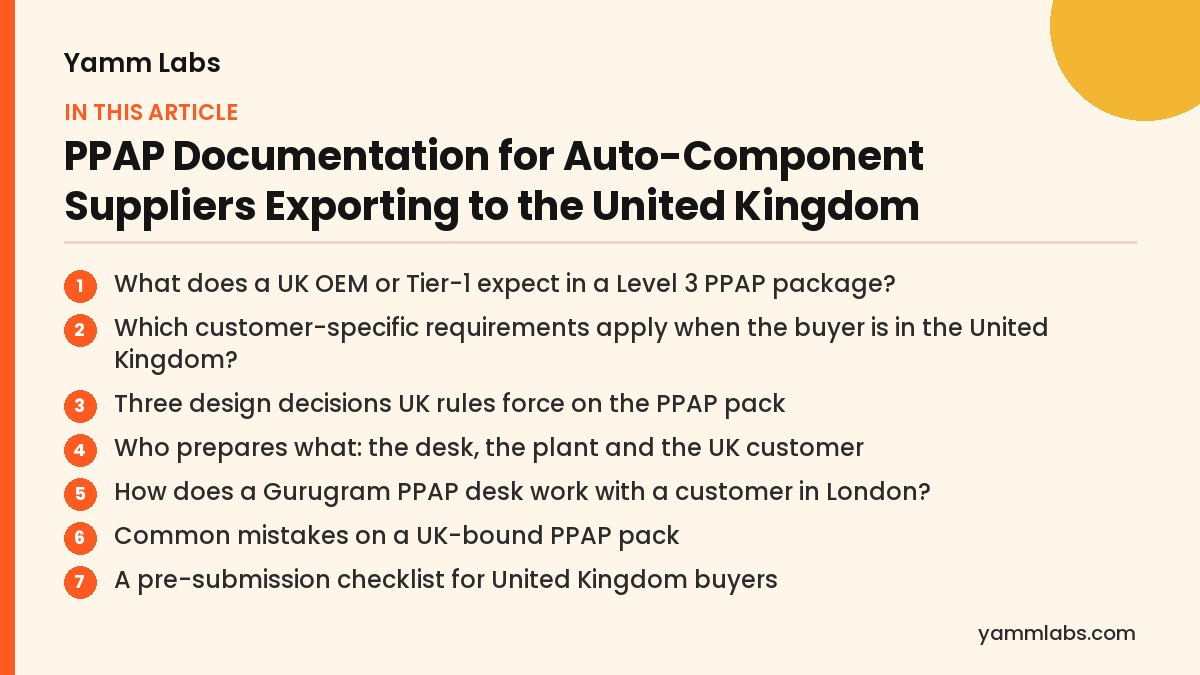
- What does a UK OEM or Tier-1 expect in a Level 3 PPAP package?
- Which customer-specific requirements apply when the buyer is in the United Kingdom?
- Three design decisions UK rules force on the PPAP pack
- Who prepares what: the desk, the plant and the UK customer
- How does a Gurugram PPAP desk work with a customer in London?
- Common mistakes on a UK-bound PPAP pack
- A pre-submission checklist for United Kingdom buyers
- People also ask
What does a UK OEM or Tier-1 expect in a Level 3 PPAP package?
The base is the AIAG PPAP manual. It defines how a supplier shows that its production process makes parts to the design record at the quoted rate, and it sets out five submission levels. Level 3 is the default when the customer does not name another, and it means the warrant goes to the customer with product samples and complete supporting data, not on its own.
On top of the manual sits the customer’s layer. Large OEMs publish customer-specific requirements, usually called CSRs, through IATF Global Oversight, the body whose rules bind the certification bodies that audit to IATF 16949. The UK’s own member of that system is SMMT Oversight, which appears on the IATF site both as a global oversight office and as a national industry association. A UK Tier-1 may then add its own supplier quality manual and portal requirements. A pack built only to the manual is built to the floor, and it will come back.
The table lists the bodies whose rules shape a UK-bound pack, what each governs, and the documentation decision each one forces.
| Body or requirement source | What it governs | Documentation decision it forces |
|---|---|---|
| AIAG PPAP manual | Submission levels, the list of elements, the Part Submission Warrant, full and interim approval | Default to Level 3 unless the customer says otherwise; draft the warrant last, from the finished pack, and leave the signature to the plant |
| OEM customer-specific requirements, published through IATF Global Oversight | Extra elements, form versions, portals, sub-tier approvals and record keeping | Download the current CSR, or confirm in writing which document stands in for it, before the first form is drafted |
| SMMT Oversight, the UK member of the IATF system | IATF oversight of the certification bodies that audit to IATF 16949 | Treat the desk as an external provider the plant evaluates and verifies, so the arrangement survives a certification audit |
| VDA formats, for German-owned buyers | Sampling and approval formats used by German-owned OEMs and their Tier-1s | Confirm at the quoting stage whether the buyer wants AIAG PPAP, VDA-style sampling or both |
| Vehicle Certification Agency | GB type approval of vehicles and components, and conformity of production | Mark every characteristic tied to an approval as a controlled characteristic in the PFMEA and control plan |
| DVSA | Safety defects and recalls under the government’s code of practice | Carry lot, date code and heat or batch number through the process flow, control plan and part label |
| HMRC | Rules of origin that decide whether an importer can claim a preferential tariff | Keep the commodity code, origin statement and a supporting bill of material in the same folder as the warrant |
Which customer-specific requirements apply when the buyer is in the United Kingdom?
This is where the United Kingdom differs from the United States. As of September 2026 the IATF Global Oversight page lists published CSRs for BMW Group, Ford, Geely, General Motors, IVECO, Mercedes-Benz, Renault, Stellantis, Volkswagen and Volvo Group. For JLR, the Coventry-registered carmaker that is part of Tata Motors, the same page says its customer-specific requirements are under development. An Indian supplier heading for a JLR programme, directly or through a Tier-1, should not assume a public CSR exists. Ask the buyer in writing which document governs the submission: an interim OEM requirement, the Tier-1’s supplier quality manual, or both.
The second question is format. German-owned OEMs build cars in England. BMW Group Plant Oxford in Cowley assembles the MINI Cooper range, with panels from its Swindon plant and engines from Hams Hall. A Tier-1 supplying a plant like that may ask for VDA-style sampling instead of AIAG PPAP, or alongside it. The forms and the sampling logic differ, so get the answer before the pilot starts, not at the portal.
The third question is sub-tier control. A CSR or Tier-1 manual can make the supplier responsible for approving its own suppliers’ parts. For an Indian exporter that can mean holding approvals for the local forging, plating or heat-treatment vendor as well. Our PPAP documentation FAQ covers the AIAG and VDA question and sub-tier PPAPs in more detail.
Three design decisions UK rules force on the PPAP pack
None of the three UK bodies below reads your PPAP. Each one still changes what goes into it, because your customer answers to them and passes the duty down.
- Type approval sets the controlled characteristics. The Vehicle Certification Agency is the UK’s designated type approval authority for vehicles and components, and it runs the GB scheme for manufacturers placing vehicles and components on the market in Great Britain. It describes conformity of production as evidence that a series of products matches the specification, performance and marking in the approval documents. If your part carries an approval mark, or feeds an approved system, the characteristics behind that approval belong in the PFMEA and control plan as controlled characteristics, with the reaction plan written out. That decision is made when the ballooned print is numbered, not after the trial run.
- The recall code sets the traceability fields. The DVSA monitors vehicle recalls, and the government’s code of practice on vehicle safety defects and recalls, updated in March 2024, covers vehicles and their components. It expects producers to tell the DVSA once a safety defect is confirmed and to take reasonable steps to find and fix affected products. Your customer can only do that if a field failure traces back to your batch. So lot number, date code and heat or batch number go into the process flow, the control plan and the part label as controlled items.
- Origin rules set what travels with the warrant. HMRC’s guidance explains that an importer must understand rules of origin to claim a reduced or zero tariff under a trade agreement. The PPAP does not decide the duty. The importer will still ask the exporter for the commodity code, the origin statement and a bill of material that supports it. Put all three in the same folder as the warrant, so they are ready the day the buyer asks.
The APQP, PFMEA and control plan questions page covers how controlled characteristics carry from the PFMEA into the control plan.
The manual is the floor; the customer’s checklist is the test, and the plant’s signature is the promise.
Who prepares what: the desk, the plant and the UK customer
Split the work by who holds the information. Documents that can be written from the drawing, the route and the customer’s requirements can be prepared by an outsourced desk. Evidence that exists only after parts are made stays in the plant. Approval stays with the customer. That is how the Yamm Labs PPAP Desk works on any order, UK-bound or not.
- The desk prepares the documentation core. The ballooned print and characteristic register, process flow diagram, PFMEA, control plan, process and setup sheets, checking-aid list and gauge specifications, incoming inspection standard, MSA and dimensional report formats, initial process study formats, and the draft warrant with a package index.
- The plant keeps the evidence. The trial run, physical measurement, capability studies, Gage R&R trials, laboratory testing, samples, master sample and IMDS entry happen in the plant, because they cannot happen anywhere else. The desk formats the results; it does not produce them.
- The plant’s qualified checker verifies every page. Nothing goes to the customer until someone in the plant who knows the part has read each document against the drawing and the customer’s checklist.
- The responsible official signs the PSW. The warrant is the supplier’s promise to the customer. A desk, a consultant or an agency cannot sign it, and PSW authority always stays with the plant.
- The customer decides. Full approval, interim approval or rejection is the customer’s call under its own requirements.
This answers the question a UK buyer may ask directly: who wrote this PPAP? The plant owns it, the plant signed it, and a documentation desk drafted it under the plant’s control. The PPAP Desk service page describes the split from the desk’s side.
How does a Gurugram PPAP desk work with a customer in London?
Remotely. Yamm Labs is based in Gurugram, serves India first and works with clients in the Gulf and other international markets. It does not keep offices outside Gurugram; international work is run from Gurugram with calls and reviews scheduled across time zones. It has no office in the United Kingdom. What it offers a UK-bound Indian supplier is the documentation core, prepared in India inside the supplier’s own quality process, to the UK customer’s checklist. In-person work, where needed, happens with the plant in India.
The time difference helps here. London runs four and a half hours behind India during British Summer Time and five and a half hours behind in winter. A buyer’s morning question arrives in the Indian early afternoon, and the desk can answer it the same day. The rhythm is simple: Indian morning for drafting and plant review, Indian afternoon for the customer’s questions.
The pilot sequence is fixed. On Day 0 the NDA is signed and the plant sends the inputs: the released drawing, the route, the gauge list and whatever document the customer has named in place of a CSR. On Day 1 the desk confirms the route. On Days 2 to 4 the desk builds and QA-checks the pack. On Day 5 the checker-ready pack goes to the plant. The plant then runs its trial, measurements and signature on its own timeline.
Budget follows the same logic. The PPAP Desk two-part pilot is free, with no retainer and no software setup, so the pilot is a test rather than a contract.
Common mistakes on a UK-bound PPAP pack
Most rejections on a first UK order trace back to a decision made too late, not to a badly filled form. These are the ones worth checking before the pilot starts.
- Building to the AIAG manual alone. The manual is the floor. A UK Tier-1 will test the pack against its own supplier quality manual and the OEM’s requirements, so a pack that ignores them comes back.
- Assuming every OEM has a published CSR. For JLR the IATF page still shows its requirements as under development. Get the governing document named in writing instead of guessing.
- Finding out about VDA at the portal. AIAG PPAP and VDA-style sampling are not interchangeable. Ask which one the buyer wants when you quote.
- Marking controlled characteristics after the trial run. If the part carries an approval mark or feeds an approved system, those characteristics belong in the PFMEA and control plan from the ballooned print onwards.
- Leaving traceability off the label. Lot number, date code and heat or batch number need to run through the process flow, the control plan and the part label, or a field failure cannot be traced to your batch.
- Chasing origin paperwork after shipment. The commodity code, origin statement and supporting bill of material should sit in the warrant folder before the buyer asks.
A pre-submission checklist for United Kingdom buyers
Run this list in the plant before the warrant is signed.
- The governing document is named in writing: a published CSR, an interim OEM requirement, the Tier-1’s supplier quality manual, or a stated mix of them.
- The submission format is confirmed as AIAG PPAP, VDA-style sampling or both, and the submission level is agreed, with Level 3 as the default.
- Every characteristic tied to type approval or conformity of production is marked as controlled in the PFMEA and control plan, with a written reaction plan.
- Lot, date code and heat or batch number appear in the process flow, control plan and part label.
- The commodity code, origin statement and supporting bill of material are filed with the warrant.
- Sub-tier approvals are held where the customer’s requirements make them your responsibility.
- The plant’s qualified checker has read every page against the drawing and the UK customer’s checklist.
- The responsible official signs the PSW and the plant submits from its own account.
The UK rules behind items 3 to 5 change over time. Confirm the current text with your compliance team, or with the customer’s quality contact, before you rely on this list for a live programme.
People also ask
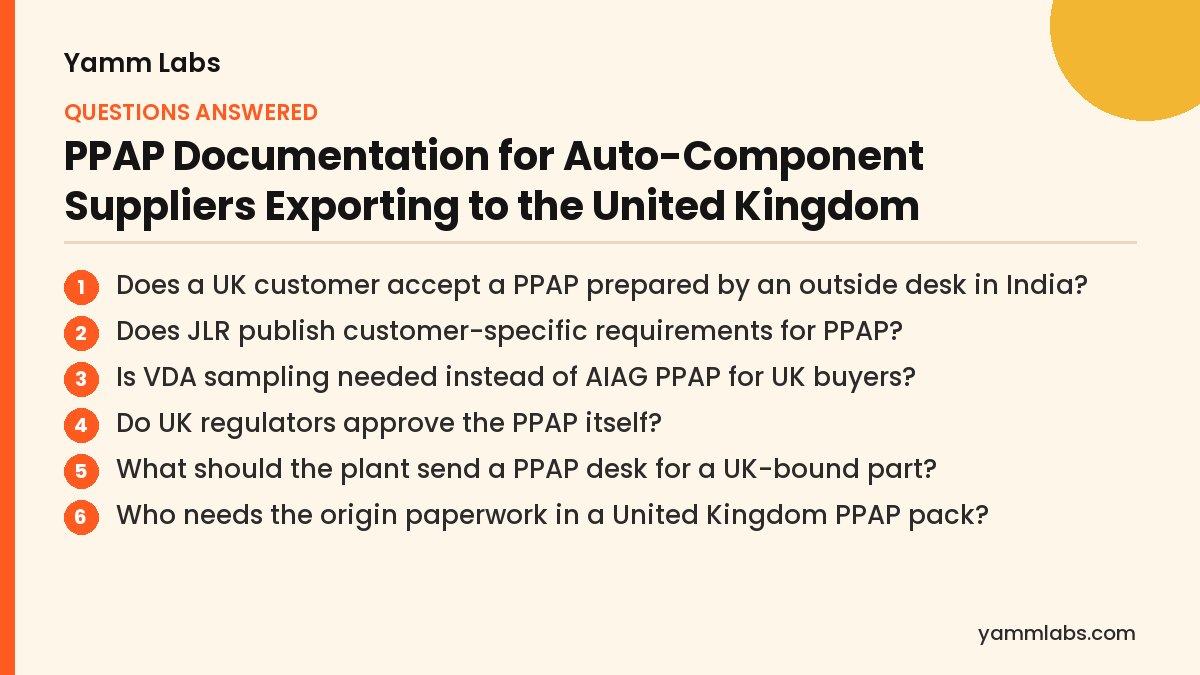
Does a UK customer accept a PPAP prepared by an outside desk in India?
It can, provided the plant owns the submission. The supplier’s responsible official signs the warrant, the plant’s checker verifies every page and the plant submits from its own account. The desk is an external provider the plant evaluates and verifies, which is how an IATF 16949 site should treat any outsourced work.
Does JLR publish customer-specific requirements for PPAP?
As of September 2026, IATF Global Oversight lists JLR’s customer-specific requirements as under development. Until they are published, ask the buyer in writing which document governs the submission, usually the Tier-1’s supplier quality manual or an interim OEM requirement, and build to that.
Is VDA sampling needed instead of AIAG PPAP for UK buyers?
Only when the buyer asks for it. German-owned OEMs build cars in England, including BMW Group’s MINI plant in Oxford, and their Tier-1s may specify VDA-style sampling. Confirm the format at the quoting stage, because the two packs are not interchangeable.
Do UK regulators approve the PPAP itself?
No. The customer approves the PPAP. The Vehicle Certification Agency, the DVSA and HMRC shape what goes into it: controlled characteristics tied to type approval, traceability fields for recalls, and origin paperwork the importer needs alongside the warrant.
What should the plant send a PPAP desk for a UK-bound part?
On Day 0, after the NDA is signed, the plant sends the released drawing, the route, the gauge list and whatever document the UK customer has named in place of a CSR. With those inputs the desk returns a checker-ready pack on Day 5, and the plant runs its trial, measurements and signature on its own timeline.
Who needs the origin paperwork in a United Kingdom PPAP pack?
The importer. HMRC guidance says an importer must understand rules of origin to claim a reduced or zero tariff under a trade agreement. The PPAP does not decide the duty, but the importer will ask the exporter for the commodity code, an origin statement and a bill of material that supports it. Filing all three with the warrant saves a scramble when the first shipment is booked.
Sources
- learnqctools.in: PPAP Process Explained (Step-by-Step Guide for Automotive Suppliers)
- IATF: Page lists CSRs for BMW Group, Ford, Zhejiang Geely, General Motors, IVECO Group, Mercedes-Benz, Renault Group
- IATF: SMMT Oversight appears under both 'IATF Global Oversight Offices' and 'National Industry Associations'.
- jlr.com: JLR Corporate Website
- bmwgroup-werke.com: MINI Plant Oxford, Cowley OX4 6NL
- fmearatings.com: 'German OEMs (like Volkswagen Group, BMW, Mercedes-Benz) historically follow VDA 2' while North American OEMs
Quoting your first Level 3 for a UK Tier-1 and not sure which checklist governs it?
Prove it on two live parts: a five-day pilot inside your existing quality process. No retainer, no software setup. Start a 2-part pilot →