

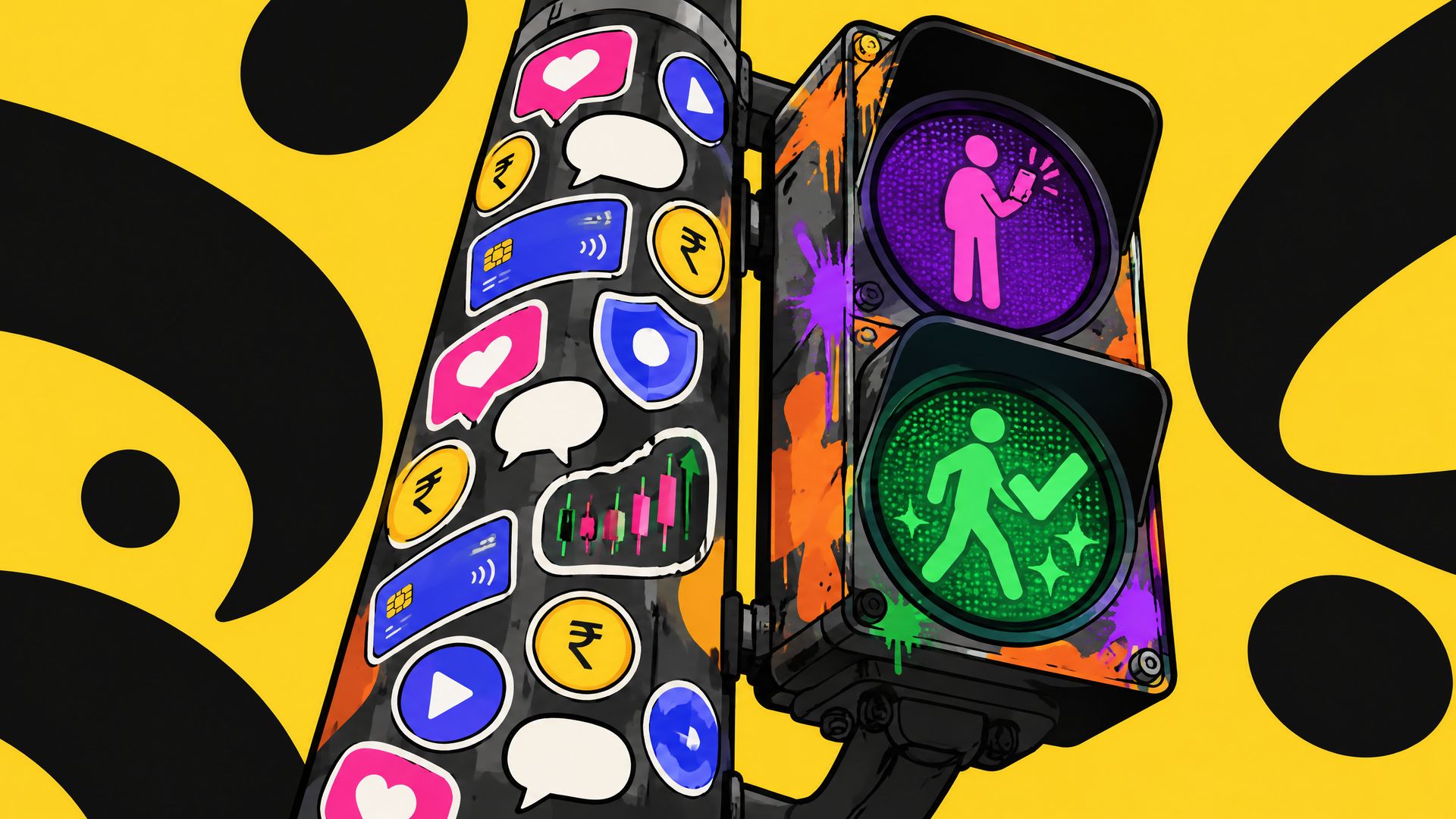
A social media manager at a fund house uploads a 20-second reel about starting a SIP. The edit is tight, the music is right and the product shot lands on second 18. Compliance sends it back the same afternoon. The standard mutual fund warning flashes for one second as a super and the voiceover never reads it. The reel has to be re-cut, and the launch slot is gone. That is finance social media marketing in one scene: the same craft every brand uses, run inside rules that decide the edit before the idea does.
- What does finance social media marketing include?
- How is finance social media different from social for other brands?
- Which rules shape a finance brand’s social feed in India?
- What does a regulator-driven design decision look like?
- Should a finance brand run social in-house, with an agency or through creators?
- Common finance social media marketing mistakes
- A worked example: rescuing the SIP reel
- A step-by-step approval workflow for finance social posts
- How should a finance brand handle comments and complaints?
- People also ask
What does finance social media marketing include?
For an Indian bank, insurer, AMC or fintech, the work usually covers six jobs. Each one exists at a consumer brand too. What changes is the review step attached to it.
- Content calendar. Product explainers, market-moment posts, tax-season and festive content, and brand films, planned so that every piece has time for a compliance round.
- Short video. Reels, Shorts and explainer videos, where disclaimers, voiceover timing and on-screen text are the hardest part to get right.
- Paid social. Lead-generation and app-install campaigns, where the ad, the landing page and the app journey all have to say the same thing.
- Creators and finfluencers. Who the brand pays, what they may say and what they may never claim.
- Community and grievances. Comments and DMs about failed payments, claims or KYC, which need a response path that protects customer data.
- Approval workflow. Who signs off, in what order, with a record kept for every post.
If you want the wider set of short answers first, the hub page on finance social media questions covers 100 of them in one place.
How is finance social media different from social for other brands?
A food brand can say its biryani is the best in Delhi. A fund house cannot say a scheme will beat the market, and a lender cannot hide the real cost of a loan behind a low headline rate. Three differences follow from that.
First, the copy is a regulated statement. Return claims, performance numbers and words like guaranteed or assured carry legal weight, and the regulator’s rules on advertisements apply to a reel exactly as they apply to a newspaper page.
Second, the messenger is regulated too. SEBI now bars the entities it regulates, and their agents, from associating with anyone who gives securities advice or makes return or performance claims without SEBI registration or permission. People doing investor education are carved out, as long as they stay out of advice and return claims. For a broker or an AMC, that changes creator marketing from a media-buying question into a vetting question.
Third, the approval chain is longer. A post at a consumer brand might need one sign-off. At a bank or insurer it usually needs marketing, product, legal and compliance, and for an insurer’s distributors, the insurer itself.
In finance, the disclaimer is part of the edit, not a sticker on top of it.
Which rules shape a finance brand’s social feed in India?
Each regulator touches social content in a different place. The table shows where the rule lands on the post itself.
| Regulator | Who it covers | Where it lands on a social post |
|---|---|---|
| SEBI | Mutual funds | The standard warning must be shown and voiced for five seconds in audio-visual ads, so it needs its own beat in the reel. |
| SEBI | Brokers, AMCs, advisers and their agents | No tie-ups with unregistered people who give securities advice or make return claims, which changes creator briefs and contracts. |
| IRDAI | Insurers and their distributors | The insurer’s registered name must appear prominently with its trade name or logo; ads by a distribution channel need the insurer’s written approval before they go out. |
| RBI | Banks and regulated lenders | For retail and MSME term loans, the borrower gets a Key Facts Statement with the annual percentage rate before signing, so a loan ad should not promise a cost the journey cannot back up. |
Rules change. Treat this as a map of where to look, and check the current regulator text with your compliance team before a campaign goes live.
SIGNALNewsletter by Yamm Labs
The next piece, straight to your inbox.
New writing on BFSI brands, B2B and influencer marketing, and AI search.
One click to unsubscribe. Privacy policy

What does a regulator-driven design decision look like?
Agencies in this space often call themselves compliance-aware. The test is whether they can show you a decision the rule forced. Here are three we make as standard.
- The five-second beat. In a 20-second mutual fund reel, the standard warning takes five seconds of screen and voice, a quarter of the runtime. We script it as the closing beat with its own voiceover line, instead of a super running over the product shot, so the cut never has to be redone.
- The insurer lockup. For insurance content, the registered name sits in a fixed lockup with the trade name or logo inside the template. Nobody adds it at export, so nobody forgets it.
- The distributor clock. When a bank or broker promotes an insurer’s policy, the insurer’s written approval comes before the post goes live. We build that approval into the content calendar as its own step, so a festive post is not waiting on sign-off on the day.
The same thinking applies to longer formats. Our financial explainer video questions page goes deeper on scripting disclaimers into video.
Should a finance brand run social in-house, with an agency or through creators?
This is the decision a buyer actually makes, and most brands end up with a mix. An in-house team knows the product and the compliance people. An agency brings craft, volume and a tested review workflow. Creators bring reach, but in securities they now carry a registration question that the brand has to answer before the contract.
Ask any agency three things. Show me a post where a rule changed the layout. Show me your approval tracker. Tell me which creators you would not work with, and why. Yamm Labs works from Gurugram with BFSI brands such as TATA AIA Life Insurance, HDFC Life, Axis Bank, Paytm Money and Aditya Birla Sun Life Mutual Fund, and serves clients in the Gulf and elsewhere remotely. If you run an AMC, our guide to choosing a mutual fund marketing agency in India lists the questions to put to any shortlist.
Common finance social media marketing mistakes
Most rejected posts fail for the same few reasons. None of them is about taste.
- The warning as a one-second super. The opening scene is the classic case. In a mutual fund reel, the standard warning needs its own five seconds of screen and voice, planned in the script.
- Trend audio over the required voiceover. A trending track can leave no room for the spoken warning. Choose the audio after the voiceover beats are fixed.
- Return claims in captions and comments. The reel passes review, then the caption or a pinned reply adds a performance claim nobody checked. Treat captions and replies as part of the post.
- Creator briefs without a registration check. For a broker or an AMC, the first question about a creator is whether the association is allowed, not how many followers they have.
- A headline rate with no path to the real cost. A loan ad that leads on a low rate while the journey shows a different annual percentage rate sets up a complaint.
- Distributor posts without the insurer’s approval. A bank’s festive post about an insurance plan goes live before the insurer has signed off in writing.
A worked example: rescuing the SIP reel
Go back to the 20-second SIP reel from the opening. Compliance returned it because the standard warning flashed for one second as a super and the voiceover never read it. Here is how the re-cut works, and how to avoid the re-cut next time.
The re-cut. Five seconds of the reel now belong to the warning, on screen and in voice. That leaves 15 seconds for the idea. The product shot that landed on second 18 moves up to around second 12, and the hook in the first two seconds stays. Anything that does not serve the one message, such as a second benefit or an extra scene, comes out.
The template. The team builds a reel template with the warning beat locked at the end, set in brand type, with its voiceover line in the script from day one. Every future mutual fund reel starts from that template.
The calendar. The launch slot moves back by one compliance round, and the next campaign books that round before the edit starts. Confirm the current warning text and timing with your compliance team for each new asset.
A step-by-step approval workflow for finance social posts
The sixth job in the list above, the approval workflow, is the one that decides whether the other five run on time. This is the order we use.
- Brief with the rules attached. Every brief names the product, the regulator whose rules apply and the fixed elements the post must carry.
- Copy review. Compliance reads the words before design starts. This is where return claims and loaded words are caught.
- Design in templates. Warnings, lockups and disclaimers sit in locked template zones, so designers cannot move or drop them.
- First-cut review. Compliance checks timing, placement and readability on a phone screen, the way the audience will see it.
- Third-party approvals. Where a distributor promotes an insurer’s product, the insurer’s written approval comes here, before scheduling.
- Caption and landing page check. The caption, hashtags, link and landing page are reviewed with the creative, since they make the same claim.
- Publish and record. Keep the approved file, the approval record and the live link together for every post.
Confirm the current regulator text and your internal policy with your compliance team before you adopt this sequence.
How should a finance brand handle comments and complaints?
Comments and direct messages are where customers raise failed payments, claim delays and KYC problems. The reply is part of the brand, and it carries risk of its own.
- Never ask for sensitive details in public. Account numbers, policy numbers and personal documents never belong in a comment thread. Move the customer to a secure, official channel.
- Use written reply templates. Pre-approved replies for common issues let the community team respond quickly without improvising claims.
- Route complaints properly. A complaint made on social should reach the same grievance process as one made by phone or email, with a record.
- Watch for impersonation. Fake handles that copy a bank’s name to collect customer details are a known risk. Report them, and warn customers in the brand’s own voice.
People also ask
Is finance social media marketing the same as fintech marketing?
No. Fintech marketing covers the whole growth plan for a financial app, from app-store pages to referral schemes. Finance social media marketing is the social part of that plan, for fintechs and for banks, insurers and fund houses alike.
Can a mutual fund or broker work with finfluencers?
Only within SEBI’s limits. Regulated entities and their agents cannot associate with people who give securities advice or make return claims without SEBI registration or permission. Investor education without advice or return claims is carved out, so the creator brief has to hold that line.
Do insurance social posts need approval before they go live?
If a distributor such as a bank or broker is posting about an insurer’s product, yes: the insurer’s written approval is needed before it is issued. The insurer’s own posts must also show its registered name prominently alongside its trade name or logo.
Which platforms matter most for finance social media marketing in India?
It depends on the audience and the product. Short-video formats such as Instagram Reels and YouTube Shorts suit product explainers and launches, LinkedIn suits B2B fintech and investor relations, and long-form YouTube suits deeper education. Pick the two or three channels you can staff with a proper review process rather than spreading the team thin.
How often should a bank or fund house post on social media?
As often as the team can post with a full compliance round behind every piece. A steady rhythm built on approved templates beats a burst of posts that stalls in review. Plan market moments, tax season and festive content in advance, and keep a small library of evergreen, pre-approved education posts for quieter weeks.
Can a finance brand use memes and trends?
Yes, with care. A meme is still a financial advertisement when a regulated brand posts it, so the same rules on claims, warnings and disclosures apply. Trends move fast and review takes time, so prepare templates that can carry the required elements, and skip any trend that only works with a claim you could not make in a normal ad.
What should a finance social media report measure?
Beyond reach and engagement, measure what the regulated context adds: how many posts passed compliance on the first round, how long approvals took, how many comments turned into complaints and how fast they were resolved. For performance campaigns, track the journey from ad to landing page to application, since a mismatch there shows up as drop-off and complaints.
Who owns finance social media inside a bank or insurer?
Marketing usually owns the calendar and the creative, but ownership is shared in practice. Product owns the facts in each post, compliance owns sign-off and customer service owns replies to complaints. The brands that move fastest name one person in each team and agree the approval order in writing before the first campaign.
Sources
Want to know if your social feed would pass a compliance review?
Get a free Fintech Brand Audit across 8 dimensions, plus 3 fixes. No pitch. Run the free Brand Audit →