

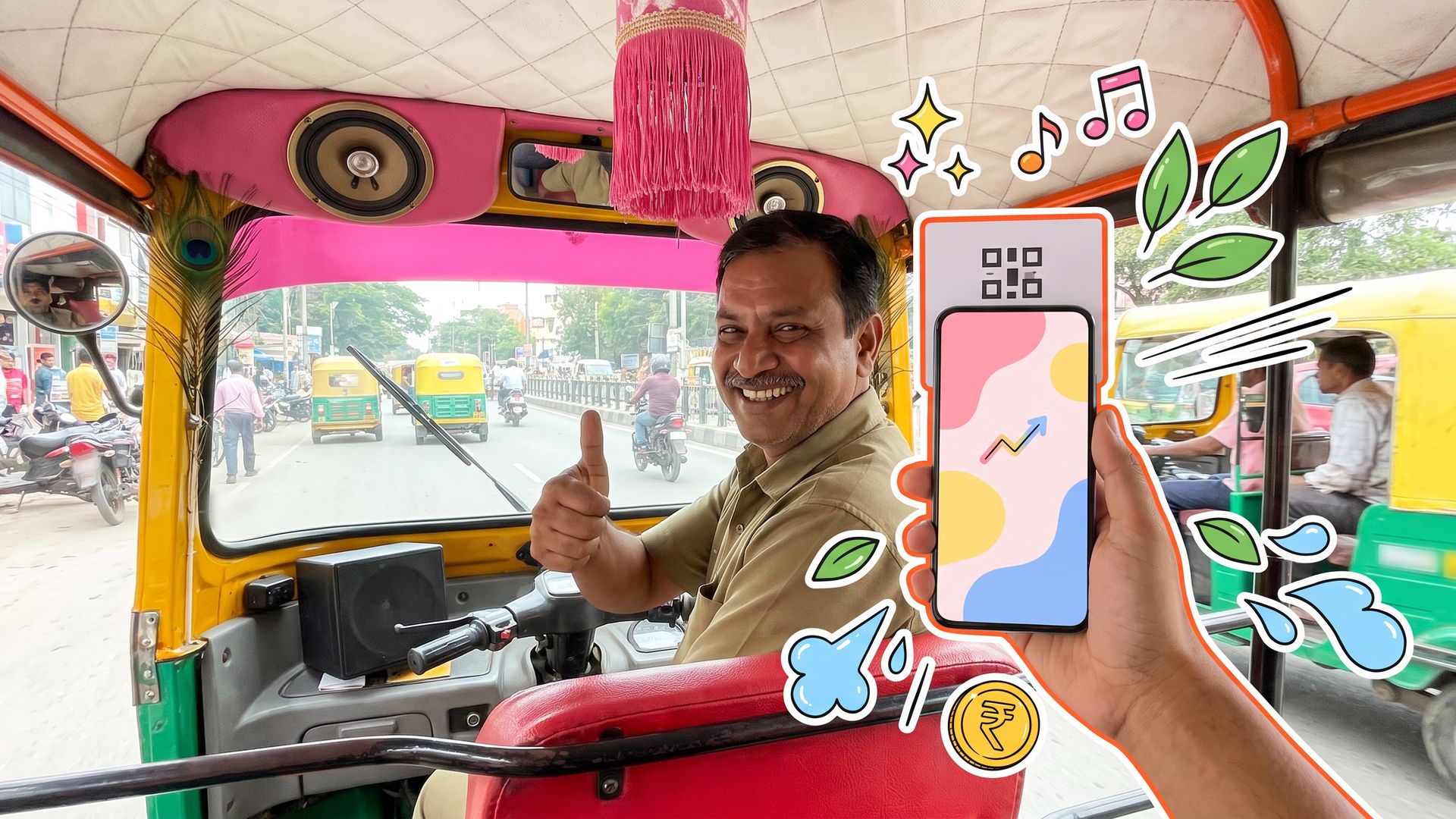
A kirana shop in Gurugram on a weekday morning. The owner does not look at the phone pointed at his QR standee. He waits for the soundbox to announce the amount, nods, and turns to the next customer. The payment took two seconds. The app on the customer’s phone took the credit. The rail that moved the money never appeared. UPI is the most used thing in Indian payments and one of the least seen. UPI Chalega is the campaign that gave the rail a name, a voice and a habit, and it is the best Indian case on branding infrastructure nobody looks at.
- What was UPI Chalega, and who actually ran it?
- What ran, and when? The UPI Chalega timeline
- Why did an industry campaign make sense for a rail nobody sees?
- Which NPCI brand rules shape a bank’s UPI design?
- What did UPI Chalega change, and what is not publicly reported?
- Where did the campaign stop working, and what replaced it?
- What can a bank or fintech still own once the payment is invisible?
- What should a regulated brand take from UPI Chalega today?
- People also ask
What was UPI Chalega, and who actually ran it?
By early 2020 the problem with UPI was no longer availability. Banks and large apps were already on the rail. The problem was habit: people who had UPI on their phones still paid the vegetable seller in cash. NPCI’s answer was not a product ad. It was an industry campaign, created with member banks, payment service providers and third-party apps, and steered by the Financial Literacy and Awareness Campaign committee, chaired at launch by Karthi Marshan, chief marketing officer of Kotak Mahindra Group. State Bank of India took part as a founding member of NPCI.
The creative agency was Ogilvy and Mather. It built the campaign around Mrs Rao, who narrates six television films and reprimands viewers, kindly, for their faith in cash and in the old ways of splitting bills. The line was “Batwe ke jagah mobile nikalo; len den ki nai aadat dalo”: take out your phone instead of your wallet, and build a new payment habit.
The films showed moments, not features: a vegetable shop, a petrol pump, a restaurant, an online order, a bill payment. Television, cinema, outdoor, radio and digital all pointed to one microsite, UPIChalega.com, which carried how-to videos and a list of participating banks and apps. No budget was disclosed at launch, and none of the sources we opened publish one since.
What ran, and when? The UPI Chalega timeline
The campaign never had a single launch and a single end. It ran as phases, each with a different job, and the phases read like a diary of what NPCI thought the rail’s problem was that year. Every date and name below comes from a source we opened.
| When | What ran | Who the source names | What the phase was for |
|---|---|---|---|
| 24 February 2020 | Launch: six Mrs Rao television films across TV, cinema, outdoor, radio and digital, driving to the UPIChalega.com microsite | NPCI and the FLAC committee; Ogilvy and Mather; Kotak Mahindra Group and SBI | Habit: pay daily expenses by UPI |
| 7 April 2020 | #IndiaPaySafe: six short Mrs Rao videos on paying digitally during lockdown, including a call to donate to the PM CARES Fund; influencers, social, OTT | Ogilvy and Mather creative; Mediacom and Crayons-Yaap media; Fulcro digital; Adfactors PR | Safety and distance: pay from home |
| 24 August 2021 | #ZimmedarRahoUPIKaro digital films extending UPI Chalega, with four UPI Safety Shield tips | Virat Kohli, Ranveer Singh, Pratik Gandhi, Saina Nehwal, Sonu Sood and others; no agency named | Responsibility: safe usage |
| 27 June 2022 | “Life Hai Wow”, a Badshah rap anthem for UPI AutoPay, extending UPI Chalega | NPCI; content company YAAP developed the song with Badshah | Feature adoption: recurring payments |
| August 2023 | UPI Chalega 3.0, #UPIWaliShaadi: Mrs Rao runs a family wedding and shows UPI LITE, UPI AutoPay and interoperability; TV, radio, OTT, outdoor, influencers, digital | Ogilvy; ICICI Bank quoted alongside NPCI | Features on top of the habit |
| 6 November 2024 | Main Moorkh Nahi Hoon: six fraud-awareness films in 11 languages, opening with Moongfaliwala and Paanwala | Pankaj Tripathi; Ogilvy | Fraud: recognise the scam |
Read down the last column and the arc is clear. 2020 sold the habit. 2021 sold responsibility. 2022 and 2023 sold features that sit on the habit. 2024 sold suspicion, because by then fraud had become the rail’s reputational risk. No brand plans a multi-year arc this neatly in advance. NPCI got there by letting each phase answer the problem of its year.
SIGNALNewsletter by Yamm Labs
The next piece, straight to your inbox.
New writing on BFSI brands, B2B and influencer marketing, and AI search.
One click to unsubscribe. Privacy policy

Why did an industry campaign make sense for a rail nobody sees?
Most payment marketing is app marketing: cashback, a celebrity, a colour. NPCI is not in the business of winning the app comparison. It owns the rail every app uses, and its members compete with each other. The design followed from that constraint.
- Sell the verb, not the product. “UPI Chalega” means roughly “UPI works here”. It is the sentence a shopkeeper says. The campaign put a phrase into the mouths of merchants, where the habit is decided, rather than a feature list into an ad.
- A character instead of a spokesperson. Mrs Rao is not a bank employee and not a celebrity. She is an aunt who has already switched and is mildly disappointed that you have not. Every partner could run the films; none owned her.
- One microsite, many logos. UPIChalega.com listed participating banks and apps. The rail got the story; the partners got the traffic. That trade is fair only when the rail owner writes the brand rules, which NPCI does.
- Indian moments, not checkout pages. The vegetable shop, the petrol pump, the restaurant bill. The films showed the moment cash usually wins and made UPI the easier move in that exact moment.
- A committee, not a client. The FLAC structure meant the creative had to survive a room of competing marketers. That slows things down, and strips out anything one bank could claim as its own.
UPI Chalega sold a habit and a mark, not an app, which is why every app could run it and no app could own it.
Which NPCI brand rules shape a bank’s UPI design?
Agencies like to say they are compliance-aware. The useful question is which decision the rule forced. NPCI’s BHIM UPI brand guidelines, in the version updated in June 2026, set rules that every bank or fintech on the rail has to design around. Here are four decisions they force, described in general terms. Check the current document on NPCI’s site before you sign off artwork.
- The lockup rule: the UPI mark is not yours to merge. The guidelines say the UPI logo must never be merged or altered together with a partner’s logo, and that no partner may add a prefix or suffix to the UPI identity in its logos, features or campaign assets. When the two appear together, they are separated by clear space and a solid dividing line, with the partner logo held in proportion to the UPI logo’s height. The design decision: a bank’s UPI ad leads with the bank’s identity and carries the UPI mark as a fixed lockup the creative team cannot tint or fuse. Budget for two masters of every asset, one co-branded and one for the bank alone.
- The screen sequence: onboarding carries the rail’s mark. The guidelines expect “Powered by UPI” wherever UPI is being called, including the onboarding flow from the moment the customer starts linking a bank account, and they ask app-store previews to show the UPI ID and UPI PIN screens. After the customer creates a UPI ID, the partner app is expected to show a do’s and don’ts pop-up before the customer explores the app, with lines such as entering the UPI PIN only on the UPI PIN page. The design decision: the bank’s voice runs up to the transaction and resumes after it, but set-up and PIN entry are shared-brand moments, and the safety copy belongs there.
- The merchant standee is a compliance artefact first. On 5 June 2026 NPCI issued an addendum to its mandatory brand guidelines for BHIM UPI merchant QR. Regulatory trackers report that it standardises the BHIM UPI logo, QR standees and acceptance signage, applies to banks, payment service providers, third-party apps, aggregators and acquirers, and expects newly issued material to align within NPCI’s timelines, with non-compliant material open to replacement. The design decision: the acquirer’s branding sits in whatever zone the guideline leaves, and the print run follows the compliance calendar.
- Safety detail lives one click away, not in the film. The 2020 films sold the habit in a few seconds; the how-to content sat on the microsite. Any regulated brand copying this should keep its disclaimer and safety copy where it can change without a re-shoot.
On budget: no source we opened publishes a figure for any phase, and we will not guess one. The lesson is structural. A bank planning a feature campaign on the rail should expect the film to be the smaller line item and the co-branded asset library, in every language and every lockup, to be the larger one.
What did UPI Chalega change, and what is not publicly reported?
The government’s own numbers describe the scale the rail reached while the campaign ran. In a written reply in the Lok Sabha in July 2026, the Minister of State for Finance said NPCI had reported 55.49 crore users onboarded on UPI as of June 2026. The same reply gave 24,161.69 crore transactions worth 314.23 lakh crore rupees in FY 2025-26, up from 18,586.60 crore transactions worth 260.56 lakh crore rupees in FY 2024-25.
What none of those sources give is attribution. No NPCI release, ministry reply or trade article we opened reports reach, recall, brand tracking or a share of growth credited to UPI Chalega. Growth happened alongside the campaign; the campaign’s contribution is not publicly measured, and we will not invent a number. What the sources do show is narrower and still useful: the campaign’s stated job moved from adoption in 2020, to responsibility in 2021, to features in 2022 and 2023, to fraud recognition in 2024.
Where did the campaign stop working, and what replaced it?
Two places, on our reading. First, the habit message ran out of road. Once a shopkeeper says “UPI chalega” without prompting, a film telling him to say it is wasted, and the 2024 phase dropped the habit pitch for fraud. Second, the celebrity phases of 2021 and 2022 carried the hashtags of those years without building a device NPCI kept. Mrs Rao returned at the centre of the 2023 wedding films. That return is the tell. When a campaign goes back to its original device, the interim devices did not build anything the brand wanted to keep.
What replaced the habit message was not marketing. The July 2026 reply points to security controls, including the Comprehensive UPI Information Security Framework 2025, transaction limits and safeguards against unauthorised account access. Fraud is fixed by controls; communication can only teach recognition. The Pankaj Tripathi films accept that limit and teach the viewer to say “I am not a fool” to the caller. For a regulated brand, that is the right brief: when the risk is behavioural, the campaign’s job is recognition and the product’s job is the control.
What can a bank or fintech still own once the payment is invisible?
When the rail is a common brand and the QR standee is a compliance artefact, the app can feel like a commodity. It is not, but the ownable ground has moved. In our work with banks and payment apps, including Axis Bank and Paytm Money, the ground worth holding sits in six places.
- The two seconds before. The home screen, the payee search, the default account. The rail marks set-up and PIN entry; the bank owns what the customer sees on the way there.
- The two seconds after. Confirmation, receipt, the offer to set an AutoPay, the nudge to check a limit. Here a bank’s voice is free and decisive.
- The credit decision. Where a bank extends credit that the customer spends over UPI, the bank, not the rail, says yes or no. Its brand should be visible at exactly that moment.
- Limits, disputes and the statement. A failed transaction, a wrong transfer, a refund question. The rail is invisible until something goes wrong; the bank is the name on the screen when it does.
- The merchant relationship. The soundbox, the settlement time, the loan against receivables. The standee is standardised; the service around it is not.
- The safety promise in the bank’s own words. NPCI teaches recognition. A bank can promise what it will do after a fraud report, in plain language, on its own pages. The rail cannot make that promise for you.
The principle underneath all six is in our guide to the psychology of trust in financial brand design: trust is built at the moments of friction, not the moments of ease. UPI made ease a public good. Friction is still yours.
What should a regulated brand take from UPI Chalega today?
- Name the behaviour, not the product. “UPI chalega” is a sentence a merchant says. Find the sentence your customer says when your product works, and build the campaign on it.
- Give the rules a place in the layout before the idea arrives. The separated lockup, the onboarding mark, the safety pop-up, the standee zone. Decide them first and the creative meets fewer surprises in review.
- Keep one character, and protect it. Mrs Rao ran from 2020 to 2023 and through a pandemic. The celebrity phases did not leave a device behind. Equity compounds only in a device you can keep.
- Change the job when the job is done. Habit, responsibility, features, fraud. Each phase had one task. When the task is done, write a new brief, not a louder old one.
- Design the moment after the rail. Our 100 branding questions for trading and payment apps is the checklist we use to find which of those moments are still unowned in a product.
People also ask
Who created the UPI Chalega campaign?
NPCI created it with member banks, payment service providers and third-party apps through its Financial Literacy and Awareness Campaign committee, which Karthi Marshan of Kotak Mahindra Group chaired at launch. Ogilvy and Mather was the creative agency and built the Mrs Rao character.
When did UPI Chalega launch, and what came after?
It launched on 24 February 2020 with six Mrs Rao films. Later phases covered lockdown safety in 2020, responsible use in 2021, UPI AutoPay in 2022, UPI LITE and interoperability in 2023, and fraud awareness with Pankaj Tripathi from 6 November 2024.
Did UPI Chalega increase UPI transactions?
The government reports 24,161.69 crore UPI transactions in FY 2025-26 and 55.49 crore users onboarded as of June 2026. None of the sources we opened attribute any share of that growth to the campaign, so the accurate answer is that the campaign ran alongside the growth and its contribution is not publicly measured.
Can a bank or fintech use the UPI logo in its own advertising?
Only within NPCI’s BHIM UPI brand guidelines, which forbid merging or altering the UPI logo with a partner’s logo and expect a “Powered by UPI” mark where UPI is used. Check the current guidelines on NPCI’s site before artwork is approved, because the merchant QR rules were updated in June 2026.
Sources
- indiantelevision.com: NPCI launches UPI awareness campaign in association with payment ecosystem players
- archive.adgully.com: FLAC committee chaired by Karthi Marshan, CMO Kotak Mahindra Group
- archive.adgully.com: 7 Apr 2020 #IndiaPaySafe, 6 Mrs Rao pieces, PM CARES via any BHIM UPI app
- medianews4u.com: Virat Kohli and Ranveer Singh Promotes #ZimmedarRahoUPIkaro The campaign urges users to be responsible and fol
- afaqs.com: 27 Jun 2022, Life Hai Wow, Badshah, UPI AutoPay, extends UPI Chalega, YAAP created with Badshah.
- mediabrief.com: Ogilvy and NPCI launch new UPI adoption and safety awareness campaign › Mediabrief.com
Building a campaign on a rail you do not own?
Get a free Fintech Brand Audit across 8 dimensions, plus 3 fixes. No pitch. Run the free Brand Audit →