


A salaried investor in Pune types “is a flexi-cap fund safe for a first SIP” into Google on her phone. Before any blue link, she sees a block of AI-written text that answers the question in four sentences, with a few source links beside it. She taps Listen and hears it read out. Your scheme page still ranks on the first page, but it sits below an answer she has already heard. That block is a Google AI Overview, and it has changed what being on page one means for a financial brand.
- How do Google AI Overviews build an answer?
- Are AI Overviews live in India, and in which languages?
- Why do AI Overviews change where a BFSI disclaimer goes?
- Can a financial brand control what AI Overviews show from its site?
- What should a bank, insurer or fund decide about AI Overviews now?
- How to check whether Google AI Overviews quote your pages
- A worked example: rewriting a fund page passage
- Common mistakes financial brands make with AI Overviews
- How to brief your content team or agency on AI Overviews
- People also ask
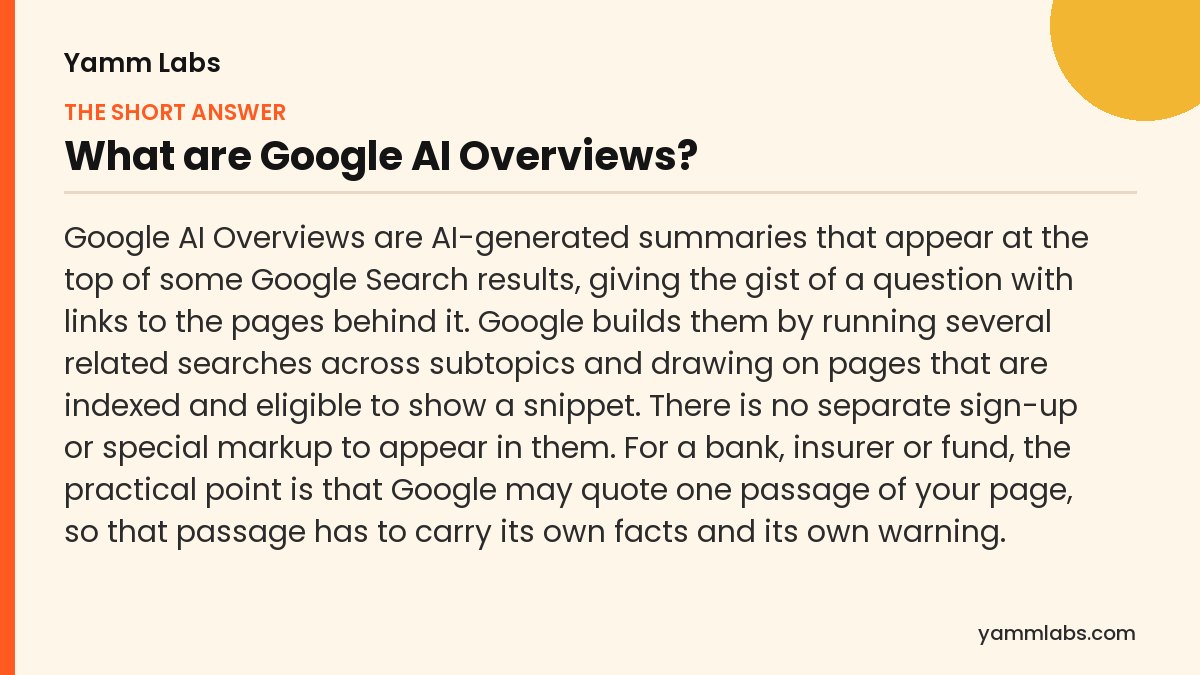
How do Google AI Overviews build an answer?
Google describes AI Overviews as a way to get to the gist of a complicated question quickly, with links as a starting point to explore further. Behind the summary, Google says its AI features may use a query fan-out technique: it issues several related searches across subtopics and data sources, then assembles one response.
The key facts, in Google’s own guidance for site owners:
- Eligibility is ordinary SEO. A page must be indexed and eligible to be shown in Google Search with a snippet. Google says there are no additional requirements or special optimisations needed to appear in AI Overviews or AI Mode.
- No new files or markup. Google says you do not need new machine-readable files, AI text files or markup to appear in these features.
- Traffic is reported, not separated. Clicks and impressions from AI features are counted in the Search Console Performance report under the Web search type, inside your overall search traffic.
- Owners keep controls. The nosnippet, data-nosnippet, max-snippet and noindex controls limit how your content appears in AI features.
Google’s full wording is on its AI features guidance for site owners. The shorter version of this answer sits in our GEO and AEO FAQ for financial brands.
Are AI Overviews live in India, and in which languages?
Yes. Google brought AI Overviews to India in August 2024, in English and Hindi, after testing them in its Search Labs experiment. The Indian rollout added a toggle to switch between English and Hindi and a Listen button that reads the Overview aloud, and Google said Indian users listen to Overviews more often than users in other countries. In May 2025 Google said AI Overviews were available in more than 200 countries and territories and more than 40 languages, and that in its biggest markets, including India, they were driving over a 10% increase in Google usage for the types of queries that show them.
For a financial brand this matters in two ways. Your buyers may hear the answer rather than read it, so a warning printed in small type at the foot of a page does not travel with the spoken summary. And the Overview may appear in Hindi even when your best page is in English.
Why do AI Overviews change where a BFSI disclaimer goes?
A regulated page used to be read top to bottom, with qualifiers in the footer. An AI Overview reads it in pieces. It can lift the sentence that states a return, a benefit or a rate and leave the qualifier behind. Indian financial rules attach to your communication, not to Google’s summary, so the design decision is to move the qualifier into the passage that is likely to be quoted.
SIGNALNewsletter by Yamm Labs
The next piece, straight to your inbox.
New writing on BFSI brands, B2B and influencer marketing, and AI search.
One click to unsubscribe. Privacy policy

The rules make that decision concrete:
- Mutual funds. SEBI requires the standard market-risk warning in mutual fund advertisements, and in audio-visual ads it must be displayed and voiced for five seconds so it can be followed. A fund page carries that warning in the same section as any statement about returns.
- Insurance. IRDAI’s 2024 regulations on policyholder protection and insurer operations require an insurer’s advertisement to show its registered name prominently along with its trade name or logo, and ads issued through distribution channels need the insurer’s written approval first. On an answer-first page, the registered name appears in the answer text itself, because the logo is not part of the quoted passage.
- Loans. The RBI requires lenders to give a Key Facts Statement, including the annual percentage rate, before the loan contract is executed, for retail and MSME term loans sanctioned from 1 October 2024, in a language the borrower understands. A loan page that states an interest rate in its answer section also states that the APR and all charges are set out in the Key Facts Statement.
We have not seen SEBI, IRDAI or RBI guidance that addresses AI summaries directly. The safe reading is that any passage Google can quote should stand on its own as a compliant communication.
Google quotes the paragraph, not the page, so the paragraph has to carry the warning.
Can a financial brand control what AI Overviews show from its site?
Partly. You cannot write Google’s summary, but you control the source and the snippet rules. Marking a block with data-nosnippet keeps that text out of snippets and AI features, and max-snippet limits how much text can be used. The trade-off is real: a page that blocks its snippet also becomes less useful as a source, so it is less likely to be linked from the Overview at all.
For most banks, insurers and funds the better decision is to write passages you are happy to see quoted, and keep nosnippet for text that must never appear out of context.
What should a bank, insurer or fund decide about AI Overviews now?
Start with the questions your buyers ask, not with your product brochure. List the ten to twenty questions that decide a purchase in your category, search each one and note whether an Overview appears, which pages it links and what it says about you. Then rewrite the pages that should be answering, one question per section, with the direct answer first and the qualifier in the same passage.
That rewrite uses content and a compliance review you already have. The wider work of getting your brand named across Google, ChatGPT and other engines is generative engine optimisation, which we run for financial brands through our AI visibility programme for BFSI. To see how we measure our own presence engine by engine, read our AI visibility log baseline.
How to check whether Google AI Overviews quote your pages
Search Console will not separate AI Overview traffic for you, so the check is manual. A first pass takes an afternoon, and each monthly repeat takes less. Run it logged out or in a private window, so your own search history does not shape what you see.
- Write the question list. Ten to twenty questions a buyer asks before choosing a product in your category, in the words a buyer would use. Add Hindi versions of the most common ones if your buyers search in Hindi.
- Search each question on a phone. Many buyers search on their phones, and the mobile layout shows how far below the summary your own result sits.
- Record what appears. Note whether an AI Overview shows, which pages it links and whether your brand is named. Take a dated screenshot, because the same search can return a different answer next week.
- Read the passage on your own page. If Google links your page, find the passage it seems to draw on. Check that the passage states the fact and its qualifier together.
- Mark each question. Quoted and complete, quoted but missing a qualifier, or not quoted. The second group is your first rewrite list.
Keep the sheet. A repeat check after each rewrite shows whether the change moved anything, and it gives your compliance team a record of what the public saw on a given date.
A worked example: rewriting a fund page passage
Take the Pune investor’s question from the top of this page. A typical scheme page answers it in pieces: a headline about long-term growth, a returns table further down, and the market-risk warning in the footer. An AI Overview that lifts the headline and the table can present the fund without the warning attached.
The rewrite keeps the same facts and moves them together. The section heading becomes the buyer’s question. The first two sentences say what a flexi-cap fund is and that returns are not guaranteed. The standard warning, that mutual fund investments are subject to market risks and scheme related documents should be read carefully, sits in the same paragraph, not only in the footer. The returns table follows with its own past-performance note.
Nothing new was written for Google. The page now says in one passage what it used to say across three, which is also easier for a compliance reviewer to check. Confirm the current wording of the warning and any performance disclosure with your compliance team before you publish.
Common mistakes financial brands make with AI Overviews
- Buying AI Overview work as a technical project. Google says no special files or markup are needed. Budget spent on new code is usually better spent rewriting the pages that answer buyer questions.
- Leaving the qualifier in the footer. The footer is the part least likely to travel with a quoted passage. Put the qualifier where the claim is.
- Blocking whole pages with nosnippet. It keeps text out of the Overview, but it also makes the page a weaker source. Use data-nosnippet on specific blocks instead.
- Checking once. Overviews change as Google’s systems and the pages around yours change. A single check is a snapshot, not a position.
- Writing for the product name, not the question. A page headed with a product name answers fewer buyer questions than a section headed with the question the buyer typed.
- Forgetting Hindi. If the Overview appears in Hindi and your only strong page is in English, check what the Hindi answer says about your category.
How to brief your content team or agency on AI Overviews
Keep the brief short and specific. Name the ten to twenty buyer questions, attach the sheet from your last check and list the pages that should be answering each one. Ask for one rewritten section per question, with the direct answer in the first two sentences.
State the compliance rule for your category in the brief itself: the risk warning for a fund, the registered name for an insurer, the Key Facts Statement reference for a lender. Ask that each rewritten passage carry that rule inside it. Then route every rewrite through the same compliance review you use for advertising, because a quotable passage is a public communication.
Agree how success will be judged before the work starts. A fair measure is whether the next manual check shows your pages linked for more of the questions, with the qualifier intact. Search Console totals alone will not show that, because Google reports AI feature traffic inside ordinary web search.
People also ask
Are Google AI Overviews the same as AI Mode?
No. AI Overviews are short summaries shown above ordinary results for some searches. AI Mode is a separate conversational experience that Google positions for questions needing more exploration, reasoning or comparison. Both use the same eligibility rules for your pages.
Do I need special schema or an AI text file to appear in AI Overviews?
No. Google says no new machine-readable files, AI text files or markup are needed. A page that is indexed and eligible to show a snippet can be used, so clear structure and answer-first writing matter more than new code.
Can I see AI Overview traffic in Search Console?
Only as part of the total. Google counts traffic from AI features in the Performance report under the Web search type, together with the rest of your search traffic, so you need your own prompt checks to see where you are quoted.
Do Google AI Overviews appear for every search?
No. They appear for some searches and not for others, and the same question can show an Overview one week and not the next. That is why a dated record of your checks matters more than a single screenshot, and why each page should work whether or not a summary sits above it.
Should a regulated brand block AI Overviews with nosnippet?
Usually not for a whole page. Blocking the snippet keeps your text out of AI features, but it also makes the page a weaker source, so Google is less likely to link it. Use data-nosnippet on specific blocks that must never appear out of context, and write the rest of the page so that any passage can be quoted safely.
What should we do if an AI Overview misstates our product?
Start with your own page. Find the passage the summary seems to draw on and check whether it states the fact and its qualifier together. Rewrite it so it cannot be read out of context, then recheck the search once Google has recrawled the page. Keep a dated screenshot of the original answer for your compliance file.
How often should a financial brand recheck its AI Overview presence?
Once a month is a practical rhythm for most teams, plus a recheck after any major page rewrite or product change. Use the same question list each time so the results can be compared. If a key question stops showing your page, look first at what changed on the pages Google now links instead.
Would a Google AI Overview quote your product page with its warning intact?
Get a free Fintech Brand Audit across 8 dimensions, plus 3 fixes. No pitch. Run the free Brand Audit →
One Comment