


A salaried buyer in Pune opens the Google app, taps the AI Mode tab and types a long question: which term plan suits a non-smoker who wants ₹1 crore of cover, and how does the claim process work? She gets one written answer with a handful of links, then asks a follow-up in Hindi without starting again. The insurer whose page ranks for those words is now competing to be quoted, not just listed.
- How does Google AI Mode work?
- When did AI Mode launch in India, and in which languages?
- What does a page need before AI Mode will link to it?
- Why does AI Mode change where a financial disclaimer sits?
- What should a bank, insurer or fund decide about AI Mode now?
- How to test your brand in Google AI Mode
- A worked example: an insurer’s term plan section
- Common mistakes financial brands make with AI Mode
- How to brief an agency on AI Mode pages
- People also ask
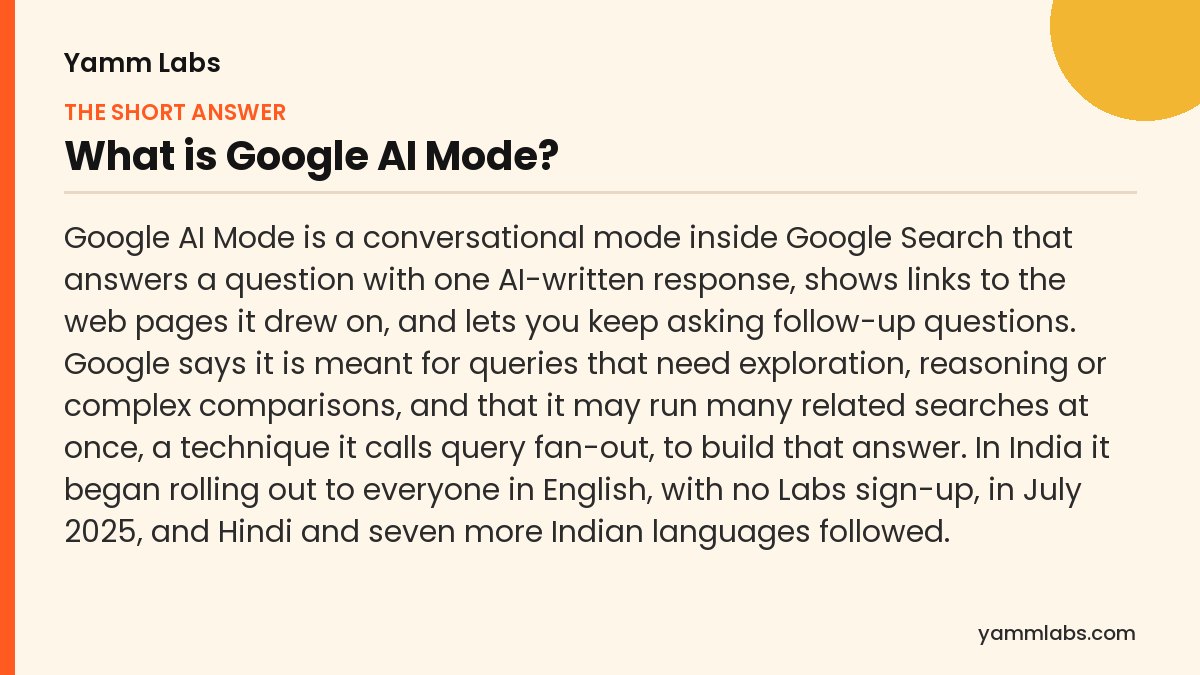
How does Google AI Mode work?
AI Mode breaks a question into subtopics, searches each, and writes one response. Google’s Search Central documentation says both AI Overviews and AI Mode may use this query fan-out technique, issuing multiple related searches across subtopics and data sources. Google’s India blog says you can type, use your voice, or take a photo with Lens, and that the answer comes with links to the web. Google has said AI Mode in Hindi uses a custom version of its Gemini 2.5 model.
| Question | What Google says |
|---|---|
| Where does it appear? | As a separate AI Mode tab in Google Search and the Google app |
| How does it build an answer? | It may run several related searches across subtopics, then write one response with supporting links |
| Which pages can it link to? | Pages that are indexed and eligible to show in Google Search with a snippet |
| Is special markup needed? | No new machine-readable files, AI text files or special schema.org structured data |
| Where is the traffic reported? | Inside overall Web search traffic in Search Console |
The short version of this answer sits in our GEO and AEO FAQ for financial brands. This page holds the full one.
When did AI Mode launch in India, and in which languages?
Google first offered AI Mode in India in June 2025 as an experiment in Search Labs, in English. On 8 July 2025, Google’s India blog announced it was starting to roll out AI Mode in Google Search with no Labs sign-up required. On 8 September 2025, Google began rolling out AI Mode in Hindi for users around the world. On 8 October 2025, it added Bengali, Kannada, Malayalam, Marathi, Tamil, Telugu and Urdu, and brought Search Live, which lets people talk to Search and point their camera at something, to India in English and Hindi. Google said India was the first country outside the US to get Search Live.
For a financial brand, the language list matters more than the launch date. If your pages exist only in English, a Marathi or Tamil answer is built from someone else’s words.
SIGNALNewsletter by Yamm Labs
The next piece, straight to your inbox.
New writing on BFSI brands, B2B and influencer marketing, and AI search.
One click to unsubscribe. Privacy policy

What does a page need before AI Mode will link to it?
- Indexed and snippet-eligible. Google says a page must be indexed and eligible to be shown in Search with a snippet to appear as a supporting link in AI Overviews or AI Mode.
- No extra files or schema. Google says you do not need to create new machine-readable files, AI text files or markup, and there is no special structured data to add.
- Preview controls apply. Google says nosnippet, data-nosnippet, max-snippet and noindex limit what it shows from your pages, in these features as well.
- No separate report. Google counts traffic from AI features inside overall Web search traffic in Search Console, so you track your presence in AI Mode answers yourself.
The full technical note is on Google Search Central’s page on AI features.
Why does AI Mode change where a financial disclaimer sits?
AI Mode reads a page in pieces. A fan-out search can land on the section that states a return or a rate and use it without the footer that qualifies it. Indian financial advertising rules attach to the brand’s content, not to the search engine. We have not seen SEBI, IRDAI or RBI guidance that addresses AI search answers directly, so our reading is simple: any passage an engine can quote should be able to stand as the ad.
The rules make the design decisions concrete. SEBI requires the standard mutual fund risk warning in advertisements, and requires it to be displayed and voiced for five seconds in audio-visual ads. IRDAI’s current regulations on protecting policyholders’ interests require every insurer’s advertisement to show its registered name with its trade name or logo prominently, and require advertisements issued by distribution channels to carry the insurer’s written approval before they go out. RBI requires lenders to give borrowers a Key Facts Statement, including the annual percentage rate, before the loan contract is signed, for new retail and MSME term loans sanctioned from 1 October 2024.
- Fund pages. The standard market-risk warning goes inside the short-answer block and inside any section that mentions returns, not only in the footer.
- Insurance pages. The insurer’s registered name appears in the text of each product section as well as in the logo.
- Loan pages. A headline interest rate never stands alone in a section. The same passage says that the Key Facts Statement, with the APR, comes before signing.
- Distributor pages. A section a partner can lift and republish goes through the insurer’s written approval first, the same as any other ad.
- No hidden qualifiers. We never wrap a disclaimer in data-nosnippet. That control would let the claim travel into an answer while the warning stays behind.
AI Mode quotes the paragraph, not the page, so the warning has to live in the paragraph.
What should a bank, insurer or fund decide about AI Mode now?
Google decides whether you appear. You decide which questions you want to answer, and whether your pages can be quoted safely.
- List the buyer questions. Write the product questions customers ask, in English and in Hindi or the regional language you sell in.
- Check the answers by hand. Run each question in AI Mode and note which brands and pages it links to.
- Rewrite section by section. One question per heading, the answer in the first sentence, the regulator’s qualifier in the same passage.
We publish how we track our own presence in the Yamm Labs AI visibility log. Yamm Labs works from Gurugram and has served brands such as TATA AIA Life Insurance, HDFC Life, Axis Bank, Paytm Money and Aditya Birla Sun Life Mutual Fund. Our AI visibility work for BFSI brands starts from that list of questions.
How to test your brand in Google AI Mode
AI Mode is a conversation, so a single search does not show you what a buyer sees. The buyer in Pune asked one question and then a follow-up in Hindi. Your test should copy that pattern. Run it logged out or in a private window, and keep every answer with its date.
- Start with the first question. Use the buyer’s own words, including the details that make the question long: the cover amount, the age, the product type.
- Ask two follow-ups. Choose the ones a real buyer asks next, such as how claims work or what the exclusions are. Note whether your brand stays in the answer or drops out.
- Repeat in the languages you sell in. Ask the same chain in Hindi, and in the regional language of your biggest market if it is on Google’s list.
- Open every link to your site. Read the passage the answer seems to rely on. Check that the fact and its qualifier sit together.
- Record the brands named. Note who else is quoted. If a competitor is linked for a question you answer better, compare the two passages side by side.
Repeat the same chains each month and after every page rewrite. A dated record is the only way to see whether a change on your site moved an answer, because Search Console does not break AI Mode out on its own.
A worked example: an insurer’s term plan section
Take the term plan question from the top of this page. Many insurer pages answer it in fragments: a banner with the cover amount, a premium calculator, a claims page in another part of the site, and the registered name only in the header logo and the footer. When AI Mode lifts one fragment, the reader gets a number without the name of the company that stands behind it.
The rewrite is a section headed with the buyer’s question. Its first sentence says what the plan covers, in plain words, and names the insurer by its registered name in the text. The next sentences point to the claim process and where the policy terms are set out. Any premium example carries the conditions it depends on in the same paragraph.
None of this changes the product or adds a claim. It moves facts the page already had into one passage that can stand on its own. If a distributor or aggregator will reuse the section, it goes through the insurer’s written approval first. Confirm the current requirements with your compliance team before the page goes live.
Common mistakes financial brands make with AI Mode
Most of these come from treating AI Mode as a ranking problem. It is closer to a review problem: every section of a page may be read alone, so every section has to pass the same test a compliance team applies to an ad.
- Testing only the first question. Buyers ask follow-ups. A brand that appears in the first answer and disappears in the second has a gap on the follow-up page, not the first one.
- Relying on the logo for the registered name. AI Mode quotes text. A registered name that lives only in an image does not travel with the answer.
- Hiding the disclaimer with data-nosnippet. It lets the claim travel while the warning stays behind, which is the opposite of what a regulated page needs.
- Waiting for a Search Console report. Google counts AI feature traffic inside ordinary web search, so a separate AI Mode number is not coming from there.
- Ignoring Indian languages. Google has added Hindi and seven more Indian languages. An English-only site leaves those answers to other sources.
- Buying special markup. Google says no special schema or AI text file is needed. Spend the budget on rewriting sections instead.
How to brief an agency on AI Mode pages
A useful brief fits on one page. List the buyer questions with their likely follow-ups, attach the dated answers from your last test, and name the pages that should be answering each chain. Say which languages matter and which of them need a new page rather than a translated paragraph.
Put the category rule in the brief: the market-risk warning for a fund, the registered name for an insurer, the Key Facts Statement for a lender. Ask that every rewritten section carry its own rule inside it. Ask the agency to show each section as it would read if quoted alone, because that is how your compliance team should review it.
Finally, agree the measure. The honest one is whether your pages are linked for more of the question chains at the next test, with the qualifier intact. Ranking reports and total traffic will not answer that question.
People also ask
Do you need to sign up for Google AI Mode in India?
No. Google’s India blog said the rollout that began in July 2025 needed no Search Labs sign-up. AI Mode appears as its own tab in Google Search and the Google app.
Is Google AI Mode the same as AI Overviews?
No, though they are related. Both are Google Search AI features, both may use query fan-out, and both link to pages that are indexed and snippet-eligible. AI Mode is a separate tab built for longer questions and follow-ups.
Does a financial brand need special schema to appear in AI Mode?
No. Google says there is no special schema.org structured data or AI text file to add. What matters is that the page is indexed, eligible for a snippet, and written so each section answers one question with its disclaimer in place.
How do I know if Google AI Mode links to my site?
Check by hand. Google counts traffic from AI features inside overall Web search traffic in Search Console, so there is no separate AI Mode report. Run your list of buyer questions and follow-ups in AI Mode each month, open every link to your site and keep a dated record of which brands and pages were named.
Can we stop AI Mode from quoting a page?
Yes. Google says the nosnippet, data-nosnippet, max-snippet and noindex controls apply to its AI features too. The cost is that a page with no snippet becomes a weaker source and is less likely to be linked at all. For most regulated pages, a passage that is safe to quote is the better answer than a block.
Should a financial brand translate its pages for AI Mode?
Translate the pages that answer your most important buyer questions, in the languages you actually sell in. A translated page is still a financial communication, so it goes through the same compliance review as the English version. Start with Hindi if your buyers use it, then add the regional languages of your largest markets.
Which pages should a bank or insurer rewrite first?
Start with the pages behind your most common buyer questions: product pages that state a rate, a cover amount or a return. Those are the passages most likely to be quoted and the ones where a missing qualifier matters most. Leave brand and campaign pages until the product answers are done.
Want to see how your brand reads when AI Mode answers for you?
Get a free Fintech Brand Audit across 8 dimensions, plus 3 fixes. No pitch. Run the free Brand Audit →