


The edit is locked at 30 seconds. The brand team wants the last four seconds for the logo and the SIP line. Then someone from compliance asks how long the standard warning is on screen, and the answer is “about three seconds, in the end card”. The film goes back to the edit suite. The rule behind that meeting is short, and it costs far less when it is planned before the shoot than after the online edit.
- What does SEBI’s advertisement code say about the warning in video ads?
- Does the five-second rule apply to every financial ad?
- Where should the warning sit in a 30-second, 10-second or bumper cut?
- What should a marketing head decide before the shoot?
- A worked example: the 30-second film that went back
- Common standard warning timing mistakes in fund films
- A timing checklist from script to master
- How to brief a production house and voice artist
- People also ask
What does SEBI’s advertisement code say about the warning in video ads?
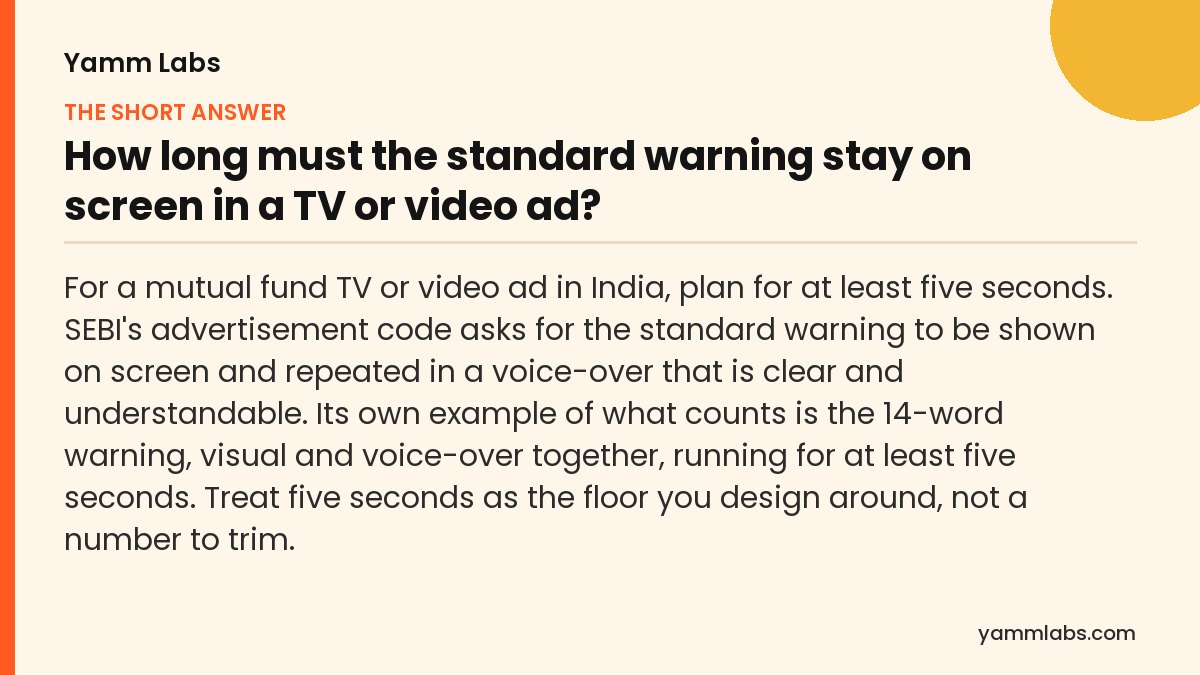
The rule sits in the advertisement code attached to the SEBI (Mutual Funds) Regulations, 2026, which came into force on 1 April 2026. It asks for four things that shape a film.
- The warning is always there. Every mutual fund advertisement carries the standard warning in legible fonts: “Mutual Fund investments are subject to market risks, read all scheme related documents carefully.”
- The words are fixed. No word can be added or removed. You cannot shorten it to fit a frame or swap “MF” for “Mutual Fund”.
- Screen and voice both carry it. In audio-visual ads the warning appears as a visual and is repeated in a voice-over that must be audible, clear and understandable.
- Five seconds is the benchmark. The code gives an example: both the visual and the voice-over of the 14-word warning running for at least five seconds may be considered clear and understandable.
The five-second benchmark is older than the 2026 regulations. SEBI first set it in a 2008 circular on the standard warning, which also asked radio ads to read the warning over five seconds. The full hub of short answers on this topic is in our SEBI advertising rules FAQ for BFSI marketers.
Does the five-second rule apply to every financial ad?
No. The 14-word warning and its five-second example belong to mutual fund advertising. Other categories carry different mandatory lines, and some borrow the same timing.
| Ad type | What the rule asks | Design decision it forces |
|---|---|---|
| Mutual fund TV or online video | Standard warning shown and voiced clearly; 14 words for at least five seconds is SEBI’s example | Hold the warning card five seconds or longer, with the voice-over reading it inside the same window |
| Mutual fund ad in Hindi or a regional language | Warning carried in the language of the ad | Time the card to the translated voice-over, which may run longer than the English read |
| Mutual fund radio or audio ad | SEBI’s 2008 circular: warning read over five seconds | Reserve five seconds of script for the warning before writing the idea |
| Creator video linking to a broker’s account opening | NSE’s member FAQ: the 17-word warning, visual and voice-over, running for at least five seconds | Put the warning and its timing into the creator brief and the approval checklist |
| Insurance ad | IRDAI: insurer’s registered name shown prominently with its trade name or logo; distribution-channel ads need the insurer’s written approval before issue | Lock the name lockup before the edit, and route bank or broker partner ads to the insurer first |
If a film sells more than one product, such as a bank promoting its own fund house and an insurance partner, plan for each product’s mandatory line and agree its placement with compliance.
SIGNALNewsletter by Yamm Labs
The next piece, straight to your inbox.
New writing on BFSI brands, B2B and influencer marketing, and AI search.
One click to unsubscribe. Privacy policy

Where should the warning sit in a 30-second, 10-second or bumper cut?
The code gives the clarity test and the five-second example. It does not say where in the film the warning goes. That placement is the decision your agency and compliance team make together, and it should be written down.
- Count the seconds at script stage. A 30-second film with a five-second warning has 25 seconds for the idea. A 10-second cutdown has five. Script every cutdown with the warning already inside it.
- Bumpers are mostly warning. Google describes YouTube bumper ads as non-skippable and five to six seconds long. A bumper that carries the warning properly has almost no room for anything else, so decide early whether that format belongs in the media plan.
- Skippable ads change what an end card means. YouTube lets viewers skip in-stream ads after five seconds. A warning placed only in the closing frames is seen by those who stay. Agree with compliance whether it runs early, stays as a persistent super, or closes the film.
- The voice-over pace is part of compliance. Fourteen words in five seconds is close to three words a second, brisk but readable in English. A rushed read that saves one second can fail the clear and understandable test.
- Legible has no point size. The code asks for legible fonts and does not fix a size. Choose high contrast, keep the super inside the title-safe area, avoid busy footage behind it, and check it on a phone screen as well as a TV.
What should a marketing head decide before the shoot?
Three decisions keep the warning from reopening a finished film.
- The cutdown list. Name every duration the film will run in, from the TV master to the six-second cut, and mark which ones carry the full warning at five seconds or more.
- The languages. Each vernacular version needs its own warning card and its own voice-over read, timed with the actual voice artist, not estimated from the English script.
- The sign-off point. Show compliance the animatic with the warning timecoded, not the final master. A change at animatic stage is a quick fix. A change after grading and mixing means a new edit and another review round.
For the rest of the rules a fund film has to pass, see our creative guide to the SEBI advertisement code and the one-page BFSI compliance-creative cheat sheet.
Five seconds is the floor you design around, not the number you edit down to.
A worked example: the 30-second film that went back
Go back to the locked 30-second edit. The brand team wanted the last four seconds for the logo and the SIP line, and the standard warning had about three seconds in the end card. That is two seconds short of the example SEBI gives, and it is why the film went back to the edit suite.
Here is how the same film looks when the warning is planned at script stage. The idea gets 25 seconds. The final five seconds or more carry the warning, shown on screen and read in the voice-over. The logo and the SIP line then need a home: either earlier in the film, or on an end card that also holds the warning, if compliance agrees the warning stays legible and the voice-over reads all fourteen words inside the same window.
The 10-second cutdown follows the same logic. Five seconds for the warning leaves five for the idea, so the cutdown needs its own script rather than a trim of the master. The bumper is a separate decision: at five to six seconds, it is almost all warning, so the team decides early whether it belongs in the plan.
None of this changes the creative idea. It changes when the seconds are counted. Counted at script stage, they cost nothing. Counted after the online edit, they cost a new cut and another review.
Common standard warning timing mistakes in fund films
Most timing problems come from the same few habits. Each one is easy to avoid if it is spotted before the shoot.
- Treating five seconds as a ceiling. The code gives five seconds as an example of a clear warning. Editing down to exactly five, with a rushed read, misses the point.
- Timing the super but not the voice-over. The visual and the voice-over both need to carry the warning. A long super with a clipped read, or the reverse, covers only half the rule.
- Trimming cutdowns from the master. A 10-second cut made by trimming the 30-second film usually loses warning time first.
- Estimating vernacular reads from the English script. A translated warning can take longer to read. Time it with the actual voice artist.
- Checking legibility only on a TV monitor. The same super may be too small or too low in contrast on a phone.
- Showing compliance the final master first. A timing fix at animatic stage is quick. After grading and mixing, it is a new edit.
A timing checklist from script to master
Use this list on every mutual fund film and cutdown. It follows the production order, so each check happens when a fix is still cheap.
- Script. Every duration on the cutdown list has a warning slot of at least five seconds written in.
- Storyboard. The warning frame is drawn at its real position, size and contrast, inside the title-safe area.
- Voice-over booking. Each language has its own warning read, booked at a normal pace.
- Animatic. The warning is timecoded, and compliance reviews the animatic, not the master.
- Offline edit. The on-screen warning and the voice-over run inside the same window, five seconds or longer.
- Online and grade. Footage behind the super is calm enough to keep every word readable.
- Delivery. Each cutdown is checked on a phone screen as well as a TV before it is released.
Timing rules and exchange guidance are updated from time to time. Confirm the current text with your compliance team before the script is locked, especially for formats that are new to the media plan.
How to brief a production house and voice artist
A production house plans a shoot around the script, so the warning has to be in the script it receives. Send the exact fourteen words, the list of durations and languages, and a note that the warning runs for at least five seconds on screen and in the voice-over in every cut.
For the voice artist, the brief is about pace. Ask for a clear, even read of the full warning, not a compressed one, and record each language separately. Time each read in the booth and note it on the script, so the editor knows how long the warning card must hold.
Ask the editor to keep a warning track in the timeline from the first assembly, not add it at the end. That way every cutdown starts with the warning already in place, and nobody is tempted to trim it to save a second.
Finally, name the person who signs off the timing. When the brief makes compliance review the animatic, the film usually reaches the final master with its warning intact.
People also ask
Can a mutual fund video ad show the warning as text only, without a voice-over?
SEBI’s advertisement code describes the warning in audio-visual ads as a visual with an accompanying voice-over that is clear and understandable. A text-only super covers half of that. Plan for both, running together.
Does a six-second YouTube bumper for a mutual fund need the full warning?
The code applies to advertisements, and a bumper is one. A warning shown and voiced for five seconds leaves little room for anything else, so settle the approach with your compliance team before buying the format, or move that budget to a longer unit.
Do Hindi or regional-language fund ads need the warning in that language?
Yes. The code says advertisements in a vernacular language carry the standard warning in that language. Time the card to the translated voice-over, because the read may not fit the same five seconds as the English version.
How fast should the voice-over read the standard warning?
At a clear, even pace. Fourteen words in five seconds is close to three words a second, which is brisk but readable in English. If the read sounds rushed at that speed, give the warning more time rather than speeding up. A translated warning may need longer, so time it with the actual voice artist.
Can the warning run as a persistent super through the whole film?
It is one of the placement options, especially for skippable ads where viewers may leave before the end card. The code does not fix where the warning goes, so agree the approach with your compliance team. The voice-over still needs to read the warning clearly, so plan a window for that as well.
Does a broker’s creator video need a timed warning too?
Yes, but a different one. NSE’s member FAQ asks for its 17-word warning, visual and voice-over, running for at least five seconds in creator videos that link to a broker’s account opening. Put the warning and its timing into the creator brief and the approval checklist, just as you would for a fund film.
Should a longer film give the standard warning more than five seconds?
The code’s example is the same five seconds whatever the film’s length, so a 60-second film does not have a longer written minimum. A longer film does have more room, though, and giving the warning a little extra time costs little and removes any doubt about a rushed read. Decide the timing per duration on the cutdown list and record it in the script.
Who should check the warning timing before release?
The editor checks the timecode in every cut, the producer checks legibility on a phone and a TV, and the fund house’s compliance team gives the final approval, ideally at animatic stage. Writing these three checks into the production schedule keeps the standard warning from being the reason a finished film goes back to the edit suite.
Sources
Want your next fund film checked for warning timing before it reaches compliance?
Get a free Fintech Brand Audit across 8 dimensions, plus 3 fixes. No pitch. Run the free Brand Audit →