


A creative team at a fund house is cutting a short vertical video for an SIP campaign. The story takes nine seconds. The standard warning takes five more, so someone proposes a tidy fix: “MF investments are subject to market risks.” Shorter, cleaner, same meaning. The compliance reviewer sends it back before lunch. The wording of this warning is not a copy decision, and no fund house gets to edit it.
- What is the exact wording of the mutual fund standard warning?
- Can a fund house shorten, abbreviate or reword the standard warning?
- How long must the warning run in a video or radio ad?
- When does a mutual fund ad not need the standard warning?
- What should a marketing team decide before briefing the creative?
- A worked example: fixing the nine-second SIP video
- Common mistakes with the standard warning
- A pre-release checklist for the standard warning
- How to brief a creative agency on the warning
- People also ask
What is the exact wording of the mutual fund standard warning?
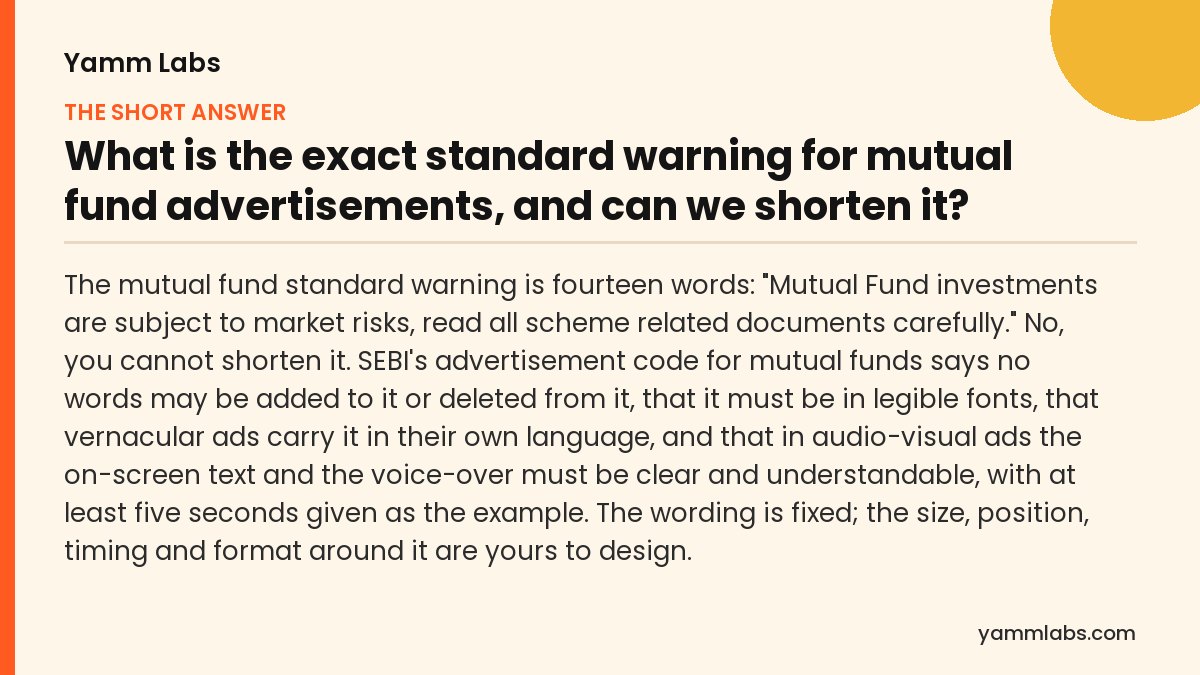
The current wording is: “Mutual Fund investments are subject to market risks, read all scheme related documents carefully.” It sits in the advertisement code that SEBI attached as a schedule to its Mutual Funds Regulations, 2026, which came into force on 1 April 2026. The regulations as published set out the full code.
Count the words and you get fourteen. That number matters, because the code uses the fourteen-word warning as its own example when it explains what a clear audio-visual warning looks like.
Watch for old templates. A 2008 SEBI circular quoted an earlier version that ended “read the offer document carefully before investing”. Artwork files and edit templates carried over from older campaigns sometimes still hold that line. It is not the wording the current code states, so replace it.
| Format | What the rule asks | The design decision it forces |
|---|---|---|
| Print, outdoor, static digital | The full warning in legible fonts, no words added or removed | Reserve a fixed warning strip in the master layout and set a minimum type size per format with compliance |
| Vernacular ads | The warning in the language of the ad | Get each language version approved once and store it as a locked asset |
| TV, online video, reels | On-screen warning and voice-over, clear and understandable; at least five seconds is the example | Write the script to finish before the final five seconds and hold a clean end card |
| Radio and audio | The warning read in an easily understandable manner over five seconds | Book the voice-over at a normal pace, not compressed |
| Pure corporate brand ads | No warning needed if the ad does not solicit investment or influence an investment decision | Keep scheme names, returns and calls to invest out of brand-only work |
Can a fund house shorten, abbreviate or reword the standard warning?
No. The code states that no addition or deletion of words shall be made to the standard warning. That closes every shortcut teams usually try.
- Abbreviations. “MF investments” swaps two listed words for letters the code does not list. Treat it as a change.
- Trimmed versions. Dropping “read all scheme related documents carefully” deletes words. It fails.
- Friendly rewrites. “Please read the scheme documents before you invest” adds and removes words. It fails too.
- Tiny type. The full sentence in unreadable type breaks the legible fonts requirement, even though every word is there.
What you can change is everything around the sentence: its position, its line breaks, the contrast behind it, the moment it appears and how long it stays. That is where a good creative team spends its effort. Our creative guide to the SEBI advertisement code covers the rest of the code that shapes a fund ad.
How long must the warning run in a video or radio ad?
The current code says the on-screen warning and the voice-over in an audio-visual ad must be clear and understandable, and gives the fourteen words running for at least five seconds as an example of that. The five-second figure goes back to a SEBI circular of 26 February 2008, which raised display and voice-over time to five seconds because the warning was being delivered so fast that viewers and listeners could not follow it. The same circular asked that audio ads read the warning in an easily understandable manner over five seconds.
SIGNALNewsletter by Yamm Labs
The next piece, straight to your inbox.
New writing on BFSI brands, B2B and influencer marketing, and AI search.
One click to unsubscribe. Privacy policy

The arithmetic drives the edit. In a 20-second spot, five seconds is a quarter of the running time. In a six-second bumper it leaves one second for everything else. So the decision comes early: scheme ads go into formats long enough to carry the story plus the warning, and very short formats carry brand work that does not ask anyone to invest.
The fourteen words are fixed; everything around them is a design decision.
When does a mutual fund ad not need the standard warning?
SEBI’s regulations define an advertisement as any communication issued by or on behalf of the mutual fund or asset management company that may influence the investment decision of an investor or prospective investor. That covers social posts, emails, app banners and reels, not only print and TV.
SEBI’s FAQ for mutual fund intermediaries adds one carve-out. Corporate advertisements and programme sponsorships that do not solicit investment in the fund or its schemes, and do not influence investment decisions, but are only a branding exercise, do not need the risk disclaimer. The moment a scheme name, a return figure or an invitation to start an SIP appears, the piece is an advertisement again and the warning goes back in.
What should a marketing team decide before briefing the creative?
- Lock the text. Store the approved English and vernacular warnings as locked assets so nobody retypes them.
- Set minimum sizes. Agree a minimum type size and contrast for each format with compliance, before design starts.
- Budget the seconds. Give every video and audio script a warning slot of at least five seconds at a normal speaking pace.
- Separate brand from scheme. Decide up front which pieces are brand-only and which solicit investment, because that decides whether the warning applies.
For the short version of this and other SEBI questions, see our SEBI advertising rules FAQ for BFSI marketers. If you are choosing a partner for fund campaigns, our note on what AMCs should ask a mutual fund marketing agency lists the questions that surface these decisions.
A worked example: fixing the nine-second SIP video
Go back to the creative team with the short vertical video. The story runs nine seconds. The mutual fund standard warning needs at least five seconds on screen and in the voice-over, so the honest length of the ad is fourteen seconds or more. Shortening the words is not an option, so the team has three real choices.
Choice one: lengthen the ad. Keep the nine-second story, add a clean end card for the warning, and deliver a longer cut. The script finishes before the final five seconds, the voice-over reads all fourteen words at a normal pace and the on-screen text stays up for the same time.
Choice two: shorten the story. If the placement caps the length, cut the story, not the warning. A tighter idea that leaves room for five clean seconds is better than a full idea that forces a rushed read.
Choice three: make the short cut brand-only. A very short format can carry brand work that does not solicit investment. That means no scheme name, no return figure and no invitation to start an SIP. The moment the SIP call comes back, the piece is an advertisement again and the warning goes back in.
Most teams end up using the first choice for scheme ads and the third for reach. What they cannot do is the fix proposed in the opening, which is why the compliance reviewer sent it back before lunch.
Common mistakes with the standard warning
The wording is fixed, so most errors happen in execution. These come up again and again in fund creative reviews.
- Old templates. Artwork carried over from older campaigns still holds the earlier line ending “read the offer document carefully before investing”. Replace it with the current wording.
- Abbreviations. “MF investments” looks tidy and changes the words. It fails the no-addition, no-deletion rule.
- Legible in the file, unreadable on the phone. Type that works on a desktop proof can shrink below readability on a mobile feed. Check the warning at the size people will actually see it.
- Busy backgrounds. A warning set over moving footage or a patterned background loses contrast. A clean strip or end card solves it.
- Rushed voice-overs. Reading fourteen words fast to save a second defeats the purpose of the five-second example.
- Missing vernacular versions. A Hindi or regional-language ad needs the warning in that language, approved and locked like the English one.
A pre-release checklist for the standard warning
Run every mutual fund ad through this list before it goes to the compliance reviewer. It turns the rules on this page into checks a producer can tick.
- The warning text is pasted from the locked asset, not retyped.
- All fourteen words are present, in order, with nothing added or removed.
- The warning is in the language of the ad.
- Type size and contrast meet the minimum agreed with compliance for this format.
- In video, the on-screen warning and the voice-over both run for at least five seconds, on a clean end card.
- In audio, the warning is read at a normal, easily understandable pace.
- If the piece is treated as brand-only, it carries no scheme name, return figure or call to invest.
- No old artwork, template or edit file with the earlier wording has been reused.
The code is revised from time to time, so confirm the current text with your compliance team before a new campaign template is locked.
How to brief a creative agency on the warning
Put the warning in the brief, not in the feedback round. A creative team that learns about the five seconds after the idea is sold will either shrink the warning or fight to keep the idea. Both waste a review cycle.
Give the agency the locked warning assets in every language the campaign will use, the minimum type sizes per format and the end-card template. State which pieces are scheme ads and which are brand-only, because that decides whether the warning applies at all.
Ask for the warning to appear in the first storyboard and the first layout, at its real size and duration. It is much easier to judge an idea when the fourteen words are already sitting where they will run. An agency that designs around the warning from the first sketch usually delivers work that passes compliance on the first try.
Finally, agree who checks what. The agency checks the warning against the locked asset and the checklist. The fund house’s compliance reviewer gives the final approval. Writing that split into the brief saves arguments later.
People also ask
Does a Hindi or regional-language fund ad need the warning in that language?
Yes. SEBI’s advertisement code says advertisements in vernacular languages carry the standard warning in the vernacular language. Get each translation approved once and reuse it as a locked asset.
Does an Instagram post about a mutual fund scheme need the standard warning?
Yes, if it may influence an investment decision. SEBI defines an advertisement by what the communication can do, not by the channel, so a scheme post on social media carries the full warning in legible type.
Is five seconds a hard minimum for the warning in video ads?
The current code frames five seconds for the fourteen words as an example of a clear and understandable warning, and a 2008 SEBI circular set five seconds for display and voice-over. Treat five seconds as the floor and slow down if the voice-over sounds rushed.
Can the standard warning be split across two lines?
Yes. The code fixes the words, not the layout. You can break the sentence across two or three lines, choose where it sits and set its contrast, as long as all fourteen words appear in order, nothing is added or removed and the type is legible. Line breaks at natural pauses, such as after “risks”, usually read best.
Does an email or app banner about a scheme need the warning?
Yes, if it may influence an investment decision. SEBI’s definition of an advertisement covers any communication issued by or on behalf of the fund or AMC that can influence an investor, and that includes emails and app banners. Design a warning slot into those templates the same way you would for print.
What should we do with old campaign files that carry the 2008 wording?
Replace the warning in every reusable file: artwork masters, video edit templates and social templates. The earlier line ending “read the offer document carefully before investing” is not the wording the current code states. Replacing it once in the master files stops it from slipping back into new work.
Can the warning use the brand’s colours?
It can, as long as it stays legible. Brand colours are fine for the strip or end card if the contrast between text and background keeps every word readable at the size people will see. When a brand colour makes the warning harder to read, a plain high-contrast treatment is the safer choice.
Who should sign off the mutual fund standard warning in an ad?
The fund house’s compliance reviewer gives the final approval, as the opening example shows. Before that, the agency or in-house producer should check the warning against the locked asset and the pre-release checklist, so the reviewer sees a clean file. Splitting the checks this way keeps the warning from becoming a last-minute argument on every campaign.
Does a six-second bumper ad work for a scheme?
Rarely. At least five seconds for the warning leaves about one second for everything else, which is not enough to tell a story or name a scheme clearly. Very short formats are usually better used for brand-only work that does not solicit investment, with scheme ads placed in formats long enough to carry both the idea and the warning.
Want your fund’s warning designed into the ad instead of squeezed in at the end?
Get a free Fintech Brand Audit across 8 dimensions, plus 3 fixes. No pitch. Run the free Brand Audit →