

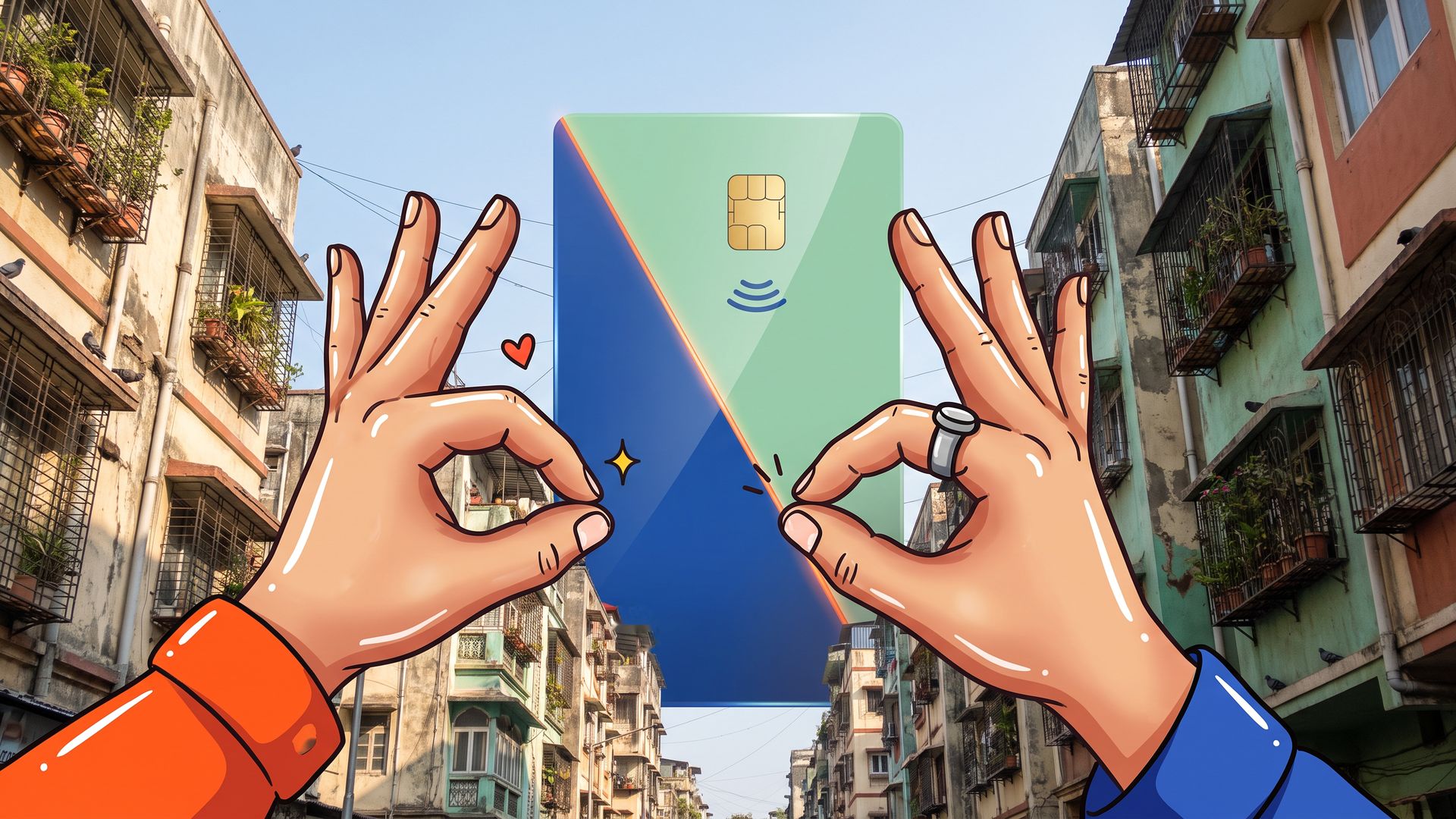
Two brand teams, one card. The e-commerce partner wants its logo on top, its colour on the face and its name first in the campaign, because the customer is theirs. The bank wants its name first, because the regulator says the card is the bank’s. The network wants its mark in the corner it specifies. The chip is where the chip has always been. Somewhere in the middle of that argument a designer has 85.6 by 53.98 millimetres to make everyone happy and a customer who just wants to know what the card gives them.
- What does RBI require of a co-branded credit card from a customer-communication viewpoint?
- How should the lockup hierarchy work between issuer, partner and network?
- What are the physical constraints on card face design?
- How do you design campaign creative that serves both partners?
- Which decisions need to be made before creative starts?
- What do the Indian co-brands get right and wrong?
- People also ask
What does RBI require of a co-branded credit card from a customer-communication viewpoint?
RBI’s Master Direction on credit and debit card issuance and conduct, issued in 2022 and amended since, sets the frame. Read from a creative team’s seat, the requirements that change design decisions are these, described generally rather than clause by clause.
- The issuer is the regulated entity. The bank or the RBI-approved NBFC issues the card, owns the credit decision, the customer relationship, grievance redressal and the liability for the co-brand partner’s conduct in the arrangement. Every piece of creative is therefore the issuer’s communication, whatever logo is larger.
- The partner’s role is limited. The co-branding partner markets and distributes the card and provides the benefits under the arrangement. It does not issue, underwrite or service credit. The partner’s access to transaction data is restricted; recent amendments allow limited display of transaction information to the cardholder through the issuer’s systems under conditions, but the partner is not the custodian of card data.
- The card must declare the arrangement. The card should make clear that it is issued under a co-branding arrangement, and the issuer’s name must be on it. This settles most “whose logo goes where” arguments: the partner can be the hero of the face, but the issuer cannot be hidden.
- Disclosure rules apply to the product, not the partner. The Most Important Terms and Conditions, the fee schedule, interest rates, the reward terms and the grievance process are the issuer’s documents. Campaign creative that quotes a cashback rate quotes it on the issuer’s terms and points to the issuer’s MITC.
- No unsolicited cards, no unsolicited upgrades. A co-brand partner with a large app audience cannot push a card onto customers who did not apply, and any pre-approved messaging must be consent-based. Creative for in-app placements needs a clear application step, not a one-tap “activate”.
- Network choice. Issuers now offer a choice of card network on eligible cards at issuance, which means a co-branded card may exist in Visa, Mastercard and RuPay variants. The design system has to accommodate all of them without redrawing the face each time.
The wider advertising rules that govern any credit product, from “pre-approved” claims to how an interest rate is expressed, are covered in our guide to SEBI, IRDAI and RBI advertising rules for creative teams.
SIGNALNewsletter by Yamm Labs
The next piece, straight to your inbox.
New writing on BFSI brands, B2B and influencer marketing, and AI search.
One click to unsubscribe. Privacy policy

How should the lockup hierarchy work between issuer, partner and network?
A co-branded card lockup has three participants and one fixed rule: the network’s mark goes where the network says, at the size the network says. Everything else is negotiable and should be settled once, in writing, before any creative starts. The hierarchy we recommend for most Indian co-brands:
- Partner-led face, issuer-visible. The partner brand carries the emotional load (Amazon’s smile, Swiggy’s orange, Flipkart’s blue and yellow, Tata Neu’s purple), because the customer chose the card for the partner’s ecosystem. The issuer’s wordmark sits in a fixed secondary position, typically the top-left or bottom-left, at a minimum size the bank’s brand team defines. Amazon Pay ICICI Bank and Flipkart Axis Bank both follow this: partner as hero, bank as signature.
- Name order. The product name is almost always “Partner Issuer Credit Card” in India (Swiggy HDFC Bank Credit Card, Airtel Axis Bank Credit Card, Myntra Kotak Credit Card). The order is fixed in the co-brand agreement and used identically on the card, in the app, in the MITC and in every ad. Swapping it for rhythm in a headline is an error.
- Network mark. Visa, Mastercard, RuPay and Diners Club each specify placement, clear space, minimum size and background contrast for their marks. On most modern faces the network mark sits bottom-right; the network guideline governs. On a RuPay variant that is UPI-enabled, the RuPay mark also communicates a feature, which the campaign can use.
- Tier and variant names. When a co-brand has tiers (Tata Neu Plus and Infinity; IndiGo’s tiered cards with Kotak), the tier name is a descriptor in the issuer’s system, not a fourth brand. Fix its typographic treatment once.
- Legal line. The issuer’s legal name and the “issued under a co-branding arrangement” statement appear on the card back and in the welcome kit. Design it, do not just paste it.
The lockup decision is a brand architecture decision in miniature. The partner and the issuer are two masterbrands sharing one product, and the same questions apply as when a bank decides how its subsidiaries relate; we set out those questions in brand architecture for a bank with ten products.
What are the physical constraints on card face design?
A credit card is a standardised object. The design freedom is real but bounded, and every co-brand should start from the bounds.
- Size and corners. ID-1 format, 85.6 by 53.98 mm, with rounded corners of a fixed radius. Full-bleed artwork needs bleed and a safe zone; a logo placed near the edge will be clipped by the corner radius.
- Chip position. The EMV chip’s position is fixed by standard, on the left side. Artwork cannot move it, and a partner motif placed under the chip disappears.
- Contactless indicator. The EMVCo contactless symbol appears on the face when the card supports tap-to-pay, usually on the right. It is a required mark, not a decoration, and it must contrast with the background.
- Card number, expiry and name. Many Indian issuers have moved the PAN, expiry and CVV to the back for security and a cleaner face. Where they stay on the front, they sit in fixed embossed or printed zones that dictate where a partner’s artwork can and cannot go. Cardholder name placement is fixed by the issuer’s personalisation system.
- Hologram and signature panel. The network’s security hologram and the signature panel are fixed elements on the back. Back-of-card artwork works around them.
- Vertical orientation. Vertical faces have become common because tap-to-pay makes the swipe orientation irrelevant. They give a partner’s logo more presence but move the network mark and issuer wordmark into a different fixed arrangement; the network guidelines cover vertical layouts separately.
- Material and finish. Metal cards, matte laminates and spot-UV are brand signals in the premium segment, but each affects contrast for the network mark and the legibility of the contactless symbol. Test the network mark on a physical proof, not a render.
- Variant families. If the same product ships on Visa and RuPay, design one face system with a swappable network zone, so the two variants are visibly the same product.
How do you design campaign creative that serves both partners?
The campaign is where co-brands most often fall apart: two marketing teams, two agencies, two versions of the card. The fix is a shared creative system with defined territories.
- One card render, shared. The approved card render, in every variant and angle, is a single set of files owned jointly. Neither partner redraws it, recolours it or crops the issuer’s wordmark out for a cleaner social post.
- Partner territory: the benefit. The partner’s creative leads with what the customer gets in the partner’s ecosystem: cashback on the platform, free delivery, lounge access via a loyalty programme. It uses the partner’s visual language and tone.
- Issuer territory: the product. The issuer’s creative leads with the credit product: fees, limits, the app in which the card is managed, security, EMI conversion. It uses the bank’s visual language and its disclosure system.
- Shared territory: the launch. Launch creative is co-owned and uses a neutral layout in which both wordmarks appear at agreed relative sizes. This is the one piece both boards will see.
- Disclosure carried consistently. The reward rate, the annual fee, “T&C apply” and the MITC link appear the same way in both partners’ creative. The issuer’s compliance team signs off on the partner’s ads too, because the issuer is liable for them.
- In-app placements. The partner’s app is the main acquisition channel (Amazon, Flipkart, Swiggy, Myntra, Airtel Thanks, Tata Neu). Placements there must show the issuer’s name, route to an application journey with consent and KYC, and never imply that the card is already the customer’s.
Which decisions need to be made before creative starts?
This is the checklist we run at the start of a co-brand engagement. Every row has caused a late-stage argument on some project; deciding them in week one is cheaper.
| Decision | Usual answer in Indian co-brands | Who decides | Design consequence |
|---|---|---|---|
| Product name order | Partner first, issuer second, “Credit Card” last | Co-brand agreement | Fixed string used everywhere, including MITC and app |
| Hero brand on the card face | Partner | Joint brand teams | Partner colour and motif lead; issuer wordmark in fixed secondary zone |
| Issuer wordmark minimum size and position | Set by issuer’s brand guidelines | Issuer | Non-negotiable in the lockup file |
| Network mark placement | Per network guideline, usually bottom-right | Network | Fixed zone with clear space; separate spec for vertical cards |
| Front or back for card number | Increasingly back | Issuer (personalisation vendor) | Cleaner face; back artwork constrained by hologram and signature panel |
| Variant families (Visa, RuPay, tiers) | One face system, swappable network zone, tier descriptor | Issuer with partner | Design once, render all variants from the same master |
| Campaign territories | Partner: benefits; issuer: product; launch: shared | Joint marketing leads | Two visual languages, one card render, one disclosure system |
| Disclosure and approvals | Issuer’s compliance approves all creative from both sides | Issuer compliance | Disclosure block designed as a component and reused |
| Welcome kit and physical collateral | Issuer-produced, partner-styled | Issuer with partner input | Same card render, same name order, issuer’s legal text |
| App surface | Card managed in the issuer’s app; benefits tracked in the partner’s | Both product teams | Consistent card render and name in both apps; no conflicting reward numbers |
| Exit and rename | Rare but real (partner changes, network changes) | Co-brand agreement | Design files structured so the partner layer can be replaced |
What do the Indian co-brands get right and wrong?
- Amazon Pay ICICI Bank. The reference case for a partner-led face with an unmistakable issuer presence. The benefit story (cashback on Amazon) is simple enough to fit in one line, and both partners have kept the creative consistent for years.
- Flipkart Axis Bank. Strong partner colour, clear issuer name, a benefit structure that needed a table from day one. The design lesson: when the reward grid is complex, the creative should show a table rather than a headline number with an asterisk.
- Swiggy HDFC Bank. A food-delivery brand’s warmth on a bank’s card, with the bank’s wordmark held to its standard. The card is easy to recognise in a wallet, which is the whole point of a co-brand face.
- Tata Neu HDFC Bank. The variant challenge in one product: two tiers, RuPay and Visa versions, a loyalty currency (NeuCoins) and a super app. The system works because the tiers and networks are treated as descriptors on one face family.
- IndiGo with Kotak, Myntra Kotak, Airtel Axis. Each shows the same pattern: partner ecosystem as the reason to apply, issuer as the product owner, and creative that has to explain a reward structure without breaking the disclosure rules. The ones that work keep the partner’s visual language for benefits and the bank’s for terms.
The common failure across the category is not the card face; it is the partner’s app placement that shows a card render with the issuer cropped out, a cashback number without its cap, and an “apply” button that looks like an “activate” button. Those are the placements a regulator sees first.
On a co-branded card, the partner earns the application and the issuer owns the card; the design has to say both without saying either twice.
People also ask
Who is responsible for a co-branded credit card, the bank or the partner?
The card issuer, which is the bank or the RBI-approved NBFC. Under RBI’s card directions the issuer owns the credit decision, the customer relationship, grievance redressal and liability for the co-branding partner’s conduct within the arrangement. The partner’s role is limited to marketing, distribution and the benefits it provides.
Does the bank’s name have to appear on a co-branded credit card?
Yes. The card must indicate that it is issued under a co-branding arrangement and carry the issuer’s name, so that the customer knows which regulated entity stands behind it. The partner’s brand can dominate the face, but the issuer’s wordmark cannot be dropped or hidden.
Can the same co-branded card be issued on Visa, Mastercard and RuPay?
Yes. Issuers now offer eligible cardholders a choice of network at issuance, so a single co-branded product may exist in more than one network variant. Design the face as one system with a swappable network zone so that all variants are visibly the same product.
Can the co-brand partner run its own advertising for the card?
The partner markets and distributes the card, so it can advertise it, but the creative remains the issuer’s communication about a regulated credit product. In practice the issuer’s compliance team approves the partner’s creative, the product name is used in its agreed form, and the disclosures match the issuer’s terms.
Two brands on one card is a system problem, not a logo argument. Solve the system first.
Get a free Fintech Brand Audit across 8 dimensions, plus 3 fixes. No pitch. Run the free Brand Audit →
One Comment