


On the morning of 1 February 2024, a grocer somewhere in India opened his shop, switched on the small speaker next to the till and heard it call out the first payment of the day, the same as always. His phone told a different story. The night before, the Reserve Bank of India had ordered Paytm Payments Bank to stop taking deposits and top-ups.
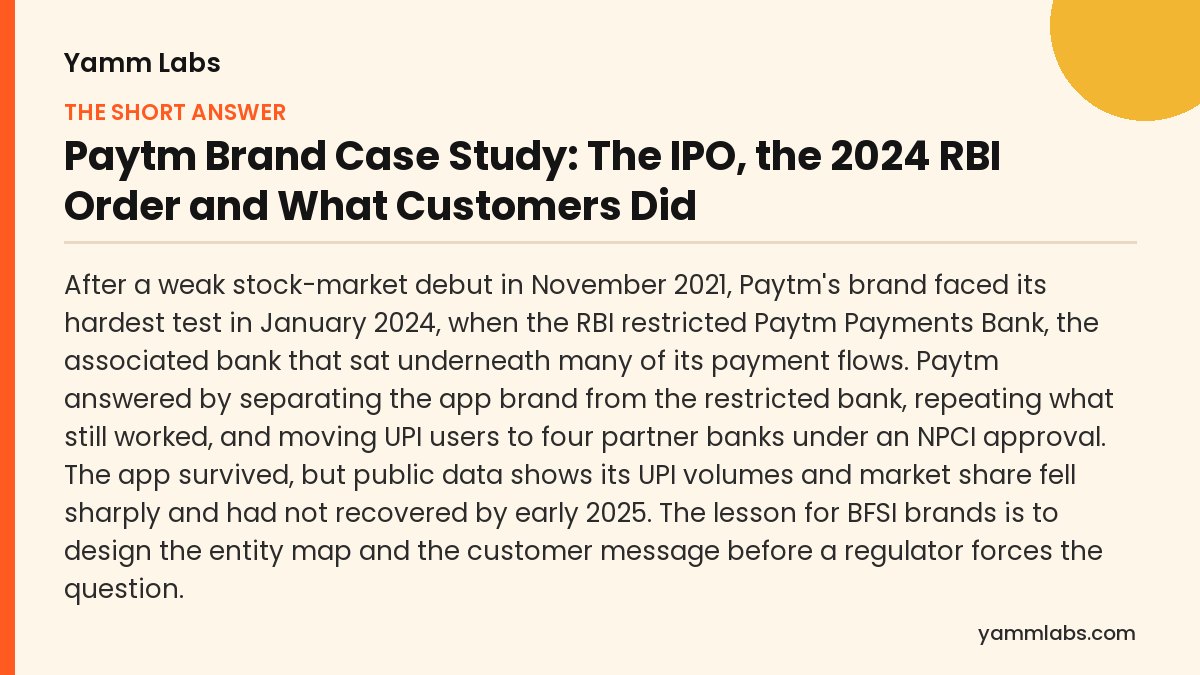
By the end of that day, the parent company’s shares had fallen 20% and locked at the lower limit. He had one question, and so did millions of Paytm users: does my Paytm still work? This Paytm brand case study follows how the company answered that question, what customers did next, and what a bank, insurer or fintech in India should copy or avoid when its own regulator acts.
- What was the situation at Paytm between the IPO and 2024?
- What did the RBI order on 31 January 2024, and why did it matter for the brand?
- How did Paytm communicate after the RBI action?
- What regulator-driven design decisions did the migration force?
- What did customers actually do after the RBI order?
- What changed in Paytm’s brand structure before and after 2024?
- What should a BFSI brand in India learn from the Paytm brand case study?
- People also ask
What was the situation at Paytm between the IPO and 2024?
Paytm is the consumer brand of One97 Communications. It listed on the Indian stock exchanges on 18 November 2021 in what was then India’s largest-ever initial public offering, raising about US$2.5 billion at an issue price of ₹2,150 a share. The debut went badly. The shares fell more than 27% on the first day and closed at ₹1,560.8. From that day on, the brand carried two reputations at once: a household payments name trusted by shopkeepers, and a listed stock that investors watched with suspicion.
Under the brand sat several legal entities. The most important one for this story was Paytm Payments Bank Limited, a payments bank licensed by the RBI. It held the savings accounts, the Paytm wallet balances, FASTags and National Common Mobility Cards, and it hosted the nodal accounts of One97 Communications and Paytm Payments Services, which the RBI’s 2024 order told it to terminate by 29 February 2024. The @paytm UPI handle also ran through it. To a customer, all of this looked like one thing called Paytm. To the regulator, these were separate entities with separate obligations.
The warning signs came early. On 11 March 2022, the RBI directed Paytm Payments Bank to stop onboarding new customers with immediate effect. The RBI’s later press release cited that earlier direction when it took further action in 2024. For almost two years, the brand kept growing on the consumer side while its banking arm stayed under a supervisory cloud that most users never saw.
What did the RBI order on 31 January 2024, and why did it matter for the brand?
On 31 January 2024, the RBI issued a press release titled Action against Paytm Payments Bank Ltd under Section 35A of the Banking Regulation Act, 1949. The central bank said an external audit and a follow-up compliance validation had revealed persistent non-compliance and continued material supervisory concerns. It directed that after 29 February 2024 no further deposits, credit transactions or top-ups would be allowed in customer accounts, wallets, FASTags and similar products, with exceptions for interest, cashbacks and refunds. Customers could keep withdrawing or using their balances without restriction.
For the brand, the order created a problem of names. The regulator was acting against one entity, the payments bank. To many customers, it sounded like a ban on Paytm itself. Merchants saw headlines and wondered whether their QR stand would stop working. Investors reacted within hours. One97’s shares were locked at ₹608.80 on BSE on 1 February 2024, down 20%, and hit the 20% lower circuit again the next day at ₹487.05. TechCrunch reported that about US$2.1 billion of market value was wiped out over those two days.
Two weeks later, on 16 February 2024, the RBI issued a second press release extending the deposit cut-off to 15 March 2024. It said the extension was meant to give customers, including merchants, a little more time to make alternative arrangements, and it published a set of frequently asked questions for customers. That FAQ became a key public document. It told merchants to get a fresh QR code linked to another bank, and told wallet users what they could and could not do after the deadline.
SIGNALNewsletter by Yamm Labs
The next piece, straight to your inbox.
New writing on BFSI brands, B2B and influencer marketing, and AI search.
One click to unsubscribe. Privacy policy

How did Paytm communicate after the RBI action?
The brand’s response followed a clear pattern: say what still works, separate the app from the bank, and name a date for the switch. On 1 February 2024, the company said the action did not affect user deposits in savings accounts, wallets, FASTags and NCMC accounts, where customers could keep using their existing balances. A statement on the Paytm blog then made the separation explicit. Its headline said Paytm would expand its relationships with third-party banks to distribute payments and financial services products. The post listed products that would carry on as usual, including Paytm QR, Paytm Soundbox and Paytm Card Machine, and said loans, insurance and equity broking were unaffected.
The same statement did something many brands avoid in a crisis. It put a number on the damage, estimating a worst-case impact of ₹300 to ₹500 crore on annual EBITDA. It also addressed a rumour directly, stating that the founder had not taken margin loans or pledged his shares. Paytm’s founder posted a short reassurance on social media, reported by TechCrunch: “Your favourite app is working, will keep working beyond 29 February as usual.”
The strongest move was structural, not verbal. The company said it would work only with other banks, and not with the payments bank, from then on. That turned a message (“don’t worry”) into an architecture change (“your payments now run through other banks”). The table below sets out the dated steps from the regulator releases and company statements we opened.
| Date | What happened | Who acted |
|---|---|---|
| 18 November 2021 | One97 Communications lists at ₹2,150 issue price; shares close more than 27% lower | Stock exchanges, investors |
| 11 March 2022 | Paytm Payments Bank told to stop onboarding new customers | RBI |
| 31 January 2024 | Deposits, top-ups and credits barred after 29 February 2024 | RBI |
| 1–2 February 2024 | Shares hit the 20% lower circuit on two straight days; Paytm says it will move to other partner banks | Market, One97 |
| 16 February 2024 | Cut-off extended to 15 March 2024; customer FAQs published | RBI |
| 14 March 2024 | One97 approved as a third-party UPI app with Axis Bank, HDFC Bank, SBI and YES Bank; @paytm handle moves to YES Bank | NPCI |
| 16 April 2024 | Approval to begin migrating users to the new partner banks | NPCI |
| 22 October 2024 | Approval to onboard new UPI users again | NPCI |
| 24 April 2026 | Banking licence of Paytm Payments Bank cancelled | RBI |
What regulator-driven design decisions did the migration force?
The UPI side of the story shows how a regulator’s decision turns into screens, handles and labels. On 14 March 2024, one day before the deadline, the National Payments Corporation of India approved One97 Communications as a Third-Party Application Provider under the multi-bank model. Axis Bank, HDFC Bank, State Bank of India and YES Bank became its payment service provider banks, and YES Bank became the merchant acquiring bank. The existing @paytm handle was redirected to YES Bank so that users and merchants could keep making UPI payments and AutoPay mandates without a break. NPCI advised the company to migrate all existing handles and mandates to the new banks at the earliest.
That is a brand decision disguised as a technical one. A UPI handle is part of a customer’s payment identity. It is printed on shop QR stands, saved in contact lists and linked to recurring mandates. Keeping @paytm alive through a redirect protected the most visible piece of the identity, the name customers typed and saw, while the bank behind it changed. When NPCI later cleared Paytm to onboard new UPI users again in October 2024, reporting on the approval letter listed conditions that included risk management, multi-bank rules, data protection and brand standards. The regulator was shaping the brand surface directly.
For any BFSI buyer, the decisions below are the ones a regulator can force on you in weeks. Each one has a design consequence that should be planned in advance.
- Entity line on every payment screen. When a bank partner changes, the “powered by” or “in partnership with” line on the payment confirmation screen should change with it. Plan a lockup where the partner bank name is a replaceable slot, not baked into the artwork.
- Screen sequence for a forced migration. The order that calms customers is: what still works, what you must do, by which date, which bank now serves you, and a confirmation. Leading with the regulator’s order, or burying the deadline, creates the panic the brand is trying to prevent.
- Handles and identifiers. Payment handles, QR codes and card faces are identity assets. Keep them as stable as the rules allow, because every reprint at a merchant counter costs money and trust.
- Merchant-first print materials. The RBI FAQ told merchants to get a fresh QR linked to another bank. That means new standees and stickers across the merchant base. Budget for a physical reprint, not only an in-app banner.
- A named date in every message. The RBI’s dates, 29 February and then 15 March 2024, became the anchor for customer action. A message without the date is a message customers cannot act on.
What did customers actually do after the RBI order?
The app kept working, and the core message held: payments through the Paytm app did not stop. The behaviour data, though, shows that a meaningful share of customers moved some of their activity elsewhere. Business Today reported that Paytm processed 1.57 billion UPI transactions in January 2024 and 1.23 billion in March 2024, and put its UPI market share at about 9% as of March. Inc42 reported that Paytm’s share of UPI for the full year nearly halved, from 14.1% in 2023 to 7.03% in 2024, and attributed the decline to the RBI action against the payments bank.
The recovery was slow. The ban on adding new UPI users lasted until NPCI’s approval on 22 October 2024. Inc42 later reported Paytm’s UPI share at 6.87% in January 2025. We have not found a public source that measures brand trust or consideration for Paytm before and after the order, so we do not claim one. The transaction data is the best public proxy, and it points to a brand that kept its existing base using the app while losing share in a market that kept growing.
The payments bank itself did not come back. On 24 April 2026, the RBI announced that it had cancelled Paytm Payments Bank’s banking licence with effect from the close of business that day, prohibiting it from conducting banking business, and that it would apply to the High Court to wind the bank up. Because of the brand architecture decision taken in February 2024, to run Paytm’s payments through other banks, the consumer app no longer depended on the bank underneath it when that bank closed.
What changed in Paytm’s brand structure before and after 2024?
The clearest way to read this case is as a forced change of brand architecture. Before 2024, Paytm behaved like a single masterbrand with a bank at its core. After 2024, the app became a front end that sits on top of several partner banks, each named where the rules require it. The comparison below uses only public statements and regulator releases.
| Brand element | Before 31 January 2024 | After the March 2024 migration |
|---|---|---|
| Bank behind UPI payments | Paytm Payments Bank as a key partner | Axis Bank, HDFC Bank, SBI and YES Bank as payment service provider banks |
| @paytm handle | Served through the payments bank | Redirected to YES Bank, with migration of handles and mandates to new banks |
| Wallet and FASTag | Top-ups and credits allowed | No new credits after 15 March 2024; existing balances usable |
| Merchant QR and Soundbox | Settlement could run through the payments bank | Continued, with merchants told to link a QR to another bank |
| Core brand promise | Paytm as the all-in-one payments app | Paytm as the app that works, powered by other banks |
This is the same masterbrand versus endorsed-brand question we cover in our guide to brand architecture for banks with multiple products. When one legal entity under a shared name gets into regulatory trouble, the shared name takes the headline. The more a group’s entities look identical to customers, the faster a problem in one spreads to all of them.
A regulator acts against an entity; customers hear the brand name, so the brand has to show them which entity was hit.
What should a BFSI brand in India learn from the Paytm brand case study?
The Paytm case is useful because the rules, dates and customer data are public. It is less useful as a model of perfect crisis messaging, because the public sources we found do not show the internal choices or name an agency behind the communication. What it does show clearly is where a regulated brand is exposed.
- Map your entities to your brand before a regulator does. Know which licence sits under each product and each screen. If a regulator acts against one entity, you need to say in one sentence which products are affected and which are not.
- Write the “what still works” message now. Paytm’s early statements listed specific products that would continue. A pre-approved template with blanks for dates and partner names saves precious time in the first days.
- Keep identity assets portable. Handles, QR standees, card art and app screens should allow a change of partner bank without a redesign.
- Put numbers in the investor message and dates in the customer message. Investors got an EBITDA range. Customers needed deadlines. Mixing the two confuses both audiences.
- Expect the recovery to be measured in quarters, not weeks. The public UPI data shows share falling within weeks and staying low for months after the app kept working.
For app teams, our list of 100 questions on trading and payment app branding covers the partner-bank and disclaimer placement choices in more detail. For groups that are renaming or restructuring after regulatory action, our history of bank rebranding in India since Axis shows how other institutions handled a change of name or structure.
A disclosure: Paytm Money, the group’s broking business, is on our client list. This case study is built only from public regulator releases, company statements and press reports, and it draws on no client work.
People also ask
Did the RBI ban the Paytm app in 2024?
No. The RBI’s action on 31 January 2024 was against Paytm Payments Bank, not the Paytm app or its parent company. The app kept running UPI payments through partner banks after NPCI approved One97 Communications as a third-party UPI app in March 2024.
Why did the RBI act against Paytm Payments Bank?
The RBI said an external audit and a follow-up compliance validation revealed persistent non-compliance and continued material supervisory concerns. It had already stopped the bank from onboarding new customers in March 2022.
What happened to the @paytm UPI handle?
NPCI’s March 2024 approval redirected the @paytm handle to YES Bank so that existing users and merchants could keep paying without a break. NPCI also advised the company to migrate handles and mandates to its new partner banks.
Did Paytm lose customers after the RBI order?
Public reporting shows Paytm’s UPI transactions fell from 1.57 billion in January 2024 to 1.23 billion in March 2024, and its yearly UPI share nearly halved in 2024. No public source we found measures brand trust directly, so the full effect on loyalty is not publicly reported.
Would your brand survive a regulator acting against one of your entities?
Get a free Fintech Brand Audit across 8 dimensions, plus 3 fixes. No pitch. Run the free Brand Audit →