


A growth head at a Mumbai lending app opens Search Console on a Monday morning. Impressions on the EMI explainer pages are holding. Clicks are not. She searches Google for the reason and gets an AI-written answer at the top of the page that summarises three other lenders and never mentions hers. In the next tab, compliance has left a comment on the creator reel scheduled for Friday: the creator is not registered, so the reel cannot run.
Those two tabs are the whole story of what Indian fintech marketers are searching for in late 2026. They want to know how to be the answer, how to keep the customers they already paid for, how to work with creators without a regulator problem, and how to prove to a nervous customer that the app is real.
- What are Indian fintech marketers searching for right now?
- Why are AI Overviews and zero-click answers the first question on every brief?
- Why is retention beating acquisition in Indian fintech plans?
- How do creator partnerships work under SEBI’s finfluencer rules?
- Why are fraud and trust searches shaping bank and payments content?
- What regulator-driven design decisions should a fintech brand make this quarter?
- What should a fintech brand publish or change before March 2027?
- People also ask
What are Indian fintech marketers searching for right now?
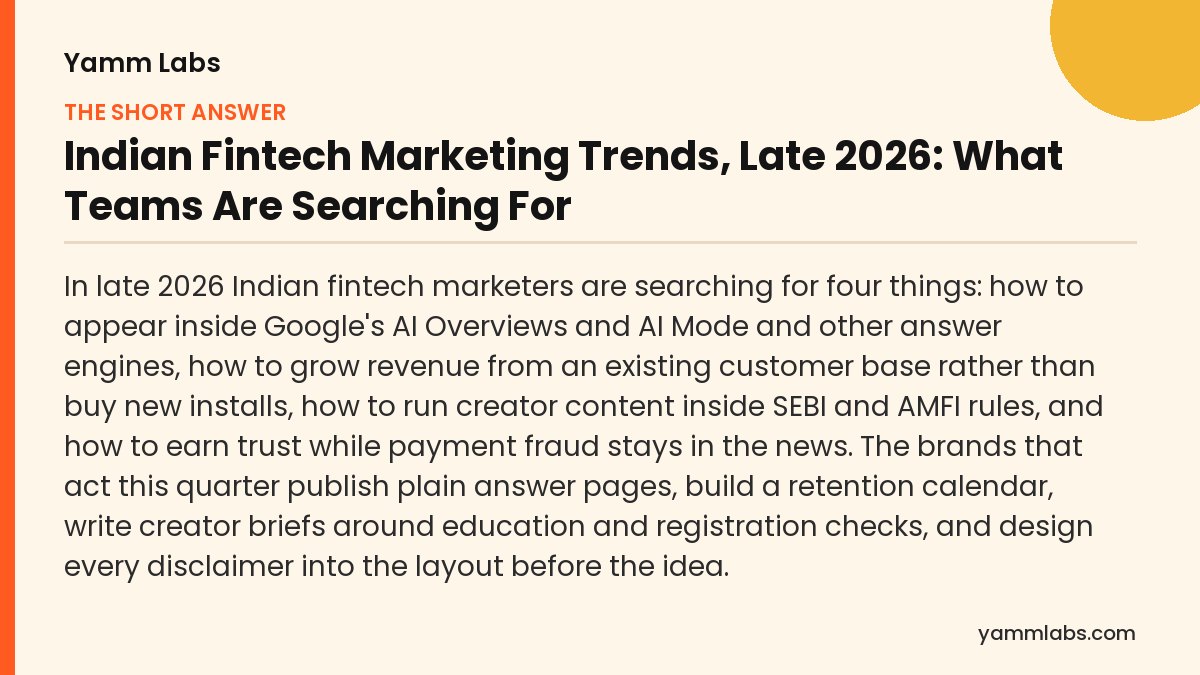
Read the questions marketing teams at banks, lenders, brokers, insurers and payment apps are putting into Google and into ChatGPT, and four clusters repeat. None of them is about a new channel. Each is about a rule changing underneath an old one: how search sends traffic, how growth is counted, who is allowed to talk about money, and how a customer decides a brand is safe.
We have not quoted Google Trends index numbers in this piece. Google says Trends shows relative popularity on a 0 to 100 scale for the region and time range you choose, not absolute search volume, so an index value for one date range tells you little on its own. Open it yourself for your own category terms and compare them against each other. The signals below come from regulators, NPCI, AMFI and Google’s own documentation instead.
| Trend | What marketers type | The published signal behind it | What to publish or change this quarter |
|---|---|---|---|
| AI answers and zero-click search | How do we show up in AI Overviews? Is GEO different from SEO? | Google’s October 2025 post put AI Mode in over 200 countries and territories; Google says AI feature clicks sit inside the normal Web report in Search Console | One answer page per buyer question, with the answer in the first two sentences |
| Retention over acquisition | How to increase SIP continuity, cross-sell to existing users, reduce churn | AMFI counted 28.35 crore mutual fund folios on 31 August 2026; the Finance Ministry said 55.49 crore users were onboarded on UPI as of June 2026 | A lifecycle content calendar for month 1, month 3 and month 12 customers |
| Creator content under rules | Can we work with finfluencers? What must a creator disclose? | SEBI’s 2024 board proposal to stop regulated entities associating with unregistered advisers; AMFI’s distributor FAQ on YouTube and Instagram | A creator brief built on education, with a registration check before the contract |
| Fraud, trust and verification | How do customers verify our app? What should a fraud page say? | RBI’s .bank.in domain migration for banks; NPCI’s 11-language UPI safety campaign | A “how to check it is really us” page, linked from every channel |
The table is the whole quarter in four rows. The rest of this piece takes each row in turn and ends with the design decisions a regulator forces on each one.
Why are AI Overviews and zero-click answers the first question on every brief?
Because the top of the page changed. For many money questions, such as what a good credit score is, how a SIP differs from a lump sum, or whether a personal loan app is safe, Google now places an AI-written summary above the links. In October 2025 Google said AI Mode had expanded to more than 35 new languages and over 200 countries and territories in total. ChatGPT, Perplexity and Gemini answer the same questions in their own apps. The buyer reads an answer, sometimes clicks a source, and often does not.
SIGNALNewsletter by Yamm Labs
The next piece, straight to your inbox.
New writing on BFSI brands, B2B and influencer marketing, and AI search.
One click to unsubscribe. Privacy policy

The search behind this trend is practical. Teams want to know whether there is a special trick. Google’s developer documentation says there are no additional requirements and no special optimisations needed to appear in AI Overviews or AI Mode. A page must be indexed and eligible to show with a snippet. The same documentation says clicks from AI features are counted in the Search Console Performance report under the Web search type, so the traffic is not broken out on its own.
That last point explains the Monday-morning confusion. Impressions and clicks move for reasons you cannot see in one report. The practical answer is to measure the engines directly: a fixed set of buyer prompts, asked the same way every month, scored for whether your brand is named. We explain the method in our GEO and AEO FAQ for financial brands, and the longer list of engine questions sits in AI Search Optimisation: 100 Questions Answered.
- Write the answer first. Put a two-to-four sentence answer directly under the question. Engines lift that paragraph whole.
- One question per page. A page that answers “What is a key fact statement?” beats a page that covers the whole loan journey.
- Say who you are in the text. Brand name, regulator, product category and city, in words, not just in a logo.
- Keep numbers dated. An interest rate or a return figure without a date is the first thing an engine and a compliance reviewer both distrust.
Why is retention beating acquisition in Indian fintech plans?
The customer base is already large, and the easy installs have been bought. AMFI’s industry page puts mutual fund folios at 28.35 crore as of 31 August 2026, with industry assets of about ₹87.08 lakh crore on the same date. In a July 2026 Lok Sabha reply, the Minister of State for Finance said NPCI had reported 55.49 crore users onboarded on UPI as of June 2026. UPI crossed 20 billion transactions in a single month for the first time in August 2025, according to DD News reporting NPCI data.
When the customer is already in someone’s app, the next rupee of growth comes from use, not from a new download. That is why marketers now search for SIP continuity, dormant account reactivation, cross-sell from payments to credit, and referral design. It is a reading of the numbers above, not a survey finding, and it matches what brand teams ask us for.
Zerodha is the Indian case every retention deck cites. In January 2025 Business Today reported its founder saying that about 30 percent of its 1.6 crore users came through referrals from existing customers, and that if the company had advertised, much of its profit would have gone to Google and Meta. You do not need to give up paid media to learn from that. You need content that existing customers want to forward.
- Month 1. Explain the first statement, the first debit and the first notification in plain language.
- Month 3. Answer the question the customer is most likely to call about. For a fund platform it is often a fall in NAV. For a lender it is a changed EMI date.
- Month 12. Show the customer their year in one screen, then offer the next product with its full disclosures, not a teaser.
In 2026 the cheapest growth in Indian fintech is the customer who already trusts you enough to open the app.
How do creator partnerships work under SEBI’s finfluencer rules?
Creator content is where Indian fintech attention sits, and it is where the rules tightened. In 2024 a SEBI board memorandum proposed barring SEBI-regulated entities and their agents from any association, paid or unpaid, with persons who give securities advice or recommendations without SEBI registration, or who make claims of return or performance. It described finfluencers as people who give information or advice on financial topics through reels and videos on platforms such as Instagram, Facebook, YouTube, LinkedIn and Twitter. That is why marketers now search for “can we work with finfluencers” rather than “which finfluencers should we hire”.
For mutual fund distribution, AMFI has spelt out the social media side. Its FAQ on distributors says a mutual fund distributor may run a YouTube channel or Instagram account, but only for educational content. It must not make scheme-specific recommendations or performance claims, must avoid past-performance and future-return talk about specific schemes, and must disclose its distributor affiliation with its ARN and any conflicts of interest. AMFI says the same points apply to LinkedIn, Facebook, Instagram and X.
The result is a different creator brief. The creator explains a concept, the brand owns the call to action, and the registration check happens before the contract, not after the reel is cut.
- Check registration first. Confirm whether the creator is registered with SEBI, a stock exchange or AMFI, and in what capacity, before the brief goes out.
- Brief on concepts, not schemes. “How an SIP works” is education. “Why this fund beats that one” is a recommendation.
- Script the disclosure into the frame. Registration details and the standard warning belong in the video, not only in the caption, which many viewers never expand.
- Watch the comments. A clean script can still attract a pinned comment or reply that promises returns. Somebody on the brand side owns moderation for the life of the post.
Why are fraud and trust searches shaping bank and payments content?
Because the customer’s first question about a money app is now “is this real?”. Regulators and the payments network have made that question part of the brand. In April 2025 the RBI told banks to migrate their websites to the exclusive .bank.in domain, to be completed no later than 31 October 2025, as a measure against digital payment fraud. In November 2024 NPCI launched a UPI safety campaign, Main Moorkh Nahi Hoon, with six films in 11 languages on common scams.
So the searches marketers run have shifted from “fraud awareness campaign ideas” to specific pages: how to tell customers our official domain, which app names and handles are ours, what we will never ask for. The RBI’s Digital Lending Directions of 2025 add a lending angle: a regulated entity must publish on its website the details of its digital lending apps and the lending service providers it works with, and what they do.
A verification page is a trust asset and an answer-engine asset at once. It answers the exact question a worried customer types, in the brand’s own words, on the brand’s own domain.
What regulator-driven design decisions should a fintech brand make this quarter?
Every agency says it is compliance-aware. The test is whether it can show you the decision on the screen. Here are five that follow directly from the rules above, each one a layout, sequence or timing choice. None of them is a legal opinion.
- The five-second end-card. SEBI requires the standard risk warning in audio-visual mutual fund advertisements to be clear and understandable on screen and in voice-over, and gives five seconds as an example of what may meet that test, not a fixed minimum. In a 15-second reel five seconds is a third of the running time, so the warning gets its own planned end-card with a voice-over, scripted on day one. It is not a fast crawl added in the edit.
- The brand-film test. SEBI’s FAQ for mutual fund intermediaries says the risk disclaimer applies to all communications that fall within the definition of an advertisement, meaning anything that may influence an investment decision, while a corporate film that is merely a branding exercise does not need it. Decide in the brief which side of that line a fund house’s brand film sits on, because a film that starts to solicit investment needs the warning.
- The lender’s name on the offer screen. Where a lending platform shows offers from several lenders, the RBI’s 2025 digital lending rules require that view to name each regulated entity extending an offer, with amount, tenor, APR, monthly repayment and penal charges, and a link to its key fact statement. That fixes the screen sequence: the lender’s name and the key numbers sit on the offer screen, and the key fact statement comes before the borrower signs, with no “details later” link.
- The cooling-off line in the journey. The same rules give borrowers a cooling-off period to exit a digital loan, set by the lender’s board and not less than one day. Put that window in the confirmation screen and the welcome message, where a nervous borrower looks for it.
- The approved base version. IRDAI’s 2024 regulations, which replaced its 2021 advertisement rules, require insurance advertisements to go through the insurer’s own approval process, and an advertisement issued by a distribution channel needs the insurer’s written approval first. Lock and approve the base layout first, then translate into it, so the Tamil and Marathi versions match what was approved.
None of these slows a campaign when it is decided in the brief. Each one costs a week when it is discovered in review.
What should a fintech brand publish or change before March 2027?
Treat the rest of this financial year as one quarter of work in four streams. Each stream is small. Together they cover the four searches in the table.
- Answer pages. List the 20 questions your buyers ask about your product category, write one plain answer page per question, and track whether the engines name you each month. Our AI visibility work for BFSI brands starts from exactly that list.
- A retention calendar. Map month 1, month 3 and month 12 content for your largest customer group. Measure repeat use, not reach.
- A creator playbook. One page covering the registration check, education-only briefs, on-screen disclosures and comment moderation. Share it with compliance before the first creator call.
- A verification page. Official domain, app names, social handles, the things you will never ask for, and how to report a fake. Link it from the app, the footer and every campaign.
If you want the questions that sit behind these pages, our library of BFSI questions answered is organised by product line and regulator.
People also ask
What is the biggest fintech marketing trend in India in 2026?
The move from ranking to being the answer. AI Overviews, AI Mode and chat assistants now answer many money questions directly, so the brand named in the answer wins attention even when nobody clicks. Plain, dated, one-question answer pages are the response.
Can a fintech brand in India still work with finfluencers?
Yes, with care. SEBI moved in 2024 to stop regulated entities associating with unregistered persons who give securities advice or claim returns, so the creator’s registration status is checked first. Education-led briefs with disclosures in the frame are the safer format.
Does a mutual fund brand film need the risk disclaimer?
Only if it works as an advertisement. SEBI’s FAQ for mutual fund intermediaries says the risk disclaimer applies to all communications that fall within the definition of an advertisement, while corporate films that are merely a branding exercise and do not influence investment decisions do not need it. Where the warning is needed in audio-visual formats, SEBI requires it to be clear and understandable on screen and in voice-over, with five seconds given as an example, not a fixed minimum, so plan the end-card from the start.
Why are fintech marketers focusing on retention in 2026?
The customer base is already large: AMFI counted 28.35 crore folios in August 2026 and UPI had 55.49 crore onboarded users by June 2026. Growth increasingly comes from getting existing customers to use more, stay longer and refer others, which is a content job as much as a media job.
Sources
- Google: FAQ about Google Trends data
- blog.google: AI Mode in Google Search expands to more than 40 new areas
- Google Search Central: AI Features and Your Website | Google Search Central | Documentation
- AMFI: AMFI
- newkerala.com: MoS Finance Pankaj Chaudhary, Lok Sabha written reply (July 2026), citing NPCI
- ddnews.gov.in: UPI transactions cross 20 billion in August; PhonePe, Google Pay lead market
Is your brand ready for the searches your buyers are running this quarter?
Get a free Fintech Brand Audit across 8 dimensions, plus 3 fixes. No pitch. Run the free Brand Audit →