

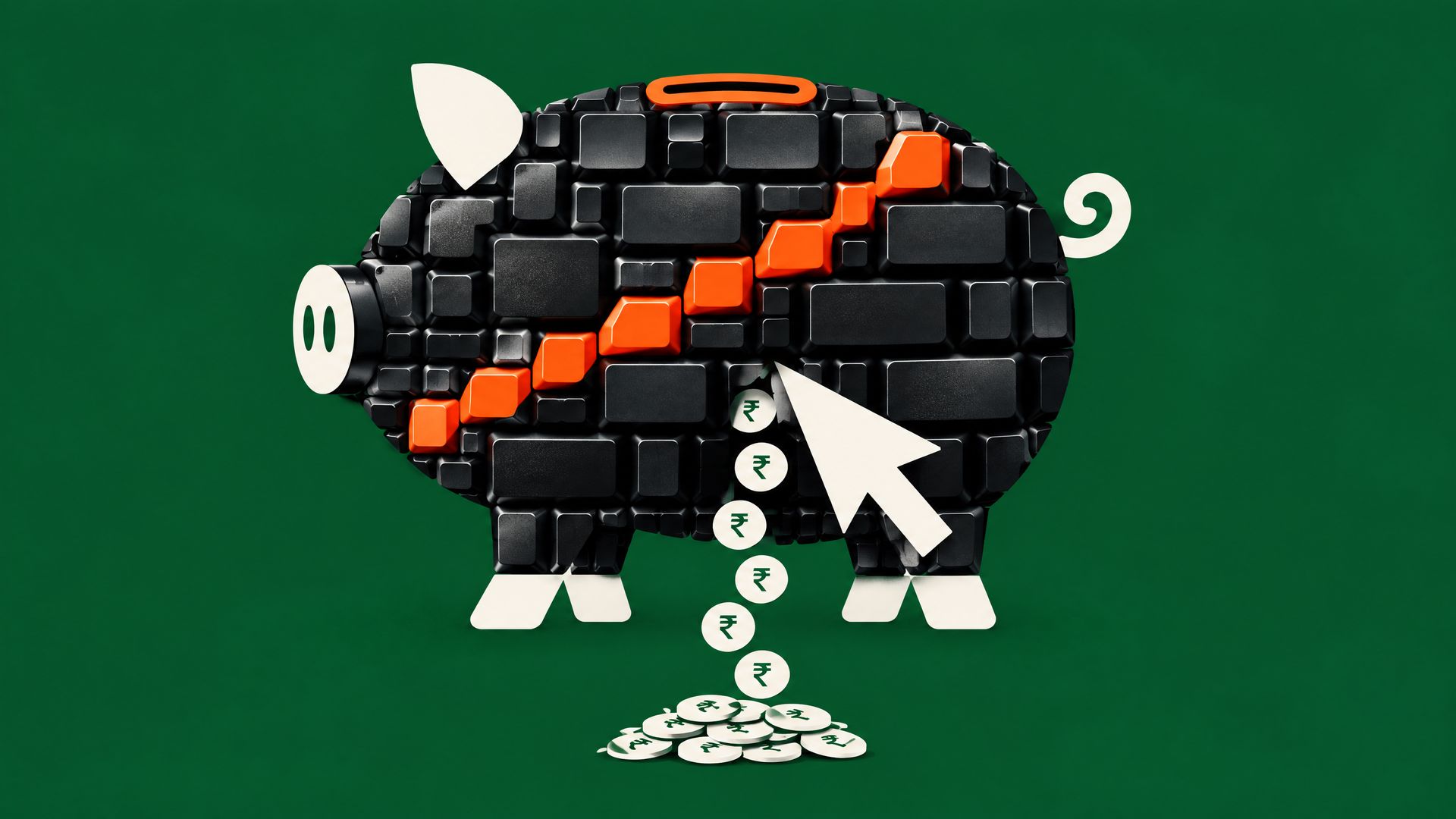
It is the second week of the quarter at a Bengaluru lending app. The growth lead has the fintech CAC dashboard open on the big screen: cost per install is up, cost per approved loan is up more, and the finance team wants to know why the same creative that worked last year now needs a bigger bid to win the same auction.
Someone suggests a new hook for the reels. Someone else suggests a cashback. Nobody in the room says the word brand, because brand feels like a cost and the dashboard only shows costs. That is the mistake. The rising number on the screen is not a media problem. It is a memory problem, and memory is what brand work builds.
- Why does fintech CAC keep rising even when the creative is good?
- What does brand investment actually buy a fintech?
- Where do regulator rules and brand memory meet?
- Is brand spend too slow for a fintech that needs growth this quarter?
- What should a fintech marketing head do on Monday?
- What mistakes do fintechs make when CAC rises?
- How do you brief an agency on a fintech CAC problem?
- People also ask
Why does fintech CAC keep rising even when the creative is good?
Every performance channel an Indian fintech buys from is an auction. Search, social, app stores and affiliate networks all price attention against everyone else who wants the same customer. A lending app, a broker, a card issuer and an insurance aggregator are often bidding for the same young salaried professional in the same week. When every bidder looks the same, the auction decides on price alone, and price only goes one way when more money chases the same audience.
Good creative helps for a while. A sharp hook lifts click-through, the algorithm rewards it, and the cost per result drops. Then the hook wears out, competitors copy the format, and the team needs a new one. This cycle is familiar to anyone who has run a paid calendar for a year. What it does not do is leave anything behind. When the campaign stops, the customer who scrolled past it keeps no picture of who the company is.
That is why we call CAC a brand problem. The cost of acquiring a customer is partly the cost of the ad and partly the cost of the doubt the ad has to overcome. A stranger asking for your PAN, your bank statement and your Aadhaar-linked mobile number meets a lot of doubt. A name the person already recognises meets much less. The media plan cannot fix that doubt; only familiarity can.
| What the budget buys | Performance spend | Brand spend |
|---|---|---|
| Main job | Convert people already looking | Make the company the one they think of when they start looking |
| What it leaves behind when paused | Very little; results stop with the spend | Recognition of a name, colour, sound or line |
| Where it shows up | Cost per install, cost per funded account | Branded search, direct installs, referral acceptance, drop-off at KYC |
| Who it helps | This month’s funnel | Every future ad, including performance ads |
| Main risk | Rising auction prices and creative fatigue | Being measured on the wrong clock and cut too early |
What does brand investment actually buy a fintech?
Brand is not a logo refresh or a film for the annual report. For a financial product, it is a small set of assets that a person can recall without effort and that the company uses the same way every time. The job is to make every paid impression add to the same memory instead of starting from zero.
- A name that is easy to say and search. If users misspell it in the app store, part of the performance budget is spent recovering people who already wanted you.
- One distinctive visual asset used everywhere. A colour, a shape or a character that appears on the ad, the app icon, the onboarding screen and the statement email, so the moment of recognition happens on every surface.
- A line that says what the product is for. Not a slogan about the future of money, but a sentence a customer could repeat to a friend who asks what the app does.
- Consistency across the regulated moments. The disclaimer frame, the key facts screen and the policy document are where trust is decided, and they are usually the least designed parts of the journey.
None of these is expensive on its own. What makes them work is repetition over years, which is why they get cut: they look like costs in the quarter they are paid for and pay back in quarters nobody is measuring. A founder who reads our Signal notes will recognise the pattern. The companies that people name when asked about a category are rarely the ones with the cleverest ads. They are the ones that kept showing the same things.
Where do regulator rules and brand memory meet?
Compliance-aware is a phrase every agency uses. Here is what it looks like as an actual design decision, because the regulated moments in a financial ad are often the most repeated moments, and repetition is what memory is made of.
The mutual fund end frame. SEBI raised the time for which the standard warning must be displayed and read out in audio-visual mutual fund advertisements to five seconds, after finding it was being recited so fast that viewers could not follow it. Most teams treat those five seconds as dead air bolted onto the end of the film.
We treat them as the one frame that appears, unchanged, in every cut of every film the fund house will ever run. So the brand asset lives there: the colour field, the logo lockup and the sound cue sit behind and around the warning, which stays legible and fully read out. Over a year of edits, that end frame is seen more often than any hero shot.
The insurance lockup. IRDAI’s current advertising rules ask an insurer to show its registered name prominently alongside any trade name or logo, and to keep mandatory disclosures clear, conspicuous and legible. That settles a lockup rule before any creative starts: the registered name sits inside the master lockup at a size that stays readable on a phone screen, not in a footnote line added at the end. When the full name is part of the lockup from day one, the brand gets remembered as one unit, and nobody has to shrink the logo in the last review round to make room.
The loan screen sequence. RBI’s directions require lenders to give prospective borrowers a Key Facts Statement in a standardised format before the loan contract is signed, including a computation sheet for the annual percentage rate. Charges not mentioned in it cannot be levied later without the borrower’s explicit consent. For a lending app, that screen arrives at the exact moment the borrower decides whether to trust you.
We design it in the same type, colour and tone as the rest of the app, place it before the consent step rather than behind a small link, and write the surrounding copy in the language the borrower chose at onboarding. A borrower who reads a clear, familiar screen at that point does not abandon the journey, and each abandonment is acquisition money already spent.
SIGNALNewsletter by Yamm Labs
The next piece, straight to your inbox.
New writing on BFSI brands, B2B and influencer marketing, and AI search.
One click to unsubscribe. Privacy policy

Is brand spend too slow for a fintech that needs growth this quarter?
This is the strongest objection, and part of it is right. An early fintech with a short runway cannot pause performance spend to run a year of brand films. Performance marketing is measurable, reversible and close to revenue, and a board can read it on a single slide. Brand work is slower, harder to attribute, and easy to do badly: a vague film about empowering Bharat with no product in it is a waste of money, and plenty of them get made.
So the argument is not brand instead of performance. It is that the performance budget should stop being spent on assets that leave nothing behind. That costs very little extra. It means the same colour, the same lockup, the same line and the same end frame in every performance ad, so that each paid impression adds to recognition while it chases a click. It means fixing the regulated screens where trust is lost, which is a design job, not a media job. It means protecting a modest slice of spend for work aimed at people who are not in the market yet, and measuring it on branded search and direct installs instead of cost per install.
A company that does this still runs performance. It simply stops paying full price to introduce itself to the same people every quarter.
Every rupee of performance spend is cheaper when the customer already knows your name.
What should a fintech marketing head do on Monday?
Five things, none of which needs a new agency or a bigger budget to start.
- Pull the last ten performance ads onto one wall. If a stranger could not tell they came from the same company, the budget is paying for introductions, not memory.
- Pick one distinctive asset and make it mandatory. One colour, one lockup, one sound or line, used in every ad, app screen and email from now on.
- Audit the regulated moments. Look at the mutual fund end frame, the insurance lockup or the key facts screen as a customer would. If it looks like an afterthought, it is costing you trust at the moment of conversion.
- Add two memory metrics to the dashboard. Track branded search and direct or organic installs alongside cost per install, so brand work has a number that moves.
- Get an outside view before the next budget cycle. A short teardown of your current ads and screens will usually show where the same money could build memory. Our free 15-minute brand teardown is one way to get it.
Yamm Labs works from Gurugram with banks, insurers, fund houses and fintechs in India and, remotely, in the Gulf and beyond. You can read more about how we work on our about page.
What mistakes do fintechs make when CAC rises?
When the cost line on the dashboard climbs, the first reactions are usually media reactions. Most of them make the next quarter more expensive, not less.
- Raising bids to hold volume. A higher bid wins the same auction at a higher price. It buys this month’s installs and leaves nothing behind for next month.
- Changing the look of every campaign. A new colour, a new character and a new line each quarter keeps the creative fresh for the team and makes the company a stranger again for the customer.
- Using cashback as the only reason to install. An incentive can move a number quickly, but it teaches people to wait for the next offer and does little to make them remember the name.
- Treating regulated screens as legal leftovers. The mutual fund end frame, the insurance lockup and the key facts screen are seen at the moments trust is decided. Leaving them undesigned wastes the acquisition money spent to get the customer that far.
- Judging brand work on cost per install. Brand spend moves branded search, direct installs and drop-off at KYC. Measured on the performance clock, it will always look like a cost and will always be the first line cut.
How do you brief an agency on a fintech CAC problem?
A useful brief starts with the funnel, not the logo. Share the numbers the team already watches: cost per install, cost per KYC completed, cost per funded account, and where people drop off between them. Ask the agency to show where recognition is being lost, not just where clicks are expensive.
Then give it the regulated surfaces as part of the scope. Send the current mutual fund end frame, the insurance lockup or the key facts screen alongside the ads, and ask how the brand asset will live inside them without weakening the disclosure. Confirm the current text of the relevant SEBI, IRDAI or RBI rules with your compliance team before the work starts, so the agency designs to the real requirement.
Finally, agree the measures before the work begins. Branded search, direct or organic installs and KYC drop-off should sit on the same dashboard as performance spend and cost per install, reviewed on a yearly clock. An agency that promises a lower fintech CAC within a single quarter from brand work alone is promising something the mechanism does not deliver.
People also ask
Why is customer acquisition cost so high for Indian fintechs?
Most fintechs buy customers through the same auctions, target the same salaried audience and look alike in their ads, so price becomes the only thing that separates them. On top of that, a financial product asks for sensitive data, and a name the customer does not recognise has to overcome more doubt at every step.
Can brand marketing reduce performance marketing costs?
It can make each performance rupee work harder, because a recognised name converts better at the click, at KYC and at the key facts screen. The effect builds over time and should be measured through branded search, direct installs and funnel drop-off, not through cost per install alone.
How should a fintech split budget between brand and performance?
There is no single right ratio, and anyone quoting one without knowing your stage and runway is guessing. Start by making every performance ad carry the same distinctive assets, then protect a modest, fixed share of spend for work aimed at people who are not yet in the market, and review it on a yearly clock.
What is fintech CAC and how is it measured?
Fintech CAC is the customer acquisition cost for a financial product: what the company spends to win one customer. Many teams measure it at more than one stage, such as cost per install, cost per completed KYC and cost per funded account, because the gap between those stages shows where trust is being lost. The later the stage, the closer the number is to real revenue.
Why does performance marketing get more expensive over time?
Performance channels are auctions, and more fintechs chasing the same audience push prices up. Creative fatigue adds to it: a hook that worked wears out, competitors copy the format, and the team pays to test a new one. Without a recognisable brand behind the ads, each new campaign starts from zero with the customer.
Which metrics show brand work is lowering customer acquisition cost?
Look at branded search volume, direct or organic installs, referral acceptance and drop-off at KYC. If these improve while performance spend stays steady, recognition is doing part of the work the auction used to charge for. Read them over quarters rather than weeks, because memory builds slowly.
Sources
Paying for the same introduction every quarter?
Get a free Fintech Brand Audit across 8 dimensions, plus 3 fixes. No pitch. Run the free Brand Audit →
One Comment