


It is 10.40 on a weeknight in a Pune flat. A software tester with a new baby and a fresh home loan has a term plan quote from his bank’s relationship manager, and he does not trust it. He does not call the manager back. He types three words into his phone, lands on a grid of insurers sorted by premium, and books a call with an advisor for the next morning.
The insurer he finally buys from matters less to him than the page where he made the choice. In India that page very often belongs to Policybazaar, and the way a comparison site became the front door to a whole category is one of the clearest brand cases in Indian financial services.
- Who is Policybazaar, and where did it start?
- Why is a comparison marketplace hard to brand in insurance?
- What did Policybazaar’s advertising actually say?
- How much did Policybazaar spend on advertising, and what changed?
- Which regulator rules shaped Policybazaar’s pages and ads?
- What results can be tied to the brand, and what is not public?
- What should an Indian insurer or fintech take from the Policybazaar case?
- People also ask
Who is Policybazaar, and where did it start?
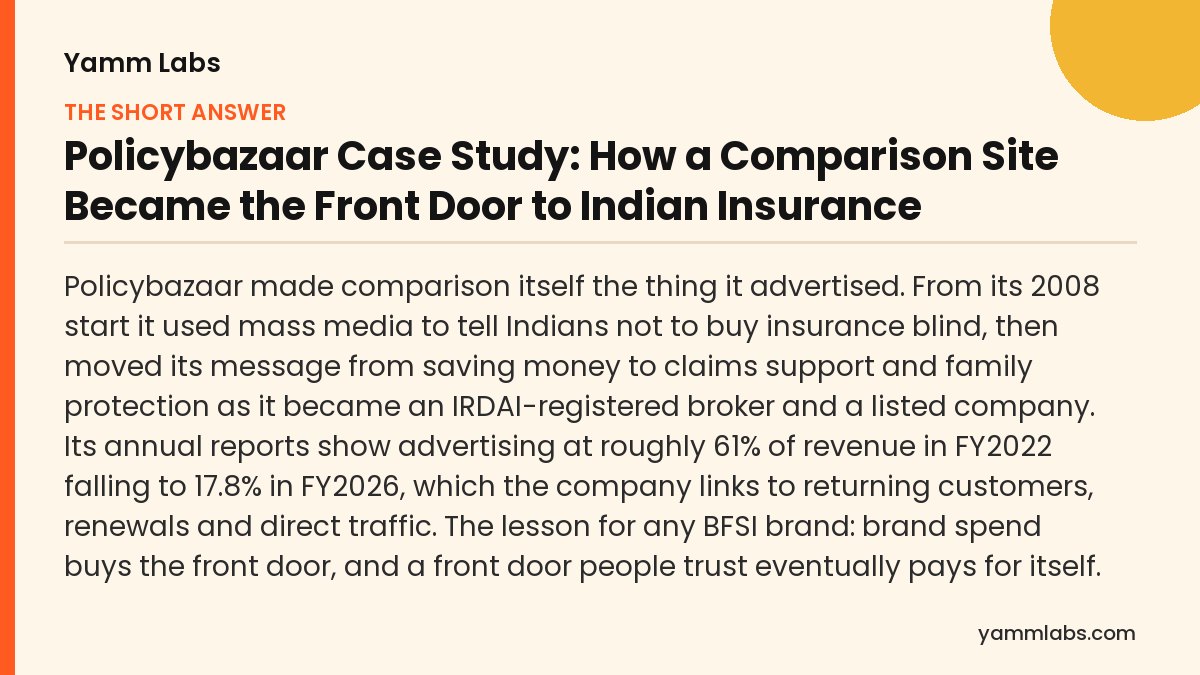
Policybazaar is the insurance marketplace of PB Fintech Limited, a company headquartered in Gurugram. PB Fintech says it launched Policybazaar in 2008 to answer consumers’ need for awareness, choice and transparency, and to build a consumer-pull, provider-neutral model for insurance distribution. The company was incorporated on 4 June 2008 as Etechaces Marketing and Consulting Pvt. Ltd., took the PB Fintech name in September 2020, and listed on the NSE and BSE on 15 November 2021 at an issue price of ₹980 a share. Those details sit on the PB Fintech corporate site.
The company’s FY2022 annual report lists its founding-era milestones in one block: a seed investment from Info Edge, being the first platform to focus on life and health insurance, an insurance web aggregator licence from IRDAI, and its first TV brand campaign, “Ullu mat bano”. A sister platform for loans and credit cards, Paisabazaar, followed in 2014.
The scale came later. PB Fintech states that in fiscal 2020 Policybazaar held a 93.4% share of India’s online insurance distributors by number of policies sold, and that it accounted for 65.3% of all digital insurance sales in India, including insurers’ own online sales. Policybazaar’s about page reports over 42 million policies sold and 16.6 million unique buyers since inception, up to FY2024, and over 77 million registered customers. Those are company figures. They are also the reason every insurer in India now plans for how its products look on someone else’s screen.
Why is a comparison marketplace hard to brand in insurance?
Insurance is bought rarely and thought about even less. There is no weekly habit to build on, the way a payments app or a grocery app has. PB Fintech’s own FY2026 annual report names two barriers it designs against: procrastination, a decision that is easy to postpone until it is too late, and distrust of claims, the doubt about whether a claim will be honoured that stops buyers at the last step.
A marketplace carries a third problem that an insurer does not. It does not underwrite. PB Fintech describes an asset-light model that underwrites no insurance and holds no credit risk. So the insurer makes the claim decision, but when a claim goes badly the customer remembers the site where they bought. The marketplace carries the reputational risk of a product it does not control.
The fourth problem is neutrality. A comparison site is only worth visiting if people believe the ranking is fair, yet the same site depends on the insurers it ranks for its revenue. The brand has to look independent to consumers while staying a partner insurers want to be listed with.
The fifth is regulation. Insurance advertising in India is governed by IRDAI, and an intermediary advertising an insurer’s products sits inside the insurer’s approval chain. Every campaign has to be designed with that sign-off in mind, which shapes what can be said on screen and how quickly it can go out.
SIGNALNewsletter by Yamm Labs
The next piece, straight to your inbox.
New writing on BFSI brands, B2B and influencer marketing, and AI search.
One click to unsubscribe. Privacy policy

What did Policybazaar’s advertising actually say?
Read across the FY2022 and FY2026 annual reports, the campaigns fall into a clear sequence. The early work sold comparison as street smarts. The later work sold protection and service.
- Ullu mat bano. The first TV brand campaign, from the 2008 to 2013 era. The Hindi line means, roughly, don’t be made a fool of. Alongside “Compare & Save”, it framed checking prices before buying as the sensible thing to do.
- Paison Se Badhkar. The FY2022 report calls this the brand philosophy behind its work. Under it the company made “The Sweet Sound of Wood”, its third long-format brand video, which the report says drew 40 million views across digital channels.
- No Insurance Day. A comic set of TV commercials that acted out absurd excuses for not buying health insurance and then answered each one. The report says the comic tone was a deliberate choice to hold viewers.
- Mr. Policybazaar. A superhero figure used to stand for the strength of customer support, especially at claim time. This is the first campaign in the reports that sells service, not price.
- The second-wave film. During the Delta wave of Covid, the company ran a television advertisement on the importance of term life and health insurance.
- Famous faces. The FY2026 report lists Kapil Sharma as a brand ambassador in its 2018 to 2024 era, and describes a partnership with Amitabh Bachchan carrying the lines “Health Insurance se Hospital ka Kharcha Bachaiye” and “Parivaar Sabse Pehle”.
- Claims and languages. The same report says recent work highlights claims assistance, real customer experiences, grievance resolution and Claims Samadhan Diwas, runs in 10 languages, and includes the Ashray brand film about a ₹50 lakh medical emergency.
The pattern is the point. The message moved from “you might be overpaying” to “we will be there when you claim”. A comparison site that only promises a lower premium competes on price forever. One that promises help at the worst moment competes on trust, which is harder to copy. Policybazaar’s head of brand wrote in the FY2022 report that this focus had made it “the default destination for all Insurance needs for India”. That is the company’s own claim, but it describes the goal of every campaign above.
How much did Policybazaar spend on advertising, and what changed?
PB Fintech reports advertising and promotion as its own expense line, covering digital marketing, affiliate marketing and brand promotion. The consolidated figures below come from the company’s FY2022 annual report and FY2026 annual report. The FY2021 and FY2022 shares are our arithmetic from the reported figures; the FY2025 and FY2026 shares are as the company reports them.
| Financial year | Advertising and promotion (₹ crore) | Revenue from operations (₹ crore) | Advertising as share of revenue |
|---|---|---|---|
| FY2021 | 367.8 | 886.7 | About 41% (our calculation) |
| FY2022, the IPO year | 864.5 | 1,424.9 | About 61% (our calculation) |
| FY2025 | 1,090.1 | 4,977.2 | 21.9% (reported) |
| FY2026 | 1,212.6 | 6,794.0 | 17.8% (reported) |
Read the table from top to bottom and the story is plain. In the listing year the company spent more than half of every rupee of revenue on advertising and promotion. Four years later it spent more in absolute terms, ₹1,212.6 crore, but less than a fifth of revenue. Over the same span, the FY2026 report says, the profit after tax margin moved from negative 58% to positive 10%, with FY2026 profit after tax of ₹670 crore against ₹352 crore in FY2025.
The company’s explanation is the most useful line in the report for any brand team. It says the falling share reflects returning customers, renewal revenue and direct traffic. It says brand investment was not cut, since absolute spend still rose by ₹122.5 crore in FY2026. Back in FY2022 it had already reported that the direct channel drove 80% of premium and that searches had grown four times over three years. Brand spend was building a habit of coming straight to the site, and that habit is what later brought the ratio down.
Which regulator rules shaped Policybazaar’s pages and ads?
Policybazaar’s regulatory status changed during this story. Until June 2021 it was registered with IRDAI as an insurance web aggregator. The FY2022 annual report records that Policybazaar moved from web aggregator to insurance broker, with the broker licence granted on 10 June 2021, and that the PB Partners agent platform followed. The site footer today describes Policybazaar Insurance Brokers Private Limited as a registered composite broker. That change sits behind several design decisions a visitor can see.
- A fixed disclosure footer on every page. The footer names the broking entity, its licence category and its registration details and validity. It also tells visitors that information they submit may be shared with insurers, and that product information comes from the insurers. It sits in the site template, so every campaign landing page inherits it and no media team has to remember to add it.
- A fraud warning in the regulator’s name. The same footer warns about spurious phone calls and fictitious offers, and states that IRDAI and its officials do not sell policies, announce bonuses or invest premiums. For a brand that sells over the phone, this warning protects the channel as much as the customer.
- The insurer signs off before the ad goes out. Under the IRDAI (Protection of Policyholders’ Interests, Operations and Allied Matters of Insurers) Regulations, 2024, an advertisement issued by a distribution channel needs the insurer’s written approval before it is issued. One practical reading for a marketer: a spot that puts five named plans and their premiums on screen needs five insurers to approve their part first. A film about the act of comparing, or about putting family first, has a much shorter path to air.
- The insurer’s registered name stays prominent. The same regulations say an insurer’s advertisement must show its registered name together with its trade name or logo, prominently. When an insurer co-brands with a marketplace, the lockup has to carry the insurer’s registered name at a readable size, not bury it in fine print under the marketplace logo.
None of these rules is unique to Policybazaar. What the case shows is that the disclosure and approval steps were built into the template and the campaign calendar from the start, not added at the end. If you want the wider rulebook across SEBI, IRDAI and RBI, our BFSI marketing compliance FAQ sets out the common questions.
What results can be tied to the brand, and what is not public?
Some outcomes are reported in the company’s own filings and pages. Policybazaar’s share of online insurance distribution in fiscal 2020, the policies and unique buyers it reports up to FY2024, the listing in November 2021, the direct channel’s 80% share of premium in FY2022, and the move to a 10% profit after tax margin in FY2026 are all on the record. So is the fall in advertising as a share of revenue.
Other things are not publicly reported, and a careful reader should not fill the gaps. The annual reports we read do not name the creative agencies behind the campaigns. They do not give the sales lift from any single film, the cost of any ambassador contract, or the split of spend between television, digital and outdoor. The 40 million views for “The Sweet Sound of Wood” is a view count reported by the company, not a sales figure. Causation is also shared: renewals, advisor-led selling, the PB Partners agent platform and product integrations with insurers all feed the same numbers the brand spend does.
What can be said fairly is narrower and still useful. A marketplace that spent heavily on mass media while it was loss-making is now profitable, spends less of each rupee of revenue on advertising, and says the difference comes from people returning to it directly.
What should an Indian insurer or fintech take from the Policybazaar case?
- Advertise the decision, not only the product. Policybazaar’s best-known lines sold a behaviour: compare before you buy, protect the family first. A single insurer or AMC can do the same by selling the reason to act now, which also keeps partner approvals simpler.
- Move your proof from price to service as you grow. Price claims win the first sale and invite a price war. Claims support, grievance handling and real customer stories are harder to copy, and they answer the distrust that stops buyers at the last step.
- Budget in bands, not borrowed ratios. A 61% advertising-to-revenue year came while the company was still loss-making, with a profit after tax margin of negative 58%. A mid-sized insurer or NBFC should set a budget band tied to what it can sustain and measure direct traffic as the sign the brand is working. Our fintech branding cost guide lays out typical bands in rupees.
- Put disclosures in the template. A fixed footer with entity, licence category and data-sharing notice means every new landing page is compliant on day one. Treat it as part of the design system, not as legal copy pasted in at the end.
- Put the insurer’s sign-off in the calendar. If a distributor will name your product, schedule the written approval before the media booking, not after the edit. The same holds in reverse for any fintech that distributes someone else’s product.
- Plan for more than one language. Policybazaar reports campaigns across 10 languages. Trust in financial products is local, and a translated disclaimer that nobody can read helps no one.
Yamm Labs works from Gurugram with BFSI brands in India and serves clients in the Gulf and elsewhere remotely. Clients have included TATA AIA Life Insurance, HDFC Life, Axis Bank, Paytm Money and Aditya Birla Sun Life Mutual Fund. If you are weighing who should build this kind of system for you, our page on choosing a fintech branding agency in India sets out what to ask.
A comparison brand does not sell insurance first; it sells the confidence to choose, and it has to earn that again at every claim.
People also ask
Is Policybazaar an insurance company?
No. Policybazaar’s site describes it as a registered composite broker, and PB Fintech says it does not underwrite any insurance. Policies bought through it are issued by the insurers listed on the platform, which also decide claims.
What was Policybazaar’s first TV advertising campaign?
PB Fintech’s annual reports name “Ullu mat bano” as Policybazaar’s first TV brand campaign, from its 2008 to 2013 era. Later work moved from comparison and savings towards claims support and family protection.
How much does Policybazaar spend on advertising?
PB Fintech reported consolidated advertising and promotion expenses of ₹1,212.6 crore in FY2026, or 17.8% of revenue, down from 21.9% in FY2025. The company says absolute spend still rose, and that the lower share reflects returning customers, renewals and direct traffic.
Can an insurance distributor run ads without the insurer’s approval?
IRDAI’s 2024 policyholder-protection regulations require an advertisement issued by a distribution channel to carry the insurer’s written approval before it is issued. Build that approval into the campaign calendar before booking media.
Is your brand earning trust on someone else’s comparison screen, or only on your own site?
Get a free Fintech Brand Audit across 8 dimensions, plus 3 fixes. No pitch. Run the free Brand Audit →