

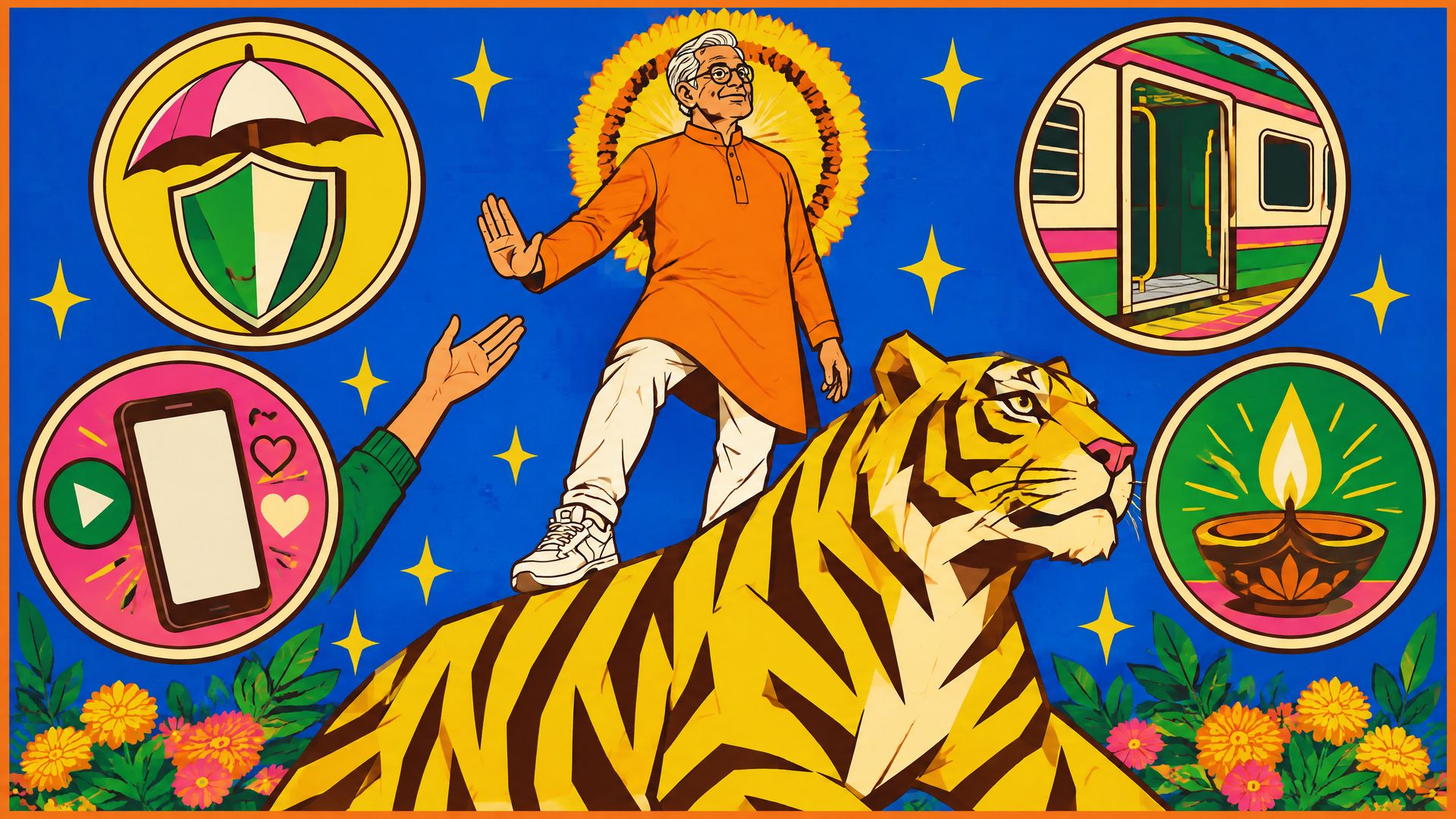
A father is about to step down from a train. His son offers a hand to help him. The father refuses it and steps off on his own. No policy is named. No death is implied. That was HDFC Life’s first brand film, in 2005, and it set a line the company still signs off with two decades later: Sar Utha Ke Jiyo, live with your head held high. Most life insurance advertising in India sold the fear of what happens to your family if you die. This one sold the pride of never having to ask anyone for anything.
- What is Sar Utha Ke Jiyo, and where did it come from?
- How did the campaign change between 2005 and 2025?
- Why does dignity work better than fear in life insurance advertising?
- Which regulator-driven design decisions shape a dignity campaign today?
- Where did the dignity positioning stop working, or show its limits?
- What should a regulated insurance brand take from Sar Utha Ke Jiyo in 2026?
- Who made the Sar Utha Ke Jiyo films, and what should you read into that?
- People also ask
What is Sar Utha Ke Jiyo, and where did it come from?
HDFC Life received its licence from the insurance regulator on 23 October 2000, as the first private life insurer in India. For its first few years it advertised like everyone else: plans, tax benefits, cover amounts. A 2012 Campaign India profile of the brand reports that consumer research in 2004 found people could not tell one insurer from another in blind tests. The category had a sameness problem, and the problem was the emotion. Everyone was selling the same fear.
The answer, launched in 2005, was a different emotion. A 2011 adgully account of the brand’s first decade describes the insight behind it: people value self-reliance and do not want to become a burden on their families. Insurance, in that reading, is not a bet on your own death. It is how you stay upright, in your own eyes and in your children’s, whatever happens. The line that carried the idea was Sar Utha Ke Jiyo.
The first film was the train. Campaign India credits it to Dentsu, with a jingle sung by Kailash Kher. It worked because it showed the benefit without showing the product. The father is not insured on screen. He is simply a man who does not need help, and the viewer does the maths.
How did the campaign change between 2005 and 2025?
The thought stayed fixed. The stories, agencies, media and even the company’s name moved around it. This timeline covers only what an opened source reports. Where a source gives no agency, the table says so.
| Year | What ran | Who made it | What it changed |
|---|---|---|---|
| 2005 | The Train film; Sar Utha Ke Jiyo launched as the core brand thought | Dentsu | Moved the brand from product claims to self-respect |
| 2006 to 2007 | Children’s plan and pension plan films on the same dignity idea | Not dated by agency in the sources we opened; Campaign India credits Leo Burnett with the brand’s pension and father-daughter spots | Stretched the thought across product lines |
| 2008 | Ghum Nahi Hona brand campaign and a Sar Utha Ke Jiyo music album | Song composed by Shantanu Moitra, sung by Mohit Chauhan | Turned the line into a song people could hum |
| 2009 | Rajasthan Royals association in the IPL and a music video with Shilpa Shetty and the team | Campaign India credits Leo Burnett with the Rajasthan Royals work | Took the thought into cricket and mass reach |
| 2010 | Kal Ki Socho, Sar Utha Ke Jiyo campaign; company rebranded from HDFC Standard Life to HDFC Life with a new logo | Not named in the sources we opened | Put the line under a new identity without dropping it |
| 2015 | Apno Ko Apne Dam Pe Jeena Sikhao, the Ghungroo film, directed by Vikramaditya Motwane | Leo Burnett, Mumbai | Returned to the big emotional film after a reported gap of five years |
| 2016 | Memories for Life, a platform for recording video messages to share later | Not named in the source we opened | Carried the thought into a digital product |
| January 2020 | Bounce Back, a father-daughter story about setbacks | Leo Burnett | Framed dignity as recovery, not only independence |
| February 2023 | A father gives his daughter the financial and emotional confidence to pursue her dreams | Leo Burnett | Framed protection as starting with the self; ran on TV, digital, outdoor and PR |
| January 2025 | Two brothers bound by their parents’ values, directed by Shoojit Sircar | Leo Burnett South Asia | Tied the line to values passed down plus financial planning |
Two things stand out. First, the line has survived at least two agencies, a change of company name and a new logo. Second, the films after 2015 keep returning to one relationship: a parent teaching a child to stand alone. The father at the train door and the father who lets his daughter fasten her own ghungroo are the same man, ten years apart.
SIGNALNewsletter by Yamm Labs
The next piece, straight to your inbox.
New writing on BFSI brands, B2B and influencer marketing, and AI search.
One click to unsubscribe. Privacy policy

Why does dignity work better than fear in life insurance advertising?
- It flips who the hero is. Fear advertising makes the buyer a future absence. Dignity advertising makes the buyer the protagonist, alive and in charge. People watch a story about themselves more willingly than one about their funeral.
- It leaves room in a crowded category. When every insurer shows the widow and the unpaid school fees, the viewer stops seeing the brand. The 2004 blind-test finding, as Campaign India reports it, is what a category looks like when everyone uses the same emotion.
- It travels across products. Term cover, pensions, children’s plans and savings plans can all sit under self-respect. A fear line fits term cover and very little else. That is why HDFC Life could run children’s plans in 2006 and pension films in the same era under one thought.
- It survives a change of director. A feeling is easier to brief than a format. Vikramaditya Motwane in 2015 and Shoojit Sircar in 2025 made very different films, and both still read as Sar Utha Ke Jiyo.
- It suits Indian family dynamics. The unspoken fear for many Indian parents is not dying early. It is becoming dependent on their children. The line speaks to that fear without naming it.
We have written about the wider shift in insurance brand design from fear to confidence. HDFC Life’s twenty-year run with one line makes it a useful Indian example of it.
Which regulator-driven design decisions shape a dignity campaign today?
A dignity film makes no product promise, which keeps it clear of most claims review. It still carries fixed elements that a regulator decides, and those elements change how the last few seconds are built. The rules have moved since the train film. In 2024 IRDAI replaced its older advertisement regulations with the IRDAI (Protection of Policyholders’ Interests, Operations and Allied Matters of Insurers) Regulations, 2024. Three requirements from that framework drive real layout decisions.
- The lockup rule. Every insurer’s advertisement has to show the insurer’s registered name alongside its trade name or logo, and prominently. For a campaign that ends on a short Hindi line, the end frame has to hold three things: the line, the logo and the full registered company name, legible at the size the ad will actually be seen. On a phone-first reel that means designing the end card before the story, so the registered name is not squeezed into the bottom few pixels at the edit.
- The distributor sign-off step. When a distribution channel, such as a bank partner or a broker, issues an advertisement for the insurer’s products, it needs the insurer’s written approval before the ad goes out. For a campaign with co-branded versions, that approval is a step in the timeline. Build it in as a named review round, with the insurer’s compliance owner on the calendar, not as a last-minute email.
- The internal approval, not a regulator filing. Advertisements are no longer filed with IRDAI. The insurer’s own compliance function carries the decision. That makes the brand team’s approval deck the document of record, so every version of the end frame, in every language, should be in it.
Screen sequence for a 60-second dignity film, as we would build it: story until the last ten seconds, the line on its own for two to three seconds, then a held end card with line, logo and registered name together, then any product or channel card after it. The emotion lands before any fixed element appears, and the fixed elements never share a frame with an actor’s face. None of this is written in the regulation. It is the design decision that follows from it.
Where did the dignity positioning stop working, or show its limits?
The sources we opened report no sales figures, market-share shifts or brand-tracking scores that HDFC Life has attributed to Sar Utha Ke Jiyo. Anyone who says the line produced a specific result is guessing. What the record does show are three limits.
- It went quiet. The 2015 Ghungroo film was reported as HDFC Life’s return to this kind of campaign after a gap of five years. A brand thought can survive a pause, but a pause shows that other priorities took the budget.
- It does not sell a product on its own. HDFC Life has run separate product and digital work, such as Click2Protect and the #YoungandResponsible series, alongside the brand films. A dignity film earns attention and preference. It does not tell anyone which term plan to buy or how much cover they need.
- The media under it changed. Campaign India reported in 2012 that television had fallen to less than half of HDFC Life’s media budget, down from 75 to 80 percent in the 2005 to 2008 peak, and digital had risen to about 30 percent from under 10 percent two years earlier. A thought built on long emotional TV films has to be rebuilt for six-second pre-roll and vertical reels. The father at the train door needs a full minute. A reel gives him three seconds.
Fear sells a policy once; self-respect sells a brand for twenty years.
What should a regulated insurance brand take from Sar Utha Ke Jiyo in 2026?
- Choose the emotion before the product. Write down the one feeling your competitors do not use. If it is fear, you are in the crowd. Self-respect, calm, competence and ambition are all open in most Indian BFSI categories.
- Write a line in the language your buyer thinks in. Sar Utha Ke Jiyo is Hindi, short and physical: you can picture a raised head. An English abstraction such as secure tomorrow gives a director nothing to shoot.
- Keep the line and change the story. HDFC Life changed agencies, logos, directors and relationships on screen. It did not change the line. Consistency lives in the thought, not in the format.
- Design the end frame first. Under the 2024 IRDAI framework the registered name has to sit with the logo, prominently. Decide that frame, in every language and every aspect ratio, before the script is locked.
- Plan the distributor versions on day one. If a bank partner will run your film, its version needs your written approval before release. Put that review round into the schedule with a date and an owner.
- Pair the brand film with product work. A dignity campaign sets up preference. Separate product creative, with its own disclosures, has to carry the buyer to a plan.
If you are hiring an agency to build this kind of positioning, our guide to how to brief an insurance branding agency in India covers what to put in the brief and what to ask for in the first meeting.
Who made the Sar Utha Ke Jiyo films, and what should you read into that?
Campaign India credits Dentsu with the 2005 train film and Leo Burnett with the father-daughter and pension spots that followed. Leo Burnett, Mumbai made the 2015 Ghungroo film, and Leo Burnett South Asia made the January 2025 film directed by Shoojit Sircar. Directors changed: Vikramaditya Motwane in 2015, Sircar in 2025. The music came from Shantanu Moitra and Mohit Chauhan in the 2008 album era, and Kailash Kher sang the jingle on the train films.
The lesson is not that one agency held the account for twenty years. It is that the client held the thought. A long-running line survives agency changes when the brand team owns it and briefs every partner against it. A line that belongs to the agency leaves with the agency.
A disclosure: HDFC Life is on our client list, alongside TATA AIA Life Insurance, Axis Bank, Paytm Money and Aditya Birla Sun Life Mutual Fund. We did not make Sar Utha Ke Jiyo or any film described here. Everything above comes from public reporting.
People also ask
What does Sar Utha Ke Jiyo mean?
It is Hindi for live with your head held high. HDFC Life has used it since 2005 as its core brand thought, positioning life insurance as a way to keep your self-respect and independence rather than as protection against death.
Which agency created HDFC Life’s Sar Utha Ke Jiyo campaign?
The first film, The Train, in 2005 is credited to Dentsu. Leo Burnett is credited with the later films we traced, including the 2015 Ghungroo film and the January 2025 film directed by Shoojit Sircar.
Is fear or dignity better for life insurance advertising in India?
Fear is the category default, which makes brands hard to tell apart. Dignity gives a brand an emotion it can own across products for years, but it needs separate product creative to turn preference into a policy sale.
What must an Indian life insurance ad show under IRDAI’s 2024 rules?
The IRDAI regulations of 2024 require every insurer’s ad to show its registered name with its trade name or logo prominently. Ads issued by a distribution channel need the insurer’s written approval first, and ads are no longer filed with IRDAI. See our insurance marketing questions for more.
Does your insurance brand own an emotion, or borrow the category’s fear?
Get a free Fintech Brand Audit across 8 dimensions, plus 3 fixes. No pitch. Run the free Brand Audit →