


A marketing head moves from a private bank to a life insurer and brings her best campaign with her: a bold rate in the hero, a branch-and-app call to action, a partner co-brand in the corner. The insurer’s compliance team sends it back with three notes. The insurer’s registered name is missing from the lockup. The bank partner’s version needs the insurer’s written sign-off before it runs. And the promise in the headline talks about returns that depend on markets. None of the notes is about taste. Insurance sells a promise that pays out later, through people who do not work for the insurer, under its own regulator.
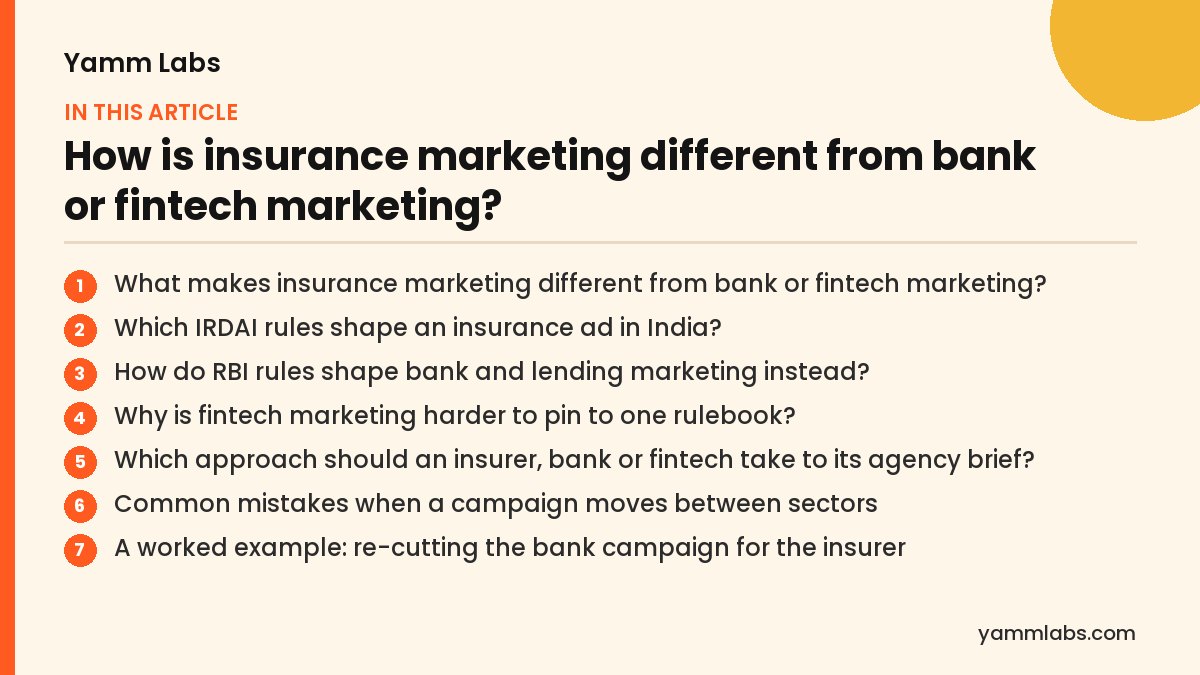
- What makes insurance marketing different from bank or fintech marketing?
- Which IRDAI rules shape an insurance ad in India?
- How do RBI rules shape bank and lending marketing instead?
- Why is fintech marketing harder to pin to one rulebook?
- Which approach should an insurer, bank or fintech take to its agency brief?
- Common mistakes when a campaign moves between sectors
- A worked example: re-cutting the bank campaign for the insurer
- A pre-launch checklist for insurance, bank and fintech marketing
- People also ask
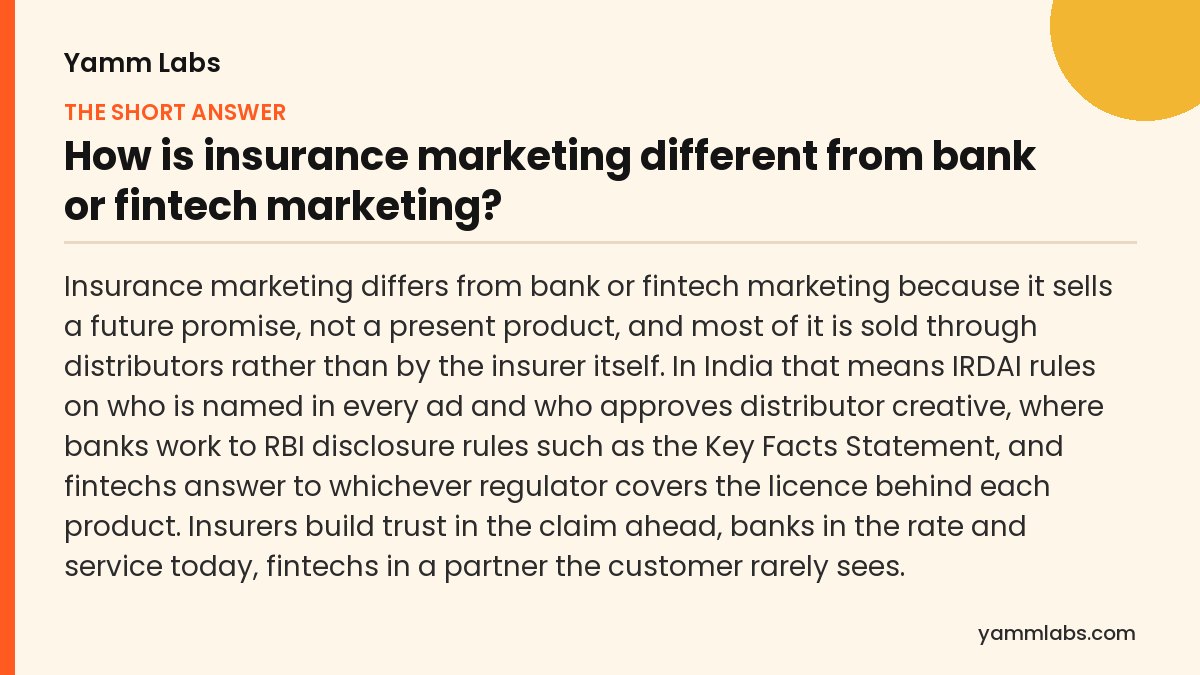
What makes insurance marketing different from bank or fintech marketing?
Three things change when the product is insurance. The customer pays today for something they hope never to use, so the proof they want is about claims, not features. The sale usually runs through an agent, a broker or a bank’s bancassurance desk, so the insurer’s brand has to survive in creative it did not make. And the regulator is IRDAI, whose rules for advertisements now sit inside its policyholder protection regulations of 2024.
A bank sells products the customer uses every month: an account, a card, a loan. The number in the hero is a rate, and RBI’s disclosure rules decide what the customer must see before signing. A fintech sits in between. It may run payments, lending, investing and insurance distribution in one app, and each of those carries the rules of the licensed entity behind it.
| Question a buyer asks | Insurance | Bank | Fintech |
|---|---|---|---|
| What is being sold? | A promise that pays out later, often years later | An account, card or loan used every month | A mix of products, often built on a licensed partner |
| Who usually makes the sale? | Agents, brokers, bancassurance partners and online distributors | The bank’s own branches, app and relationship teams | The app itself, with the partner in the background |
| Main regulator for the message | IRDAI | RBI | Depends on the product: RBI for lending and payments, SEBI for investing, IRDAI for insurance distribution |
| The design decision it forces | Insurer’s registered name in every lockup, including partner creative | A plain, legible Key Facts Statement before the loan contract | The licensed partner’s name next to the offer, not only in the footer |
Those four rows are the four differences that matter most when a campaign moves from one sector to another.
A bank ad sells what you get today; an insurance ad sells what someone will do for you years from now.
Which IRDAI rules shape an insurance ad in India?
IRDAI’s 2021 advertisement regulations were replaced by the IRDAI (Protection of Policyholders’ Interests, Operations and Allied Matters of Insurers) Regulations, 2024. Two rules from them change the design work more than any other.
- The insurer’s name travels with every ad. Every insurer’s advertisement must show its registered name along with its trade name or logo, prominently. We treat this as a lockup rule: the registered name sits with the logo in one fixed unit, sized so it stays legible on a mobile banner.
- Distributor ads need the insurer’s written approval. An advertisement issued through a distribution channel needs the insurer’s written approval before it goes out. So a bank’s bancassurance mailer or a broker’s reel for a term plan joins the insurer’s approval queue, and the campaign calendar needs a separate approval round for partner creative.
- Approval now sits with the insurer. Under the 2024 regulations, ad approval sits inside the insurer, whose own internal review is the last gate before release.
For a fuller list of how Indian regulators treat financial ads, see our SEBI and BFSI advertising rules FAQ.
SIGNALNewsletter by Yamm Labs
The next piece, straight to your inbox.
New writing on BFSI brands, B2B and influencer marketing, and AI search.
One click to unsubscribe. Privacy policy

How do RBI rules shape bank and lending marketing instead?
Bank marketing is shaped by what the customer must see before signing. RBI’s Key Facts Statement circular requires lenders to give a Key Facts Statement before the loan contract is executed, for retail and MSME term loans sanctioned from 1 October 2024, and the statement includes the annual percentage rate.
The design decision follows. The rate in a loan ad and the APR in the Key Facts Statement should tell the same story, so we design the Key Facts Statement as a brand document: one type size that reads on a phone, the APR as the largest number, no decoration competing with it.
Why is fintech marketing harder to pin to one rulebook?
A fintech is usually several regulated businesses in one app. RBI’s 2025 digital lending directions require the digital view of loan offers on a multi-lender platform to name the regulated entity extending the offer, alongside the loan amount, tenor and APR. A mutual fund product brings SEBI’s standard warning, which audio-visual ads must show and voice clearly. Insurance sold in the same app brings IRDAI’s approval rule back in.
- Name the partner at the offer. The lender or insurer’s name sits beside the number as well as in the footer.
- Build the video end frame for the warning. For fund ads, the closing frames carry the displayed and voiced warning, so the edit is planned around it. Our financial explainer video questions cover that timing.
Which approach should an insurer, bank or fintech take to its agency brief?
An insurer should brief for partner creative first: a lockup that works inside a bank’s layout, a claims story backed by what the insurer can show, and an approval round for every distributor asset. A bank should brief for the moment of disclosure, because the Key Facts Statement and the rate card are where trust is won or lost. A fintech should brief for a product-by-product disclosure map before the first campaign, so the lending, investing and insurance screens do not borrow each other’s rules.
Our client list spans all three: TATA AIA Life Insurance and HDFC Life in insurance, Axis Bank in banking, and Paytm Money and Aditya Birla Sun Life Mutual Fund in investing. More short answers sit in our insurance marketing questions hub.
Common mistakes when a campaign moves between sectors
Marketers move between banks, insurers and fintechs all the time, and good habits from one sector can cause trouble in the next. The opening example shows three of them in a single campaign. These are the mistakes we see most often.
- Leading an insurance ad with a number built for banking. A bold rate works in bank marketing because the customer uses the product today. In insurance marketing the stronger proof is about what happens at claim time, and a headline about returns that depend on markets invites a compliance note.
- Leaving the insurer’s registered name out of the lockup. Bank and fintech brands often run a logo alone. An insurer’s advertisement must show its registered name with its trade name or logo, prominently, so the lockup needs that space from the start.
- Treating partner creative as the partner’s problem. A bank’s bancassurance mailer or a broker’s reel still needs the insurer’s written approval before it goes out. If the calendar has no round for it, the launch waits.
- Letting the loan ad and the Key Facts Statement tell different stories. In bank and lending marketing, the rate in the ad and the APR the borrower later sees should agree. A gap between them damages trust at the exact moment of signing.
- Hiding the licensed partner in the footer. Fintech marketing often puts the brand of the app first and the lender or insurer last. RBI’s digital lending directions ask for the regulated entity to be named in the digital view of loan offers on multi-lender platforms, so the partner belongs next to the offer.
- Cutting the fund video before planning the warning. When a fintech app advertises mutual funds, the end frames carry SEBI’s displayed and voiced warning. An edit that ignores it gets re-cut in review.
Every item on that list is a habit that works in one sector and fails in another. The fix is to ask, before the brief goes out, which regulator covers the product in this particular ad.
A worked example: re-cutting the bank campaign for the insurer
Go back to the marketing head from the opening. Her bank campaign had a bold rate in the hero, a branch-and-app call to action and a partner co-brand in the corner. This is an illustrative re-cut built only from what this page already says, not a client case.
The hero. The rate goes. In its place sits the promise the insurer can stand behind, framed around the claim ahead rather than a return that depends on markets. If the product is market-linked, the claims about it are checked against the policy wording and signed off by compliance before the design is final.
The lockup. The insurer’s registered name and logo become one fixed unit, sized to stay legible on a mobile banner. The same unit is supplied to every distributor, so the bank partner’s version carries it without being redrawn.
The partner version. The bancassurance creative is planned as a separate asset with its own approval round. The insurer approves it in writing before the bank sends it. The campaign calendar shows that round as a named step with an owner, not as a hope.
The call to action. Branch and app still work, but now they point to the distributor’s journey, where the insurer’s name travels with the offer. The result is the same campaign idea, rebuilt for a product that pays out later and is sold by someone else.
A pre-launch checklist for insurance, bank and fintech marketing
Run this list before any campaign leaves the building. It keeps each rule in principle, so confirm the current text with your compliance team, because regulations and circulars change.
| Check | Insurance marketing | Bank marketing | Fintech marketing |
|---|---|---|---|
| Who is named in the ad? | The insurer’s registered name with its trade name or logo, prominently | The bank | The app and the licensed partner behind each product, next to the offer |
| Who approves before release? | The insurer’s internal review, plus written approval for distributor ads | The bank’s own compliance process | Compliance for each product line, and partners where they must sign off |
| What must the customer see? | A promise the policy wording supports | A Key Facts Statement with the APR before the loan contract, for covered loans | The regulated entity, loan amount, tenor and APR on lending offers; the standard warning on fund ads |
| What proof builds trust? | What the insurer can show about claims and service | Rate, service and access today | Clarity about the partner and the product |
- Name the regulator for every product in the campaign before writing a headline.
- Check that the lockup has space for every name the rules require.
- Add an approval round for each partner or distributor asset, with an owner and a date.
- Match every number in the ad to the document the customer will see later.
- Plan video edits around any fixed warning before the first cut.
- Keep one master file of approved templates, so the next campaign starts from something already signed.
People also ask
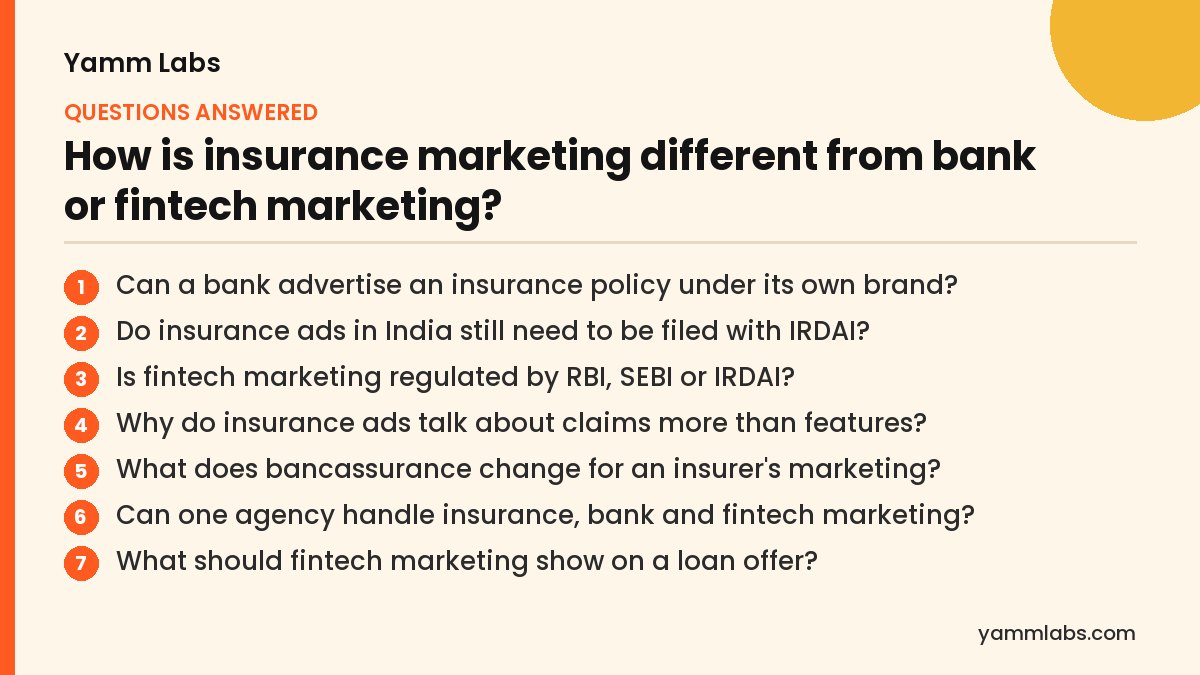
Can a bank advertise an insurance policy under its own brand?
A bank can promote a policy it distributes, but IRDAI’s 2024 regulations require the insurer’s registered name with its trade name or logo prominently, and the insurer must approve the ad in writing before it goes out.
Do insurance ads in India still need to be filed with IRDAI?
The 2024 regulations place approval inside the insurer: its own internal review signs ads off before release, and distributor ads need its written approval before issue.
Is fintech marketing regulated by RBI, SEBI or IRDAI?
It depends on the product. Lending and payments follow RBI rules, investing products follow SEBI rules, and insurance sold in the app follows IRDAI rules, so one fintech campaign can carry three sets of disclosures.
Why do insurance ads talk about claims more than features?
Because the customer pays today for something they hope never to use. The feature list matters less than confidence that the insurer will pay when the time comes. That is why insurance marketing leans on proof about claims and service, while bank marketing can lead with a rate or a benefit the customer feels every month. Any claim about claims should rest on figures the insurer can show and compliance has approved.
What does bancassurance change for an insurer’s marketing?
It puts the insurer’s product inside a bank’s layout, voice and channels. The insurer’s registered name and logo still have to appear prominently, and the bank’s version of the ad needs the insurer’s written approval before it goes out. In practice the insurer designs its lockup to sit inside someone else’s creative and adds a separate approval round to every campaign calendar.
Can one agency handle insurance, bank and fintech marketing?
Yes, if it briefs each product under the right regulator rather than applying one playbook across all three. Ask the agency to show how it handled an insurer’s name lockup, a Key Facts Statement screen and a fund video end frame. An agency that can explain the reason behind each decision is more useful than one with a larger portfolio from a single sector.
What should fintech marketing show on a loan offer?
On a multi-lender platform, RBI’s 2025 digital lending directions ask the digital view of loan offers to name the regulated entity extending the offer, alongside the loan amount, tenor and APR. Design the offer card so those details sit beside the headline number, not below it. Confirm the current text of the directions with your compliance team before finalising the screen.
Sources
- taxguru.in: Reg 58 of the 2024 PPHI regulations repeals the IRDAI (Insurance Advertisements and Disclosure) Regulations, 2
- Reserve Bank of India: Circular dated 15 April 2024
- Reserve Bank of India: RBI (Digital Lending) Directions, 2025 (8 May 2025), para 6(iii)
- Reserve Bank of India: RBI regulates banking and payment systems
Selling insurance, banking or fintech products under one brand?
Get a free Fintech Brand Audit across 8 dimensions, plus 3 fixes. No pitch. Run the free Brand Audit →