


A fund house’s brand team is reviewing two cuts from the same creator on a Tuesday afternoon. One is a 45-second reel. The other is a 14-minute YouTube explainer on how a systematic investment plan behaves in a falling market. Compliance marks up the reel first: the paid-partnership label has to stay on screen for a third of its length, the standard mutual fund warning has to be shown and voiced for five seconds, the creator’s credentials have to open the video, and the line about what the fund returned last year has to go.
By the end of the review, the reel has about 20 seconds left for the idea. The explainer carries the same furniture and still has thirteen minutes to show its working. That meeting is the whole long-form vs short-form argument in one room: in finance, the format that can hold the rules is the format that builds trust.
- Why does long-form creator content build more trust for financial brands?
- How much of a finance reel do the disclosure rules actually take?
- Long-form vs short-form: is the real risk the length or the language?
- Where does short-form still earn its place in a finance content plan?
- What changes when the creator is an insurance agent or a lending partner?
- What are the common mistakes in finance creator content?
- What should a finance marketing team do on Monday?
- People also ask
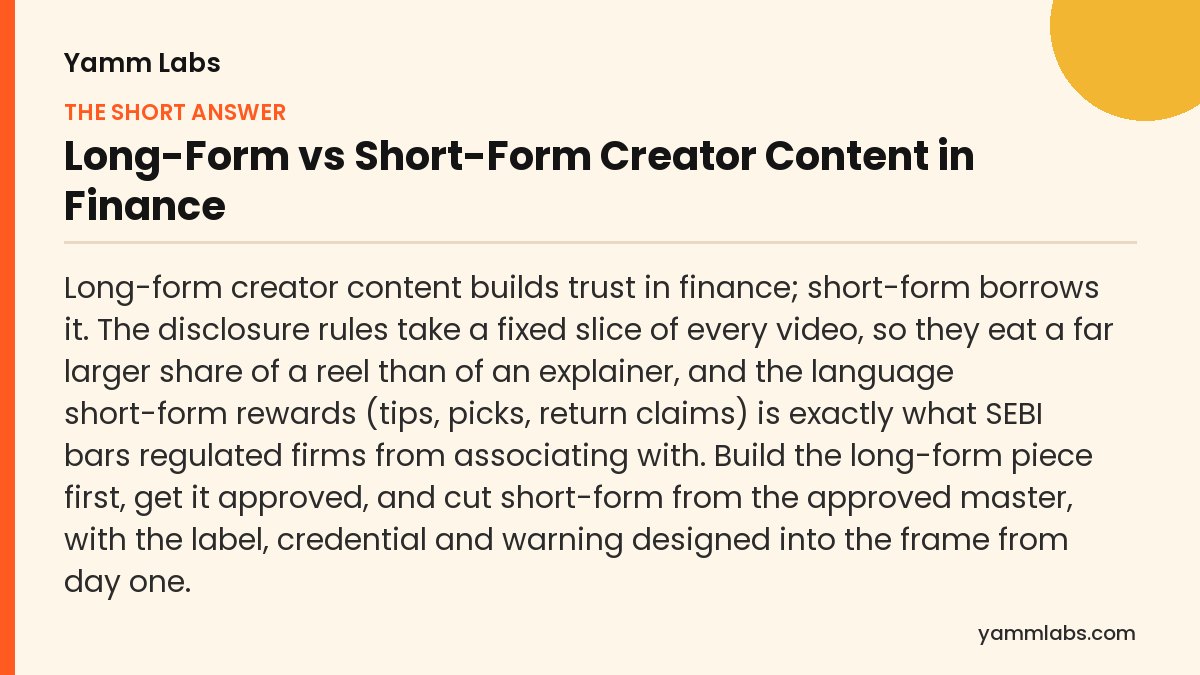
Why does long-form creator content build more trust for financial brands?
Trust in a financial product forms when a customer can check the claim. A bank, insurer or fund house is asking for money now against a promise that plays out over years, so the viewer is looking for evidence that the person on screen knows what they are talking about and is not hiding the catch. Long-form gives the creator room to show that evidence: the assumptions behind a number, the scenario where the product does not suit you, the exclusion in the policy, the cost that sits under the headline rate. Each of those moments is a small act of disclosure, and disclosure is what a sceptical buyer reads as good faith.
Short-form rewards the opposite. A reel has to land its point in the first two seconds and resolve it before the viewer swipes, so it drifts toward certainty, simplicity and a single benefit. That works for a snack brand. In finance, certainty without caveats is the pattern customers have learned to distrust, because it is how mis-selling sounds. We make the longer version of this argument in our note on the psychology of trust in financial brand design: trust is built on the regulated, detailed surfaces, not on the slogan.
There is also a credibility asymmetry. A creator who spends twelve minutes walking through a term plan’s claim process has visibly done the work. A creator who spends twelve seconds telling you to buy one has not, whatever their follower count. Viewers can tell the difference, and so can the compliance reviewer who has to sign off on both.
How much of a finance reel do the disclosure rules actually take?
This is the design decision most agencies never show. India’s advertising self-regulator, the Advertising Standards Council of India, sets how long a disclosure label must stay on screen in an influencer video, and the rule scales with length. For videos of 15 seconds or less, the label must stay for at least 3 seconds. For videos longer than 15 seconds but under 2 minutes, it should stay for a third of the video. For videos of 2 minutes or more, it must stay for the whole section in which the promoted brand or its features are mentioned. In live streams, the label is announced at the start and the end.
ASCI’s guidelines for finance influencers add a second fixed element. Where a creator gives investment-related advice, they should be registered with SEBI and state the registration number with their name and qualifications, superimposed prominently and upfront or said as the opening remark in the video. And when the creator film is a mutual fund advertisement, SEBI’s standard warning must be displayed on screen and voiced for at least five seconds.
| Format | Label on screen | Credential and warning | What is left for the idea | Trust job it can do |
|---|---|---|---|---|
| 15-second reel | At least 3 seconds | Credential card in the opening; a fund ad also needs the five-second warning | Very little once the opening card and, for a fund ad, the five-second warning are in | Recognition: a face, a name, a brand lockup |
| 45-second reel | 15 seconds (a third) | Same opening card and warning | The label sits over a third of the runtime; the story gets one point | Familiarity and a reason to watch the full piece |
| 90-second explainer | 30 seconds (a third) | Same | Enough for one worked example | A single checkable claim with its caveat |
| 12-minute YouTube explainer | For the whole section where the brand is discussed | Opening remark, plus the warning where it applies | Most of the runtime | Evidence: working, exclusions, costs, the case where it does not fit |
Read the table from the designer’s side. In a reel, the label is not a footnote; it is part of the composition for a third of the runtime, so it needs a fixed band that does not fight the platform’s own captions and buttons. The credential card is the first frame, so it has to double as the hook. The five-second warning is a sixth or more of a 30-second film. None of that is a problem if it is designed first. All of it is a problem if it is pasted on in the edit.
Long-form vs short-form: is the real risk the length or the language?
The language. Since SEBI’s 2024 amendments to its intermediaries rules, persons it regulates, including asset management companies, stock brokers and their agents such as mutual fund distributors, must not have any direct or indirect association with a person who gives advice or recommendations about securities without being registered or permitted to, or who makes claims of returns or performance without permission. SEBI has clarified that a person engaged solely in investor education is outside that restriction, provided they do neither of those two things, and that regulated firms may work with creators for branding and marketing on the same condition.
SIGNALNewsletter by Yamm Labs
The next piece, straight to your inbox.
New writing on BFSI brands, B2B and influencer marketing, and AI search.
One click to unsubscribe. Privacy policy

SEBI’s clarification also draws a practical line between education and advice. As updated in May 2026, it says a person engaged solely in education should not use market price data of the preceding thirty days to name a security in a way that indicates its future price, or advice or a recommendation about it. The earlier version of the same answer used a three-month window.
Now look at what short-form formats reward: the stock of the week, the fund that beat the index, the one card every salaried person should have. Those are recommendations and performance claims compressed into a hook. Long-form education does not need them. It can explain how an index fund works using a chart that is months old, or walk through a hypothetical portfolio with no named security at all. The design decision that follows is simple: write a script ban-list before the brief goes out (no named securities on recent prices, no return figures, no “buy” or “switch” verbs for anyone unregistered) and build the long-form structure around illustrative examples instead.
In finance, a creator’s credibility is measured in caveats, and caveats need minutes, not seconds.
Where does short-form still earn its place in a finance content plan?
The strongest objection to this argument is reach. Most of the audience is on short-form, most long-form videos are not watched to the end, and nobody trusts a brand they have never seen. That objection is right about the first step. Familiarity comes before trust, and short-form is the cheapest way to buy familiarity at scale.
ASCI’s own update in April 2025 supports a narrower role for short-form rather than none. It separated generic promotions and public-service messages from content that gives technical information or advice, and said the qualification requirement applies only to the second. Its example of the first kind was an insurance company using an influencer to talk about the need for annual health check-ups. That is a good description of what short-form does well in finance: a behaviour nudge, a product category reminder, a face the viewer will recognise when the longer piece appears.
So the concession is real but bounded. Short-form earns attention and familiarity. It should not carry a product claim on its own, and it should not be where a new idea is first put in front of compliance. Cut it from an approved long-form master, point it at that master, and let the long piece do the persuading.
What changes when the creator is an insurance agent or a lending partner?
For insurance, the approval sequence is the design constraint. Under IRDAI’s 2024 regulations on protecting policyholders’ interests, an advertisement issued by a distribution channel needs the insurer’s written approval before it goes out, and every insurer’s advertisement must show its registered name with its trade name or logo prominently. A creator who is also an agent or works with a broker is making distribution-channel content, so the lockup and the approval step sit inside the production timeline, not after it.
That favours long-form in a quiet way. One approved 10-minute film with an agreed list of cut-downs goes through the insurer’s approval once. Twenty independent reels go through it twenty times, and each one is a fresh chance for a claim to slip past. The lockup rule is also easier to meet in a longer frame, where the registered name can sit in a stable end card, clear of the hook.
Lending content has its own sequence. RBI’s rules on the Key Facts Statement, now consolidated in its Master Directions, require the lender to give the borrower the statement, including the annual percentage rate, before the loan contract is executed for retail and MSME term loans. A creator who explains what the KFS is and how to read the APR is doing useful, trust-building education.
A creator who promises an instant loan at a headline rate is setting up exactly the gap between promise and paperwork that the KFS exists to close. The brands on our clients page work under all three of these regulators, and the pattern holds across them: the long, explanatory piece is the one that survives review and keeps working.
What are the common mistakes in finance creator content?
The same few errors account for most creator films that come back from review more than once. Each is a planning choice, so each can be fixed before the shoot.
- Briefing the reel first. When the short cut is written before the long piece, the hook sets the claim and the explainer has to defend it. Write the master first and cut down from it.
- Pasting the label on in the edit. A label added late lands wherever there is space, often under the platform’s buttons. Fix its band in the frame template.
- Letting the hook carry a return figure. The fastest opening line is usually a performance claim, which is the line SEBI’s rules keep regulated firms away from.
- Sending every cut-down for fresh approval. Twenty unlinked reels mean twenty reviews. List the cut-downs in the master brief so they are approved as derivatives.
- Choosing creators on follower count alone. Check registration where advice is involved, and read the creator’s past videos for tips and return claims before signing.
- Measuring reels on views only. If a reel’s job is to bring viewers to the full explainer, report how many reach it, not just how many watched the first seconds.
What should a finance marketing team do on Monday?
- Brief long-form first. Commission the explainer as the master asset and list the short-form cut-downs in the same brief, so compliance approves one script and one set of derivatives.
- Build the frame template before the shoot. Fix the label band position, the credential card as the opening frame, the five-second warning slot for fund ads, and the insurer or lender lockup on the end card.
- Time the label to the format. Put the length-based label rule into the edit checklist: 3 seconds up to 15 seconds, a third of the runtime up to 2 minutes, the whole brand section beyond that.
- Write the ban-list. No named securities on recent prices, no return or performance claims, no advice from anyone who is not registered to give it.
- Check the creator, not only the content. Confirm registration status for anyone who will give investment advice, and record it in the partnership file.
- Keep the visual system constant. The label band, card and end card should use the brand’s type and colour so the disclosure reads as part of the brand, not as a sticker; our note on colour psychology in finance covers why that consistency matters.
People also ask
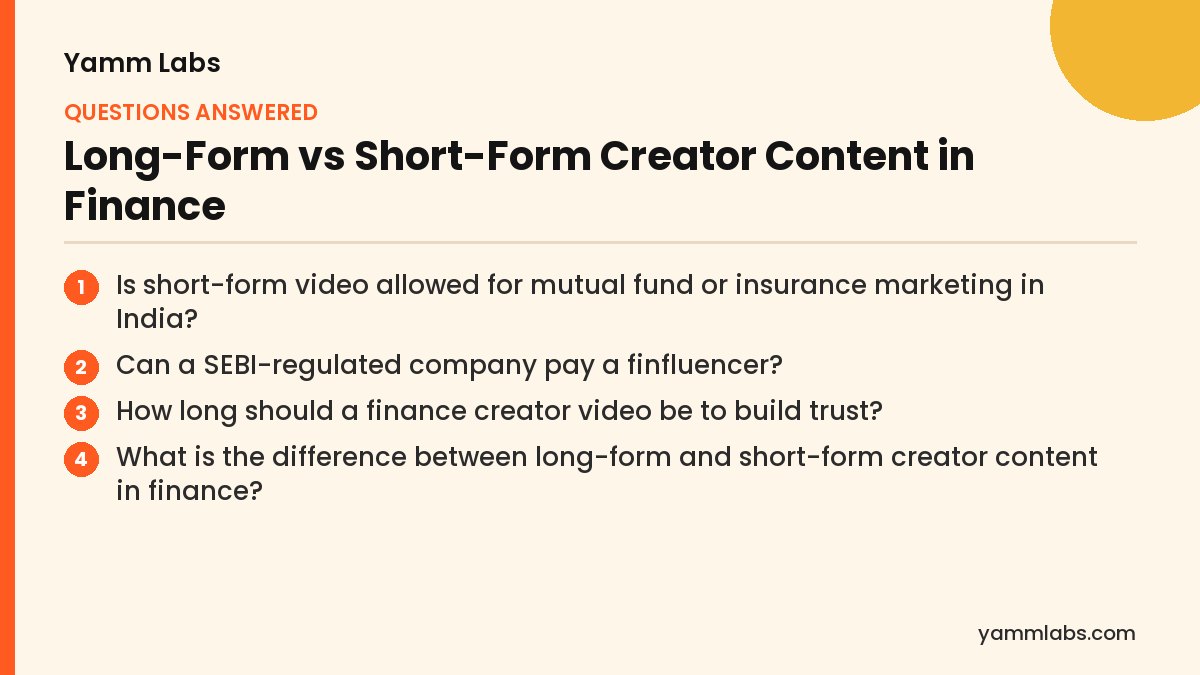
Is short-form video allowed for mutual fund or insurance marketing in India?
Yes. Short-form is allowed, but the same rules apply at any length: the influencer disclosure label, the creator’s credentials where advice is given, the mutual fund standard warning in fund ads, and the insurer’s approval for distribution-channel ads. Because those elements take a fixed amount of screen time, they leave far less room in a reel than in a longer video.
Can a SEBI-regulated company pay a finfluencer?
A regulated company may work with a creator for branding and marketing, provided the creator does not give securities advice or recommendations without registration and does not make return or performance claims without permission. Creators engaged solely in investor education are outside the restriction on the same condition, so check the creator’s past content as well as the brief.
How long should a finance creator video be to build trust?
Long enough to show the working: the assumptions, the costs and the case where the product does not fit. For most explainers that means several minutes, with short cut-downs used to bring viewers to the full piece rather than to make the claim on their own.
What is the difference between long-form and short-form creator content in finance?
Short-form is a reel or short of up to about a minute, built to land one point before the viewer swipes. Long-form is an explainer of several minutes that can show assumptions, costs, exclusions and the case where a product does not fit. In finance, the fixed disclosure elements take a far larger share of the short piece, which is why long-form carries the trust.
Sources
- ASCI: Influencer Advertising Guidelines
- ASCI: ASCI modifies influencer guidelines; update for health and finance influencers (28 April 2025)
- SEBI: Standard warning in advertisements by mutual funds (26 February 2008)
- SEBI: Clarifications on association of regulated persons with persons engaged in prohibited activities (29 January 2025, updated 8 May 2026)
- Taxguru: IRDAI (PPHI, Operations and Allied Matters of Insurers) Regulations, 2024 (Advertising)
- Reserve Bank of India: Key Facts Statement (KFS) for Loans & Advances (15 April 2024)
Want to see where your creator content is losing trust?
Get a free Fintech Brand Audit across 8 dimensions, plus 3 fixes. No pitch. Run the free Brand Audit →