

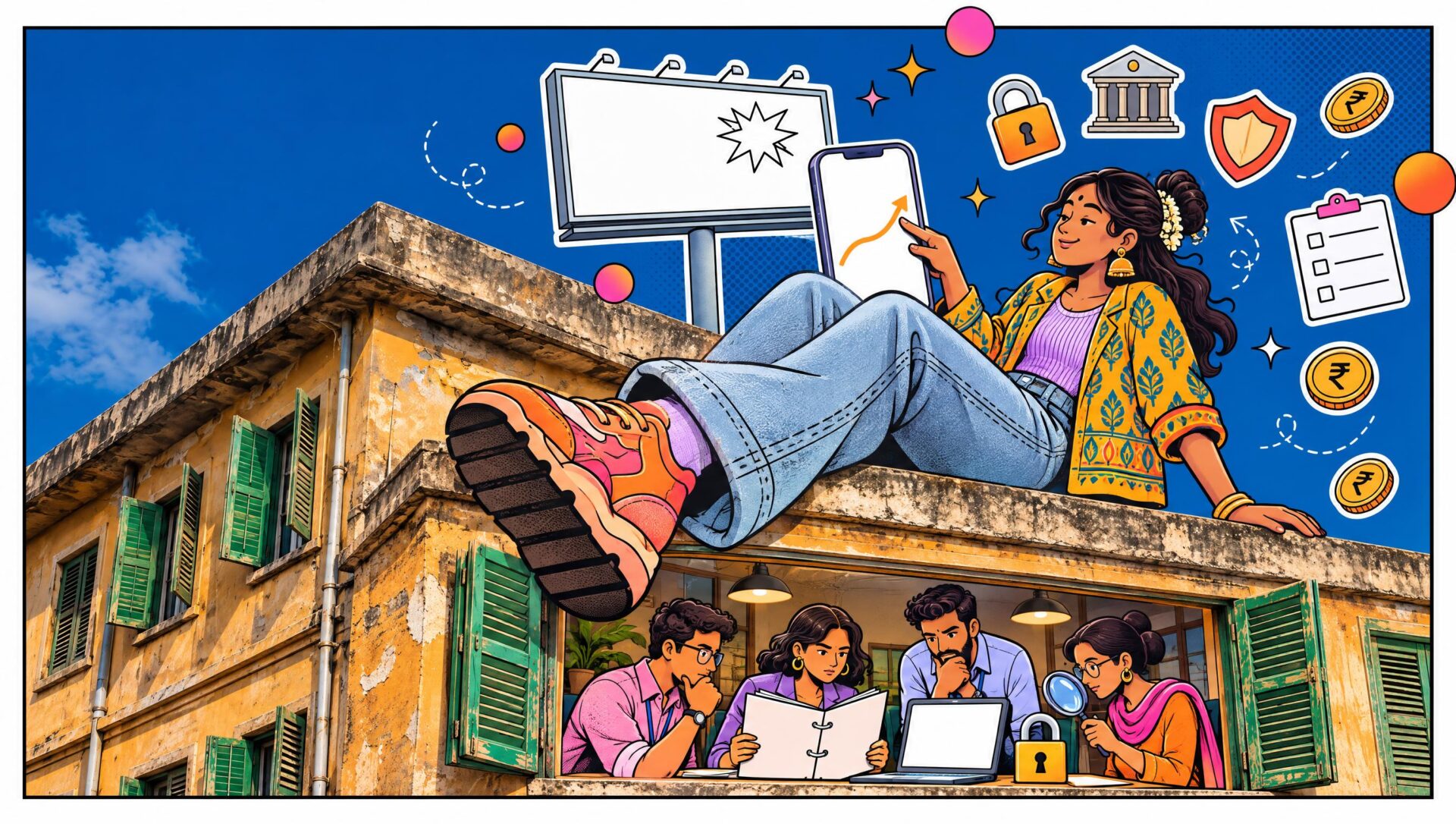
Picture a payments infrastructure company in Bengaluru that hires the studio behind a well-liked consumer investing app. Eight weeks later its homepage has a mascot, a pastel gradient and a headline about making money feel light. The finance head of a mid-size NBFC opens the site on a Tuesday afternoon because her CTO sent the link. She looks for four things: who holds the money between collection and settlement, who she calls when a payout run fails, what RBI has authorised this company to do, and how many weeks of her team’s time the integration will take. None of it is on the first two screens, so she closes the tab. Nothing is wrong with the design. It was built for a person choosing an app, and she is a person approving a vendor.
What is the difference between B2B and B2C fintech positioning?
Positioning answers one question: why should this buyer pick you over the alternative, in words the buyer would use. In consumer fintech the buyer is one person, and the alternative is another app or doing nothing. In B2B fintech the buyer is a group inside a company, and the alternative is often the bank they already use, a spreadsheet or an in-house build.
That changes what the brand has to prove. A consumer app is judged in the app store and on the first few screens after install. A B2B fintech is judged over several meetings, by people who each open a different page: pricing, documentation, security, the contract. The consumer brand has to make one person feel safe with their own money. The B2B brand has to make it easy for a cautious employee to recommend you without putting their own name at risk.
The short version of this answer sits in our fintech and BFSI branding FAQ, next to related questions on NBFC positioning and brand architecture. The table below is the longer version.
| Question | B2C fintech app | B2B fintech |
|---|---|---|
| Who decides? | One person, usually on a phone | A group: finance, technology, compliance and procurement |
| What are they afraid of? | Losing their own money or being cheated | A failed payout run, an audit finding, a vendor that folds mid-contract |
| Where is the first judgement made? | App store listing, an ad, the first screens after install | Homepage, pricing page, documentation, a sales deck forwarded inside the company |
| What is the promise? | A personal outcome: save, invest, borrow or pay | An operating outcome: fewer failed payments, a faster month-end close, less manual work |
| What proof counts? | Ratings, a familiar regulated partner’s name, a clean KYC flow | Regulatory status, security certifications, uptime history, reference customers, contract terms |
| What is the regulated content? | Disclosures the regulator wants the customer to see | Evidence the buyer’s compliance team must collect and file |
| What voice fits? | Warm and simple, playful with care | Plain and exact, with one system for the deck and the docs |
| How does a yes happen? | In one sitting | Across several meetings and a vendor assessment |
A consumer app has to be chosen. A B2B fintech has to be approved.
Who is the buyer in B2B fintech, and how many people have to say yes?
In a consumer app the buyer, the user and the payer are the same person. In B2B fintech they are usually different people, and a fourth can veto the deal. Each of them reads a different part of your brand.
- The finance head. She owns the outcome and the budget. She wants a sentence she can repeat to her board about what gets faster, cheaper or safer. She will not read API documentation.
- The technology head. He owns the integration. He wants documentation, a sandbox and a frank account of what breaks and how you recover.
- The compliance head. She can stop the purchase. She wants to know what you are licensed or authorised as, what your partner bank or NBFC does, where the data sits and whom the regulator can inspect.
- Procurement. They own the paperwork. They want pricing they can compare, contract terms they can redline and a company that will still exist at renewal.
A B2B fintech brand that speaks only to developers loses the finance head. One that speaks only in outcomes loses the engineer who has to defend the choice. We cover that trade-off in B2B fintech positioning: speak to the CFO. The practical rule is one message in layers: the outcome on the homepage, the mechanics one click down, the evidence one click below that.
A consumer app has no such layers. Its whole argument has to fit in a store listing and an onboarding flow, in the language the customer speaks at home. That is why consumer fintech money goes into film, vernacular copy and the first minute of the product, and B2B fintech money goes into the website, the sales deck and the documents behind them.
SIGNALNewsletter by Yamm Labs
The next piece, straight to your inbox.
New writing on BFSI brands, B2B and influencer marketing, and AI search.
One click to unsubscribe. Privacy policy

Which RBI and SEBI rules change what each brand has to show?
Many agency pages say they are compliance-aware and stop there. Here is what the rules do to the screens. On the consumer side, the regulator scripts part of what the customer sees. On the business side, the regulator scripts what your buyer must check about you, and in some cases what you must publish.
Four rules shape a consumer fintech brand before a designer opens a file.
- The fund warning. SEBI’s mutual fund rules require the standard risk warning in video and audio ads to be clear and understandable, on screen and in the voice-over. Five seconds for the fourteen-word warning is given as an example of what may meet that test. For an investing app, this fixes the end frame of every fund film before the script is written.
- Celebrities. Until SEBI’s common advertisement code takes effect in April 2027, mutual fund rules allow celebrities only in industry-wide campaigns, with SEBI’s approval first. The code was notified in October 2026. From April 2027 it lets regulated firms use a celebrity to endorse the brand, with prior approval and no claims about a specific product. A consumer investing brand should plan its 2027 media calendar around that date.
- The loan offer screen. RBI’s digital lending rules, first issued as one set of Directions in May 2025, say an app that works with several lenders must show the borrower every matching offer. Each offer carries the lender’s name, the amount and tenor, the annual percentage rate, the monthly repayment and any penal charges, with a link to the Key Facts Statement. Lenders that did not match are named too, and the app may not push one lender’s product through dark patterns. The comparison screen in a loan marketplace is drawn by the rule first and the designer second.
- The cooling-off period. The same rules give the borrower of a digital loan a cooling-off period of at least one day. The way out needs a visible place in the app’s navigation.
A B2B fintech meets a different set of rules, and most of them land on pages a consumer brand never builds.
- Payment aggregators. Under RBI’s payment aggregator Directions of September 2025, a non-bank company needs RBI’s authorisation to run the business. It must hold merchant funds in an escrow account with a scheduled commercial bank and carry out due diligence on the merchants it onboards. It must publish its merchant policies, privacy policy and terms, and display a grievance officer and an escalation matrix prominently on its website. The pages that look dull are mandated, and they are the ones a finance head goes looking for.
- Loans to small businesses. RBI’s Key Facts Statement rule covers MSME term loans as well as retail ones, for loans sanctioned on or after 1 October 2024. The lender gives the statement before the contract is executed, with the annual percentage rate worked out to include all charges. It stays valid for at least three working days on loans of seven days or longer. For commercial banks the rule now sits in RBI’s November 2025 Responsible Business Conduct Directions; other lenders should check the Directions that apply to them. A business-loan fintech carries the same screen a consumer loan app does.
- Technology sold to banks and NBFCs. RBI’s IT outsourcing rules, issued in April 2023 and in force from October 2023, keep the bank or NBFC responsible for anything it outsources. Before signing, it must assess the provider on points such as financial soundness, security controls and continuity arrangements. The contract must give it the right to audit the provider and must let RBI inspect. A provider has to report a cyber incident to its client without undue delay, so that the client can report to RBI within six hours of detection.
Put plainly, your buyer’s compliance team is filling in a form about you. A B2B fintech brand’s job is to make that form easy to complete.
| Business model | What the rule fixes | Where it shows up in the brand |
|---|---|---|
| Consumer investing app | Fund risk warning, clear on screen and in voice-over | End frame of every film and reel, and the ad templates |
| Consumer loan marketplace | All matching offers shown, with lender name and annual percentage rate | Offer comparison screen and the logic behind any ranking |
| Payment aggregator | Authorisation, escrow, published policies and grievance contacts | Trust page, footer and help centre |
| MSME lender or its technology partner | Key Facts Statement before the contract | A fixed step in the application flow |
| Vendor to banks and NBFCs | Client due diligence, audit rights and incident reporting | Security page, due-diligence pack and contract summary |
What should a B2B fintech website show that a consumer app can skip?
A consumer app can put its regulatory details in the footer and the app’s legal section, because the customer rarely reads them before installing. A B2B buyer reads them first. Five things belong within one click of the homepage.
- A regulatory status page. Say exactly what you are authorised or registered as, name the regulator, and say what your partner bank or NBFC does. If you are a technology provider and the licence belongs to your partner, say so in one sentence. Implying a licence you do not hold is a quick way to fail a vendor assessment.
- Where the money sits. For a payments company, name the escrow arrangement and explain the settlement cycle in plain words. The website should say the same thing the merchant agreement says.
- An incident and uptime record. A status page with history tells a technology head more than an availability claim in a headline. If you had an outage, the write-up is part of the brand.
- A due-diligence pack. Put the security certifications that apply to you, a continuity summary, data location and the list of sub-contractors in one download, and keep it current. Your buyer has to collect all of it anyway.
- Named people. List the grievance officer, the escalation contacts and the leadership team. A finance head approving a vendor wants to know who picks up the phone.
The reverse list is short. A consumer app needs store screenshots, onboarding copy in regional languages and ad templates with the regulated wording already placed. A B2B fintech can skip most of that and spend the effort on the pages above.
Should a B2B fintech sound serious and a B2C app sound friendly?
That shortcut is half right. A consumer fintech brand can be warmer because the decision is individual and often emotional: a first SIP, a first loan, a parent’s health cover. Even there, warmth comes after clarity, since the product involves someone’s savings.
A B2B fintech should sound plain and exact. Restraint helps: a mascot that charms an app user is a risk on a slide shown to a risk committee. But dull is not the same as credible. The B2B brands people remember write error messages a tired engineer can act on at midnight and pricing pages a finance head can read without a call. Tone in B2B is mostly a matter of how precisely you describe what you do.
One system has to hold across very different documents. The same typeface and diagram style should work in a board-level sales deck and in developer documentation. If the deck looks like a bank and the docs look like a gaming startup, the buying group will wonder which company it is dealing with.
The spokesperson differs too. Consumer brands hire a familiar face. In B2B the persuasive face is usually the founder or the head of engineering explaining how the product works. SEBI’s new code points the same way: its definition of a celebrity leaves out a firm’s own founders, directors and senior management when they appear in the firm’s ads. That code applies to SEBI-regulated firms from April 2027.
What if the same company sells to businesses and to consumers?
Many Indian fintechs do both. A lending-technology company runs a borrower app under a lender’s licence. A payments company has a merchant dashboard and a checkout page that millions of shoppers see. Two audiences then meet one brand, and each surface carries its own rules.
The checkout page is a consumer surface inside a B2B product. RBI’s payment aggregator Directions say any charge on top of the price must be shown distinctly to the payer before the transaction. That is a layout decision on a screen the merchant’s customer sees, made by a company whose own customer is the merchant.
Lending partnerships work the other way round. Under RBI’s digital lending rules, a lender keeps a list on its own website of the apps and service providers it works with and what each one does, in one prominent place. A B2B lending partner’s name is public on its lender’s website whether or not it planned a co-branding strategy. Decide how the two names sit together before the lender’s web team decides for you.
Our advice is to keep one name while the buyers overlap and to separate the surfaces underneath it. The merchant dashboard, the borrower app and the developer portal each get their own tone and their own regulated blocks. Split the brand into two names only when one audience would be put off by the other.
How much time and budget does B2B fintech positioning need?
There is no public rate card for fintech positioning in India. One Indian agency price guide from June 2026, cited on our page about fintech branding cost in India, puts brand strategy plus identity between ₹2 lakh and ₹15 lakh or more. Yamm Labs does not publish prices and quotes per scope after a discovery call. Our cost guide’s rule of thumb is that adding positioning and naming before identity roughly doubles the strategic work compared with a design-only refresh.
B2B work costs more in some places and less in others. It needs interviews on both sides of the sale, with your own team and with a few customers’ finance and technology heads. It covers more surfaces: website, sales deck, documentation and the due-diligence pack. It needs no film shoot, celebrity fee or mass-media plan, which is where consumer budgets go.
On time, treat the compliance read as a fixed step on every surface and book it at the start. A legal comment on a homepage claim costs little in week two and a great deal after the site is built.
What should a B2B fintech decide before it briefs an agency?
Five decisions come before tone, colour or a tagline. Take them in this order.
- Name who signs and who can veto. Write down the roles in a typical deal and what each one needs to see.
- State what you are regulated as. Put your own authorisation or registration in one sentence and your partner’s in another. Everything on the website has to agree with those two sentences.
- List the regulated blocks for each surface. Checkout, application flow, website and deck each have their own. Give the list to the designer on day one.
- Choose one outcome line for the finance buyer. It should describe a result she owns, in her words, without a technical term.
- Decide what proof you can publish. Reference customers, certifications and incident history need permission and upkeep. Confirm what is available before the copy promises it.
Tone and identity come after that, and they are easier once these are settled. Yamm Labs works from Gurugram on brand and positioning for BFSI clients including TATA AIA Life Insurance, HDFC Life, Axis Bank, Paytm Money and Aditya Birla Sun Life Mutual Fund, and serves other markets remotely.
People also ask
Does a fintech that sells only to businesses still have to show regulatory disclosures?
Often, yes. RBI’s Key Facts Statement rule covers MSME term loans, and its payment aggregator Directions require published policies and grievance contacts on the website. Selling to businesses changes which disclosures apply, and some of the consumer ones still follow you.
Can a B2B fintech use one brand for its business product and a consumer app?
Yes, and most should keep one name while the buyers overlap. Build separate surfaces under it, each with its own tone and its own regulated blocks. Move to two names only when one audience would be put off by the other.
Should a B2B fintech market to developers or to the finance head?
Both, in layers. Lead with the outcome the finance head owns, put the technical mechanics one click down for engineers, and keep the compliance evidence one click below that. A brand that addresses only one of them stalls when the others join the meeting.
Selling to finance teams with a brand built for app users?
Get a free Fintech Brand Audit across 8 dimensions, plus 3 fixes. No pitch. Run the free Brand Audit →