

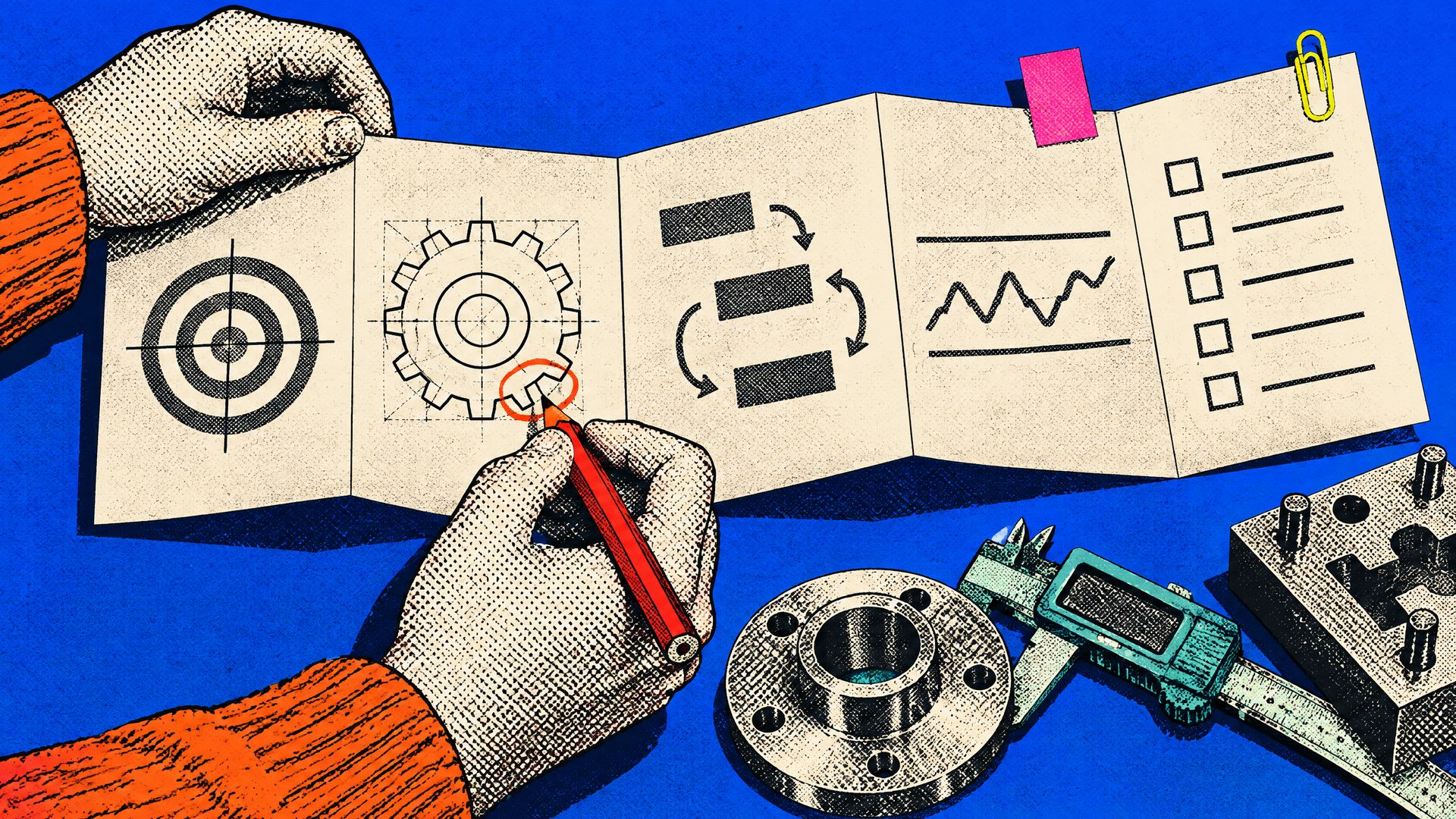
A Tier-2 machining shop in Manesar wins its first nomination from a Tier-1 that ships to a US carmaker. The drawing arrives with a second request: an APQP timing plan within two weeks, and a status report against it at every gate until the PPAP is signed. The owner has made good parts for twenty years without a document called APQP. His question is fair. What is this for, and why can the customer insist on it?
- What is the purpose of APQP in plain words?
- Why is APQP required, and who requires it?
- Which edition of APQP do customers expect in 2026?
- What requirement-driven decisions should an APQP file show?
- What does a supplier decide next?
- The purpose of APQP, shown on one part
- Common mistakes when APQP is treated as paperwork
- A checklist before your first APQP gate review
- How to explain APQP to a plant owner who never needed it
- People also ask
What is the purpose of APQP in plain words?
APQP is a planning method for a new part and the process that will make it. It moves the argument about risk to the cheapest point in the program. A wrong tolerance caught in a design review costs a meeting. The same error caught after the die is cut costs a new die, and caught at the customer’s line it costs a containment, a sorting team and a supplier rating.
AIAG, which publishes the APQP manual, describes its aim as improving new product launches. The method does that in five phases, each ending in a gate where the customer can see what has been decided. The full list of phases and their outputs sits in our APQP, PFMEA and Control Plan questions; the table below shows what each phase is there to prevent.
| APQP phase | The risk it catches | Evidence a customer asks to see |
|---|---|---|
| 1. Plan and define | Quoting a part without knowing what the customer will check | Quality goals, preliminary special characteristics, preliminary process flow |
| 2. Product design and development | A design that cannot be made or measured reliably | DFMEA, design reviews, drawings and specifications |
| 3. Process design and development | A process with no control on a critical feature | Process flow chart, PFMEA, pre-launch control plan, MSA plan |
| 4. Product and process validation | A process that works in trial but not at rate | Capability studies, PPAP, production control plan |
| 5. Feedback and corrective action | Repeating the same problem on the next part | Reduced variation, customer feedback, lessons learned |
APQP is the cheapest place in a program to be wrong.
Why is APQP required, and who requires it?
APQP is an industry method, and the requirement comes down the supply chain, from three sources.
- The carmaker’s customer-specific requirements. Each OEM publishes its own requirements on top of IATF 16949, and IATF Global Oversight hosts the current documents on its customer-specific requirements page. This is where APQP becomes contractual.
- IATF 16949. The automotive quality management standard refers to product quality planning and expects statistical tools to be built into an advanced product quality planning process or its equivalent. A certified supplier is audited against that expectation.
- Your Tier-1 customer. A Tier-1 cannot prove its own readiness without yours. Its supplier quality manual and purchase order pass the requirement down to you, often in its own formats.
Ford’s PPAP requirements, effective 15 June 2026, show how far this reaches. Tier-1 suppliers to Ford must require their sub-tier suppliers to use APQP to plan for production part approval, track sub-tier readiness against Ford’s APQP/PPAP Readiness Assessment, known as Schedule A, and include the final Schedule A with the warrant submission. The same document states that the APQP Manual 3rd Edition is required from 31 December 2024. You can read it through the Ford requirements document.
Which edition of APQP do customers expect in 2026?
The third. AIAG states that the APQP 3rd edition and the standalone Control Plan 1st edition were required by GM and Stellantis from 1 September 2024 and by Ford from 31 December 2024. The APQP-3 manual adds sections on sourcing, change management, APQP program metrics, risk assessment mitigation plans and gated management, and moves the control plan into its own document. A timing plan or status report built from a second-edition template will look out of date to a customer who has moved.
What requirement-driven decisions should an APQP file show?
Most explanations of APQP stop at the five phases. The customer’s requirements force specific decisions, and a good file shows them on the page.
- The references line. Page one of the timing plan names the APQP edition, the control plan edition, and the customer requirement document with its effective date. A reviewer knows at a glance which rulebook the plan follows.
- The traceability chain. Ford requires characteristic traceability from the DFMEA through the PFMEA to the control plan and the process instructions, documented on its APQP/PPAP Evidence Workbook. Build the characteristic list once and carry the same numbering through all four documents.
- The gate calendar. Put the customer’s gate dates, not your internal ones, on the timing plan, and mark which deliverable closes each gate. Pull the requirement document again the week before each gate, because customers revise them.
- The sub-tier column. If you buy castings, forgings or plating, add their readiness to your plan. Ford expects its Tier-1s to report sub-tier readiness, so your customer will ask you.
What does a supplier decide next?
First, confirm in writing which APQP edition and which requirement document your customer applies. Second, decide who owns the file. The plant must own the engineering: the trial run, the measurements, the capability studies and the signature. The drafting can be shared. Our outsourced PPAP documentation service drafts the process flow, PFMEA, control plan and report formats from Gurugram, with a free two-part pilot, while your team keeps every test and sign-off.
The purpose of APQP, shown on one part
Take the machining shop in Manesar. It has two weeks to send a timing plan and a status report at every gate until the PPAP is signed. The purpose of APQP is easiest to see if you follow one part through the five phases and ask, at each step, what goes wrong if the step is skipped.
Phase 1. The shop lists the characteristics the customer will check before it commits to a price and a date. Skip it, and the shop quotes a part without knowing which dimensions the customer treats as special, then finds out at the first sample.
Phase 2. For a build-to-print part the design is the Tier-1’s, so the shop’s job is to raise any feature it cannot make or measure reliably while the drawing can still change. Skip it, and the question arrives after the tooling is ordered.
Phase 3. The process flow, PFMEA and pre-launch control plan decide how every critical feature will be controlled. Skip it, and the process runs with no planned check on the feature that matters most.
Phase 4. Capability studies and the PPAP prove the process works at rate, not only in a careful trial. Skip it, and the first production lots find the variation the trial hid.
Phase 5. Lessons learned go into the next quotation. Skip it, and the next nomination repeats the same problems.
Each phase is a cheap check that replaces an expensive surprise. That is the purpose of APQP in one line, and it is why a customer asks for the plan before it trusts the part.
Common mistakes when APQP is treated as paperwork
Suppliers who meet APQP for the first time often treat it as a set of forms to complete after the real work is done. The result is a file that looks complete and fails the first gate review.
- Filling the forms after the trial. A PFMEA written after the process is already running describes what happened, not what was planned. Reviewers can tell, because the controls match the machines rather than the risks.
- Using an old template. A timing plan built on a second-edition layout signals that the supplier has not read the current requirement document.
- Breaking the numbering chain. If a special characteristic carries one number in the PFMEA and another in the control plan, traceability fails even when the engineering is sound.
- Internal dates instead of customer gates. A plan that shows the shop’s own milestones, not the customer’s gate dates, cannot be used for the status report the customer asked for.
- Forgetting the sub-tier. Castings, forgings and plating bought from others are part of the part. Leaving them off the plan leaves the customer’s question unanswered.
None of these needs more engineering to fix. They need the file to be built in the order the method intends, and checked against the customer’s current requirements.
A checklist before your first APQP gate review
Run through this list the week before the first gate. It uses only what this page has already covered, so it works for any customer that applies the third edition.
- Page one of the timing plan names the APQP edition, the control plan edition and the customer requirement document with its effective date.
- The requirement document has been downloaded again this week, in case the customer has revised it.
- Every gate date on the plan is the customer’s date, with the deliverable that closes it.
- Every deliverable has a named owner and a status.
- Special characteristics carry the same number from the drawing through the PFMEA and the control plan.
- Sub-tier suppliers for castings, forgings, plating or heat treatment appear with their own readiness status.
- Open issues are listed with an action and a date, not hidden.
Customer requirements change, and so do the documents that set them. Confirm the current text with your compliance team or your customer’s supplier quality engineer before each gate, rather than relying on last quarter’s copy.
How to explain APQP to a plant owner who never needed it
The owner in Manesar has made good parts for twenty years. He does not need to be told that quality matters. What helps is showing him that APQP writes down what a careful plant already does in its head, and hands the customer proof of it.
Start with his own history. Ask about the last part that caused a customer complaint, and where in the launch it could have been caught. The answer is almost always a feature nobody flagged early or a check that was never planned. That is phase 1 and phase 3 of APQP, described in his own words.
Then show him what changes on the shop floor. Very little. The same machines, the same people, the same gauges. What changes is that decisions are dated, owned and visible to the customer, and that the Tier-1 can show its own customer that the sub-tier is ready.
Finally, separate the work that must stay inside the plant from the work that can be shared. Trials, measurements, capability studies and the signature belong to the plant. Drafting the timing plan, PFMEA and control plan formats can be done with outside help and reviewed internally. Framed this way, the purpose of APQP stops sounding like extra paperwork and starts sounding like a record of good practice.
People also ask
Is APQP mandatory under IATF 16949?
IATF 16949 expects a product quality planning process or its equivalent, not the AIAG manual by name. The AIAG method becomes mandatory when your customer’s requirements call for it, as Ford’s, GM’s and Stellantis’s do for the third edition.
Does a Tier-2 supplier need to do APQP?
Often, yes. Ford requires its Tier-1s to make sub-tier suppliers use APQP to plan for production part approval, and Tier-1s pass that down through their own supplier manuals. Check your purchase order and your customer’s supplier quality manual.
Is APQP the same as PPAP?
No. APQP is the planning method that runs from quotation to launch. PPAP is the approval package produced in its fourth phase, which proves the planned process makes good parts at rate.
What is the main purpose of APQP?
The main purpose of APQP is to find and fix product and process risks on paper, before tooling is cut and parts are shipped. It does this through five phases, each ending in a gate where the customer can see what has been decided. The payoff is a launch where problems are caught when they are cheapest to fix, not at the customer’s line.
What happens if a supplier skips APQP?
The gaps usually surface at the PPAP review. A PFMEA with no link to the process flow, a control plan with no answer to a high-severity risk, or a missing sub-tier status all hold up approval. Where the customer’s requirements call for APQP, skipping it also means the supplier is not meeting the terms it accepted with the purchase order.
What is an APQP status report?
An APQP status report shows progress against the timing plan at each gate. It lists each deliverable, its owner, its status and any open issues with an action and a date. Customers ask for it so they can see readiness building up over the program, rather than learning about problems for the first time at the PPAP submission.
Who should own APQP inside a small supplier?
One named person should own the file and the timing plan, usually the quality head or the launch engineer. Ownership of each deliverable can sit with different people: production for the trial run, quality for measurement studies, engineering for the process flow. The file owner’s job is to keep dates, numbering and status consistent across all of them.
Does APQP apply to a change on an existing part?
It can. The third edition of the APQP manual adds a section on change management, so a design or process change is expected to go through planned steps rather than straight to production. How much of the method applies depends on the size of the change and on your customer’s requirements. Ask the customer’s supplier quality engineer which gates a change must pass before you start.
Is the purpose of APQP different for a Tier-2 supplier?
The purpose is the same: catch risks on paper before they reach parts. What changes is the audience. A Tier-2 plans for its Tier-1 customer, who in turn has to show the carmaker that its sub-tier suppliers are ready. The Tier-2’s timing plan and status reports become evidence inside the Tier-1’s own APQP file.
Have an APQP timing plan due and a gate review on the calendar?
Prove it on two live parts: a five-day pilot inside your existing quality process. No retainer, no software setup. Start a 2-part pilot →