

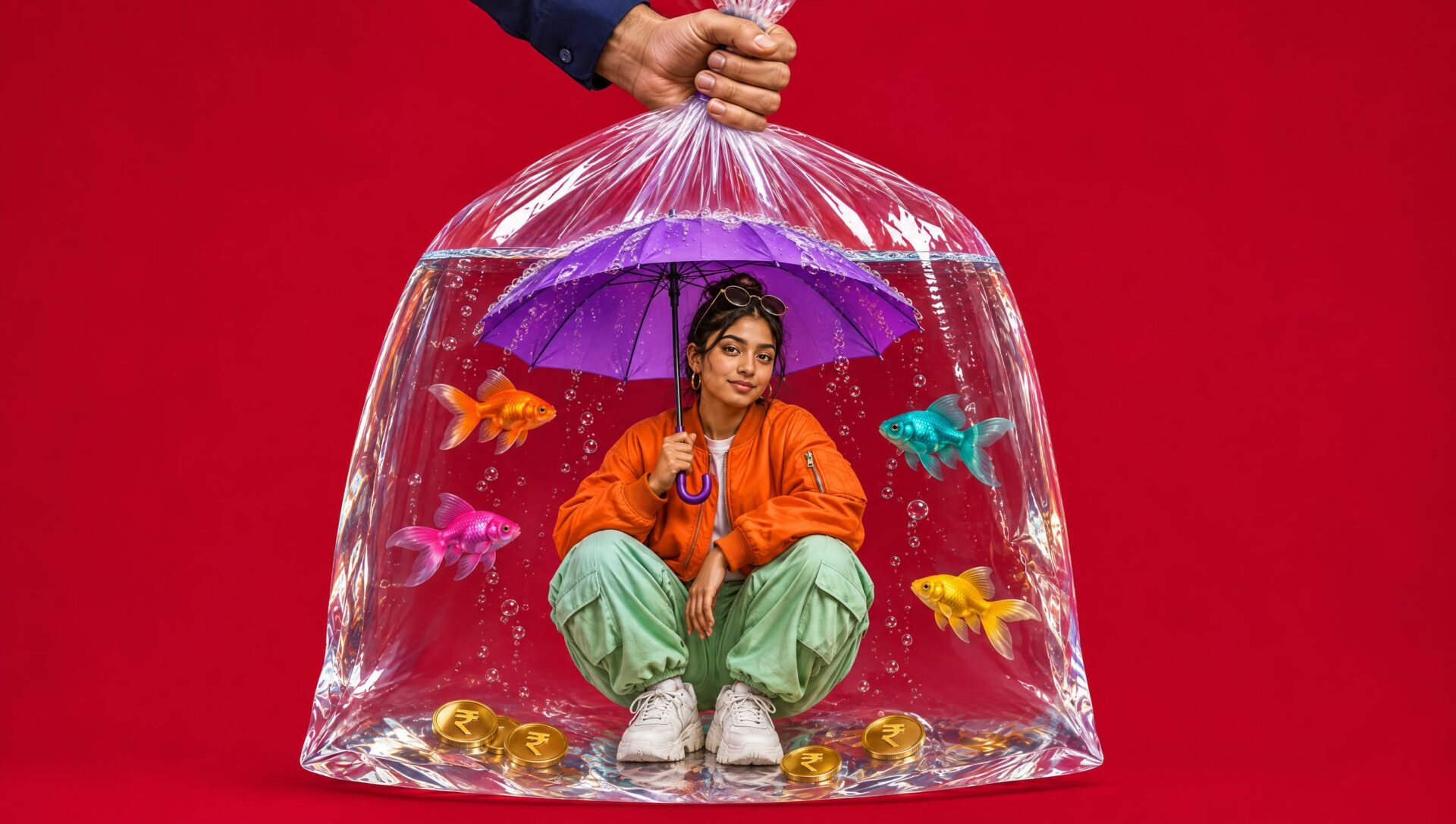
A car insurance renewal arrives on a phone in Lucknow. Above the premium and the insured declared value sits a purple logo and four Hindi words: Suraksha aur Bharosa Dono. Protection and trust, both. The car owner probably never chose SBI General Insurance for those words. She may well have chosen it for the second one, which the insurer borrows from the State Bank of India, its parent. That borrowing is the whole case.
What does suraksha aur bharosa dono mean for SBI General Insurance?
Suraksha means protection. Bharosa means trust. Dono means both. At the launch, SBI General’s then MD and CEO, Pushan Mahapatra, said the tagline was built on security and trust, as afaqs! and Life Insurance International reported on 2 July 2020. The third word does the work. It turns two nouns into a promise that the customer gets both at once.
The situation in 2020 was a change of identity, not a product launch. SBI General is the non-life insurance company of the SBI group. Its About page lists retail, corporate, SME and rural customers, and a distribution mix that runs from bancassurance and agents to car makers, brokers and digital partners. In July 2020, after a decade of operations, it changed its logo, its colour and its tagline together.
BestMediaInfo reported the details on 2 July 2020. The new identity went into use across communications from 1 July 2020 and was rolled out to visible touchpoints in stages. Rediffusion Brand Solutions won the creative mandate. The logo uses a swipe-style button as a nod to phones and a gradient for future readiness. The parent name SBI stays, and “general” is set in lowercase in a curvier typeface.
The colour is purple, which BestMediaInfo linked to SBI’s YONO app. The company described two audiences for the new look: traditionalists who value trust, loyalty, value for money and integrity, and modernists who want flexibility and future readiness. Six years later the phrase is still on SBI General’s own site, where the About page says the company aims to give both suraksha and bharosa to its customers.
Why does a two-part promise matter more for a regulated insurer?
Insurance is bought on a promise the customer cannot test until something goes wrong. At the 2020 launch, Mahapatra called the Indian insurance category “riddled with fear and insecurity”, according to BestMediaInfo. A general insurer meets that fear at bad moments: a hospital admission, a crash on the highway, a flooded shop. The tagline is the brand’s answer before the policy is ever read.
IRDAI’s rules narrow what any line can say. Under the IRDAI (Protection of Policyholders’ Interests, Operations and Allied Matters of Insurers) Regulations, 2024, an advertisement must be fair and true and must reflect potential risks. It may not claim more than the policy can deliver, under-disclose important exclusions, limitations and conditions, or carry fabricated facts, figures or features. Every insurer’s ad must show its registered name with its trade name or logo, visible prominently.
Two more rules shape how a tagline travels. Ads issued by a distribution channel, such as a bank branch or a broker, need the insurer’s written approval before issue. So the approval sits inside the insurer, which keeps its own register of the ads it approves. A tagline that compliance trusts is one less argument on every poster.
The same regulations separate an insurance advertisement, which is meant to lead to a sale, from an institutional advertisement, which only promotes the insurer’s brand image. A tagline lives on both. It has to be safe on a product ad with a premium and exclusions beside it, and general enough to close a brand film that sells nothing.
There is a further wrinkle. IRDAI’s own complaint registration portal is called Bima Bharosa. A customer whose claim is refused can take the grievance to a regulator’s portal that carries the same word the insurer put in its tagline. The promise is judged in the complaints data, long after the hoarding comes down.
For a bank-owned insurer the stakes are higher still. Bharosa is mostly SBI’s to lend. At the launch, Mahapatra spoke of pride in SBI’s parentage, and Dinesh Kumar Khara, then SBI’s MD for global banking and subsidiaries, said the insurer was carrying forward SBI’s “legacy of trust”, afaqs! reported. A bad claims experience now costs the parent’s name as well as the subsidiary’s.
A tagline is a claim the claims desk has to keep paying.
How did SBI General build the line, in four parts?
The public record shows four moves over six years. What follows is the record. The reasoning attached to each part is our analysis, because SBI General has not published its brief or its research.
- The words. Two Hindi nouns and a joining word. There is no product, price, speed or number in the line. In our reading, that means nothing in it needs a footnote, a benefit illustration or claims data to back it, so it can sit on any approved product ad without a fight.
- The identity. The line arrived in July 2020 with a new logo and a purple palette, created with Rediffusion Brand Solutions, per BestMediaInfo. Launching the words and the look together meant every renewal notice, branch standee and app screen taught the line at no extra media cost.
- The films. On 19 October 2023, BestMediaInfo reported three brand films built on the suraksha and bharosa positioning: one for health, where a family picnic turns into an emergency when someone chokes on a peanut; one for motor, where another driver’s mistake causes a crash; and one for small businesses facing an unforeseen setback. The tone was real-life and humorous. The coverage we read quotes Rathin Lahiri, Head of Marketing and CSR, and does not name an agency.
- The ambassador. On 5 March 2026, SBI General named actor Pankaj Tripathi as brand ambassador and launched “Chuniye Bharosa, Apno Sa”, roughly “choose a trust that feels like your own”. Devdiscourse reported that TBWA Lintas conceived the campaign, and the company’s release lists print, TV, out-of-home, OTT and social media.
The fourth move matters for anyone reading the line as a system. The 2026 campaign keeps bharosa in its headline and leaves suraksha to the corporate tagline. In our reading, the company decided the trust half was the one worth paying a famous face to carry.
SIGNALNewsletter by Yamm Labs
The next piece, straight to your inbox.
New writing on BFSI brands, B2B and influencer marketing, and AI search.
One click to unsubscribe. Privacy policy

Which options did SBI General weigh in 2020? That is not on record. The table below is our own comparison of the line types any Indian general insurer could choose, scored against what IRDAI’s 2024 rules ask an advertiser to prove. It is a working tool for your own shortlist, not a reconstruction of SBI General’s process.
| Line type | Hypothetical example | What the line has to prove | Works across motor, health and SME? | Risk if service slips |
|---|---|---|---|---|
| Benefit promise | “Claims settled before you get home” | Turnaround data that holds for every product and city where the ad runs | Partly; claim types differ too much | High: every slow claim contradicts the ad |
| Price promise | “Lowest premium, guaranteed” | A fair comparison that does not mislead on cover or exclusions | Weak; prices move by product and risk | High: compliance will rarely pass it |
| Product-led line | “Health cover that grows with your family” | Policy terms on the same ad, with exclusions disclosed | No; one line per product | Medium: limited to one product |
| Borrowed parent trust | Suraksha aur Bharosa Dono | Little that is specific; the ad must not imply the parent guarantees each claim | Yes | Medium: a failure also hurts the parent bank |
| Celebrity-carried trust | Chuniye Bharosa, Apno Sa with an ambassador | The ambassador’s checks on any claim the script makes | Yes, with one film per product | Medium: the face becomes part of the complaint |
Which regulator-driven decisions would a brand copying it face?
A bank-owned insurer copying this line would face at least five decisions that a regulator or a code forces. The first two columns below come from IRDAI’s 2024 regulations and ASCI’s guidelines. The choices are our recommendation for a brand in that position. This is general guidance, not legal advice; your compliance team decides.
| Decision | Constraint | Choice we would make | Reason |
|---|---|---|---|
| Where the name sits | IRDAI wants the registered name with the trade name or logo, visible prominently, on every ad | Lock the registered name under the logo and the line in one end-frame and footer lockup | Designers stop shrinking the legal name on small formats |
| Brand film or product ad | Product ads must show risks, exclusions and conditions clearly; institutional ads promote the brand only | Keep the tagline on both, and put all premiums and exclusions only on product ads | The line stays clean and the product ad carries the legal weight |
| Bank branch material | Ads issued by a distribution channel need the insurer’s written approval first | Ship one approved kit to branches and partners, with the line fixed in artwork | Thousands of local edits never reach the approval queue |
| Using a famous face | ASCI’s celebrity guidelines expect celebrities to check that ad claims are true; an influencer with 500,000 or more followers on one platform counts as a celebrity | Keep the ambassador’s script to care and trust, and keep claim-speed or price numbers out of their mouth | Fewer claims for the ambassador to verify, and fewer to defend |
| Language | No rule; a Hindi line meets Tamil, Bengali and Marathi audiences | Keep the Hindi words as a fixed lockup and explain them in the local language around it | A translated tagline drifts in meaning across regional teams |
The celebrity row changes if the brand copying it is a mutual fund. Until SEBI’s common advertisement code takes effect in early April 2027, a fund house can use a celebrity only in an industry-wide campaign that promotes mutual funds in general, with SEBI’s approval first. SEBI notified that code in the Gazette on 9 October 2026. From April 2027 it lets fund houses and other SEBI-regulated firms use celebrities to endorse the brand, with prior approval and no claims about a specific product. An AMC that wants a Pankaj Tripathi moment of its own has to plan around that date.
A lender has a different version of the same problem. RBI requires lenders to give borrowers a Key Facts Statement in a standard format before a retail or MSME loan is signed. A trust line on a loan ad is read against that document, so the cost and terms in the ad have to match it exactly.
What happened after SBI General adopted the line?
The outputs are on record. The line has been in use since July 2020. It carried a three-film brand campaign in October 2023. In 2026 SBI General’s About page still promises both suraksha and bharosa, and the insurer added a second, campaign-level line, “Chuniye Bharosa, Apno Sa”, with a celebrity ambassador and a creative agency that differs from the 2020 rebrand’s.
We found no public report of the outcomes. No published figure that we found ties the tagline to sales, market share, brand recall or claims satisfaction. SBI General reports premium and customer numbers on its site, but those figures do not credit the line, and this case study does not credit it either.
Two gaps in the record are worth stating plainly. The agency behind the October 2023 films is not named in the coverage we read. And we found no statement from SBI General on why it moved bharosa to the front in 2026. Our reading is that six years of a two-part promise taught the company which part customers respond to, but that is analysis, not a reported finding.
What can a BFSI brand learn from suraksha aur bharosa dono?
These five lessons apply to banks, AMCs, insurers, NBFCs and fintechs in India, and to Gulf firms with a strong parent brand.
- A line that promises a feeling survives compliance review longer than a line that promises a number. Benefit claims have to be re-proved every time the product or the service level changes.
- Borrowed trust is real equity and a real liability. If your trust comes from a parent bank, every service failure is charged to both names.
- Launch the line with the identity. SBI General put the words, the logo and the colour out together, so every policy document taught the line.
- A corporate line can carry campaign lines underneath it. Decide the hierarchy early, so two lines never compete in one end frame.
- Write down what the line cannot claim. A line about trust should never carry a turnaround time, a settlement ratio or a guarantee in its supporting copy unless the data is approved and current.
How should an insurer or bank start a trust line of its own?
Start with evidence, then words. The order below is the one we use when a regulated brand asks for a new line or a brand identity that moves customers from fear to confidence.
- List what your service data proves today: claim turnaround by product, cashless network size, grievance volumes and how fast you resolve them. Have the claims and service heads sign the list.
- Decide whose trust you are selling. If it comes from a parent bank or group, agree with the parent’s brand team what the subsidiary may say and what it may not.
- Draft candidate lines in the language of your largest market. Test each one in a mock product ad with premiums and exclusions beside it, and in a brand film end frame with nothing beside it.
- Take the shortlist to compliance early. Ask one question per line: what would we need to prove if a customer or a regulator challenged this?
- Build the lockup: registered name, logo and line, sized for the smallest format you use, such as an app notification banner or a branch standee.
- Ship an approved kit to every distribution partner before launch, so local teams have no reason to make their own versions.
For the campaign layer that follows a new line, our content and campaigns work starts from the same claims list, so every film, post and branch poster draws on approved proof.
How do you measure whether a trust tagline is working?
Measure a trust line with proxies, because no single metric proves a tagline sold a policy. Attribution is hard for any corporate line. These measures, tracked from before the launch, give finance and compliance something real to read.
- Line-to-brand recall. Share of surveyed category buyers who name your brand when shown the line without the logo. It shows whether the words belong to you yet.
- Branded search share. Searches for your brand divided by searches for your brand plus your main rivals, by month. It shows whether brand spend is lifting demand.
- Complaints per lakh policies. Grievances recorded, divided by policies in force, times one lakh. It shows whether service is keeping the promise the line makes.
- Renewal rate by product. Policies renewed divided by policies due for renewal. Motor and health renewals are the clearest test of whether bharosa held after a claim.
- Approval cycle time. Days from first draft to compliance sign-off for ads that carry the line. A stable line should make this number fall over time.
Report recall and search share to marketing. Report complaints and renewals to the board. If complaints rise while recall rises, the line is spreading faster than the service behind it.
What goes wrong with trust taglines, and what are the early signs?
Trust lines fail slowly and in public. The signs show up in complaints, partner artwork and internal briefs long before any brand-tracking study does.
| Failure | Early signal | Fix |
|---|---|---|
| The line outruns the service | Customers quote the tagline back in social complaints or grievance letters | Fix the claims bottleneck first, and pause trust-heavy media in that product until it is fixed |
| Parent and subsidiary drift apart | The parent bank changes its own positioning without telling the subsidiary | Hold a yearly brand review with both teams and one shared rulebook |
| The words get translated | Regional teams or partners print local versions of the line | Fix the original words in artwork and explain them in local copy |
| The legal name shrinks | Partner posters show the logo and line without the registered name | Send the approved kit again and refuse unapproved partner artwork |
| Two lines compete | A campaign line and the corporate line share one end frame at equal size | Set the hierarchy in the brand book: corporate line in the lockup, campaign line in the headline |
When is a trust tagline the wrong choice?
A trust line is the wrong choice when you have nothing yet to be trusted for. A new digital insurer or a fintech without a known parent has no bharosa to borrow. A line about what the product does, or how fast it works, will tell customers more, provided the service data backs it.
It is also wrong when buyers compare on price inside an aggregator or an app. On a comparison screen, the line is rarely seen and almost never decides the sale.
It is wrong when the category is new to the audience. A first-time buyer of cyber insurance or pet insurance needs to know what is covered before they need to feel safe. And it is wrong when the language does not match the market. A Hindi line can work across much of India, but a Gulf insurer serving Arabic and English speakers would need its own words, tested with its own customers. Our list of insurance marketing questions answered covers the product-led alternatives.
People also ask
What does Suraksha aur Bharosa Dono mean?
It is Hindi for “protection and trust, both”. Suraksha means protection, bharosa means trust and dono means both. SBI General Insurance uses it as its corporate tagline.
When did SBI General Insurance launch Suraksha aur Bharosa Dono?
SBI General introduced the tagline with a redesigned logo in July 2020, according to trade press reports dated 2 July 2020. The new identity went into use across communications from 1 July 2020, and Rediffusion Brand Solutions won the creative mandate.
Who is the brand ambassador of SBI General Insurance?
Actor Pankaj Tripathi became brand ambassador in March 2026, with the campaign “Chuniye Bharosa, Apno Sa”, conceived by TBWA Lintas. The campaign sits under the corporate tagline and puts the trust half of the promise in front.
Can an insurance tagline promise fast claim settlement?
Only if the insurer can prove it wherever the ad runs. IRDAI’s 2024 rules bar ads that claim more than the policy can deliver or carry fabricated figures, so a speed promise needs current, approved data behind it. That is why many insurers choose trust lines.
Is your tagline promising something your claims desk cannot prove?
Get a free Fintech Brand Audit across 8 dimensions, plus 3 fixes. No pitch. Run the free Brand Audit →