

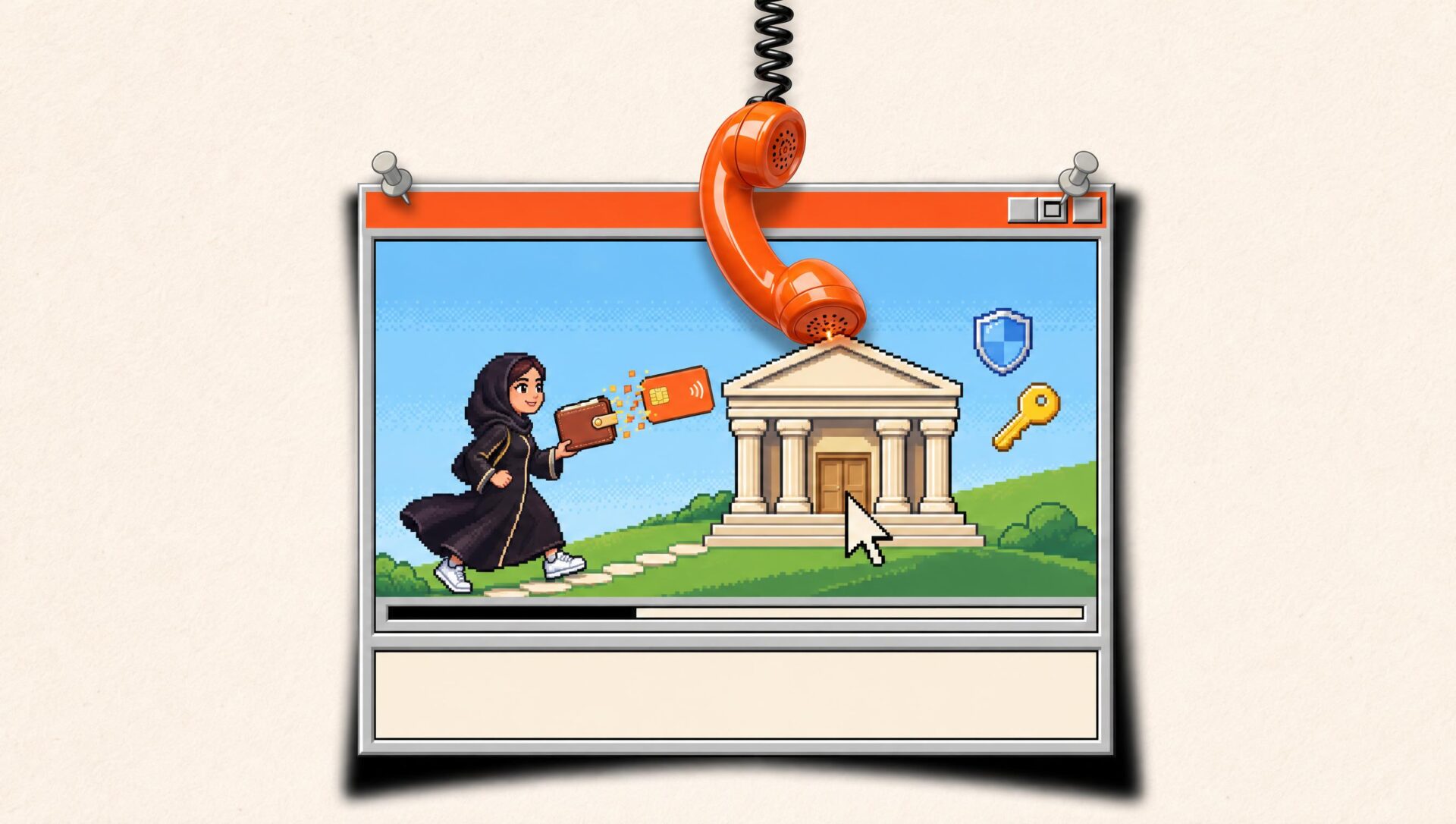
A customer in Riyadh opens the app she uses to split rent and send money home. A text message is waiting: her wallet is being moved to a digital bank account, and the old wallet stays active for 10 days from the date of that message. The icon on her phone still says stc, the same name printed on her mobile bill. Only the word after it has changed, from pay to bank. That one word took a separate company, an e-money licence, a banking licence and a customer migration to earn. It is one of the clearest recent examples of a telecom brand lending its trust to a financial product, and then having to give that product a trust of its own.
Who launched stc pay, and when did it start?
Saudi Telecom Company was founded in April 1998. Its payments company, the Saudi Digital Payments Company, launched in 2017 and began official work in 2018. The consumer product it took to market was a mobile wallet called stc pay.
The name did two jobs at once. The first half, stc, carried everything a new financial app lacks on day one: a name people already see every month on a bill, a company they have dealt with for years, and the sense that a large, established company stands behind the money. The second half, pay, told people what the app did without claiming more than the company was licensed to do. A wallet moves and holds money. It does not call itself a bank.
This is the core of the telco-to-fintech playbook. The parent brand lends credibility. The descriptor sets a boundary. Everything that happened next in the stc story is about moving that boundary, one licence at a time.
| Milestone | What the public record says | What it changed for the brand |
|---|---|---|
| April 1998 | Saudi Telecom Company is founded | The masterbrand whose trust stc pay later borrowed |
| 2017 to 2018 | The Saudi Digital Payments Company launches in 2017 and starts official work in 2018 | A separate legal entity with its own product name: stc pay |
| 2020 | stc pay earns an electronic money institution licence; Western Union buys a 15 percent stake at a reported valuation of 1.3 billion US dollars | A regulated e-money status and a global payments name on the cap table |
| June 2021 | The Saudi Central Bank approves conversion into a digital bank; a Council of Ministers decree dated 22 June 2021 licenses it | Permission to become a bank, not yet a bank in the customer’s hand |
| Today | The company operates as stc bank, with the same corporate registration numbers, under the oversight and supervision of the Saudi Central Bank | The descriptor changes from pay to bank; wallets move to bank accounts |
Why does a telecom brand hit a ceiling when it moves into money?
Borrowed trust is strongest at the start. A customer who has paid a mobile bill to the same company for years will try its wallet with little persuasion. Downloads and first transfers come cheaply because the brand has already done the hard work of being known.
The ceiling arrives when the product wants to do more than move money. Deposits, savings accounts, personal finance, credit cards and small-business lending are banking products. Today stc bank’s own site lists all of them, along with point-of-sale and e-commerce services for merchants. None of that fits under a wallet licence, and none of it fits under a brand whose only financial word is pay.
There is a second, quieter complication. When the telecom name sits on a financial product, the two reputations become linked. A network outage, a billing complaint or a service failure in one business can colour how customers feel about the other. The telecom brand helps the fintech grow, but the fintech also inherits the telecom’s weak days. A brand team planning the move has to decide how tightly to bind the two names before the regulator forces the question.
And the regulator does force it. In most markets, the right to call yourself a bank is a licensing matter, not a marketing choice. So the complication is not only creative. The brand cannot say what the business wants to become until the regulator says yes.
SIGNALNewsletter by Yamm Labs
The next piece, straight to your inbox.
New writing on BFSI brands, B2B and influencer marketing, and AI search.
One click to unsubscribe. Privacy policy

What licensing milestones changed the stc pay story?
Two milestones did most of the work.
- The e-money licence in 2020. stc pay earned its electronic money institution licence in 2020. Soon after, Western Union bought a 15 percent stake at a reported valuation of 1.3 billion US dollars, which led to stc pay being described as the first fintech unicorn in the Middle East. The licence made the wallet a regulated product in its own right. The investment added a second trusted name, one known for cross-border money transfer, to a story that until then leaned almost entirely on the telecom parent.
- The digital bank approval in June 2021. In June 2021 the Saudi Central Bank approved converting the Saudi Digital Payments Company into a digital bank, and a Council of Ministers decree dated 22 June 2021 granted the licence. From that point the brand had permission to become a bank. It still had to build one and move its customers into it before the name could change in their hands.
Notice the gap between permission and presentation. A licence date is not a launch date. The public record we reviewed does not give a single date on which every customer saw the new name, and the move from wallet to account was staged through notices sent to each customer. That staging is itself a design decision driven by regulation, and it is where most of the useful lessons sit.
What did stc pay change when it became stc bank?
Four decisions are visible on the bank’s own pages.
- Keep the masterbrand, change the descriptor. The telecom name stayed. Only pay became bank. That kept every bit of recognition the app had built while signalling a bigger promise.
- Keep the legal identity continuous. The transformation notice says the company keeps the same corporate registration numbers and identity. For a customer, that answers the first worried question: is my money with a new company?
- Move customers through a notified, time-boxed sequence. Wallet accounts transition to digital bank accounts. A text message tells each customer about the move, the existing wallet stays active for 10 days from that message, and customers who do not open a bank account are told their options through text and digital channels. That is a screen and message sequence written around a regulatory event.
- Put the licence in the lockup. The site footer carries the licence line: licensed by a Council of Ministers decree, identified by number and by both Hijri and Gregorian dates, and operating under the oversight and supervision of the Saudi Central Bank. It also states the paid-up capital of 6.35 billion Saudi riyals, the company form and the commercial registration number. The new promise, one app that takes you further, sits above that line, not in place of it.
| Brand element | Before: stc pay | After: stc bank |
|---|---|---|
| Descriptor | pay, a feature word | bank, a licensed status |
| Licence behind the name | Electronic money institution licence from 2020 | Digital bank licence by Council of Ministers decree, June 2021 |
| Customer account | Wallet | Digital bank account, after a notified transition |
| Product promise | Send, pay and transfer | Deposits, savings, cards, personal finance and merchant financing in one app |
| Trust signal | Mostly the telecom parent | The parent plus a regulator line: supervised by the Saudi Central Bank, with capital and registration shown |
Borrowed trust gets you installs; only a licence changes what you are allowed to call yourself.
What results has stc bank publicly reported from the rebrand?
Here we have to be careful. The pages we reviewed confirm the licence, the paid-up capital, the product range and the migration process. They do not report how many wallet users moved to bank accounts, how deposits grew after the change, or whether brand metrics such as awareness or trust shifted. Those outcomes are not publicly reported in the sources we opened, so we do not state them.
What the record does show is the order of events, and that order is the result worth studying. The brand did not claim bank status early. It earned a regulated e-money status first, added an outside investor with its own trusted name, received a banking licence, and only then changed the descriptor and moved customers. Each step gave the next one something true to say.
We also cannot confirm which agencies, if any, worked on the naming, identity or migration communication. The bank’s pages do not name one, and we have not found an official source that does. Any article that credits a specific agency without a source should be treated with caution.
How does the stc story map to telecom-led fintech in India?
India has run its own version of this experiment. On 19 August 2015 the Reserve Bank of India granted in-principle approval to 11 applicants to set up payments banks. Among them were Airtel M Commerce Services, Reliance Industries and Vodafone m-pesa, each tied to a large telecom business. The RBI press release lists the full set.
The Indian route differed in one important way. Here the regulator created a specific, limited category of bank, and the licence defines what a payments bank can and cannot do. The Saudi route moved a wallet into a full digital bank licence. Both routes show the same rule: the descriptor after the telecom name is set by the licence, and the brand team works inside it.
For Indian insurers and lenders, the rules on how a regulated name appears are specific. Under the IRDAI regulations on protection of policyholders’ interests issued in 2024, every insurer’s advertisement must show its registered name along with its trade name or logo prominently, and ads released through distribution channels need the insurer’s written approval before they go out. That is a lockup rule, not a legal footnote. A co-branded insurance product sold inside a telecom or payments app has to carry the insurer’s registered name clearly, whatever the host brand’s design system prefers.
Which regulator-driven design decisions should an Indian BFSI brand copy?
- Design the licence line into the lockup. stc bank shows its regulator, licence and capital as part of the brand frame. An Indian insurer faces a similar rule: registered name with trade name or logo, shown prominently. Build that pairing into the master artwork so every ad, app screen and hoarding inherits it.
- Change the descriptor only after the licence exists. stc waited for its banking licence before it changed pay to bank. An Indian fintech that has applied for, but not received, a licence should keep its current descriptor on every channel until the approval is in hand.
- Script the migration as a screen sequence. stc bank sent a message, set a 10-day window and offered options to customers who did not move. Plan the Indian equivalent as a numbered flow: notice, explanation, consent, confirmation, fallback.
- Put key facts before the contract, not after it. For retail and MSME term loans sanctioned from 1 October 2024, the RBI requires lenders to give a Key Facts Statement, including the annual percentage rate, before the loan contract is executed. A lending journey inside a super-app has to place that screen before the signature step, not in a download link after it.
- Give mandated warnings their full time. In audio-visual mutual fund ads, SEBI’s standard warning must be shown and voiced so that it is clear and understandable, and SEBI gives five seconds as an example of what may meet that test. A telecom-backed investing product that runs video on its parent’s channels still has to budget those seconds into every cut.
None of these decisions reduce the creative room. They set the frame the creative sits in. The brands that treat them as design inputs from the first sketch ship faster than those that treat them as a legal review at the end.
What should a telco-to-fintech rebrand checklist include?
If you are a parent brand lending your name to a financial product, or a fintech preparing to change what it calls itself, work through these questions before any design begins.
- What does the current licence allow the brand to say? Write down the exact descriptor the licence supports, and the ones it does not.
- How tightly is the parent name bound? Decide whether the parent appears as masterbrand, endorser or not at all, and what happens to the fintech if the parent has a bad week.
- Where does the regulator line live? Fix the position of the registered name, licence reference and regulator mention in the lockup, the app footer and the video end frame.
- What is the customer’s migration path? Map every message, screen and deadline, including what happens to a customer who ignores the notice.
- What proof can the brand state? List only outcomes the company can publish and source. Leave the rest out.
We work through this sequence with BFSI brands from our base in Gurugram, serving clients in India, the Gulf and elsewhere remotely. You can read more about how Yamm Labs works, see more brand case studies on Signal, or run our free Fintech Brand Audit to test your own lockup and disclosure placement.
People also ask
Is stc bank the same company as stc pay?
Yes. The bank’s transformation notice says the company formerly known as stc pay now operates as stc bank and keeps the same corporate registration numbers and identity. Wallet accounts move to digital bank accounts through a notified transition.
When did stc pay get its digital bank licence?
The Saudi Central Bank approved the conversion into a digital bank in June 2021. stc bank’s own site states it is licensed by a Council of Ministers decree dated 22 June 2021.
Who regulates stc bank?
stc bank operates under the oversight and supervision of the Saudi Central Bank. Its site also states a paid-up capital of 6.35 billion Saudi riyals and its commercial registration details.
Can an Indian fintech borrow a parent brand’s trust the same way?
Yes, but the descriptor and disclosures must follow the licence the entity holds. Insurers must show their registered name with the trade name or logo, lenders must give a Key Facts Statement before the loan contract, and mutual fund video ads must carry the standard warning, shown and voiced, clearly enough to be understood.
Lending a parent brand’s trust to a financial product? Check what your licence lets you say first.
Get a free Fintech Brand Audit across 8 dimensions, plus 3 fixes. No pitch. Run the free Brand Audit →