

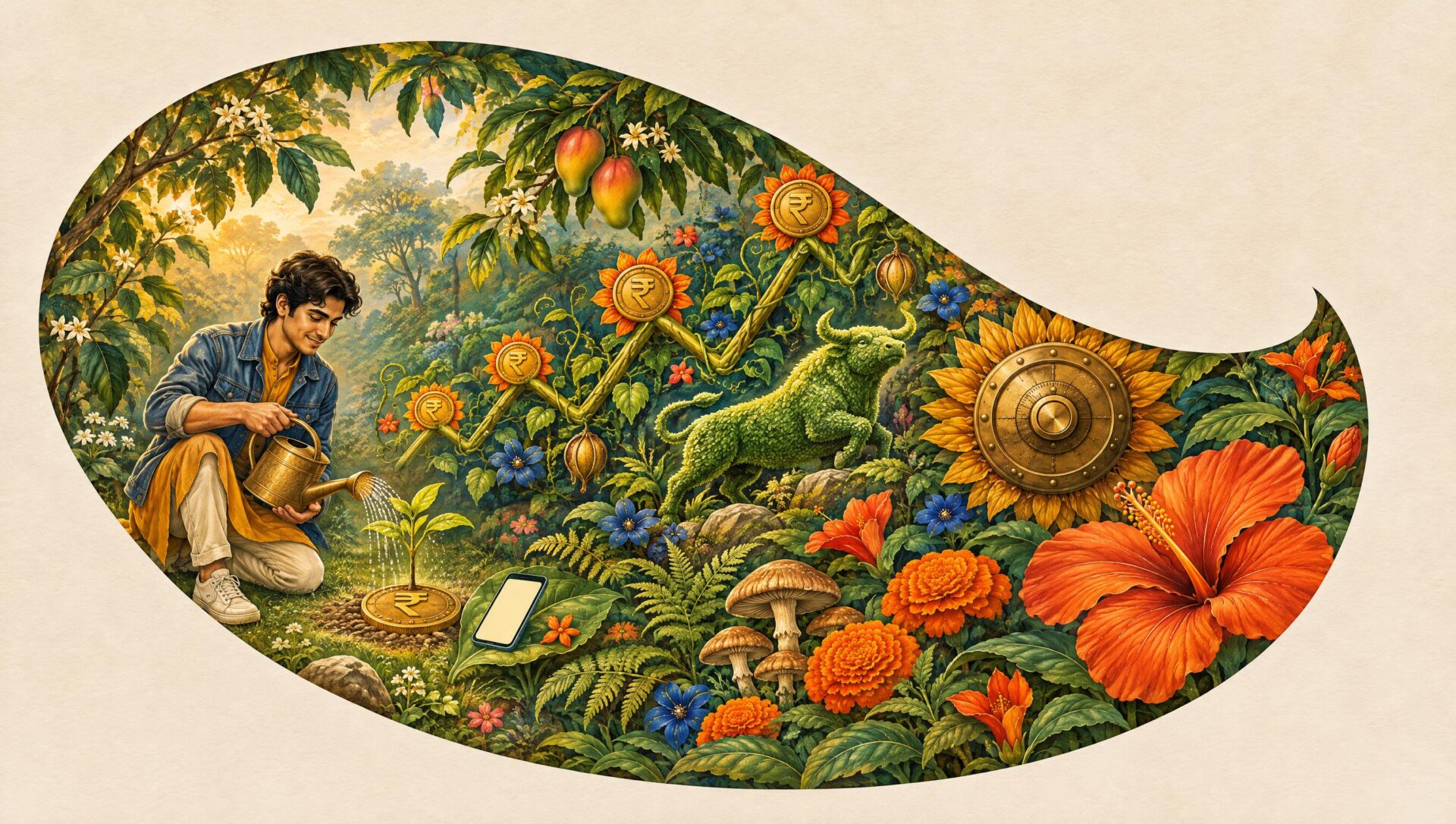
Picture a 26-year-old in a tier-2 city with ₹5,000 left at the end of the month and a vague sense that it should be doing something. A relative says “mutual funds”. A colleague says “stocks”. The bank app offers a fixed deposit and a wall of scheme names. Nobody explains what an NAV is, and nobody has time to. That person, multiplied by millions, is the customer Groww chose to build for. This case study looks at how a broking brand made simplicity its whole position, what that bought it, and what changed once the same app started selling futures and options.
Who was Groww built for, and when did it start?
Situation. Groww was started in Bengaluru by four former Flipkart employees. Inc42 gives the founding year as 2016; TechCrunch’s early 2019 funding report says 2017. Either way, the first product was narrow on purpose: direct mutual funds, SIPs and tax-saving ELSS funds, on Android, iOS and the web.
By January 2019, TechCrunch reported more than one million registered users, most of them under 40, and access to more than 5,000 mutual funds from the app. The founders framed the market as a gap rather than a competition. In that same report the CEO put it as roughly 200 million Indians with investable income against about 20 million investors, and said the only way to reach the rest was to make investing simple.
That framing matters for anyone reading this as a brand lesson. The early public story was not about beating another broker. It was about beating confusion. The competitor was the fixed deposit, the insurance-cum-investment policy a relative sold, and the feeling that markets are for other people. Robinhood made the same argument in the US with its 2021 Super Bowl commercial, We Are All Investors, and the GameStop week shows what happens when the product breaks that promise.
What was the brand problem Groww had to solve?
Complication. First-time investors do not arrive with product knowledge. They arrive with a fear of losing money and a suspicion that the fine print is where the loss hides. By September 2020, TechCrunch reported that more than 60% of Groww’s users came from smaller cities and towns, and that 60% of those had never invested before.
That audience creates three problems a brand has to answer before it can sell anything:
- Jargon. NAV, expense ratio, exit load, lock-in. Each word is a reason to close the app.
- Trust. A new app asking for PAN, bank details and a KYC selfie has to look safer than the branch the user already knows.
- Regulation that does not simplify. Mutual fund advertising has to carry SEBI’s standard market-risk warning, and Groww’s own pages carry its SEBI broking and depository registration numbers and its AMFI distributor registration. The brand cannot remove these, so the simplicity has to hold with them on the page.
The second complication arrived later and is harder. A brand built on “investing made simple” for beginners began selling products that are not simple and not for beginners. That tension is the most useful part of this case for any BFSI marketer.
What did Groww decide to make its brand stand for?
Decision. Groww made simplicity the operating principle, not a tagline. Its About page lists “Simple is Beautiful” among its core values and says it tries to keep making the app, website and services simpler. TechCrunch’s 2020 report described a deliberately simplified interface for a largely millennial customer base, alongside in-person workshops in smaller cities to explain how investing works.
Four choices follow from that decision, and each is visible from the outside:
- Start with the least frightening product. Direct mutual funds and SIPs came first. A monthly SIP is an easy first yes, and it builds a habit before the user meets volatility.
- Teach before you sell. Workshops in smaller cities and explanatory content treated education as acquisition, not as a blog nobody reads.
- One name, one app. New products were added inside the same Groww app rather than launched as separate brands a first-timer would have to trust again.
- Keep the plain voice. The About page describes investing in India as the opposite of easy, fast and clear, and names those three as what Groww is changing. The copy is short because the audience is new.
What is not publicly reported: which agency, if any, shaped the identity; how the logo or colour system evolved; and whether Groww ran brand-tracking research. We found no primary source for any of these, so we do not guess.
SIGNALNewsletter by Yamm Labs
The next piece, straight to your inbox.
New writing on BFSI brands, B2B and influencer marketing, and AI search.
One click to unsubscribe. Privacy policy

How did the product widen, and what changed for the brand?
The single-product app did not stay single for long. The dated public record, in order:
| Stage | What Groww offered | Who it spoke to | What “simple” had to carry |
|---|---|---|---|
| Early 2019 | Direct mutual funds, SIPs, ELSS; more than 5,000 funds | Young, mostly under-40 first-time investors | Jargon and the mutual fund standard warning |
| September 2020 | Indian stocks and digital gold added; 8 million+ registered mutual fund users | Smaller-city users, many investing for the first time | A first stock trade, not just a SIP |
| April 2021 | US-listed stocks on offer; 15 million+ registered users, two-thirds first-time investors | Same base, now shopping across markets | Currency and overseas risk in the same clean screen |
| October 2021 | Futures, derivatives and IPOs on the platform; stated aim to offer all asset classes | A trader segment inside a beginner brand | Products where most individual traders lose money |
| 2025 to 2026 | Broking, MTF, commodities, bonds, UPI payments, credit, an asset management company, wealth advice, a pro terminal | Beginners, active traders and affluent investors | One masterbrand across very different risk levels |
The brand answer to that widening is the most instructive design decision in the case. Groww did not rename itself. It kept the masterbrand and used separately named services at the two edges of its customer base.
At the advanced edge sits 915 by Groww, which its own site calls a pro trading terminal built for speed, aimed at futures and options traders, and reached with the same Groww login. At the affluent edge sits W, a private wealth service that offers portfolio reviews and tailored strategies; eligible Groww users are notified about it inside the Groww app. The asset management business trades as Groww Mutual Fund, sponsored by Groww’s parent company.
The effect is that the main app can stay simple for the person with ₹5,000 while the trader and the wealthy client each get a named space with a different tone. On 915, the endorsement (“by Groww”) keeps the trust earned in the core app. The separate name keeps a scalping terminal from making the beginner’s home screen look like a cockpit.
How does a simplicity brand handle a SEBI-mandated warning?
This is where “compliance-aware” stops being an adjective and becomes a screen. Since 1 July 2023, a SEBI circular has required every stock broker to show a prescribed risk disclosure on equity futures and options. Clients may be prompted with it as a pop-up when they log in; they can proceed only after acknowledging it; and it must be displayed prominently, covering at least half the screen. The disclosure itself leads with SEBI’s finding that 9 out of 10 individual traders in equity F&O incurred net losses.
For a broker whose brand promise is “simple and safe for beginners”, that pop-up is not a nuisance to be minimised. It is the brand’s own promise stated by the regulator. The design decisions it forces are specific:
- Screen sequence. The disclosure sits between login and the trading screen. It cannot be a footer link. Any onboarding flow has to be storyboarded with that half-screen interruption in place, or the first real session will feel broken.
- Layout rule. At least 50% of the screen means the disclosure gets the hero position. The visual system needs a disclosure style that reads as calm and serious, not as an error state and not as an ad.
- Separation of audiences. Putting F&O depth in a separate, named terminal like 915 by Groww is consistent with the rule’s intent: the beginner journey and the derivatives journey look and feel different.
- Mutual fund timing. For fund advertising, SEBI requires the standard market-risk warning in audio-visual ads to be shown and voiced so it is clear and understandable, and gives five seconds as an example of what may meet that test. If you plan for five seconds, a 15-second film loses a third of its runtime to that line, so the script has to be written around it from the first draft.
We have not audited Groww’s login flow and do not claim how it implemented the pop-up. The rule applies to every broker. The point for a buyer is that a simplicity brand has to design these regulated moments as part of the experience, because they land on exactly the users the brand promised to protect.
What results can be attributed to Groww’s brand?
Result. The outcomes in public sources are business-scale outcomes. None of them isolates the brand’s contribution, and Groww has not published brand-attribution research that we could find.
- Users. TechCrunch reported 13.2 million active users in December 2024, against 8.1 million for Zerodha, and later 12.6 million active NSE clients, a 26% share.
- Accounts and habits. The same September 2025 report cited 37.4 million individual demat accounts, nearly 19% of India’s total, and 17 million active SIPs.
- Listing. Groww’s parent listed on 12 November 2025. TechCrunch reported an issue of about ₹6,630 crore at ₹100 a share, subscribed nearly 18 times; the stock opened at ₹112 and closed its first day above that level.
- Profitability. For the year to March 2025, TechCrunch reported revenue of about ₹3,900 crore and net profit of about ₹1,800 crore.
What a careful reader should not conclude: that the brand alone produced these numbers. Pricing, product speed, funding and market conditions all played a part, and public sources do not separate them. The fair reading is narrower. Groww picked an audience early, stayed consistent about what it promised them, and kept that promise legible while the product changed underneath it. The scale numbers are consistent with that strategy working; they do not prove it on their own.
Groww did not position against another broker. It positioned against confusion, and then had to keep that promise while selling products that are anything but simple.
What should a BFSI brand in India take from Groww?
Lessons. Most fintech founders will not have Groww’s funding or its timing. The transferable parts are cheaper than that.
- Name the confusion you beat, not the competitor. A position against jargon or fear gives every screen and every ad a test: does this make it simpler? A position against a rival goes stale the day they copy you.
- Put the first product where fear is lowest. A SIP, a small deposit, a starter card. The brand earns the right to sell riskier products only after the habit exists.
- Decide the brand architecture before you widen. Masterbrand, endorsed sub-brand or separate brand is a decision to make on a slide before launch, not after the app feels crowded. Our guide to brand guidelines for fintech startups covers how to write that rule down.
- Treat the regulated moment as a brand moment. The F&O pop-up, the fund warning, the Key Facts Statement on a loan: users see them at the point of highest anxiety. Designing them well is the promise kept.
- Be clear about what you cannot measure. If you want to know whether the brand is working, fund the research. Scale alone will not tell you.
If you want a quick outside view of where your own brand stands on these points, our free 15-minute fintech brand teardown is a good first step. Yamm Labs works from Gurugram on fintech and BFSI brands; more on how we work is on our About page.
People also ask
Why did Groww start with mutual funds instead of stocks?
Groww’s first product was direct mutual funds and SIPs for young, first-time investors. A monthly SIP is a low-stakes first commitment, and it builds an investing habit before the user faces the volatility of individual stocks, which Groww added around 2020.
Is Groww’s brand still about first-time investors?
The core app still speaks to beginners, and its About page keeps “Simple is Beautiful” as a value. Advanced traders are served through 915 by Groww and affluent users through a separate wealth service called W, so the main app can stay simple.
What does SEBI require brokers to show F&O traders?
Since July 2023, SEBI has required brokers to show a prescribed risk disclosure on equity F&O, which may appear as a pop-up at login, must cover at least half the screen, and must be acknowledged before the client proceeds. It leads with the finding that 9 out of 10 individual traders incurred net losses.
Did branding cause Groww’s growth?
No public source isolates the brand’s contribution. Pricing, product, funding and market conditions all played a part, so the fair claim is that its consistent simplicity positioning fits the results, not that it caused them alone.
Is your brand still simple after your third product launch?
Get a free Fintech Brand Audit across 8 dimensions, plus 3 fixes. No pitch. Run the free Brand Audit →