


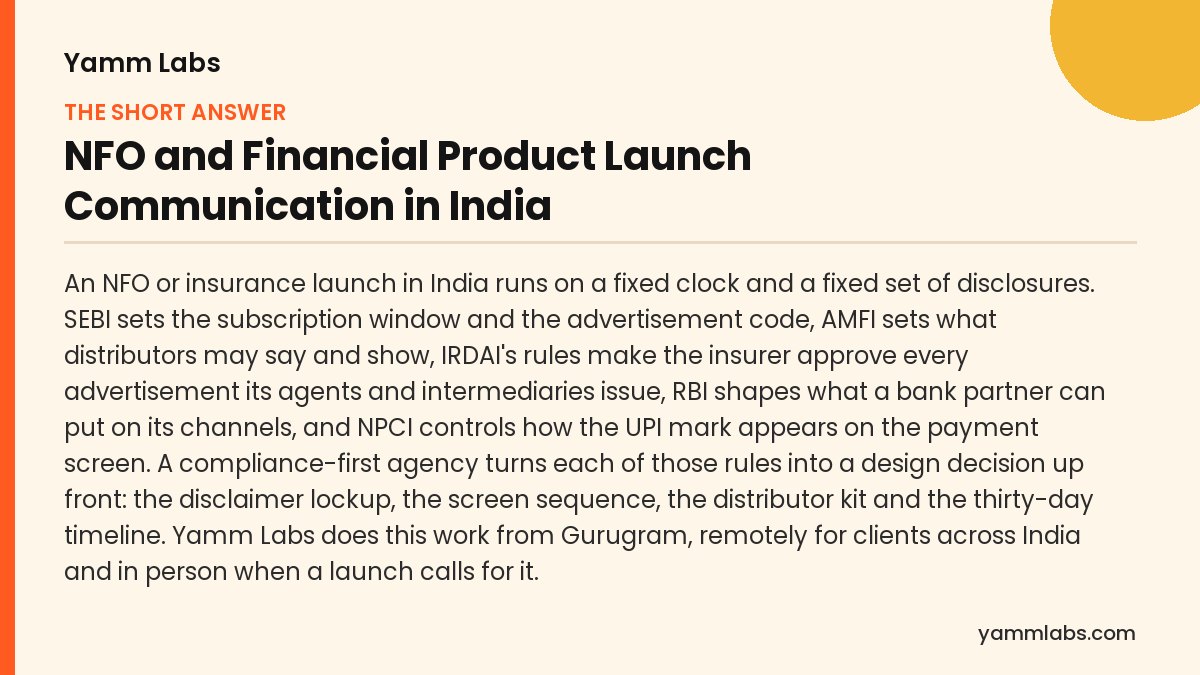
A marketing head at a Mumbai asset manager gets the NFO open date on a Tuesday. The window is fifteen calendar days, the distributor conference is in eleven, and the compliance officer has one question before anything is designed: where does the standard warning sit in the film, and for how long? That question is the whole job. In India, the communication for a financial product launch, whether a fund or an insurance policy, is a chain of decisions that a regulator has already made for you. The creative work is finding room for an idea inside those decisions.
- What does an NFO launch window in India actually look like?
- Which regulator governs which part of a financial product launch in India?
- Which design decisions do these rules force on a launch?
- How should distributor communication be handled for an NFO?
- What does an insurance product launch need that an NFO does not?
- How does Yamm Labs work with asset managers and insurers across India?
- People also ask
What does an NFO launch window in India actually look like?
The clock is short and it is not yours. Under SEBI’s rules, an open-ended scheme’s new fund offer may stay open for a minimum of three working days and no more than fifteen calendar days. After the window closes, units are allotted or money refunded within five working days.
Since April 2025, the AMC must also deploy the money it raised within thirty business days of allotment, and an investment committee can extend that only once, by another thirty business days. Miss that and the scheme cannot take fresh inflows, and investors who leave after sixty business days go without an exit load. SEBI’s stated view is that an AMC should raise only what it can put to work in a reasonable time.
For communication, that means three things. Everything investor-facing has to be ready before day zero, because a fifteen-day window leaves no room for a second production round. The message cannot lean on scale for its own sake; “raise the largest corpus” now reads as a risk to be managed. And the post-close communication, the allotment note and the first-month update, is written before the window opens. We work backwards from the open date on a thirty-day plan, which is realistic only when the scheme documents and the compliance officer are available from day one.
The standard warning is the other fixed element. SEBI’s advertisement code requires the mutual fund risk warning to appear in every advertisement, with no words added or removed, and in audio-visual work the visual and the voice-over each run for at least five seconds. In practice this is the first layout decision on a film: a five-second end card with the warning at a legible size and a voice-over that is audible over the music. Design the card first, then cut the film to reach it.
In a regulated launch, the disclaimer is not the last thing on the page; it is the first decision in the brief.
Which regulator governs which part of a financial product launch in India?
Five bodies touch a financial product launch in India, and each one forces a specific design decision. The table below is what we walk through with a client’s compliance team in the first week.
| Regulator or body | What it governs in a launch | Design decision it forces |
|---|---|---|
| SEBI | The NFO subscription window, the advertisement code for mutual funds, the standard risk warning and the scheme risk-o-meter | A fixed five-second warning end card in film, a locked warning block in print and digital, and a production plan that finishes before the window opens |
| AMFI | What AMFI-registered distributors may say and show, the “AMFI-registered Mutual Fund Distributor” tagline and the use of AMC marketing material | A distributor kit that ships as one folder with one version number, with the tagline sized to the rule and a do-not-add note on every asset |
| IRDAI | Every insurance advertisement, including insurer approval in writing before an agent’s advertisement runs, the advertising register and the disclosure of key features and exclusions | A screen sequence where benefits and exclusions sit on the same visible surface, the insurer’s registered name and registration number on every unit, and a release gate that logs each approved version |
| RBI | What a bank partner can carry on its branches, app and website for a co-branded or bank-distributed product, and the deposit insurance line for bank deposits | A separate bank-channel adaptation that keeps the bank’s mandatory lines untouched and keeps the third-party product clearly labelled as such |
| NPCI | How the BHIM UPI mark appears on payment screens, QR codes and app pages that carry a UPI transaction | An investment or premium payment screen that shows the UPI mark at the prescribed size and position, with the UPI ID under the QR, before any brand element is placed |
None of these bodies reviews an idea. They review a unit: a film, a standee, a screen, a distributor deck. So we run the creative through the compliance officer at four gates, concept, layout, adaptation and release, rather than sending a finished pack for approval at the end. Our NFO launch communication service is built around those gates.
SIGNALNewsletter by Yamm Labs
The next piece, straight to your inbox.
New writing on BFSI brands, B2B and influencer marketing, and AI search.
One click to unsubscribe. Privacy policy

Which design decisions do these rules force on a launch?
Agencies say “compliance-aware” and stop there. Here are the actual decisions a buyer should ask any agency to show from its last launch.
- The warning lockup. The SEBI standard warning is set once as a locked block: fixed wording, a legible size, a fixed position in print and a five-second card in film. Every adaptation, from a hoarding in Bengaluru to a WhatsApp creative for a distributor in Chennai, inherits the block.
- The risk-o-meter placement. SEBI prescribes a six-level risk meter with fixed colours. We place it next to the scheme name on the first surface an investor sees, not in a footer, so the same asset works in a one-pager, a standee and an app screen without re-approval.
- The distributor tagline size. AMFI requires AMFI-registered distributors to carry the tagline “AMFI-registered Mutual Fund Distributor” with their name, in a clear and legible font at a prescribed minimum size. That rule feeds the type scale of every distributor co-branded asset, so we fix the tagline size first and build the hierarchy around it.
- The insurance screen sequence. IRDAI’s rules bar advertisements that hide a policy’s risks or leave out its important exclusions, limitations and conditions, and they apply to digital and social media communication too. For a term or savings plan launch we build the landing page and the app flow so the exclusions panel is on the same scroll as the benefit panel, and we test it on a phone before it goes to the insurer’s compliance desk.
- The registered name. IRDAI requires the insurer’s registered name to appear prominently in its advertisements, not only a trade name or logo. Our lockup for insurance launches carries the registered name and number as one unit, so a film end card, a bank branch poster and a social post all show the same block.
- The UPI payment screen. NPCI’s brand guidelines fix where the BHIM UPI mark sits on an app page after login, require the partner logo and the UPI mark to be the same size, and require the UPI ID to appear under a QR code. If a launch includes a “start your SIP in one tap” or “pay the first premium” screen, that screen is designed to the NPCI grid before the brand layer is added.
- The thirty-day timeline. The fifteen-day window and the thirty-business-day deployment rule together mean a launch is planned in reverse: positioning in the first week, hero visual and film script in the second, production in the third, the collateral system and compliance rounds in the fourth. The NFO Launch Kit lays this out as a day-by-day checklist.
How should distributor communication be handled for an NFO?
Distributors are a major channel for retail mutual fund investment in India, and AMFI’s rules for them are strict for a reason. An AMFI-registered distributor must use the marketing material the AMC provides and may not design its own scheme material or show an AMC’s name or logo without written approval. That puts the burden on the AMC, and its agency, to give distributors something they can use without touching.
Our answer is one folder, one version number, one date. The distributor kit for an NFO carries a cover note, a one-pager, the explainer film, WhatsApp creatives in the sizes distributors use, email templates, talking points, an FAQ, a training deck and a do-not-add note that says in plain words what may not be changed: the warning, the risk-o-meter, the scheme name and the tagline. When a distributor in Hyderabad forwards the WhatsApp creative to a client, every mandatory element arrives intact because there was nothing to edit.
The same logic applies to the branch. A standee for a bank branch or a deck for a national distributor is an adaptation of the master, not a new piece, and it goes through the same release gate. Bank-distributed products add a bank layer: the bank’s own mandatory lines, including the deposit insurance line that tells a customer deposits are insured up to five lakh rupees per depositor per bank, stay exactly where the bank has them, and the third-party fund or policy is kept clearly separate from the bank’s own products. We wrote about what RBI’s recent board-level expectations mean for bank communication in this note on clarity over noise.
What does an insurance product launch need that an NFO does not?
An insurer’s launch has no fifteen-day window, but it has a heavier approval trail. IRDAI’s rules require every advertisement by an insurance agent to be approved by the insurer in writing before it is issued, and the insurer to keep a register of its advertisements and retain the records for at least three years. So the release gate is a record, not a courtesy: every version we release for an insurance client carries a version number and a date so the insurer’s register can be filled from the file name alone.
The second difference is the claim. A fund launch sells a strategy and a risk level. An insurance launch sells a promise, and IRDAI’s rules push towards fair, plain language and full visibility of what is covered and what is not. So the design decision is structural: the benefit and the exclusion share a surface, the registered name and registration number are on every unit, and superlative claims are written to what the product document supports. This is the first-week conversation on any insurer’s brief, before a key visual exists.
How does Yamm Labs work with asset managers and insurers across India?
Yamm Labs is based in Gurugram. Most of our asset management and insurance clients are headquartered in Mumbai, and we work with them remotely for the daily cycle of concept, layout and compliance rounds, and in person for the moments that need a room: the positioning workshop, the compliance walk-through and the distributor conference. For clients in Bengaluru and other cities the model is the same. Gurugram is our only office; the work moves through shared files, the compliance officer’s inbox and one version number per asset.
Clients we have worked with in this space include Aditya Birla Sun Life Mutual Fund, Tata AIA Life Insurance, HDFC Life, Axis Bank and Paytm Money. We name them as clients, not as outcomes, because a launch result belongs to the fund’s or the insurer’s own reporting and not to an agency page. What we can show any buyer is the decision trail from a past launch: the warning lockup, the risk-o-meter placement, the distributor kit and the gate log.
People also ask
How long can an NFO stay open in India?
Under SEBI’s rules an open-ended scheme’s NFO stays open for at least three working days and no more than fifteen calendar days, with the ELSS category treated separately. Units are allotted or money refunded within five working days of close. Plan every investor-facing asset to be ready before the window opens.
Where must the mutual fund risk warning appear in a launch film?
SEBI’s advertisement code requires the standard warning in every mutual fund advertisement with no change to its wording. In audio-visual work both the on-screen text and the voice-over run for at least five seconds, so the practical decision is a fixed five-second end card designed before the film is cut.
Can a distributor make its own NFO creatives?
No. AMFI requires distributors to use the marketing material the AMC provides and not to design their own scheme material or use an AMC’s logo without written approval. Distributor creatives must also carry the “AMFI-registered Mutual Fund Distributor” tagline at the prescribed size. The AMC’s kit has to be complete enough that nothing needs editing.
Does IRDAI approve insurance launch advertisements before they run?
IRDAI’s rules require every advertisement by an insurance agent to be approved in writing by the insurer before it is issued, and the insurer must keep a register of its advertisements and retain the records for at least three years. So the insurer’s compliance desk is the approval point, and a launch agency should build its release gate to feed that register.
Sources
- SEBI: SEBI Master Circular for Mutual Funds (20 Mar 2026) para 1.7.1-1.7.2
- SEBI: SEBI circular SEBI/HO/IMD/IMD-PoD-1/P/CIR/2025/23 (27 Feb 2025), effective 1 Apr 2025
- files.hdfcfund.com: Advertisement Code (as hosted by HDFC AMC)
- AMFI: AMFI FAQ Q.13
- taxguru.in: IRDAI (PPHI, Operations and Allied Matters of Insurers) Regulations 2024, Reg 28
- npci.org.in: NPCI BHIM UPI brand guidelines
Your NFO or policy launch has a fixed clock; find out if your brand is ready for it.
Get a free Fintech Brand Audit across 8 dimensions, plus 3 fixes. No pitch. Run the free Brand Audit →
2 Comments