

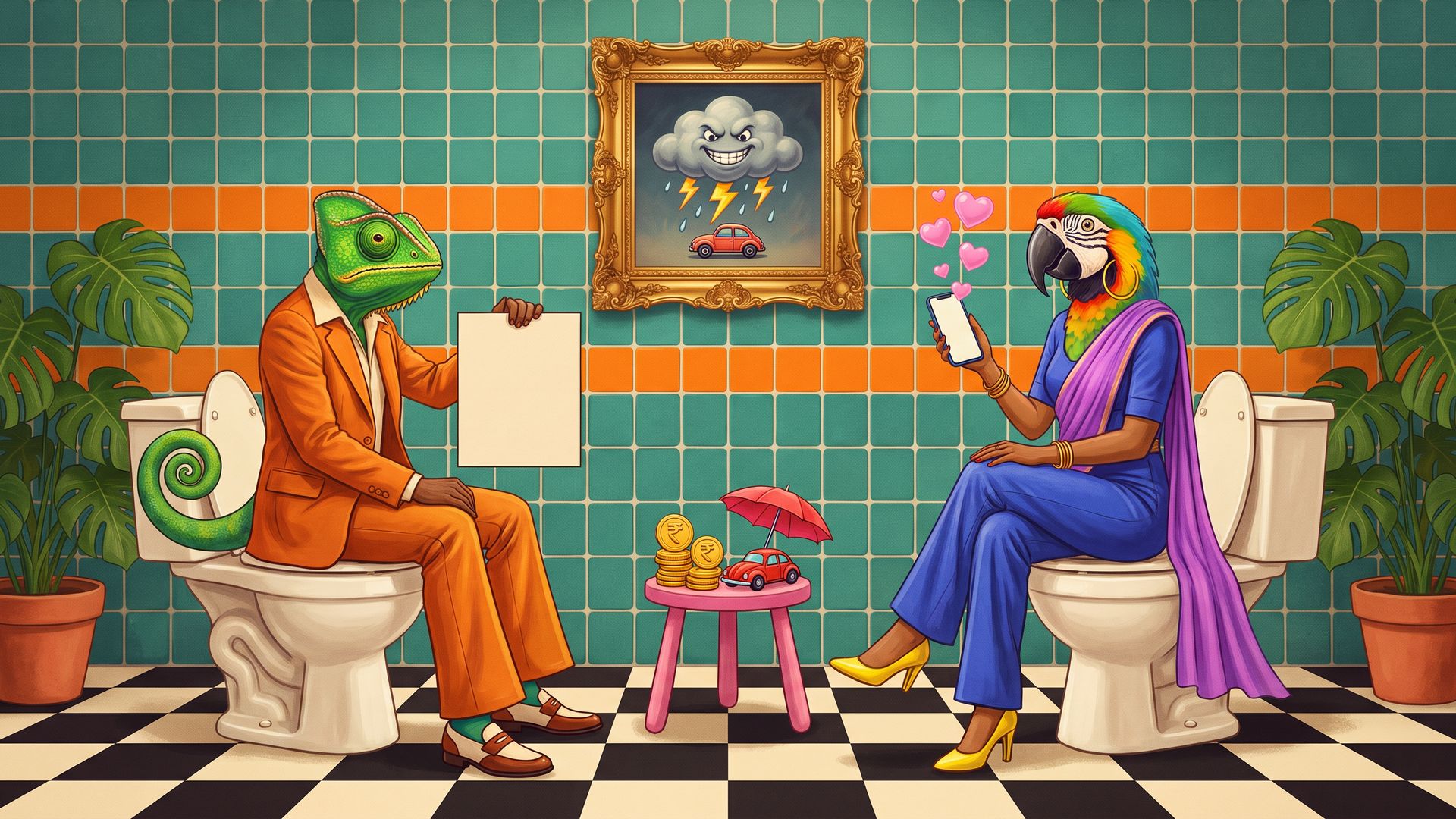
A brand manager at a life insurer plays three American TV spots back to back in a review meeting. A green lizard with a Cockney accent. A cheerful cashier in a white uniform, standing in a spotless white store that sells insurance in boxes. A man in a suit who turns into a falling tree branch and lands on a parked car. Before the third spot ends, someone asks the obvious question: can we have one of those? The compliance head asks a better one: where does our registered name go? Both questions matter. In India, the second one decides the shape of the first.
- Why did US car insurers turn price comparison into characters?
- What message did the Gecko, Flo and Mayhem each carry?
- Why did these insurance mascots keep working for so long?
- Where did the mascot strategy stop working?
- What changes when an Indian insurer wants a mascot?
- Which regulator-driven design decisions should a mascot brief settle first?
- Should a regulated Indian brand build a mascot at all?
- People also ask
Why did US car insurers turn price comparison into characters?
Car insurance is close to a commodity for the buyer. Two policies look alike on paper, the purchase is compulsory, and the decision often comes down to one number on a quote. Allstate’s own account of its Mayhem campaign says that when it launched, the insurance landscape was dominated by one message: price.
Progressive had turned comparison into a product feature long before it turned it into a character. Its corporate history says it began offering comparison rates and buy-by-phone in 1993, and in 1994 launched a toll-free, round-the-clock comparison rating service that showed a Progressive quote next to the rates of up to three other insurers. In 1997 it let consumers buy a policy online in real time.
When the product is a price and the channel is a phone number or a website, the advertising has one job: be remembered at the moment someone decides to get a quote. A character does that job better than a rate table. It gives the brand a face, a voice and a running story, and it lets a company run hundreds of different spots that all point back to the same idea.
| Year | What happened | Who made it (where a source names them) | What it changed |
|---|---|---|---|
| 1993 to 1994 | Progressive offers comparison rates by phone, then a 24-hour comparison service showing up to three rival quotes | Progressive | Made comparing prices part of the product |
| 1997 | Progressive lets buyers purchase a policy online in real time | Progressive | Moved the sale to a screen |
| 1999 | The GEICO Gecko debuts; GEICO’s longer history page places his first TV appearance in the 2000 season | The Martin Agency | Gave a direct-sales insurer a memorable face |
| 2004 | GEICO’s Caveman campaign starts, built on how easy the website is to use | GEICO | Showed one brand could run more than one character |
| 2008 | Flo and the Progressive Superstore debut | Arnold Worldwide, Boston | Put the comparison idea in a shop the viewer already understands |
| 2009 | Progressive adds a Name Your Price option to quoting | Progressive | Gave the Superstore a new product to sell |
| 2010 | Allstate launches Mayhem, played by Dean Winters | Leo Burnett | Argued against buying on price alone |
| 2014 and 2020 | Progressive adds Jamie, then Mara, alongside Flo | Progressive | Spread the load across a cast |
| 2026 | Allstate lists 15-plus years of Mayhem and more than 150 ads | Allstate | Shows how long one idea can run |
What message did the Gecko, Flo and Mayhem each carry?
The three characters look alike from a distance: friendly or funny figures selling car insurance. Up close, each was built to carry a different argument.
- The Gecko: the name you will not forget. The Martin Agency’s creative team has said the Gecko first appeared in 1999, during an actors’ strike that ruled out live performers, and that the joke of his first spot was people confusing “gecko” with “GEICO”. A name mix-up became a memory device. He has since appeared in video games, and the team says it still asks what the Gecko would do before writing a new scenario.
- The Caveman: the website is easy. GEICO’s history says the Cavemen were introduced to drive home how easy it was to use geico.com. The same brand now had two characters, each owning a different claim.
- Flo: shopping for insurance is like shopping for anything else. Progressive’s history says Flo and the Superstore arrived together in 2008. The store puts insurance on shelves, which turns an abstract product into something you can pick up and compare. Arnold Worldwide’s own profile of the campaign quotes its chief creative officer saying the Flo ads were tied directly to people calling Progressive.
- Mayhem: cheap cover can cost you. Allstate says Mayhem was created to highlight the risks of buying home or auto insurance on price alone, and that he is not meant to be a spokesperson. He is the accident. That flips the category’s price argument without naming a rival.
The pattern is simple. One character, one claim, repeated for years. The comparison message that Progressive built into its product became a person you could meet in a store, and Allstate built a character to argue the other side of the same debate.
A mascot can carry your message for a decade, but in India it can never sign the ad on your behalf.
Why did these insurance mascots keep working for so long?
Three things show up in every one of these campaigns, and none of them is the drawing.
SIGNALNewsletter by Yamm Labs
The next piece, straight to your inbox.
New writing on BFSI brands, B2B and influencer marketing, and AI search.
One click to unsubscribe. Privacy policy

First, each character had a fixed world. Flo has the Superstore. Mayhem has the moment just before something breaks. The Gecko has a voice and a manner that the creative team checks every new idea against. A fixed world means a new spot does not have to explain itself. The viewer already knows the rules.
Second, the campaigns ran long enough to become shorthand. Wikipedia’s entry on Flo counts more than 100 advertisements. Allstate’s Mayhem page counts more than 150 ads to date. Nobody learns a character from one film. They learn it from the fortieth.
Third, each character stayed tied to an action. Flo pointed at a quote and a call. The Caveman pointed at a website. Mayhem pointed at the question of what your cheaper policy leaves out. A character that is only liked is entertainment. A character that points at a next step is a sales tool.
This matters for an Indian brand team because the budget reality is different. A mascot needs years of repetition to pay back its setup cost. If the media plan covers one festive season, a clear product film or a sharp explainer will usually do more. Our note on fintech explainer video formats and costs covers the cheaper options.
Where did the mascot strategy stop working?
Long-running characters wear out, split opinion and sometimes say the wrong thing. The US campaigns show all three.
- Love her or hate her. Flo’s own Wikipedia entry records that the character split viewers, with some critics calling it “badvertising”. A face that everyone recognises is also a face some people get tired of.
- One face cannot carry everything. Progressive added Jamie in 2014 and Mara in 2020, and introduced Flo’s family in 2014. GEICO ran the Caveman beside the Gecko from 2004. Once a brand has several products or messages, a single character gets stretched thin, and a cast takes over.
- Dark humour draws complaints. A January 2011 CBS News report on Mayhem noted criticism of ads that depicted dark scenarios, and of distracted-driver spots that raised concerns about sexism. The same edge that makes Mayhem memorable makes each script a risk decision.
- Liking is not understanding. A character can make a brand famous without explaining what the policy covers. In a market where the regulator asks that ads reflect potential risks, fame alone does not clear review.
None of these campaigns stopped. What changed was the job: the characters moved from carrying the whole brand to carrying one part of it, next to product, price and service messages that the character could not hold on its own.
What changes when an Indian insurer wants a mascot?
In India, insurance advertising sits under the IRDAI (Protection of Policyholders’ Interests, Operations and Allied Matters of Insurers) Regulations, 2024, which replaced the earlier advertisement regulations. Three requirements shape any character-led campaign.
- The insurer’s registered name signs the ad. Every insurer’s advertisement must show its registered name along with its trade name or logo, prominently. A mascot can open the film, carry the story and deliver the line. It cannot replace the registered name in the sign-off.
- Partners need written approval first. When a distribution channel or intermediary issues an ad for the insurer, the insurer must approve it in writing before it goes out. Partners also must not suggest the product is their own. If a bank partner or broker wants to use your character, that use runs through your approval process every time.
- Fair, true and honest about risk. Ads must be fair and true, reflect the potential risks of the product and not mislead. A Mayhem-style fear appeal is allowed in principle, but every scenario has to match what the policy covers and excludes.
Under the 2024 rules, ad review sits inside the insurer: a board-approved advertisement committee reviews ads, and approved ads are kept in a register and published on the insurer’s website. For a mascot, that means your own committee becomes the gatekeeper for every new scenario, and it will ask the same questions each time. Our BFSI marketing compliance FAQ covers how these reviews usually run.
Which regulator-driven design decisions should a mascot brief settle first?
Calling a campaign compliance-aware means little until you can point at the decisions. These are the ones we settle before the character exists.
- The end-card lockup. Decide where the registered name, trade name and logo sit in the final frame, and at what size, for 16:9, 9:16 and 1:1 cuts. The character is placed around that lockup, never on top of it. In a vertical reel the character usually takes the top two-thirds and the lockup owns the lower third, so neither fights the platform’s own interface.
- The partner usage kit. Build a small set of pre-cleared poses, lines and end cards for bank and broker partners, plus an approval log. The written approval rule still applies to each ad, but a kit turns a two-week back and forth into a quick check.
- The claim script. Write down what the character is allowed to say about price, cover and claims before any scripts are written. A mascot that says “cheapest” needs substantiation every time. A mascot that says “check what you are covered for” does not.
- The group rule. Many Indian insurance groups have a mutual fund sibling. If the character ever appears in a fund ad, SEBI requires the standard mutual fund warning to be displayed and voiced for five seconds in audio-visual ads. Budget those five seconds in the edit from day one, or keep the character out of fund work.
- The scenario filter. Agree a short list of situations the character will never joke about, such as a death claim or a hospital bill, before the first creative round. It saves the committee from rejecting work the team loved.
The sequence matters as much as the list. Rule sheet first, then the lockup and disclosure frames, then the character bible, then scripts. Teams that reverse this order usually redesign the end card after the character is already on air.
Should a regulated Indian brand build a mascot at all?
A mascot earns its cost when three things are true: the product is hard to tell apart from rivals, the brand can fund years of repetition, and there is one message the character can own without constant caveats. Motor and simple term cover can meet that test. A complex savings product with many disclosures usually cannot, because the character ends up standing next to more small print than story.
If the answer is yes, keep the lesson from the US campaigns: one character, one claim, one fixed world, and a clear next step. Add the Indian layer on top: the registered name signs every ad, partners go through written approval, and the scripts stay inside what the policy covers. Our piece on clarity over noise in BFSI brand communication makes the wider case for choosing one clear idea over many clever ones.
We have worked with insurers, banks and fund houses including TATA AIA Life Insurance, HDFC Life, Axis Bank, Paytm Money and Aditya Birla Sun Life Mutual Fund. The question we ask before any character work is the same one the compliance head asked in that review meeting: where does the registered name go?
People also ask
Who created the GEICO Gecko and when did he first appear?
The Gecko was created by The Martin Agency, GEICO’s advertising agency. GEICO’s history page dates his debut to 1999, while its longer corporate history places his first TV appearance in the 2000 season. The agency’s team has said he was introduced during an actors’ strike that ruled out live performers.
When did Progressive’s Flo first appear?
Flo arrived in 2008 together with the Progressive Superstore, according to Progressive’s own history. She was created at the Boston agency Arnold Worldwide and is played by Stephanie Courtney. Progressive has since added other characters, including Jamie and Mara.
Can an Indian insurer use a mascot in its advertising?
Nothing in IRDAI’s 2024 advertisement provisions we reviewed bars a character. What the rules require is that the insurer’s registered name, with its trade name or logo, appears prominently, and that the ad is fair, true and reflects the product’s risks. The mascot can tell the story, but the registered name has to sign the ad.
Do banks and brokers need approval to use an insurer’s mascot?
Yes. Under IRDAI’s 2024 regulations, an ad issued by a distribution channel or intermediary must be approved by the insurer in writing before it runs, and it must not suggest the product is the partner’s own. A pre-cleared partner kit makes that approval faster, but it does not replace it.
Planning a character for your insurance brand? Check the lockup first.
Get a free Fintech Brand Audit across 8 dimensions, plus 3 fixes. No pitch. Run the free Brand Audit →