

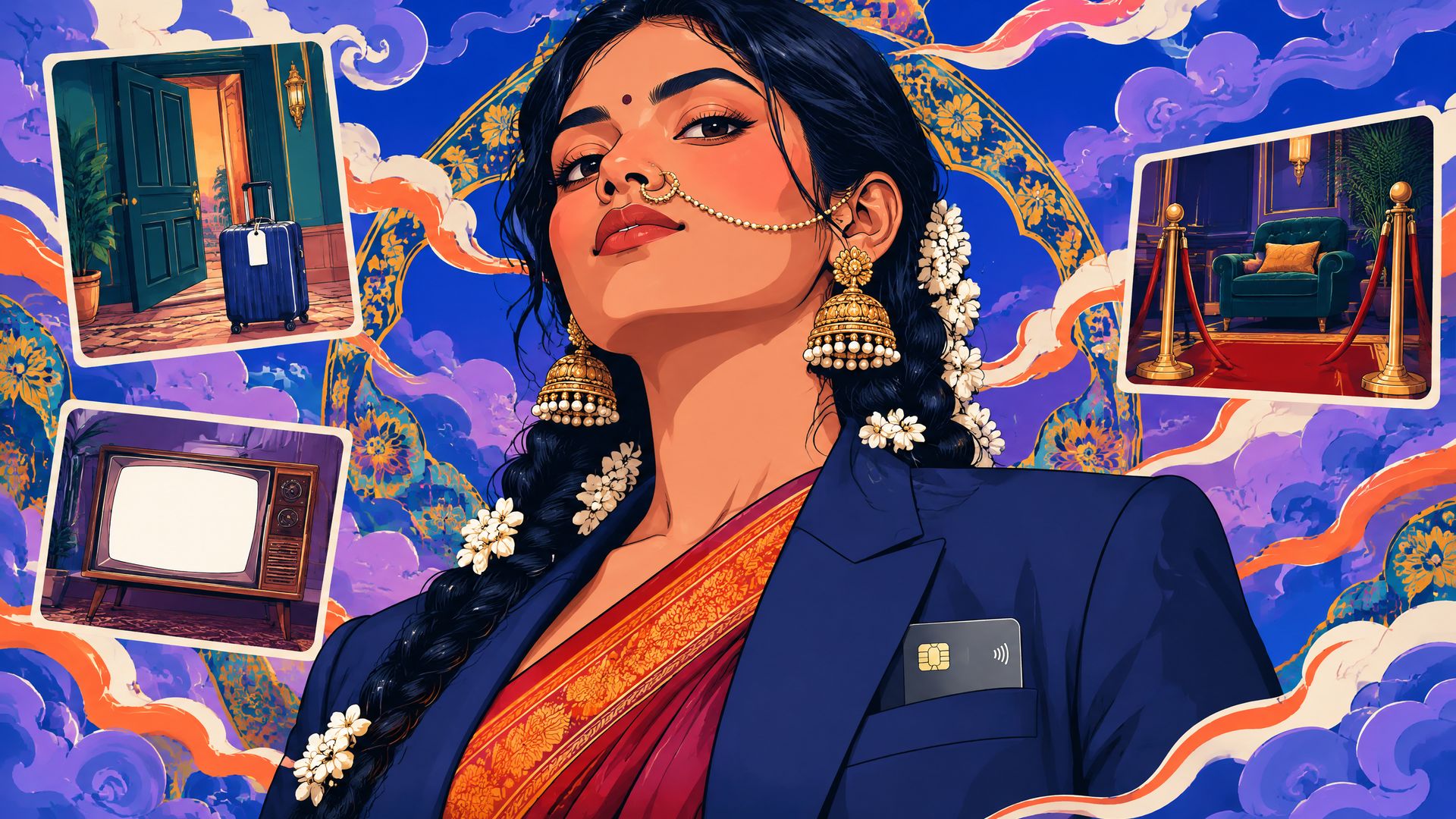
A traveller in the 1970s stands at a hotel desk in a city where nobody knows him. His wallet has been lifted on the train. On television back home, an actor has been warning him about exactly this for months, holding up a small paper cheque that can be replaced. Twelve years later the same company runs magazine portraits of famous people at ease, and the line underneath has nothing to do with theft.
It says that belonging has its privileges. The product did not change much in between. The promise did. That shift, from a tool that protects you to a club that recognises you, is the most copied move in card marketing, and most of the brands that copy it skip the part that made it work.
- What did “Don’t leave home without it” actually sell?
- How did American Express move from utility to membership? The timeline
- Why did “Membership has its privileges” work when most loyalty slogans fail?
- Where did the membership positioning stop working?
- What do RBI’s credit card rules change about a membership launch in India?
- What should a regulated Indian brand take from American Express today?
- Is “membership” still the right idea for a card brand in 2026?
- People also ask
What did “Don’t leave home without it” actually sell?
It sold a fix for a fear. The line began life on American Express Travelers Cheques, a product the company had invented in 1891. The pitch was simple: carry cash and lose it, and it is gone; carry travellers cheques and lose them, and they can be replaced. Ogilvy and Mather built the campaign around Karl Malden, then known to American viewers as a television detective, who played the calm voice of experience. The first wording was “Don’t leave home without them”, plural, because the product was a book of cheques. As the company pushed its card, the line became “Don’t leave home without it”, singular, and the same reassurance was stretched from paper to plastic.
The campaign was utility marketing at its best. It named a specific risk, showed the moment it happens, and put the product in the hero’s hand. It did not ask anyone to admire the brand. It asked them to be sensible. That is why it ran for so long, and why a regulated brand in India can still learn from it: the most durable financial ads start with a customer problem that already exists, rather than a mood the brand wishes it had.
The weakness was built in. A promise about safety is a promise about a product category. Any competitor with a replaceable instrument could make it. The line gave American Express memory, but not a reason to pay more. That reason came later, and it came from a different idea.
How did American Express move from utility to membership? The timeline
The move did not happen in one campaign. It happened across products, taglines and agencies over several decades, and the products led the advertising at each step. Every date and name below comes from a company page, a regulator notice, the agency’s own archive, trade press or a reference source we opened.
| When | What ran or launched | Who the source names | What it changed |
|---|---|---|---|
| 1850 | American Express set up as a freight forwarding company | American Express | A service business before it was a card brand |
| 1891 | Travelers Cheque invented | American Express | The product that the famous line was first written for |
| 1958 | American Express Personal Card introduced | American Express | The card that would carry the membership idea |
| 1966 | Executive Credit card, later the Gold Card | American Express | The first visible tier above the standard card |
| 1970s | “Do you know me?” television films; Ogilvy’s archive lists a 1977 execution with the Muppets | Ogilvy and Mather | Recognition: famous people who are not recognised at the till, until they show the card |
| 1975 | “Don’t leave home without them” for travellers cheques, fronted by Karl Malden; Blue Box logo introduced the same year | Ogilvy and Mather | Safety as the promise, and a fixed visual mark to carry it |
| 1984 | Platinum Card introduced | American Express | A second premium tier |
| 1987 | “Portraits” print work under “Membership has its privileges”; Optima revolving card introduced the same year | Ogilvy and Mather | Belonging as the promise; the word “member” replaces “customer” |
| 1999 | Centurion Card introduced | American Express | A top tier that made membership levels explicit |
| 2004 | “My life. My card.” | Ogilvy and Mather | The card as a statement of personal identity |
| 2007 | “Are you a Cardmember?” | Ogilvy and Mather | Membership asked as a direct question |
| 2017 | Global brand work moves to mcgarrybowen after a long Ogilvy tenure | mcgarrybowen; Ogilvy | A new platform to unify consumer and business messages |
| April 2018 | “Powerful Backing: Don’t Do Business Without It / Don’t Live Life Without It”; refreshed Blue Box identity | mcgarrybowen, Pentagram, Ogilvy, Mindshare, Digitas | The old line returns, with customers instead of celebrities |
| 23 April 2021 | RBI orders American Express Banking Corp. to stop onboarding new domestic customers from 1 May 2021 over payment data storage | Reserve Bank of India | In India, no new members could join; existing cardholders were not affected |
| 24 August 2022 | RBI lifts the restriction after satisfactory compliance | Reserve Bank of India | Onboarding resumes in India |
Read the rows in order and a pattern shows. Each new promise followed a product that made it true. Tiers came before “Membership has its privileges”. A top tier came before the brand leaned hardest on exclusivity. The advertising named what the product had already built.
SIGNALNewsletter by Yamm Labs
The next piece, straight to your inbox.
New writing on BFSI brands, B2B and influencer marketing, and AI search.
One click to unsubscribe. Privacy policy

Why did “Membership has its privileges” work when most loyalty slogans fail?
Most loyalty slogans fail because they describe a feeling the customer never has. American Express avoided that for three reasons.
- The word “member” was earned. A charge card that had to be applied for, approved and paid for annually already felt like joining something. The advertising named a feeling the product created at sign-up.
- Tiers made belonging visible. Green, Gold and Platinum gave members somewhere to move up to. A visible ladder is what turns a customer base into a membership. Without it, “privileges” is only a word.
- The creative showed people, not benefits. Ogilvy’s “Portraits” work placed well-known figures, among them Sophia Loren, Ray Charles, Luciano Pavarotti and John Cleese, in quiet, elegant settings. There was no feature list. The picture carried the claim that these were the kind of people who belonged.
- It built on the recognition idea. “Do you know me?” had already taught audiences that the card was how you proved who you were in a strange place. “Membership” took that recognition and made it permanent.
The measured commercial effect of either campaign is not reported in any source we opened, so we do not quote one. What the sources do show is longevity: the Malden films ran for years, and Ogilvy held the brand account for decades.
Membership is a product decision first and a tagline second.
Where did the membership positioning stop working?
A membership brand has two edges, and American Express met both.
The first edge is exclusivity. A brand that says “not everyone gets in” has trouble later when it wants everyone to use it. The same year the Portraits work ran, American Express introduced Optima, a revolving credit card. A club built on charge cards and prestige now also sold a product that competed on everyday credit. The brand had to hold both stories at once, and the later platforms show the strain: by 2004 the line was about personal identity, and by 2018 the brand had moved away from celebrities to real customers, and to a platform that joined consumer and business messages under one look.
The second edge is permission. Membership is a promise that you can join. In India that promise was interrupted by the regulator. On 23 April 2021 the Reserve Bank of India ordered American Express Banking Corp. not to onboard new domestic customers onto its card network from 1 May 2021, because it was not compliant with RBI’s rules on storing payment system data in India. Existing cardholders were not affected. The restriction was lifted on 24 August 2022, after RBI found compliance satisfactory. For more than fifteen months, the most famous membership brand in cards could not welcome a new member in one of its markets.
No tagline can fix that. The brand promise depends on the licence to operate, and the licence depends on unglamorous infrastructure decisions. Any Indian bank or fintech building a premium, membership-style card should put that lesson above anything in the ad archive. When a regulator can stop onboarding, the brand has to plan for it as it would plan for a product recall. You can see how banks keep trust through that kind of change in our guide on how to rebrand a bank without losing trust.
What do RBI’s credit card rules change about a membership launch in India?
This is the part most brand agencies skip. RBI’s Master Direction on credit and debit cards, issued on 21 April 2022 and effective from 1 July 2022, sets out what a card issuer must show and when. For a membership-style card, four of its rules decide design choices before any creative work starts.
- Key Fact Statement with the application. Card issuers must give a one-page Key Fact Statement with the credit card application, covering the rate of interest and charges. Design decision: the KFS screen sits inside the application flow, before submission, on its own screen. It is not a link in the footer and it is not a PDF sent after approval.
- Most Important Terms and Conditions in the welcome kit. The MITC must be highlighted and sent separately at acceptance, in the welcome kit, and in later important communications. Design decision: the welcome kit, the moment you most want to feel like a club, opens with the terms page designed as carefully as the metal card sleeve. The privileges page comes after it, not before.
- No unsolicited cards or upgrades. Issuing an unsolicited card or upgrade is prohibited. Design decision: “You have been selected” invitations must lead to an application the customer completes, never to a card that arrives uninvited. The invitation copy says “apply”, not “your card is on its way”.
- OTP consent if the card is not activated within 30 days. If a customer has not activated a credit card for more than 30 days from issue, the issuer must seek OTP-based consent to activate it. Design decision: the activation screen is a brand moment in its own right, with the OTP step designed in rather than bolted on.
There is a fifth rule for co-branded cards. RBI limits the co-branding partner’s role to marketing and distribution, and bars it from access to information on transactions made through the card. Design decision: in the co-brand lockup, the issuing bank is named on every document that carries obligations: the KFS, the MITC, the statement and the grievance page. The partner brand can lead the card face and the campaign, but not the fine print. If your group runs several card lines, our brand architecture playbook for banks covers whether each should be a masterbrand or an endorsed brand.
One more rule matters for network brands. Under a circular dated 6 March 2024, which took effect six months later, RBI requires larger card issuers to let eligible customers choose from multiple card networks when a card is issued, with existing cardholders offered the choice at renewal. RBI’s circular exempts issuers with 10 lakh or fewer active credit cards, and issuers that issue cards on their own authorised network. For a bank, this means the network logo on the card face is no longer a fixed part of the design. The card template needs a network slot that can take more than one mark without breaking the layout.
What should a regulated Indian brand take from American Express today?
Four lessons travel well from the Amex archive to an Indian bank, insurer, AMC or fintech.
- Start with a real fear or a real friction. “Don’t leave home without them” worked because losing cash abroad was a real problem. An Indian card brand can start with a problem customers already name: hidden charges, slow grievance handling, airport lounge queues. Name it plainly.
- Build the ladder before you sell the club. Tiers came before “membership” in the Amex story. If your card range has no visible step up, a membership line will sound hollow. Fix the product ladder, then write the line.
- Put the disclosures inside the membership experience. RBI’s KFS and MITC rules are not a tax on the brand. Placed well, they are proof that the club plays fair. The issuer that designs the terms page as carefully as the card face earns trust that the privilege page cannot buy.
- Plan for the regulator pause. The 2021 onboarding restriction shows that a membership brand can be told to stop admitting members. Keep an approved holding message, a waitlist flow and a service-first campaign ready, so the brand has something to say to prospects while new sign-ups are paused.
Premium cards in India also speak to a narrower, wealthier audience than mass-market products, and that audience reads design cues closely. Our note on wealthtech branding for HNI audiences covers how restraint, typography and service language signal status without sounding like a sales pitch.
Is “membership” still the right idea for a card brand in 2026?
Yes, with one change. Membership in 2026 is less about who is kept out and more about what the member gets back. American Express’s own 2018 relaunch pointed that way: it dropped the celebrity spokesperson, put customers in the work, and spoke to life and business together. The old line came back, but the reason behind it had moved from safety to backing.
For an Indian brand, the practical test is simple. List every privilege your membership line implies. Check that each one is in the product terms, the KFS or the MITC. Remove any that are not, or add them to the product. Then write the line. A membership promise that the terms can support will pass compliance review with its meaning intact. One that the terms cannot support gets rewritten by the reviewer, usually late and usually into something flat.
People also ask
Who created “Don’t leave home without it”?
The line came out of Ogilvy and Mather’s work for American Express in the 1970s. It started as “Don’t leave home without them” for Travelers Cheques, fronted by the actor Karl Malden, and later moved to the card as “Don’t leave home without it”.
When did American Express start using “Membership has its privileges”?
Ogilvy’s own archive places its “Portraits” work, featuring figures such as Sophia Loren and Ray Charles, in the “Membership has its privileges” era in 1987. The same year American Express introduced its Optima revolving card.
Why was American Express stopped from adding customers in India?
On 23 April 2021 the Reserve Bank of India barred American Express Banking Corp. from onboarding new domestic customers from 1 May 2021, for non-compliance with its rules on storing payment system data in India. Existing customers were not affected, and RBI lifted the restriction on 24 August 2022.
Can an Indian bank run a membership-style card campaign?
Yes, if the privileges it implies are in the product terms. RBI’s card rules require a one-page Key Fact Statement with the application and the most important terms highlighted in the welcome kit, so the campaign, the application screen and the welcome kit have to tell the same story.
Sources
- americanexpress.com: American Express – China
- Media Logic: Don’t Launch a Global Brand Campaign Without It
- Wikipedia: Jay Schulberg
- Ogilvy: Ogilvy 75, 75 Years of Iconic Campaigns
- Wikipedia: American Express
- Adweek: Mcgarrybowen Wins American Express Global Brand Work Away from Ogilvy Without a Review
Is your card brand selling a club the terms cannot back up?
Get a free Fintech Brand Audit across 8 dimensions, plus 3 fixes. No pitch. Run the free Brand Audit →