


A bank’s social team has a festive home-loan reel, a bancassurance carousel and a creator video lined up for Friday. On Wednesday, compliance sends back three questions. Where does the full cost of the loan live? Has the insurer approved the carousel in writing? Why does the creator’s label vanish after one second? Nobody on the team can answer, because the strategy deck covered tone of voice and posting frequency and nothing else. That is the gap this page closes.
- What are the parts of a bank social media strategy?
- Why does each bank product need its own disclosure rule?
- How should a bank handle complaints on social media?
- What should a bank’s approval workflow and calendar look like?
- How do you measure a bank social media strategy?
- How should a bank deal with fraud and impersonation on social media?
- A worked example: the Friday posts, fixed
- Common mistakes in a bank social media strategy
- How to brief an agency on a bank social media strategy
- People also ask
What are the parts of a bank social media strategy?
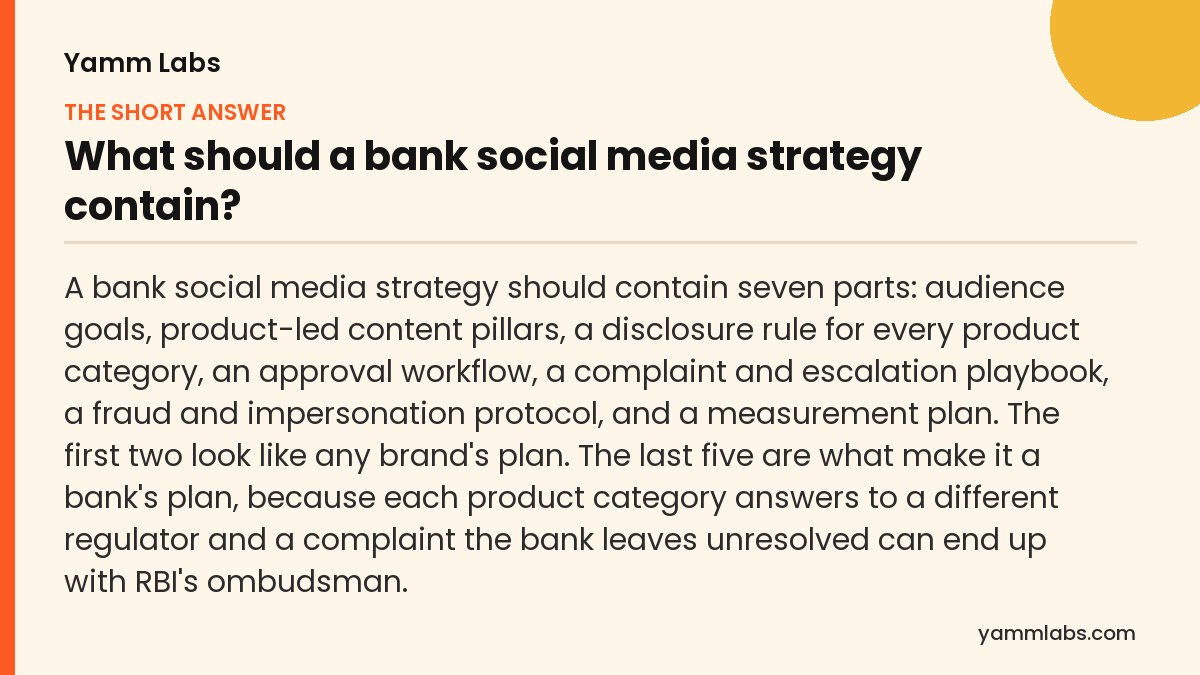
Think of the strategy as a set of decisions, each with an owner. If a part has no owner, it will be decided on deadline day by whoever is online.
| Part | What it decides | Who owns it |
|---|---|---|
| Audience goals | Which customers each platform serves: salaried savers, small business owners, NRIs, first-time borrowers | Marketing |
| Content pillars | The product and education themes, and the share of posts each gets | Marketing and product teams |
| Disclosure rules | The fixed text, labels and end frames each product category carries | Compliance |
| Approval workflow | Who signs off, in what order, and how much lead time each post type needs | Compliance and marketing |
| Complaint playbook | How a public complaint moves to a private channel and gets logged | Customer service |
| Fraud protocol | How fake handles and scam ads using the bank’s name are reported and called out | Risk and security |
| Measurement | What counts as success, beyond reach | Marketing and service |
The hub version of this answer sits in our finance social media questions. This page holds the full working detail.
Why does each bank product need its own disclosure rule?
A bank’s feed sells more than bank products. It carries loans the bank lends, mutual funds it distributes and insurance it sells as a corporate agent. Each category brings its own regulator, so one blanket disclaimer does not work.
- Loans follow RBI’s Key Facts Statement rule. For retail and MSME term loans sanctioned from 1 October 2024, RBI requires lenders to give a Key Facts Statement, including the annual percentage rate, before the loan contract is executed. A reel cannot do that job. Our design decision: loan posts tease the product and send people to an application flow built around the Key Facts Statement, with the annual percentage rate as the largest number on that screen.
- Mutual funds carry SEBI’s standard warning. SEBI requires the mutual fund standard warning to be displayed and voiced for five seconds in audio-visual ads. Our design decision: the last five seconds of every fund video are locked as a warning end frame before the script is written. AMFI’s guidance also says distributors must use material the fund house provides rather than design their own scheme creative, so fund posts start from the AMC’s kit.
- Insurance posts need the insurer’s name and written approval. IRDAI’s current policyholder protection regulations require an insurer’s advertisement to show its registered name with its trade name or logo prominently, and ads issued through a distribution channel need the insurer’s written approval before they go out. Our design decision: a fixed insurer-name lockup on every bancassurance creative, and a separate approval round with the insurer built into the calendar.
- Creator content follows ASCI’s influencer guidelines. Paid posts need a clear label such as Ad, Sponsored or Collaboration, placed upfront and not buried in hashtags. In videos of 15 seconds or less the label stays for at least three seconds, and in longer videos under two minutes it stays for a third of the running time.
How should a bank handle complaints on social media?
Customers complain in public because it is fast. The strategy has to turn that public post into a tracked complaint, quickly and without asking for account details in the comments.
SIGNALNewsletter by Yamm Labs
The next piece, straight to your inbox.
New writing on BFSI brands, B2B and influencer marketing, and AI search.
One click to unsubscribe. Privacy policy

RBI’s integrated ombudsman scheme, in its 2026 version in force from 1 July 2026, says a customer must first approach the bank. If there is no reply within 30 days of the bank receiving the complaint, or the customer is unhappy with the reply, they can go to the RBI Ombudsman. That makes the social team the front door to a formal process.
The playbook we recommend has three steps. Acknowledge in public with a short, human reply. Move the conversation to a verified private channel. Log it as a complaint with a reference number, so the service team tracks the reply against the ombudsman window. Never ask for card numbers, OTPs or passwords, even in direct messages, and say so in the reply itself, because fraudsters copy bank reply styles.
A bank’s social feed is a disclosure system and a complaint desk before it is a content calendar.
What should a bank’s approval workflow and calendar look like?
Plan the calendar a month out and sort every post into one of four lanes: brand and education, loans, third-party products, and service updates. Each lane has a fixed approval path.
- Brand and education. Marketing and compliance review. The lightest lane, and the one that should carry most of the feed.
- Loans. Compliance checks that the post points to the Key Facts Statement flow and does not state a cost the application will contradict.
- Third-party products. Fund posts start from the fund house’s approved material. Insurance posts go to the insurer for written approval, which adds a round, so they are scheduled earlier.
- Service updates. Pre-approved templates for downtime, holiday timings and fraud alerts, so the team can post in minutes without a fresh review.
The trust side of this matters as much as the rules. Clear, consistent labels are part of what makes a bank feel safe, which we cover in the psychology of trust in financial brand design.
How do you measure a bank social media strategy?
Reach and followers tell you little about a bank’s feed. Measure the parts that carry risk and revenue.
- Complaint handling. Time to first public reply, time to private handover, and share of complaints logged with a reference number.
- First-pass approvals. The share of posts compliance clears without changes. A rising number means the disclosure rules are working.
- Qualified journeys. Loan and account applications started from social, not clicks alone.
- Impersonation takedowns. Fake handles and scam ads found and reported each month.
Our BFSI work has included Axis Bank, HDFC Life, TATA AIA Life Insurance, Paytm Money and Aditya Birla Sun Life Mutual Fund; you can see the full list on our clients page. We work from Gurugram and serve financial brands in India, the Gulf and elsewhere remotely.
How should a bank deal with fraud and impersonation on social media?
Fraud is the part many strategy decks leave out, and it can do lasting damage to trust. Scammers copy a bank’s logo, colours and reply style because customers already trust them. The protocol should cover four things.
- One published list of official handles. Name every verified account on the bank’s website and link to that page from each profile, so a customer can check a handle in one step.
- A monitoring routine. Someone searches each platform on a fixed schedule for look-alike handles, fake support numbers and scam ads using the bank’s name, and logs what they find.
- A reporting path. Risk and security own reports to the platforms, with ready templates, and marketing knows who to call when a fake account starts replying to real customers.
- A public warning template. A pre-approved post and reply that says what the bank will never ask for, such as card numbers, OTPs or passwords, and where to report a suspicious message.
Design helps here too. A consistent reply signature and a fixed visual style for service posts make fakes easier to spot, provided the bank tells customers what to look for.
A worked example: the Friday posts, fixed
Go back to the team with three posts due on Friday and three questions from compliance. Here is how a complete bank social media strategy answers each one before Wednesday arrives.
The festive home-loan reel. The disclosure rule for loans says the reel teases the product and sends viewers to an application flow built around the Key Facts Statement, where the annual percentage rate is the largest number on screen. The reel does not state a cost the application will contradict. Compliance asked where the full cost lives. The answer is that screen.
The bancassurance carousel. The approval workflow puts third-party products in their own lane. The carousel carries the fixed insurer-name lockup and went to the insurer for written approval earlier in the month, because the calendar was planned a month out. The approval is on file.
The creator video. The disclosure rule for creator content follows ASCI’s influencer guidelines. For a video of 15 seconds or less, the ad label sits upfront and stays on screen for at least three seconds. It no longer vanishes after one second.
None of these fixes needed a better creative idea. They needed the strategy to contain the parts that make it a bank’s plan.
Common mistakes in a bank social media strategy
- A strategy that is only a content calendar. Tone of voice and posting frequency matter, but they cover only the first two parts. Without disclosure rules and an approval workflow, every post becomes a negotiation.
- One disclaimer for everything. A single line at the end of every post cannot cover a loan, a fund and a policy, because each answers to a different regulator.
- Treating complaints as community management. A public complaint is the start of a formal process. If it is not logged with a reference number, nobody tracks the reply window.
- Asking for details in the comments. Any reply that invites account information in public teaches customers a habit fraudsters exploit.
- Scheduling insurance posts like brand posts. The insurer’s written approval adds a round. Posts planned in the same week they go live will miss it.
- Measuring followers. Reach says little about whether the feed is safe or useful. First-pass approvals and complaint handling times tell you far more.
How to brief an agency on a bank social media strategy
An agency can write good posts only if the brief carries the bank’s constraints. Give them these before the first concept.
- The audience goal for each platform, in one line each.
- The product categories the feed will carry, and the regulator behind each one.
- The fixed disclosure elements per category: the Key Facts Statement route for loans, the standard warning end frame for funds, the insurer-name lockup for insurance and the ASCI label rules for creators.
- The approval lanes, with lead times and named approvers.
- The complaint and fraud protocols, so the agency’s community team replies the way the bank would.
- The measures the bank will judge the work on.
Ask the agency to show one sample post per lane, with its disclosure in place, before any creative round. Confirm the current text of each regulatory rule with your compliance team, because circulars and guidelines are revised.
People also ask
Can a bank in India work with finance influencers?
Yes, with conditions. ASCI’s guidelines require a clear ad label placed upfront, and creators giving stock or investment advice must be SEBI-registered and show their registration number with their name and qualifications. Banks should check both before signing a creator.
How fast must a bank respond to a complaint raised on social media?
Treat it as a formal complaint from the first reply. Under RBI’s ombudsman scheme, a customer can escalate if the bank has not replied within 30 days of receiving the complaint. Logging social complaints with a reference number keeps that window visible.
Who should approve a bank’s social media posts?
Marketing and compliance approve every post. Insurance posts also need the insurer’s written approval before they go out, and fund posts should start from material the fund house provides.
How often should a bank post on social media?
As often as the approval workflow can support. A calendar planned a month out, with most posts in the lighter brand and education lane, lets the team keep a steady rhythm without rushing loan or insurance posts through review. Frequency should follow review capacity, not the other way round, because a rushed post is where a disclosure gets dropped.
Should a bank run separate social accounts for each product?
One main brand account, plus a clearly named support handle, is usually easier to govern. Separate product accounts multiply the approval load and give fraudsters more names to copy. If the bank does run several accounts, it should list all of them on its website so customers can check which ones are real.
Can a bank reply to complaints with a template?
Yes, for the first public reply, as long as it reads like a person wrote it. The template should acknowledge the problem, move the conversation to a verified private channel and remind the customer never to share card numbers, OTPs or passwords. The follow-up in private should be specific to the case and carry a reference number.
Do employees’ personal posts belong in the strategy?
Yes, briefly. Staff who post about the bank’s products can create the same disclosure problems as the brand account. A short employee guideline should say that staff do not post product offers or rates from personal accounts, that they point complaints to the official support handle, and that they never ask customers for account details. Agree it with compliance and HR.
Sources
Want a bank social plan that clears compliance on the first pass?
Get a free Fintech Brand Audit across 8 dimensions, plus 3 fixes. No pitch. Run the free Brand Audit →